


What Happens to Social Security When Your Spouse Dies?
Can a surviving spouse get Social Security benefits? Yes — and it’s one of the most important financial lifelines available to widows and widowers in America.
Here’s the quick answer:
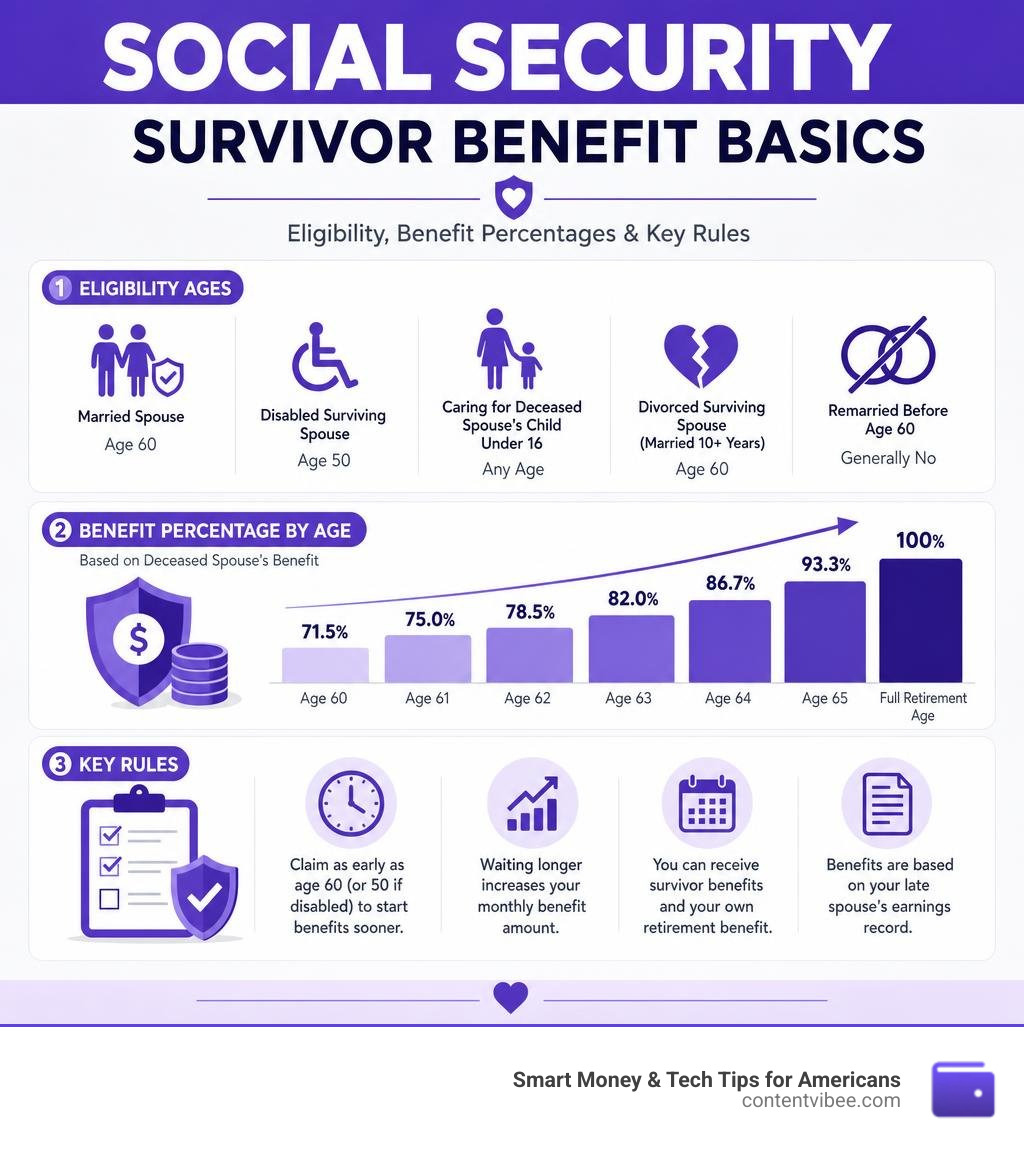
| Situation | Eligible? | Earliest Age |
|---|---|---|
| Married spouse (standard) | Yes | Age 60 |
| Surviving spouse with disability | Yes | Age 50 |
| Caring for deceased spouse’s child under 16 | Yes | Any age |
| Divorced surviving spouse (married 10+ years) | Yes | Age 60 |
| Remarried before age 60 | Generally no | N/A |
As of September 2025, more than 3.8 million widows and widowers were receiving Social Security survivor benefits. Yet many people — especially those approaching retirement — don’t fully understand what they’re entitled to, when to claim, or how to get the most out of these benefits.
The rules around survivor benefits are surprisingly complex. Your benefit amount depends on your age when you claim, your late spouse’s earnings record, and whether you’re also entitled to your own retirement benefit. Making the wrong move — like claiming too early or missing a filing deadline — can cost you thousands of dollars over your lifetime.
This guide breaks it all down in plain language, so you can make confident, informed decisions during an already difficult time.
Key can a surviving spouse get social security benefits vocabulary:
Can a Surviving Spouse Get Social Security Benefits?
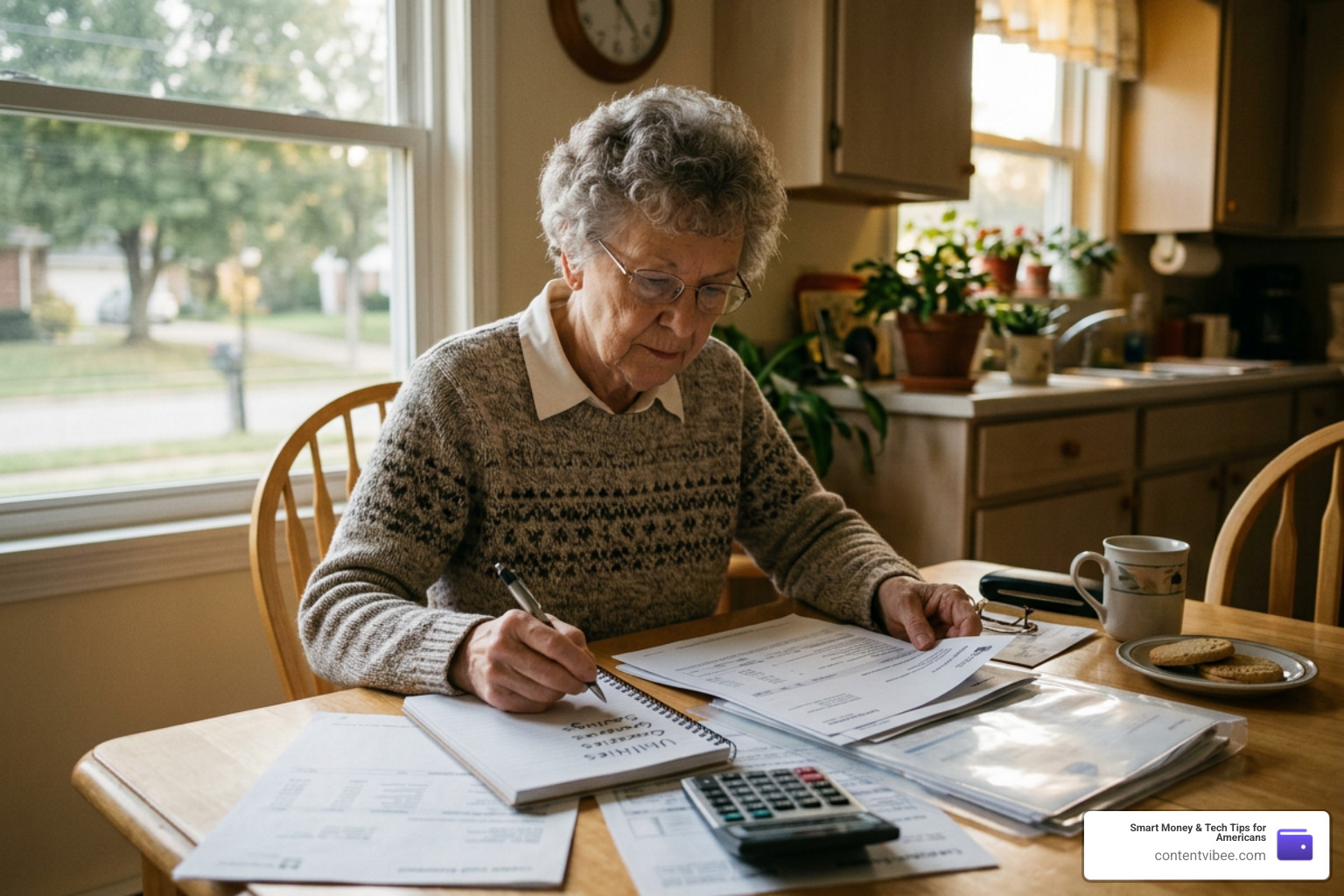
When we talk about financial security in retirement, we often focus on what we accumulate together. But we must also plan for the unexpected. If you are wondering, “can a surviving spouse get social security benefits?” the answer is a resounding yes, provided certain eligibility requirements are met.
To qualify for survivor benefits as a widow or widower, you must meet basic relationship and duration criteria established by the Social Security Administration (SSA). First, you must have been legally married to the deceased worker. Under SSA policy, this includes marriages recognized under state law, as well as “deemed” marriages where a ceremony was performed in good faith but had a technical legal impediment.
Additionally, the marriage must have lasted for at least nine months immediately preceding the day your spouse passed away.
Fortunately, the SSA recognizes that life does not always follow a standard timeline. The nine-month marriage requirement is waived in several specific circumstances, including:
- The death of your spouse was accidental.
- Your spouse’s death occurred in the line of active duty while serving in the U.S. military.
- You and your spouse are the biological or adoptive parents of a child together.
Understanding these foundational rules is the first step toward securing your future. If you are currently married and want to know how your benefits coordinate while you are both living, we recommend reading The Ultimate Guide to Spousal Social Security Eligibility for a broader look at how spousal benefits function. For detailed regulatory definitions on who qualifies as an eligible spouse, you can check the official Who can get Survivor benefits – Social Security Administration criteria.
Who Qualifies and Can a Surviving Spouse Get Social Security Benefits Early?
For most retired-worker benefits, the earliest age you can claim is 62. However, survivor benefits have a unique advantage: you can claim them as early as age 60.
There are two major exceptions that allow surviving spouses to claim even earlier:
- Disabled Widow(er)s: If you have a qualifying disability that started before or within seven years of your spouse’s death, you can claim survivor benefits as early as age 50.
- Caring for Children: If you are caring for your deceased spouse’s child who is under the age of 16 or disabled, you can receive survivor benefits at any age. In this case, the benefit is often referred to as a mother’s or father’s insurance benefit, and it equals 75% of the deceased worker’s basic benefit amount.
That claiming benefits before your own Full Retirement Age (FRA) for survivors will result in a permanently reduced monthly check. We will look at exactly how much those reductions are in the next section.
If you find yourself in the position of needing to navigate these early claiming rules, you can find helpful guidance in our resource, Claiming What’s Yours: A Guide to Deceased Spouse Social Security. For official details on how the SSA handles early and disability-based survivor claims, visit the Survivor benefits | SSA portal.
Can a Surviving Spouse Get Social Security Benefits if Divorced?
Yes! Divorce does not necessarily erase your access to a late partner’s earnings record. If your former spouse has passed away, you may still qualify for survivor benefits on their record as a surviving divorced spouse.
To be eligible, your marriage to your ex-spouse must have lasted for at least 10 years before the divorce became final. Additionally, you must generally be unmarried. However, if you remarry after reaching age 60 (or age 50 if you are disabled), your remarriage will not affect your eligibility for benefits on your deceased ex-spouse’s record.
One of the most reassuring aspects of this rule is that any benefits paid to you as a surviving divorced spouse will not affect the benefit amount paid to the late worker’s current widow or widower, nor will it impact the family maximum limit.
For a complete breakdown of how this works, read our article Can Divorced Spouse Get Social Security Benefits?. You can also dive into the technical details of the SSA’s policy manual via the SSA – POMS: RS 00207.001 – Widow(er)’s Benefits Definitions and Requirements – 05/02/2023 reference.
How Much Can a Surviving Spouse Receive?
The monthly amount you receive as a surviving spouse is directly tied to two factors: how much your late spouse paid into Social Security during their working years, and how old you are when you file your survivor claim.
If you wait until your own Full Retirement Age (FRA) for survivors to claim, you will receive 100% of your deceased spouse’s monthly benefit. It is important to note that your FRA for survivor benefits might be slightly different from your FRA for standard retirement benefits. For survivors born in 1962 or later, the survivor FRA is 67. For those born between 1945 and 1956, it is 66, and it gradually rises for those born in the years in between.
If you claim before your survivor FRA, your benefit will be reduced. The reduction is calculated on a sliding scale depending on your exact age at filing.
Here is a quick look at how your claiming age affects your survivor benefit percentage:
| Your Age When Claiming Survivor Benefit | Percentage of Deceased Spouse’s Benefit Received |
|---|---|
| Full Retirement Age (66 to 67) | 100% |
| Age 65 | ~93% to 94% |
| Age 62 | ~81% to 83% |
| Age 60 | 71.5% |
| Age 50 to 59 (with qualifying disability) | 71.5% |
| Any age (caring for a child under 16) | 75% |
Before making a final decision on when to claim, we highly recommend utilizing our tools to Calculate Spouse Retirement Benefits to see how different ages impact your long-term cash flow.
The One-Time $255 Lump-Sum Death Benefit
In addition to ongoing monthly payments, the SSA offers a small, one-time lump-sum death benefit of $255. While this amount hasn’t changed in decades and won’t cover modern funeral expenses, it is still money you are entitled to receive.
To qualify for this lump-sum payment, you must have been living in the same household as your spouse at the time of their death. If you were living apart, you may still qualify if you were already receiving benefits on their record, or if you became eligible for benefits upon their death.
Crucial Warning: You must apply for this lump-sum payment within two years of your spouse’s death, or you will lose it.
If you are already receiving spousal benefits, the switch to survivor benefits is usually automatic once the death is reported, but you should still contact the SSA to ensure the lump sum is processed. For more details on this transition, refer to the official SSA blog post: What You Should Know About Social Security if Your Spouse Passes Away | Social Security Matters | SSA.
Claiming Strategies to Maximize Your Lifetime Benefits

One of the biggest mistakes we see people make is assuming they have to claim their own retirement benefit and their survivor benefit at the same time. This is not true!
The SSA operates under a rule known as “dual entitlement.” This means that while you cannot receive both your full retirement benefit and your full survivor benefit simultaneously, you can choose which one to claim first, allowing the other benefit to grow.
Because your personal retirement benefit increases by 8% per year for every year you delay claiming past your Full Retirement Age up to age 70, coordinating the timing of these two benefits is one of the most powerful ways to maximize your lifetime income.
To understand how both partners’ benefits interact during your lifetimes, take a look at our guide: Do Both Spouses Collect Social Security?.
Coordinating Your Own Retirement and Survivor Benefits
If you qualify for both your own retirement benefit and a survivor benefit, you have a unique opportunity to employ a “switch” strategy.
Strategy 1: Survivor Benefits First, Personal Retirement Later.
If your own retirement benefit at age 70 will be larger than your maximum survivor benefit, you can claim your reduced survivor benefit as early as age 60. While you collect that monthly income, you leave your own retirement record untouched. Your personal benefit will earn delayed retirement credits, growing significantly until you reach age 70. At age 70, you switch from the survivor benefit to your own maximized personal retirement benefit.Strategy 2: Personal Retirement First, Survivor Benefits Later.
If your late spouse had a much higher earnings record than you, your survivor benefit at FRA will likely be larger than your own retirement benefit ever could be. In this scenario, you might choose to claim your own reduced retirement benefit at age 62, and then switch to your full, 100% survivor benefit once you reach your survivor Full Retirement Age.
To run the numbers for your unique household and see which strategy yields the most wealth, use our interactive Tools/Finance Calculator/Social Security Spousal Benefit Calculator.
Key Rules: Remarriage, Earnings Limits, and Recent Law Changes
Before you finalize your claiming strategy, there are three critical rules you must keep in mind: remarriage, working while receiving benefits, and recent legislative updates.
1. Remarriage Rules
If you remarry before age 60 (or before age 50 if you are disabled), you lose your eligibility to receive survivor benefits on your deceased spouse’s record. However, if that subsequent marriage ends (due to divorce or death), your eligibility to claim on your first spouse’s record is restored.
If you remarry at or after age 60 (or age 50 if disabled), your remarriage has no effect on your eligibility. You can continue to receive your survivor benefit, or choose to claim a spousal benefit on your new partner’s record if that amount is higher.
2. The Earnings Test Limits (Current for 2026)
If you choose to work while receiving survivor benefits and you have not yet reached your Full Retirement Age, the SSA enforces an earnings limit. For 2026, the rules are:
- If you are under your FRA for the entire year, the earnings limit is $24,480. The SSA will deduct $1 from your benefits for every $2 you earn above this limit.
- If you reach your FRA during 2026, the earnings limit is $65,160. The SSA will deduct $1 for every $3 you earn above this limit until the month you reach FRA.
- Once you reach Full Retirement Age, there is no limit on your earnings, and the SSA will recalculate your monthly benefit upward to credit you for any payments that were withheld.
3. Recent Law Changes
For years, public-sector workers like teachers, police officers, and firefighters faced steep reductions in their spousal and survivor benefits due to the Government Pension Offset (GPO) and the Windfall Elimination Provision (WEP). However, recent legislative momentum, including debates surrounding the Social Security Fairness Act, has sought to eliminate these rules.
If you or your late spouse worked in a public sector job where you did not pay Social Security taxes, it is vital to stay informed on how these changing laws affect your benefits. Read the official SSA update Our Survivor Benefits: Protection for Your Family | Social Security Matters | SSA to keep up with the latest policy adjustments.
How to Apply for Spousal Survivor Benefits
Unlike standard retirement benefits, you cannot apply for survivor benefits online. You must speak with an SSA representative directly.
To apply:
- Call the SSA at 1-800-772-1213 (TTY 1-800-325-0778) between 8:00 a.m. and 7:00 p.m., Monday through Friday, to schedule an appointment.
- You can choose to have your appointment over the phone or in person at your local Social Security office.
To ensure your application is processed quickly and smoothly, we recommend gathering the following documents before your appointment:
- Proof of death (typically an official death certificate or notification from a funeral home).
- Your Social Security number and your deceased spouse’s Social Security number.
- Your birth certificate (or other proof of age).
- Your marriage certificate (and divorce decrees if claiming as a surviving divorced spouse).
- W-2 forms or self-employment tax returns for your late spouse for the most recent tax year.
- Your bank routing and account numbers for direct deposit.
For a comprehensive checklist of what to expect, you can download the official [PDF] Survivors Benefits – Social Security Administration guide. To learn more about initiating this process, read our step-by-step guide on how to Claim Deceased Spouse Benefits.
Frequently Asked Questions About Survivor Benefits
Navigating the rules of the SSA can feel like learning a foreign language. Here are answers to some of the most common questions we receive from our readers.
Can I collect both my own retirement and my deceased spouse’s benefit?
No. The SSA does not allow you to combine or “stack” both benefits to receive a double payment. Instead, they will pay you an amount equal to the higher of the two benefits. However, as discussed in our claiming strategies section, you can strategically claim one benefit first and allow the other to grow before switching later.
To learn more about how spousal benefits are structured while both partners are alive, read The Golden Rules Can a Spouse Collect SS Spousal Benefits?.
How does working affect my survivor benefits?
If you are under your Full Retirement Age and earn more than the annual limit ($24,480 in 2026), your survivor benefits will be temporarily withheld. These withheld benefits are not lost forever; once you reach your FRA, your monthly check will be increased to make up for the payments that were withheld.
To understand the core mechanics of how spousal earnings and benefits are calculated, check out What is a Social Security Spousal Benefit?.
What happens to my survivor benefits if I remarry?
If you remarry before the age of 60, your survivor benefits on your late spouse’s record will stop. If you wait until age 60 or older to remarry, your benefits will continue unchanged.
For more details on how marriage and remarriage affect household Social Security income, read our detailed article Both Spouses Collect Social Security.
Conclusion
Losing a spouse is one of the most emotionally challenging experiences a person can go through. During this time, worrying about your financial security is the last thing you want to do.
By understanding the rules surrounding survivor benefits, you can make informed, strategic decisions that protect your income and maximize your lifetime wealth. Whether you choose to claim survivor benefits early, utilize a switching strategy to let your own retirement benefit grow, or claim as a surviving divorced spouse, knowing your rights is key.
At Smart Money & Tech Tips for Americans, we are dedicated to helping you navigate these complex retirement decisions with ease. For a complete look at all of your options as a spouse, we invite you to read The Ultimate Guide to Spousal Social Security Eligibility and take control of your financial future today.


