


Why Your Retirement Medicare Enrollment Guide Can Make or Break Your Healthcare Future
This retirement medicare enrollment guide gives you the key steps to enroll correctly and on time — here’s a quick overview:
Quick Answer: How to Enroll in Medicare for Retirement
- Check your eligibility — Medicare starts at 65 (or earlier with certain disabilities, ESRD, or ALS)
- Know your enrollment window — You have a 7-month Initial Enrollment Period (IEP): 3 months before your 65th birthday month, your birthday month, and 3 months after
- Check if you’re auto-enrolled — If you’re already receiving Social Security benefits, you’ll be enrolled in Parts A and B automatically
- If not auto-enrolled — Contact the Social Security Administration at least 3 months before turning 65
- Decide on extra coverage — Choose between Original Medicare, Medicare Advantage (Part C), and add Part D for prescriptions
- Avoid late penalties — Missing your window can mean permanent premium increases of 10% or more per year of delay
Nearly 68.9 million Americans are enrolled in Medicare as of 2025. But every year, thousands of retirees face permanent premium penalties — simply because they didn’t know the rules.
If you or your spouse are nearing retirement, Medicare enrollment is not something you can figure out later. The deadlines are strict. The penalties are lasting. And the decisions you make in that first 7-month window can affect your healthcare costs for the rest of your life.
The good news? With the right information, this process is very manageable.
Explore more about retirement medicare enrollment guide:
- retirement health insurance options
- can you collect a pension and still work full-time
- working past retirement age
The Ultimate Retirement Medicare Enrollment Guide
When we transition into retirement, understanding how our healthcare coverage changes is one of the most critical steps we can take. Medicare is the federal health insurance program designed primarily for individuals age 65 and older. However, it also serves younger individuals with specific qualifying disabilities, End-Stage Renal Disease (ESRD), or Amyotrophic Lateral Sclerosis (ALS).
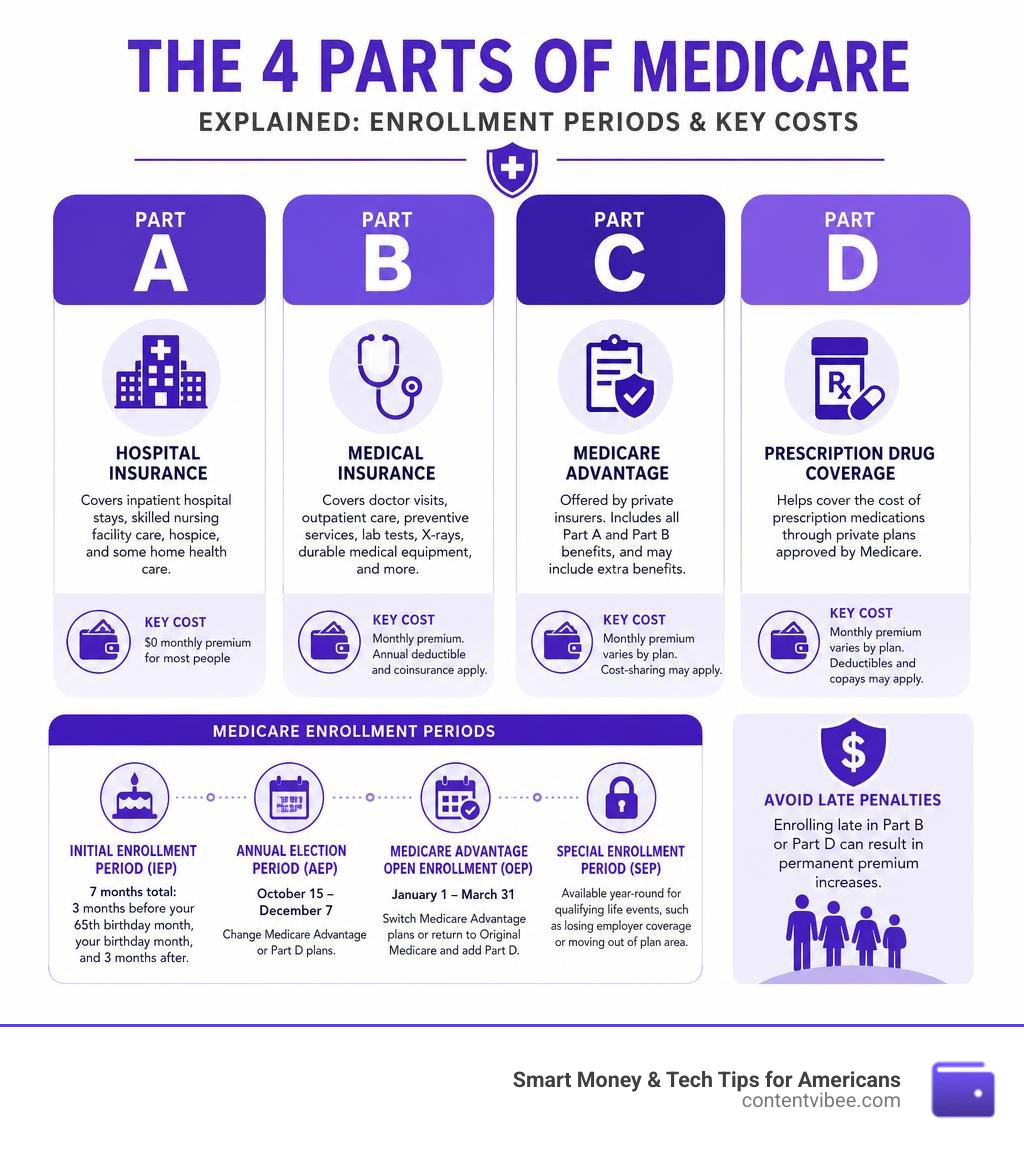
To build a solid foundation for your retirement medicare enrollment guide, we must first look at how the program is structured. Medicare is not a single, all-encompassing plan. Instead, it is divided into distinct “parts” that cover specific types of services.
To help you understand your options, the Original Medicare (Part A and B) Eligibility and Enrollment – CMS guidelines outline the core structure of the program:
- Medicare Part A (Hospital Insurance): This covers inpatient hospital stays, care in a skilled nursing facility, hospice care, and some home healthcare services. For most Americans, Part A is premium-free because they (or their spouse) paid Medicare taxes for at least 10 years (40 quarters) of employment.
- Medicare Part B (Medical Insurance): This covers outpatient medical services, including doctor visits, preventive care, durable medical equipment, and mental healthcare. Unlike Part A, Part B requires a monthly premium, which is standardized by the government but can be higher based on your income.
- Medicare Part C (Medicare Advantage): These are private plans approved by Medicare. If you choose this route, private insurers bundle your Part A, Part B, and usually Part D coverage into a single plan. These plans often feature network restrictions (like HMOs or PPOs) and may offer extra benefits like dental, vision, or wellness programs.
- Medicare Part D (Prescription Drug Coverage): This is optional, run by private insurance companies approved by Medicare, and helps cover the cost of prescription medications. Even if you do not currently take regular medications, enrolling in a Part D plan when you are first eligible is highly recommended to avoid permanent late penalties.
- Medigap (Medicare Supplement Insurance): If you stick with Original Medicare (Parts A and B), you will notice that it does not cover 100% of your medical bills. There are deductibles, copayments, and coinsurance (often 20% of outpatient costs). Medigap policies are private plans designed specifically to fill these financial “gaps.” You cannot combine a Medigap policy with a Medicare Advantage plan; you must choose one path or the other.
As of August 2025, over 68.9 million Americans rely on these programs for their daily health needs. Deciding which path to take is a major milestone. To help you visualize the differences between the two primary enrollment tracks, we have put together this comparison:
| Feature | Original Medicare (Parts A & B) + Medigap + Part D | Medicare Advantage (Part C) |
|---|---|---|
| Provider Network | Any doctor or hospital in the U.S. that accepts Medicare (no referrals needed). | Restricted network of doctors/hospitals (HMO/PPO). Referrals often required. |
| Predictability of Costs | Highly predictable. Medigap covers most out-of-pocket deductibles and coinsurance. | Variable. Lower monthly premiums but you pay copays/coinsurance as you go. |
| Prescription Drugs | Requires a separate standalone Part D plan. | Usually bundled directly into the Medicare Advantage plan. |
| Extra Benefits | Does not cover routine dental, vision, or hearing unless you buy separate policies. | Often includes dental, vision, hearing, and fitness memberships. |
| Out-of-Pocket Limit | No limit under Original Medicare, but Medigap effectively acts as a financial shield. | Has a mandatory annual out-of-pocket maximum limit for safety. |
Key Timelines for Your Retirement Medicare Enrollment Guide
Timing is everything. If there is one piece of advice we stress above all else in this retirement medicare enrollment guide, it is to mark your calendar. Medicare enrollment does not have a single “anytime” open door for beginners. Instead, you must navigate specific windows to avoid delayed coverage or permanent financial penalties.
The most important timeline is your Initial Enrollment Period (IEP). This is a strict 7-month window centered around your 65th birthday. Specifically, it includes:
- The 3 months before the month you turn 65.
- The month of your 65th birthday.
- The 3 months after the month you turn 65.
To ensure your coverage starts on the first day of your birthday month, you should ideally enroll during the first 3 months of your IEP. If your birthday falls on the first day of the month, Medicare has a special rule: your eligibility actually begins on the first day of the previous month! In that case, your entire 7-month IEP shifts forward by one month.
If you miss your IEP and do not qualify for a Special Enrollment Period (which we will discuss below), you must wait for the General Enrollment Period (GEP). The GEP runs annually from January 1 through March 31. When you sign up during the GEP, your coverage begins the first day of the month following your enrollment, but you may be subject to a permanent late enrollment penalty.
For those who continue to work past age 65 and have health coverage through an active employer, Medicare offers a Special Enrollment Period (SEP). This allows you to delay enrolling in Medicare Part B without penalty. The SEP is an 8-month window that begins the month your employment ends or your group health coverage ends—whichever happens first.
To find the exact steps for your specific age and work situation, you can review the official resources on how to Get started with Medicare.
How Social Security Benefits Affect Your Enrollment Timing
A common source of confusion for new retirees is the relationship between Social Security benefits and Medicare enrollment. While both programs are managed by the federal government, they are handled by different agencies. The Social Security Administration (SSA) processes Medicare eligibility and enrollment, while the Centers for Medicare & Medicaid Services (CMS) administers the actual health program.
Whether you have to actively sign up for Medicare depends entirely on your Social Security status:
- Automatic Enrollment: If you are already receiving Social Security retirement benefits (or Railroad Retirement Board benefits) at least 4 months before you turn 65, your enrollment in Medicare Parts A and B is automatic. Your Medicare card will be mailed to you approximately 3 months before your 65th birthday, and your coverage will begin on the first day of your birthday month. The Part B premium will be automatically deducted from your monthly Social Security check.
- Active Signup: If you are not yet receiving Social Security benefits—perhaps because you are delaying benefits to maximize your monthly payout—you will not be automatically enrolled. You must actively sign up for Medicare during your Initial Enrollment Period. You can easily do this online through the Social Security website, by calling their national toll-free number, or by visiting a local Social Security office.
Understanding how these programs intersect is crucial for a smooth transition. For deeper insights on optimizing your retirement timeline, check out our resources on The Complete Guide To Social Security Full Retirement and explore how claiming age affects your benefits in The Definitive Guide To Social Security Claiming Age.
Working Past 65 and Employer-Sponsored Coverage

In today’s economy, many of us choose to work past age 65. If you have active employer-sponsored group health coverage through your own current employment or your spouse’s current employment, you may not need to enroll in Medicare Part B right away. However, before you decide to delay, you must understand the “employer size rule.”
Medicare has strict guidelines regarding company size:
- 20 or More Employees: If your employer (or your spouse’s employer) has 20 or more employees, the employer group health plan is considered the “primary payer.” This means your employer plan pays your medical claims first, and Medicare acts as a secondary payer. In this scenario, you can safely delay Part B without facing a late enrollment penalty, utilizing your Special Enrollment Period when you eventually retire.
- Fewer than 20 Employees: If the employer has fewer than 20 employees, Medicare is considered the “primary payer.” This means your small-business health plan will expect Medicare to pay first. If you fail to enroll in Part B at age 65, your employer insurance may refuse to pay your claims, leaving you with massive out-of-pocket bills.
Even if you work for a large employer and delay Part B, it is usually recommended to enroll in premium-free Part A at age 65, as it can act as secondary hospital coverage. However, there is a major catch if you contribute to a Health Savings Account (HSA). Once you enroll in any part of Medicare (including premium-free Part A), you can no longer make tax-free contributions to an HSA. To avoid tax penalties, you and your employer must stop contributing to your HSA at least 6 months before you enroll in Medicare or apply for Social Security retirement benefits.
Additionally, do not make the mistake of relying on COBRA or retiree health coverage. COBRA and retiree plans do not count as active employer coverage based on current employment. If you leave your job at age 65 and take COBRA, you do not get an 8-month Special Enrollment Period when COBRA ends. You must sign up for Medicare Part B immediately to avoid permanent late enrollment penalties and coverage gaps.
For a comprehensive breakdown of navigating early retirement and employer plans, see our guide on Retiring Early Here Is Your Health Care Coverage Guide.
Coordinating CalPERS and PHIP Public Retirement Plans
For public employees, coordinating retirement health benefits with Medicare requires extra care. If you are covered by the California Public Employees’ Retirement System (CalPERS) or the PERS Health Insurance Program (PHIP) in Oregon, these organizations have strict rules regarding Medicare enrollment.
For CalPERS members, maintaining your health benefits after turning 65 requires you to notify CalPERS of your Medicare status and transition to a CalPERS Medicare health plan. You must enroll in both Medicare Parts A and B as soon as you become eligible. CalPERS will automatically transition you to a coordinated Medicare plan if they receive your Medicare enrollment information at least 60 days before your 65th birth month. Failing to coordinate this transition or attempting to stay on a CalPERS Basic plan past age 65 without an approved exception can lead to the cancellation of your health coverage.
Similarly, the PERS Health Insurance Program (PHIP) has strict forfeiture rules. If you do not enroll in a PHIP Medicare plan when you first become eligible for Medicare Parts A and B, you will forfeit any future opportunity to enroll in a PHIP medical plan in almost all circumstances. To maintain your PHIP coverage, you must sign up for Parts A and B and submit a copy of your Medicare card or Letter of Entitlement along with your PHIP enrollment forms.
Furthermore, if you are enrolled in a public employer Medicare plan, do not independently sign up for an outside Part D prescription drug plan. Doing so can automatically cancel your public retirement health plan, as these plans bundle their own proprietary Part D coverage.
Late Enrollment Penalties and How to Avoid Them
One of the primary goals of this retirement medicare enrollment guide is to save you money. Missing Medicare deadlines can result in severe, lifetime financial consequences. The federal government implements these penalties to encourage healthy individuals to enroll early, ensuring the program remains financially balanced.
Let’s break down the three primary late enrollment penalties:
- The Part B Late Enrollment Penalty: If you miss your Initial Enrollment Period and do not qualify for an SEP, you will face a permanent 10% penalty for each full 12-month period you delayed enrollment. For example, if you were eligible for Part B at age 65 but waited until age 68 to enroll (a 3-year delay), you will pay a 30% penalty on top of your standard monthly Part B premium. This penalty is not temporary; you will pay it every month for the rest of your life.
- The Part A Late Enrollment Penalty: If you do not qualify for premium-free Part A and must buy it, delaying enrollment by more than 12 months after first becoming eligible will result in a 10% penalty. Unlike Part B, this penalty is temporary: you must pay the extra 10% for twice the number of years you delayed enrollment.
- The Part D Late Enrollment Penalty: If you go without “creditable” prescription drug coverage (coverage that is at least as good as Medicare’s standard Part D coverage) for a continuous period of 63 days or more after your IEP, you will face a Part D penalty. This penalty is calculated as 1% of the national base beneficiary premium ($38.99 in 2026) for every single month you went without coverage. This penalty is also permanent and added to your monthly Part D plan premium for life.
To make sure you apply correctly and protect your retirement budget, refer to the official procedures on How and when to apply for Medicare – USAGov and read our detailed breakdown in The Complete Guide To Benefit Rules.
Essential Checklist for Your Retirement Medicare Enrollment Guide

To ensure a seamless transition into Medicare, we recommend compiling your paperwork early. Use this step-by-step checklist to guide your enrollment process:
- [ ] Verify Your Eligibility: Confirm your 65th birthday month and determine if you will be auto-enrolled through Social Security.
- [ ] Evaluate Employer Coverage: If working past 65, consult your HR department to confirm if your employer group health coverage is “primary” (20+ employees) and if your drug coverage is “creditable.”
- [ ] Gather Necessary Documentation:
- Your Social Security card and proof of U.S. citizenship or legal residency.
- Your birth certificate.
- Tax records (specifically your tax returns from two years prior, which determine your Part B premiums).
- If delaying Part B, have your employer fill out CMS Form L564 (Request for Employment Information) to prove continuous active group coverage.
- [ ] Submit Your Application: If not auto-enrolled, apply online via the Social Security Administration website 3 months before your 65th birthday month.
- [ ] Receive Your Medicare Card: Keep your new red, white, and blue Medicare card in a safe place and protect your Medicare number like a credit card to prevent fraud.
- [ ] Choose Your Path: Compare Original Medicare + Medigap + Part D against Medicare Advantage (Part C) using the official plan finder tool.
- [ ] Coordinate Public Plans: If applicable, submit your Medicare card and transition forms to CalPERS or PHIP at least 60 days in advance.
For more strategic tips on aligning your healthcare decisions with your financial timeline, read The Ultimate Guide To Social Security Benefit Optimization.
Frequently Asked Questions About Medicare Enrollment
Navigating Medicare can feel like learning a completely new language. If you ever feel overwhelmed, free and unbiased personal counseling is available through your State Health Insurance Assistance Program (SHIP) or by calling 1-800-MEDICARE. Here are some of the most common questions we receive.
What are the standard Medicare costs and deductibles for 2026?
Medicare costs are adjusted annually by the federal government. For the year 2026, the standard monthly premium for Medicare Part B is $202.90, and the annual Part B deductible is $283.
For Part A, the hospital deductible is $1,736 per benefit period in 2026. Under Part D, no prescription drug plan may have an annual deductible greater than $615 in 2026. Additionally, thanks to recent legislative changes, the maximum out-of-pocket cap for covered Part D prescription drugs is capped at $2,100 in 2026—once you reach this limit, you pay $0 for your covered medications for the rest of the calendar year.
It is also important to note that higher-income retirees may pay more for Parts B and D due to the Income-Related Monthly Adjustment Amount (IRMAA). IRMAA brackets are calculated using your modified adjusted gross income (MAGI) from your tax returns two years prior (for 2026 premiums, the government looks at your 2024 tax returns).
Can I change my Medicare plan after my initial enrollment?
Yes! Your healthcare needs and prescription medications will change over time, and thankfully, Medicare provides designated windows to modify your coverage:
- Annual Enrollment Period (AEP): Running from October 15 to December 7 each year, the AEP allows any Medicare beneficiary to switch from Original Medicare to a Medicare Advantage plan (or vice versa), change Medicare Advantage plans, or switch Part D prescription drug plans. Any changes made during this period take effect on January 1 of the following year.
- Medicare Advantage Open Enrollment Period (OEP): Running from January 1 to March 31 annually, this window is specifically for individuals currently enrolled in a Medicare Advantage plan. During this time, you can switch to a different Medicare Advantage plan or return to Original Medicare (and enroll in a standalone Part D plan).
We highly recommend reviewing your coverage every autumn during the AEP, as insurance companies frequently modify their drug formularies, provider networks, and premium rates.
What happens if I miss my Initial Enrollment Period without other coverage?
If you miss your Initial Enrollment Period and do not have active employer group coverage to qualify for an SEP, you cannot sign up for Medicare Part B until the next General Enrollment Period (GEP), which runs from January 1 to March 31.
Waiting for the GEP means you will experience a coverage delay, leaving you medically uninsured during those gap months. Furthermore, you will likely face a lifetime 10% Part B late enrollment penalty for every 12-month period you delayed signing up, which will permanently increase your monthly premiums.
Conclusion
Taking charge of your retirement means proactively managing both your financial health and your physical well-being. By utilizing this retirement medicare enrollment guide, you can confidently navigate the enrollment windows, coordinate your benefits, and avoid costly permanent penalties.
At ContentVibee, we are dedicated to providing clear, actionable personal finance tips and retirement planning resources to help you maximize your hard-earned benefits. For more information on navigating your transition into retirement, check out our guide: Is working in retirement going to reduce your spousal benefits?


