


Working After Retirement: What You Need to Know Before Your First Day Back
Can you collect a pension and still work full-time? In most cases, yes — but the rules depend heavily on who you work for, which type of pension you have, and how old you are.
Here’s the quick answer:
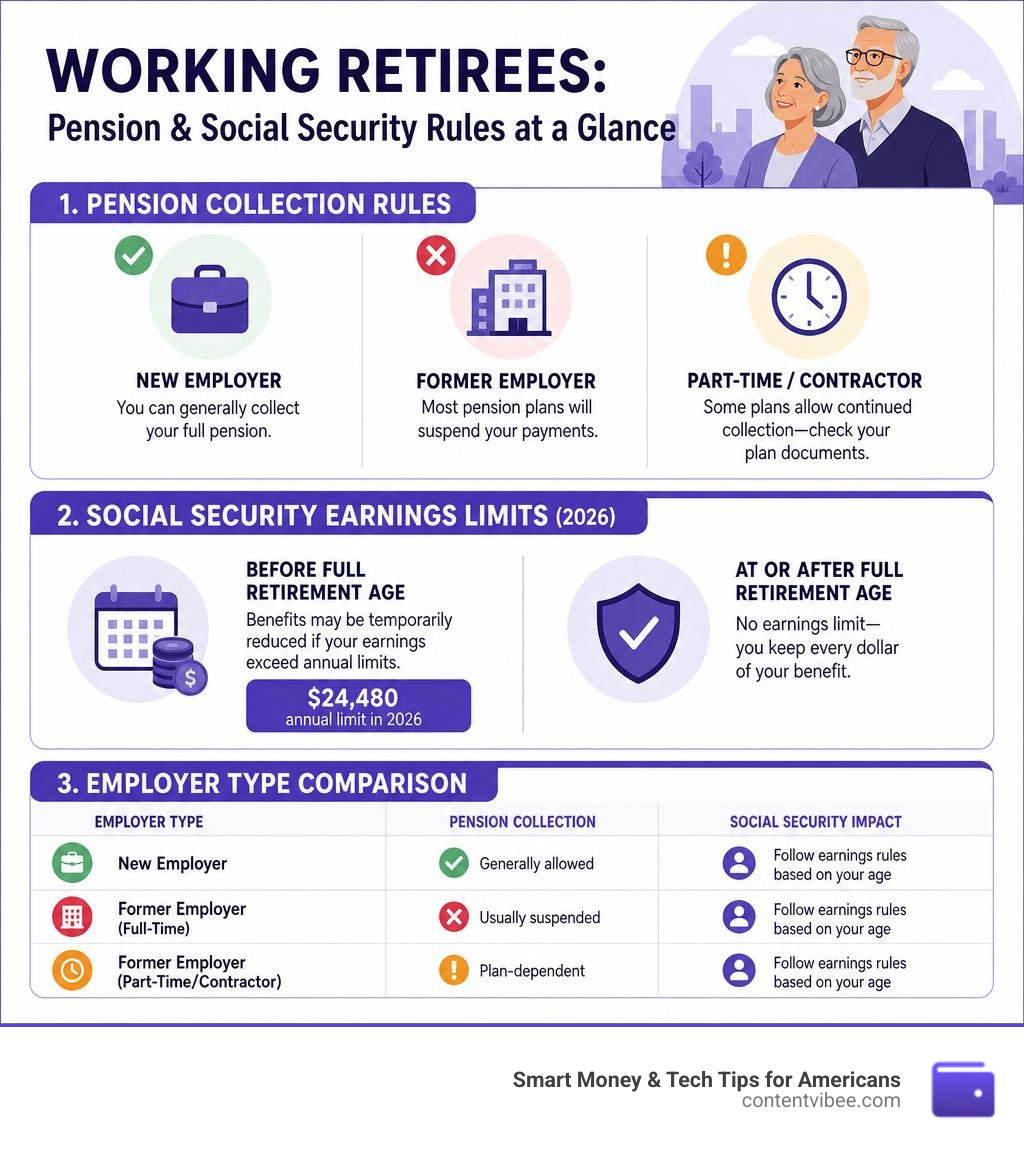
- Working for a new employer: You can generally collect your full pension with no interruption.
- Working full-time for your former employer: Most pension plans will suspend your payments.
- Working part-time or as a contractor for your former employer: Some plans allow continued collection — but it depends on your specific plan documents.
- Social Security before full retirement age: Benefits may be temporarily reduced if your earnings exceed annual limits ($24,480 in 2026).
- Social Security after full retirement age: No earnings limit — you keep every dollar of your benefit.
Only about 15% of private employers in the U.S. still offer pension plans, according to U.S. Department of Labor data from 2024. But for those who have one — teachers, law enforcement officers, civil service workers, and union members chief among them — understanding how work affects those benefits is critical before accepting a job offer.
The stakes are real. Return to work under the wrong conditions and you could see pension payments stopped, Social Security benefits reduced, Medicare coverage complicated, and your tax bill climb higher than expected.
This guide breaks it all down in plain language so you can make a smart, informed decision.
Can You Collect a Pension and Still Work Full-Time?

The short answer is yes, you can absolutely collect a pension and work a full-time job. However, the long answer requires looking closely at the rules of your specific pension plan and the employer you choose to work for.
Pensions are “defined benefit plans,” which are employer-sponsored retirement plans where your benefits are calculated using a formula based on your years of service, salary history, and age. Because these plans are entirely funded and managed by the employer, they are governed by strict federal laws, primarily the Employee Retirement Income Security Act (ERISA). ERISA is enforced by the Employee Benefits Security Administration, and it sets the standards for how private pensions must operate.
Under ERISA, once you have met the requirements to be fully vested in your pension, those benefits cannot be stripped away entirely. They are a guaranteed part of your compensation package. However, your plan’s specific language dictates when and under what conditions those benefits can be distributed to you.
The most critical factor in determining whether you can collect your pension while working is whether you are returning to your former employer or joining a completely new company. If you are interested in the legal nuances of these rules, you can read more about legal guidelines on working while collecting a pension.
How Employer Types Affect the Question: Can You Collect a Pension and Still Work Full-Time?
Different types of employers operate under very different pension rules. Let’s look at how private, state, and federal systems compare:
- Private Employers: If you hold a private-sector pension, you are generally free to work full-time for any other company in the world while collecting your monthly check. However, if you want to return to the same company that is paying your pension, ERISA rules usually require you to have a “bona fide termination of employment.” This means you must genuinely retire first, with no prearranged agreement to return to work.
- State Government Systems: State pension systems (such as those for public school teachers, police officers, and municipal workers) have incredibly strict rules. Many states require a mandatory “break in service” before you can return to any public sector employment. This break can range from 30 days to six months or more. If you return to work for a state employer before this break is complete, your pension payments will be suspended, and you may be forced to repay any benefits you already received. For those planning their retirement timeline under state guidelines, you can check out our guide on When Can You Stop Working And Retire In California.
- Federal Employees (FERS): If you retired under the Federal Employees Retirement System (FERS) and return to work for the federal government, you are considered a “reemployed annuitant.” In most cases, you can continue to receive your pension, but your new federal salary will be reduced by the amount of your annuity.
Returning to Your Former Employer vs. a New Employer
If you decide to work for a completely new employer, you are in the clear. Your former employer has no legal right to suspend your pension payments just because you took a job somewhere else.
However, if you want to return to your former employer, proceed with caution. Many corporate pension plans state that if a retiree is reemployed by the same company (or an affiliated company) and works more than a certain number of hours per month (typically 40 hours), their pension payments will be suspended until they retire again.
To bypass this, some retirees transition into part-time work or negotiate independent contractor agreements. While this can work, your pension plan must explicitly allow it. If the IRS or your pension administrator determines that your “retirement” was a sham and that you simply transitioned from employee to contractor with no real break, your pension could be suspended, and your plan could face tax penalties.
Social Security Earnings Limits and Working in Retirement

While your private pension won’t be reduced by taking a new job, your Social Security benefits might be if you choose to work before you reach your Full Retirement Age (FRA).
The Social Security Administration (SSA) uses an annual “earnings test” to determine if retirees who work have earned more than the allowable limits. If you exceed these limits, the SSA will temporarily withhold a portion of your monthly benefit. To understand how these rules apply to different family members, you can explore Social Security rules for working retirees.
Earnings Limits for 2025 and 2026
The earnings limits are adjusted annually for inflation. Here is how the limits compare for the years 2025 and 2026:
| Scenario | 2025 Limits & Rules | 2026 Limits & Rules |
|---|---|---|
| Under Full Retirement Age (All Year) | Limit: $23,400 $1 deducted for every $2 earned above the limit. | Limit: $24,480 $1 deducted for every $2 earned above the limit. |
| The Year You Reach Full Retirement Age | Limit: $62,160 $1 deducted for every $3 earned above the limit (only counts earnings before the month you reach FRA). | Limit: $65,160 $1 deducted for every $3 earned above the limit (only counts earnings before the month you reach FRA). |
| At or After Full Retirement Age | No Limit Keep 100% of your benefits regardless of earnings. | No Limit Keep 100% of your benefits regardless of earnings. |
For example, in 2026, if you are under your Full Retirement Age and earn $34,480 from a new full-time job, you are $10,000 over the limit. The SSA will withhold $5,000 of your Social Security benefits ($1 for every $2 over the limit).
The good news? These withheld benefits are not lost forever. Once you reach your Full Retirement Age, the SSA will recalculate your monthly benefit upward to credit you for the months they withheld your payments.
What Counts as Earnings for Social Security Reductions?
It is incredibly important to know what the SSA actually counts as “earnings” when they calculate these reductions.
What Counts:
- Gross wages from an employer (including bonuses, commissions, and vacation pay).
- Net earnings from self-employment.
What Does NOT Count:
- Pension payments.
- 401(k) or IRA distributions.
- Investment income, dividends, and interest.
- Capital gains.
- Veterans benefits or other government retirement benefits.
Because pensions do not count as earned income, your pension payments will never trigger a reduction in your Social Security benefits. If you are also managing spousal benefits, you should read our breakdown on Working In Retirement Are Spousal Benefits Reduced By Working.
Special Rules for Disability Retirees and Railroad Workers
If you retired on a disability pension or worked in the railroad industry, the standard retirement rules do not apply to you. Both of these categories have incredibly strict, unique guidelines. For a deep dive into disability-specific earnings, read How Much Can You Earn On Disability Pension.
Disability Pension Earnings Limits and Trial Work Periods
If you receive a disability pension (either through Social Security Disability Insurance or an employer’s private disability plan), returning to full-time work can completely disqualify you from receiving benefits.
The SSA allows disability beneficiaries to test their ability to work through a “Trial Work Period.” During this period (which lasts for a total of nine months within a rolling 60-month window), you can earn any amount of money without losing your benefits. However, once the Trial Work Period ends, any month where your earnings exceed the “Substantial Gainful Activity” (SGA) threshold will result in your benefits being suspended.
Furthermore, private disability insurance plans often have “own occupation” vs. “any occupation” definitions. If your private disability pension was approved because you could no longer perform your specific job, taking a different type of job might be permitted. But if the plan is based on your inability to work any job, returning to the workforce will immediately stop your disability payments.
Railroad Retirement Annuity Work Restrictions
Railroad workers are covered under the Railroad Retirement Act rather than the standard Social Security system. Their benefits are split into Tier I (which is coordinated with Social Security) and Tier II (which acts like a private pension funded by railroad employers and employees).
The rules for working after receiving a railroad retirement annuity are exceptionally strict:
- Railroad Employer Work: Your annuity (both Tier I and Tier II) is completely suspended for any month in which you work for a railroad employer — even if it is only for one day of work or you earn a tiny amount.
- Last Pre-Retirement Nonrailroad Employer: If you return to work for the nonrailroad employer you worked for right before retiring, your Tier II benefits and any supplemental annuities will be reduced by $1 for every $2 you earn, up to a maximum reduction of 50%. This deduction continues regardless of your age—it does not stop when you reach Full Retirement Age.
- Disability Annuitants: In 2026, disabled railroad retirees face a monthly earnings limit of $1,320 and an annual limit of $16,500. Exceeding these limits will cause you to lose your annuity for those months and could trigger a review of your medical recovery.
To keep your benefits safe, check out the official Railroad retirement post-retirement work rules.
Tax and Medicare Implications of Working While Collecting a Pension
Before you sign a new employment contract, you must calculate how your new salary will interact with your taxes and Medicare premiums. Adding a full-time salary on top of a pension can push you into a much higher tax bracket.
How Working Affects Your Income Taxes and Social Security Taxation
Pensions are generally treated as taxable income by both the IRS and most states. If you add a full-time salary to your pension, your “combined income” (your adjusted gross income + tax-exempt interest + half of your Social Security benefits) will rise.
If your combined income exceeds certain thresholds, up to 85% of your Social Security benefits can become taxable:
- Individual Filers: If your combined income is between $25,000 and $34,000, you may pay income tax on up to 50% of your benefits. If it is above $34,000, up to 85% of your benefits are taxable.
- Joint Filers: If you and your spouse have a combined income between $32,000 and $44,000, you may pay tax on up to 50% of your benefits. Above $44,000, up to 85% of your benefits are taxable.
To avoid a massive tax bill at the end of the year, you may need to ask your pension provider and your new employer to withhold extra taxes, or consider Alternative Ways To Save For Retirement That Actually Work to lower your taxable income.
Medicare Coordination with Employer Health Plans
If you are 65 or older and enrolled in Medicare, returning to work full-time introduces the question of health insurance coordination.
If your new employer has 20 or more employees, their group health plan is considered the “primary payer,” meaning it pays your medical bills first. Medicare becomes the “secondary payer.” In this case, you can often delay enrolling in Medicare Part B (and Part D) without penalty, saving you the monthly premium.
If your employer has fewer than 20 employees, Medicare remains the primary payer, and your employer’s plan is secondary. You must sign up for Part B; otherwise, your employer’s insurance may refuse to pay your claims, leaving you personally responsible for your medical bills.
Key Steps to Take Before Returning to the Workforce
Returning to work after retirement can be incredibly rewarding, both socially and financially. However, to protect your hard-earned benefits, you should take these steps before accepting any job offer.
Reviewing Your Summary Plan Description (SPD)
Your Summary Plan Description (SPD) is the legally binding document that outlines exactly how your pension plan operates. You can request a copy of this document for free from your former employer’s HR department.
When reviewing the SPD, look closely for:
- Vesting schedules: Ensure you are 100% vested before making any career changes.
- Reemployment clauses: Read the exact language regarding what happens if you return to work for the same employer, an affiliated company, or a competitor.
- Definition of “hours of service”: See if there is a specific hourly threshold (such as 40 hours per month) that triggers a suspension of benefits.
If you struggle to get this information or believe your pension is being wrongfully withheld, you can contact the Pension Action Center or the National Pension Lawyers Network for assistance.
Calculating the Financial Impact of Your Return
Do not assume that earning a $50,000 salary means you will be $50,000 richer. You must perform a complete cost-benefit analysis.
- Calculate your net income: Deduct federal, state, and local income taxes, as well as FICA taxes (Social Security and Medicare), which you must continue to pay on your wages even if you are already retired.
- Account for benefit reductions: If you are under Full Retirement Age, calculate how much of your Social Security will be withheld.
- Check for tax bracket shifts: Will your new income push you into a higher tax bracket, increasing the tax rate on your pension and investments?
- Factor in commuting and work expenses: Gas, wardrobe, and lunches out can eat into your earnings.
By running these numbers beforehand, you can determine if a full-time return is truly worth your time, or if a different withdrawal strategy makes more sense. For help mapping out your retirement income, check out our guide on Demystifying The 4 Percent Retirement Withdrawal Calculator.
Frequently Asked Questions about Working and Collecting a Pension
Can you collect a pension and still work full-time for a different company?
Yes. If you take a full-time job with a completely different company, your pension payments from your former employer will not be affected. Private pensions are protected by federal law, and your former employer cannot stop your payments simply because you found new employment.
What happens to my pension if I return to work for my former employer part-time?
It depends entirely on your plan’s specific rules. Many pension plans allow you to work part-time (often defined as fewer than 40 hours per month) for your former employer without suspending your pension. Some retirees also return as independent contractors. However, you must carefully review your Summary Plan Description, as some employers completely forbid any post-retirement work.
Does working after retirement increase my future Social Security benefits?
Yes, it can. The SSA calculates your benefit amount based on your highest 35 years of indexed earnings. If your new post-retirement salary is higher than one of the years used in your original calculation, the SSA will automatically replace the lower-earning year with your new higher-earning year, resulting in an increase in your monthly benefit. You can read the Official SSA FAQ on working and retirement benefits for more details.
Conclusion
At ContentVibee, we believe that retirement doesn’t have to mean the end of your professional journey. Whether you want to return to work for the intellectual challenge, the social connections, or to build a stronger financial cushion, you have options.
Can you collect a pension and still work full-time? Yes, you can — as long as you navigate the rules carefully. By understanding how your specific pension plan treats reemployment, tracking the Social Security earnings limits for 2026, and planning for the tax implications, you can enjoy the best of both worlds: a steady pension check and a fulfilling career.
Before you make your final decision, take the time to read our plan documents, consult with a financial advisor, and map out your complete financial picture. If you want to dive deeper into how your post-retirement work choices affect your family, learn more about how working in retirement affects spousal benefits.