


What You Need to Know About Social Security and Divorced Spouse Benefits
Social security and divorced spouse benefits are one of the most overlooked sources of retirement income available to Americans today — and if you were married for at least 10 years, you may be entitled to a meaningful monthly payment based on your ex-spouse’s work record.
Here is a quick answer to the most common questions:
| Question | Quick Answer |
|---|---|
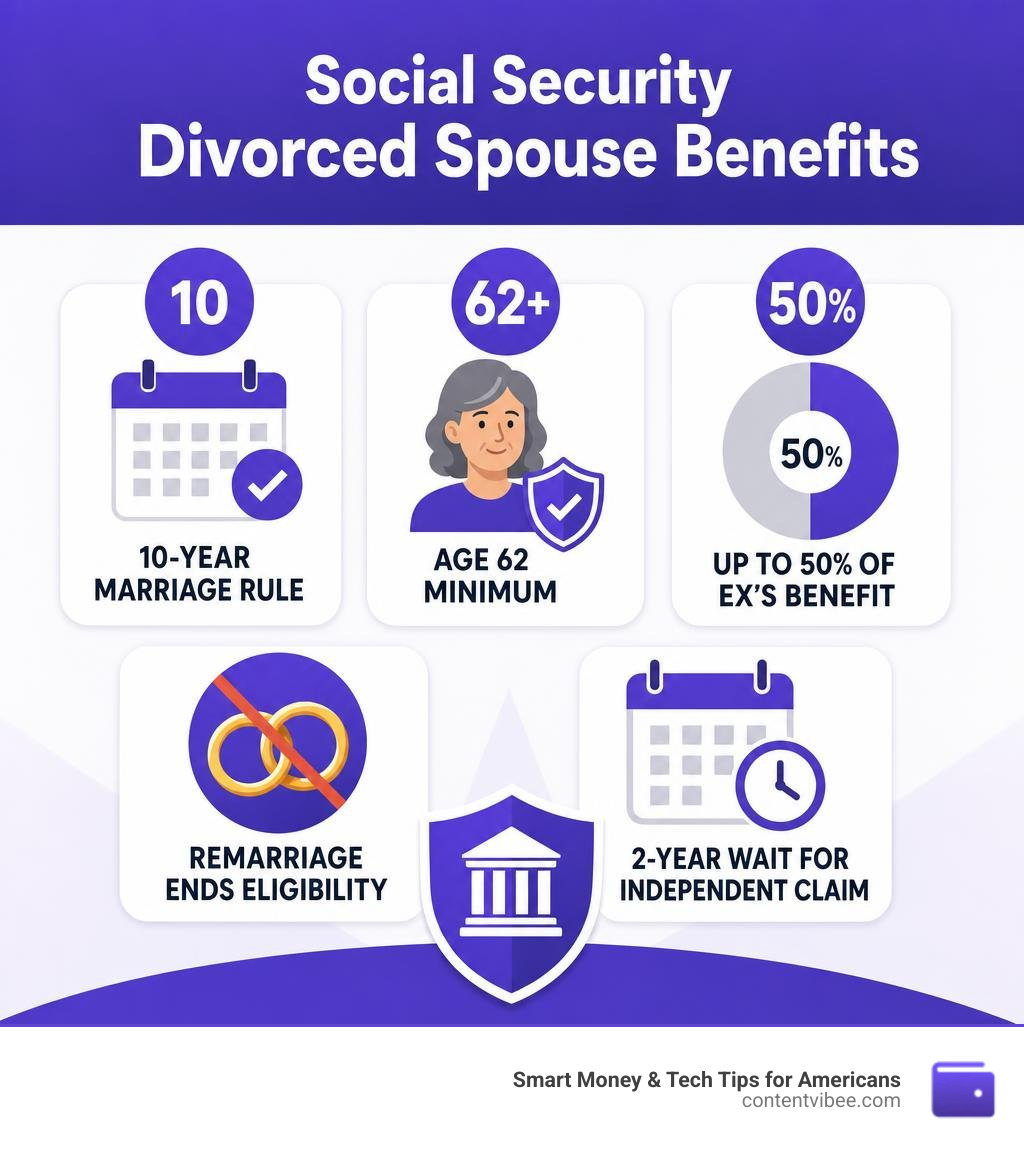
| Who qualifies? | Divorced after 10+ year marriage, age 62+, currently unmarried |
| How much can you get? | Up to 50% of your ex-spouse’s full retirement benefit |
| Does it reduce their benefit? | No — it has zero impact on what your ex receives |
| Can you claim if they haven’t filed yet? | Yes, if you’ve been divorced at least 2 years |
| Does their remarriage affect you? | No — you can still claim on their record |
These benefits fall under what the Social Security Administration (SSA) calls family benefits — and they exist specifically to protect people who spent years out of the workforce or earned less than their spouse.
The rules have layers, though. Your claiming age, work history, government pension, and marital status all affect how much you actually receive. And changes made in 2016 eliminated some popular strategies that older claimants used to maximize payouts.
This guide breaks it all down in plain language — so you can understand exactly where you stand before you file.
Who Qualifies for Social Security and Divorced Spouse Benefits?
When we sit down to look at retirement numbers, many of us are surprised to learn that our marital history can be just as valuable as our work history. If you are divorced, the federal government recognizes that a long-term marriage is an economic partnership. Because of this, you may be eligible to draw retirement income based on your ex-spouse’s earnings history.
But before you start planning how to spend that extra monthly cash, you must meet several strict statutory requirements. The SSA is highly meticulous about verifying these rules, so let’s walk through the exact criteria you must satisfy.
First and foremost, you can only collect if your ex-spouse is already entitled to Social Security retirement or disability benefits. If they qualify, you must also meet the following personal criteria:
- Your marriage must have lasted for a continuous block of time before the divorce was finalized.
- You must be at least 62 years old to claim.
- You must currently be unmarried.
- Your own personal Social Security retirement benefit must be less than the amount you would receive by claiming on your ex-spouse’s record.
Many people worry that claiming this benefit will alert their ex-spouse or, worse, reduce their ex’s monthly check. We want to put your mind at ease immediately: claiming benefits on an ex’s record has absolutely zero impact on their payments, and they are not notified when you apply. It is a completely private transaction between you and the SSA. For more on this, check out our guide on how Can You Claim Your Exs Social Security Yes And It Wont Hurt Their Wallet.
To see if you fit the general profile of someone who can leverage a former partner’s work record, you can read more about the basics in our article: Can Divorced Spouse Get Social Security Benefits. Additionally, the official SSA guidelines answer the foundational question: Can someone get Social Security benefits on their former spouse’s record? Yes, you absolutely can, provided you clear the hurdles we discuss below.
The 10-Year Marriage Rule and Age Requirements
The most famous roadblock to qualifying for social security and divorced spouse benefits is the “10-year rule.” Under federal law, your marriage must have lasted at least 10 years immediately before your divorce became final.
According to the official SSA – POMS: RS 00202.005 – Divorced Spouse – 12/24/2014, this 10-year requirement is strictly calculated. If your marriage lasted 9 years and 364 days before the final decree was signed by a judge, you are out of luck. The clock starts on the legal date of your marriage and stops on the exact date the divorce became legally final.
However, there is a fascinating loophole in the Program Operations Manual System (POMS) regarding interrupted marriages. If you divorce a spouse, remarry them, and then divorce them again, you can sometimes stitch those periods together. Specifically, if you remarry your ex-spouse no later than the calendar year following the year of your divorce, the SSA treats the marriage as continuous for the purpose of meeting that 10-year requirement.
Additionally, after December 31, 1990, the SSA allows credit for “deemed marriages” (where a marriage was entered into in good faith but was technically invalid due to a legal impediment) to count toward the 10-year requirement.
Aside from the marriage duration, you must also be at least 62 years old. If you apply the minute you turn 62, keep in mind that your benefit will be permanently reduced. To get the maximum possible spousal benefit, you must wait until your own Full Retirement Age (FRA). For a deeper dive into how age and timing interact, read our comprehensive Divorced Spouse Social Security Guide 2026.
The Two-Year Waiting Period for Independently Entitled Ex-Spouses
What happens if your ex-spouse is eligible for retirement benefits but hasn’t actually applied for them yet? Maybe they are a workaholic who plans to delay retirement until age 70, leaving you waiting in the wings.
This is where the concept of an “independently entitled divorced spouse” comes into play. Under standard spousal rules, a currently married person cannot collect spousal benefits until their partner actually files for their own retirement check. But as a divorced spouse, you are granted a special exemption—provided you have been divorced for at least two continuous years.
According to the administrative guidelines in SSA – POMS: RS 00202.100 – Independently Entitled Divorced Spouse – 09/18/2025, you can bypass your ex’s refusal to file if:
- Your ex-spouse is at least 62 years old and fully insured (meaning they have accumulated the required 40 work credits).
- Your final divorce decree has been active for at least two consecutive years.
This two-year buffer is designed to prevent couples from divorcing solely to game the Social Security system for early payouts. Once those two years have elapsed, you can apply for benefits independently. The SSA will calculate your payment based on your ex-spouse’s earnings record even if they are still working and have not touched their own retirement account.
How Much Can You Receive and How to Maximize Your Payout
Now that you know if you qualify, let’s talk about the fun part: the money. How much can you actually expect to receive each month?
The golden rule of divorced spousal benefits is that the maximum you can receive is 50% of your ex-spouse’s Primary Insurance Amount (PIA). The PIA is the monthly amount your ex-spouse is entitled to receive at their Full Retirement Age.
It is important to understand that the SSA does not simply add your own benefit to your ex-spouse’s benefit. Instead, they use a “dual entitlement” process. If you qualify for benefits on your own record and on your ex-spouse’s record, the SSA will pay your own retirement benefit first. If your divorced spousal benefit is higher than your own benefit, they will add an extra “top-off” payment to bring the total up to the amount of the spousal benefit.
To help you run these numbers without getting a headache, we highly recommend checking out our interactive resource, the Ex Files A Guide To Using The Divorced Spouse Social Security Benefits Calculator.
Calculating Your Social Security and Divorced Spouse Benefits
Your monthly check is heavily dependent on when you choose to claim. If you wait until your Full Retirement Age (which is between 66 and 67, depending on the year you were born), you will receive the full 50% of your ex-spouse’s PIA.
If you claim early—anytime between age 62 and your FRA—the SSA will permanently reduce your benefit. Unlike your personal retirement benefit, which earns “delayed retirement credits” of 8% per year for every year you delay claiming past your FRA up to age 70, divorced spousal benefits do not increase if you delay past your Full Retirement Age. There is absolutely no financial incentive to wait until age 70 to claim a spousal benefit; the maximum value caps out precisely at your FRA.
The reduction for claiming early is calculated on a sliding scale. Here is a breakdown of how claiming early affects your divorced spousal benefit, using data highlighted by the Understanding Social Security Benefits After Divorce – Hartford Funds:
| Claiming Age | Percentage of Ex-Spouse’s FRA Benefit |
|---|---|
| Full Retirement Age (66 or 67) | 50.0% |
| Age 65 | 45.8% |
| Age 64 | 41.7% |
| Age 63 | 37.5% |
| Age 62 | 35.0% |
Let’s look at a real-world scenario. Meet Maria. She is 62 years old and was married to her ex-husband for 15 years before divorcing. Her ex-husband’s PIA at his FRA is $3,200.
- If Maria waits until her own FRA (which is 67) to claim, she is entitled to 50% of his PIA, which is $1,600 per month.
- If Maria decides she cannot wait and claims at age 62, her benefit is permanently reduced to 35% of his PIA, leaving her with $1,120 per month. By claiming five years early, she leaves $480 a month on the table for the rest of her life.
How Work Earnings and Government Pensions (WEP/GPO) Reduce Your Payout
If you plan to keep working while collecting social security and divorced spouse benefits before you reach your Full Retirement Age, you must watch out for the Earnings Test.
For those under their FRA, the SSA will temporarily withhold $1 in benefits for every $2 earned over the annual limit (which changes slightly every year). In the year you reach your FRA, the penalty drops to $1 for every $3 earned over a higher limit, up until the exact month you hit your FRA. Once you reach your FRA, the earnings test disappears entirely, and any withheld benefits are gradually recredited to increase your monthly payout.
Additionally, if you worked in a public sector job—such as a public school teacher, police officer, or civil servant—where you earned a pension and did not pay Social Security taxes, your divorced spousal benefits may be severely slashed or eliminated entirely by two federal provisions:
- The Windfall Elimination Provision (WEP): This modifies the formula used to calculate your own Social Security retirement benefit if you also receive a pension from non-covered work.
- The Government Pension Offset (GPO): This is the real kicker for spousal benefits. The GPO reduces your divorced spousal or survivor benefit by two-thirds of the amount of your government pension. If two-thirds of your monthly teacher’s pension is larger than your calculated divorced spousal benefit, your Social Security spousal payment will be reduced to zero.
Maximizing Payouts and Deemed Filing Rules
Once upon a time, retirees could use clever timing strategies to maximize their lifetime payouts. A popular method was filing a “restricted application.” This allowed a divorced individual to claim only spousal benefits on their ex’s record at their FRA, while letting their own retirement benefit grow by 8% per year until age 70, at which point they would switch to their own maximized benefit.
However, the Bipartisan Budget Act of 2015 largely eliminated this strategy through a rule called Deemed Filing. Under deemed filing, when you apply for retirement or spousal benefits, you are “deemed” to be applying for both simultaneously. The SSA will automatically calculate both and pay you the higher of the two amounts.
Because we are currently in June 2026, the restricted application loophole is a piece of history for almost everyone. The restricted application strategy was grandfathered in only for individuals born on or before January 2, 1954. Since anyone born before that date is already over 72 years old, almost all active claimants today are subject to the modern deemed filing rules.
Claiming Survivor Benefits and Navigating Remarriage
A major point of confusion for many retirees is the difference between claiming a spousal benefit while an ex-spouse is alive versus claiming a survivor benefit after they pass away. These are two entirely different programs with different benefit caps, age requirements, and remarriage rules.
If you are looking for a straightforward, highly accessible breakdown of how these rules change when an ex-spouse passes away, read our guide on Surviving Divorced Spouse Benefits Explained Simply.
Differences Between Living Spousal and Survivor Benefits
The differences between living spousal benefits and surviving divorced spouse benefits are substantial. While a living spousal benefit caps out at 50% of your ex’s PIA, a surviving divorced spouse benefit can be worth up to 100% of your deceased ex-spouse’s actual benefit.
The age requirements are also much more forgiving when dealing with a loss. You can claim surviving divorced spouse benefits as early as age 60 (or age 50 if you are disabled).
To secure these benefits, the SSA requires specific documentation. According to the SSA – POMS: RS 00207.004 – Widow(er)’s Benefits – Table of Proofs and Development – Policy – 08/08/2011, you must provide:
- Proof of your ex-spouse’s death (unless already on file).
- Proof of your marriage lasting at least 10 years.
- Your final divorce decree.
- Your own proof of age.
If you claim survivor benefits early (between age 60 and your FRA), the monthly payment will be reduced. However, a major advantage of survivor benefits is that they are exempt from the deemed filing rule. You can choose to claim a reduced surviving divorced spouse benefit at age 60, let your own retirement benefit grow until age 70, and then switch to your own maximum retirement benefit if it is higher.
How Remarriage Impacts Your Social Security and Divorced Spouse Benefits
Remarriage is the ultimate dealbreaker for living social security and divorced spouse benefits, but it has a surprisingly gentle impact on survivor benefits if you time it correctly.
If you are receiving a spousal benefit based on a living ex-spouse’s record and you decide to remarry, your eligibility for that benefit ends immediately in the month before your marriage. It does not matter if your new spouse makes less money; the benefit based on your ex-spouse is terminated. You would instead have to look into claiming spousal benefits on your new spouse’s record, which requires you to be married for at least one year before filing.
However, the rules for surviving divorced spouse benefits are entirely different. According to the legal frameworks detailed in Social Security Benefits for Divorced Spouses – People’s Law Library:
- If you remarry before age 60 (or age 50 if disabled), you cannot collect survivor benefits on your deceased ex-spouse’s record while that marriage is active.
- If you remarry after age 60 (or age 50 if disabled), the SSA completely ignores the remarriage. You can continue to receive 100% of your deceased ex-spouse’s survivor benefit, or claim on your new spouse’s record if that amount is higher.
How to Apply, Appeal, and Avoid Benefit Termination
When you are ready to claim your benefits, navigating the bureaucracy of the SSA can feel intimidating. However, being organized and knowing your rights can make the process smooth and stress-free.
Required Documents and the Application Process
You can apply for divorced spouse benefits online (if you are within three months of turning 62 or older), over the phone by calling 1-800-772-1213, or in person at your local Social Security office.
To ensure your application is processed without delay, you should gather the following documents beforehand:
- Your original birth certificate or other proof of age.
- Proof of U.S. citizenship or lawful alien status if you were not born in the United States.
- Your marriage certificate showing the date you married.
- Your final divorce decree showing the date the divorce was finalized.
- Your W-2 forms or self-employment tax returns for the prior year.
- Your ex-spouse’s Social Security number (SSN) and date of birth.
Tip: If you do not know your ex-spouse’s SSN, do not panic. The SSA can look up their record using their full name, date of birth, place of birth, and parents’ names. Do not delay your application just because you are missing a document; the SSA will work with you to help locate the necessary proofs.
Appealing Decisions and Understanding Termination Events
If your application for divorced spousal benefits is denied, or if your existing benefits are suddenly reduced or terminated, you have the legal right to appeal. You must file your appeal in writing within 60 days of receiving the written notice of the decision.
It is also vital to understand the specific “termination events” that can legally end your payments. According to the official policy in SSA – POMS: RS 00202.040 – Spouse’s Benefits – Termination Events – 08/25/2023, a divorced spouse’s benefits will terminate if:
- The claimant dies.
- The claimant marries someone else (with very narrow exceptions, such as marrying someone who is also receiving certain auxiliary Social Security benefits like survivor or disability payments).
- The claimant becomes entitled to their own retirement or disability benefit that is equal to or greater than the divorced spousal benefit.
- The ex-spouse’s own disability benefit terminates without converting to a retirement benefit (unless the claimant qualifies as an independently entitled divorced spouse).
Frequently Asked Questions About Divorced Spousal Benefits
What happens to my benefits if my ex-spouse remarries?
Absolutely nothing. If your ex-spouse remarries, it has zero impact on your ability to collect benefits on their record. Even if their new spouse is currently collecting spousal benefits on their record, you can still collect your divorced spousal benefit. The SSA does not split the 50% pot; both you and the new spouse can receive the maximum spousal amount you are individually entitled to.
Can I claim benefits if my ex-spouse has not yet filed for retirement?
Yes, you can, provided you have been legally divorced for at least two consecutive years, your ex-spouse is at least 62 years old and fully insured, and you meet all other standard eligibility requirements. This is known as claiming as an independently entitled divorced spouse.
Can I collect benefits on multiple ex-spouses’ records?
If you have been married and divorced multiple times, and each marriage lasted at least 10 years, you can technically choose which ex-spouse’s record to claim on. However, you cannot collect multiple spousal benefits at the same time. The SSA will automatically evaluate the records of all eligible ex-spouses and pay you the highest amount available.
Conclusion
Navigating the rules of social security and divorced spouse benefits requires a mix of patience, strategy, and accurate information. By understanding the 10-year marriage rule, the impact of claiming age, and how life events like remarriage or work income affect your eligibility, you can secure every dollar you deserve.
At ContentVibee, we are dedicated to providing clear, actionable financial and retirement advice to help you maximize your benefits and build a secure future. Don’t leave your hard-earned retirement security to chance. Take the next step in your financial journey and learn how to Claim Spousal Benefits with confidence today.


