


When “Free” Mutual Fund Trades at Fidelity Aren’t Quite Free
Understanding the mutual fund trade fee structure at Fidelity is essential before you invest a single dollar — especially if you’re close to retirement and every basis point counts.
Here’s the quick answer most investors need:
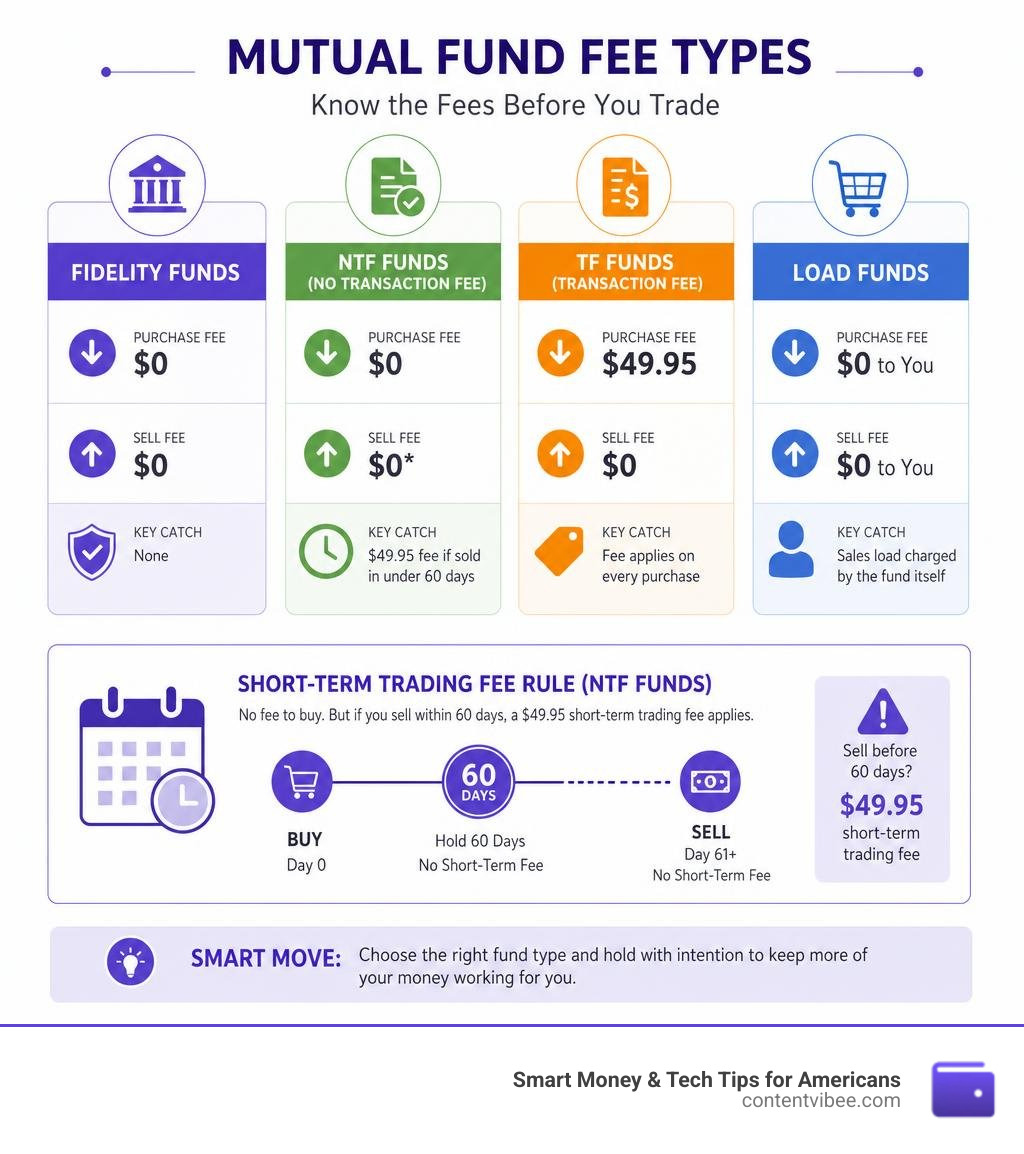
| Fund Type | Purchase Fee | Sell Fee | Key Catch |
|---|---|---|---|
| Fidelity funds | $0 | $0 | None |
| NTF (No Transaction Fee) non-Fidelity funds | $0 | $0 | $49.95 fee if sold in under 60 days |
| TF (Transaction Fee) non-Fidelity funds | $49.95 | $0 | Fee applies on every purchase |
| Load funds | $0 to Fidelity | $0 to Fidelity | Sales load charged by the fund itself |
So yes, Fidelity offers many “free” mutual fund trades. But free depends heavily on which fund you buy, how long you hold it, and how you place the trade.
For retirees and near-retirees moving money between funds — say, rebalancing a portfolio or shifting from growth to income — these fees can add up fast without much warning.
The $49.95 short-term trading fee on No Transaction Fee (NTF) funds is a common surprise. You pay nothing to buy. But sell before 60 days, and Fidelity charges you nearly $50. That’s on top of any fees the fund itself may charge.
This guide breaks down exactly how Fidelity’s mutual fund fee structure works, where the hidden costs hide, and how to keep more of your money working for you.
Glossary for mutual fund trade fee fidelity:
Understanding the Mutual Fund Trade Fee Fidelity Structure
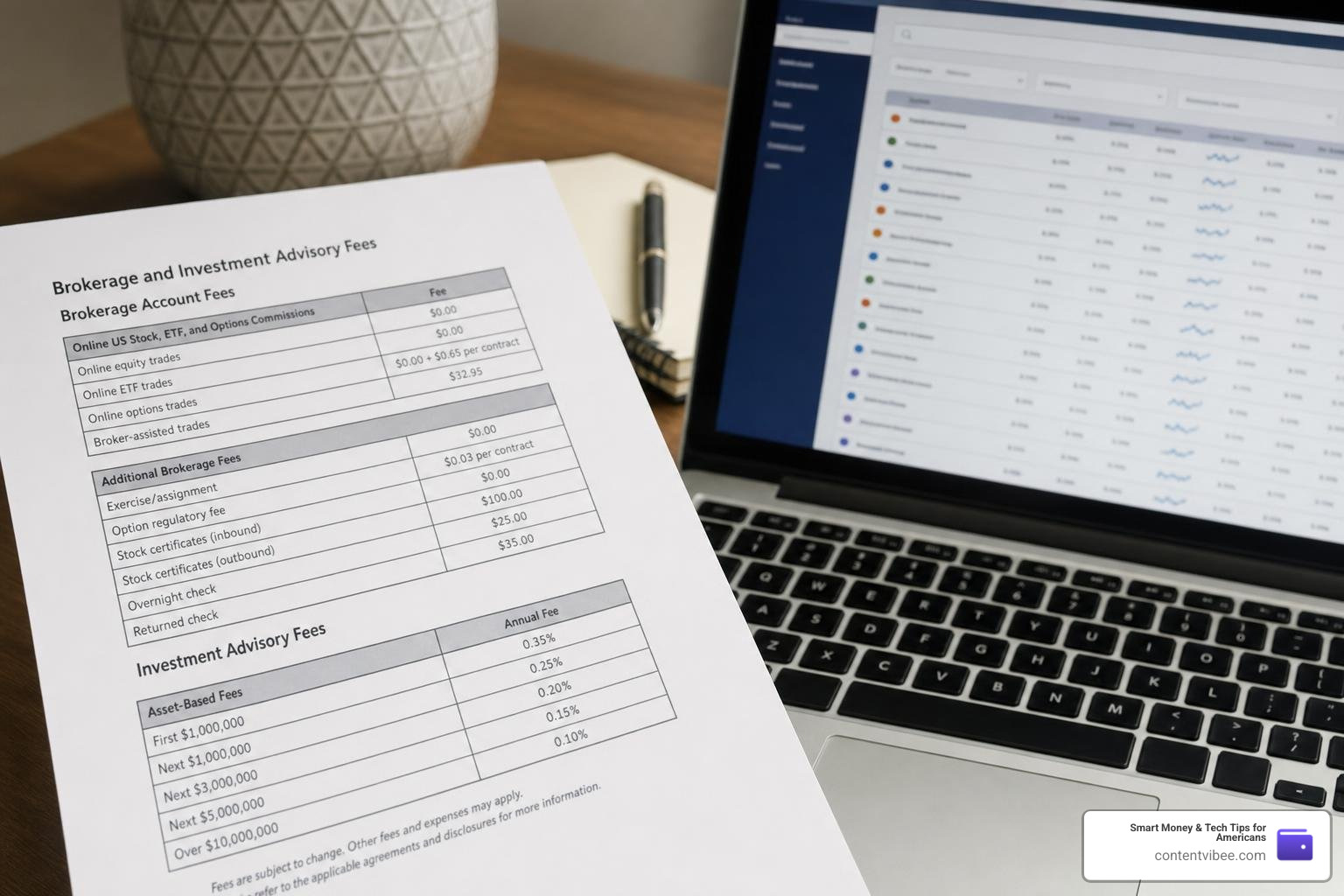
When you open a brokerage account, it is easy to get swept up in the marketing promises of “$0 commission trades.” While those promises are generally true for online U.S. stocks, ETFs, and options, mutual funds operate in an entirely different sandbox. At Fidelity, the mutual fund marketplace is managed through a platform called FundsNetwork.
FundsNetwork acts as a massive mutual fund supermarket, offering access to more than 10,000 mutual funds. However, to keep this supermarket running, Fidelity utilizes a tiered pricing structure that categorizes funds into three primary buckets: No Transaction Fee (NTF) funds, Transaction Fee (TF) funds, and Load funds.
To understand how these charges are assessed, it is highly recommended to review the official Fidelity Brokerage and Commission Fee Schedule | Trading information . Additionally, our detailed guide on the fidelity fee per trade provides an excellent baseline for understanding overall brokerage transaction costs.
No Transaction Fee (NTF) Funds and the Mutual Fund Trade Fee Fidelity Rules
The No Transaction Fee (NTF) program is incredibly popular because it allows you to buy and sell thousands of non-Fidelity mutual funds without paying a transaction fee at the time of purchase. However, “no transaction fee” does not mean these funds are entirely free.
The primary catch with the NTF program is the short-term trading fee. If you purchase shares of an NTF fund and decide to sell or exchange them within 60 days, Fidelity will charge you a flat $49.95 short-term trading fee for online trades.
Why does this fee exist? It is designed to discourage market timing and frequent trading, which can disrupt a mutual fund’s portfolio management and drive up transaction costs for all shareholders. It is important to note that this short-term trading fee is separate from any redemption fees that the mutual fund company itself might charge. To learn more about how these supermarket dynamics work, check out the Understanding FundsNetwork Fees – Fidelity Learning Center .
Transaction Fee (TF) Funds and the Mutual Fund Trade Fee Fidelity Costs
If a mutual fund is not part of the NTF program and is not a proprietary Fidelity fund, it is classified as a Transaction Fee (TF) fund. For these funds, you must pay a transaction fee when you purchase shares.
When buying a TF fund online, Fidelity charges a standard transaction fee of $49.95 per purchase. The good news is that there is generally no fee to sell or redeem shares of a TF fund.
However, if you are planning to build a position over time using dollar-cost averaging, paying $49.95 on every single purchase will quickly destroy your returns. To help mitigate this, Fidelity offers an Automatic Account Builder tool. If you set up automatic, recurring purchases of additional TF fund shares, the transaction fee drops to a much more reasonable $5.00 per purchase.
Understanding these nuances is a key part of evaluating your overall investment expenses. For a deeper dive into how transparent these costs really are, take a look at our Fidelity Cost Transparency Review.
Trading Channels and Commission Differences

How you place your trade matters just as much as what you are buying. Fidelity provides three distinct channels for placing mutual fund orders: online (via Fidelity.com, Active Trader Pro, or the mobile app), through the FAST automated telephone system, or by speaking directly with a representative.
If you are looking to keep your mutual fund trade fee fidelity costs as low as possible, online is always your best bet. However, if you prefer a human touch or need to use automated phone systems, you must be prepared for a different pricing structure. For a comprehensive overview of these service charges, refer to our guide on the broker assisted trade fee fidelity.
Online vs. FAST vs. Representative-Assisted Fees
Let’s look at how the short-term trading fees for NTF funds and transaction fees for TF funds scale depending on the trading channel you use:
- Online Trades: This is the most economical option. Purchasing a TF fund online costs $49.95. Redeeming an NTF fund held less than 60 days costs a flat $49.95.
- FAST (Fidelity Automated Service Telephone): If you use the automated phone system, the pricing shifts to a percentage of the trade’s principal. For short-term NTF redemptions, FAST trades carry a fee of 0.5625% of the principal (with a minimum fee of $75.00 and a maximum cap of $187.50).
- Representative-Assisted Trades: Speaking to a live broker is the most expensive route. If a Fidelity representative helps you execute a short-term NTF redemption, you will be charged 0.75% of the principal (with a minimum fee of $100.00 and a maximum cap of $250.00).
For standard stock and ETF trades, representative-assisted orders carry a flat surcharge of $32.95, while FAST trades carry a $12.95 surcharge. To review the complete matrix of trading channels and margin rates, visit Trading Commissions and Margin Rates | Fidelity .
Share Classes, Sales Loads, and Breakpoint Pricing
Beyond brokerage-level transaction fees, mutual funds carry their own internal fee structures. These are determined by the fund company and are detailed in the fund’s prospectus. If you buy “Load” funds on the Fidelity platform, you will not pay a transaction fee to Fidelity, but you will pay sales charges directly to the fund company.
To navigate this landscape, you must understand the difference between share classes:
- Class A Shares (Front-End Sales Loads): These funds charge a sales commission at the time of purchase. For example, if you invest $10,000 into a fund with a 5% front-end load, $500 is immediately deducted to pay the broker, and only $9,500 is actually invested in the fund. Under FINRA/NASD rules, mutual fund sales loads are legally capped at a maximum of 8.5%.
- Class B Shares (Back-End / Contingent Deferred Sales Loads): These shares do not charge a fee when you buy, meaning your full $10,000 is put to work. Instead, they charge a Contingent Deferred Sales Charge (CDSC) if you sell the shares within a certain number of years (often starting around 5% and dropping by 1% each year you hold the fund). Class B shares typically convert into lower-expense Class A shares after a set period.
- Class C Shares (Level Loads): These shares typically carry no front-end load, but they charge a continuous, higher annual operating expense (often including a 12b-1 distribution fee capped at 0.75% plus a 0.25% shareholder service fee). If you redeem Class C shares within one year of purchase, they usually impose a 1.00% CDSC.
Breakpoint Discounts
If you are investing a significant amount of money into Class A shares, you may qualify for breakpoint pricing. Breakpoints are volume discounts that lower the front-end sales load as your investment size increases.
You can qualify for these discounts through “Rights of Accumulation” (which count your existing holdings within the same fund family) or a “Letter of Intent” (where you commit to investing a certain amount over a 13-month period). To understand if you are getting a fair shake or if hidden costs are baked into these programs, read our investigative piece: Is Fidelity Actually Free Or Are You The Product.
Comparing Platform Costs with Industry Competitors
When choosing a brokerage platform, it is helpful to look at how different firms stack up on everyday administrative and account fees. Fidelity is widely regarded as one of the most cost-transparent brokers in the industry, particularly when compared to other major players like Vanguard and Charles Schwab.
Here is a direct comparison of the key platform and administrative fees you will encounter in 2026:
| Fee Category | Fidelity | Vanguard | Charles Schwab |
|---|---|---|---|
| Annual Account Service Fee | $0 | $20 (waived with $10k+ or paperless) | $0 |
| IRA Closeout / Termination Fee | $0 | $0 | $0 |
| Standard Outgoing Wire Fee | $0 | $10 – $35 (depending on asset tier) | $25 (online wires are often free) |
| Online TF Fund Purchase Fee | $49.95 | $0 (for Vanguard funds) / $50 (non-Vanguard) | $49.95 – $74.95 |
| Zero-Expense Index Funds | Yes (4 funds available) | No | No |
Fidelity’s commitment to $0 account fees and $0 wire fees gives it a distinct edge for retail investors. To see a comprehensive head-to-head analysis of these brokerage giants, check out our resource on Why The Fidelity Investments Fees Comparison.
Frequently Asked Questions About Mutual Fund Fees
How can I avoid short-term trading fees on NTF funds?
To completely avoid the $49.95 short-term trading fee on NTF funds, you must hold your shares for at least 60 days before selling or exchanging them.
Additionally, you can avoid these fees by choosing proprietary Fidelity mutual funds, which are never subject to Fidelity’s short-term trading fees (though some specialized Fidelity funds may still have fund-level redemption fees capped by the SEC at 2%). For step-by-step instructions on trading mechanics, settlement times, and cost-basis tracking, refer to the Fidelity.com Help – Trading Mutual Funds portal.
What are the zero expense ratio index funds?
Fidelity made history by introducing the industry’s first zero-expense-ratio index mutual funds directly to retail investors. These funds charge absolutely no management fees or operating expenses, meaning 100% of your money goes toward tracking the market.
The four available funds are:
- Fidelity ZERO Total Market Index Fund (FZROX)
- Fidelity ZERO International Index Fund (FZILX)
- Fidelity ZERO Large Cap Index Fund (FNILX)
- Fidelity ZERO Extended Market Index Fund (FZIPX)
These funds have $0 minimum initial investment requirements and represent an incredibly cost-effective way to build a diversified core portfolio. For details on how to access these funds and other straightforward pricing features, view Straightforward and Transparent Pricing – Fidelity .
Are there additional account maintenance fees?
For standard retail brokerage accounts and IRAs, Fidelity charges $0 in annual account maintenance fees and requires a $0 minimum initial investment.
However, investors should still be aware of circumstantial fees. While standard domestic bank wires are free at Fidelity, foreign currency wires, foreign settlement fees, and specialized paper statement fees can still apply depending on your trading activity. Always review your trade confirmation statements to ensure no unexpected fees have been assessed.
Conclusion
At Smart Money & Tech Tips for Americans, we believe that fee transparency is the single most important factor in securing your financial future. While a $49.95 fee might seem small in the grand scheme of a six-figure retirement portfolio, these costs compound over time and can quietly erode your long-term returns.
Fidelity remains an industry leader in low-cost investing, but as we have shown, “free” trades often come with strict rules. By keeping the 60-day holding period in mind for NTF funds, using automated builders for TF funds, and sticking to online trading channels, you can successfully navigate the mutual fund trade fee fidelity landscape without losing a penny to unnecessary charges.
For more strategic advice on optimizing your investment accounts and ensuring complete cost transparency, read our comprehensive Fidelity Cost Transparency Review today.


