


Are Fidelity Trades Really Free? Here’s What You Actually Pay
Understanding fidelity charges for trades is simpler than most investors expect — but there are important exceptions worth knowing before you place your next order.
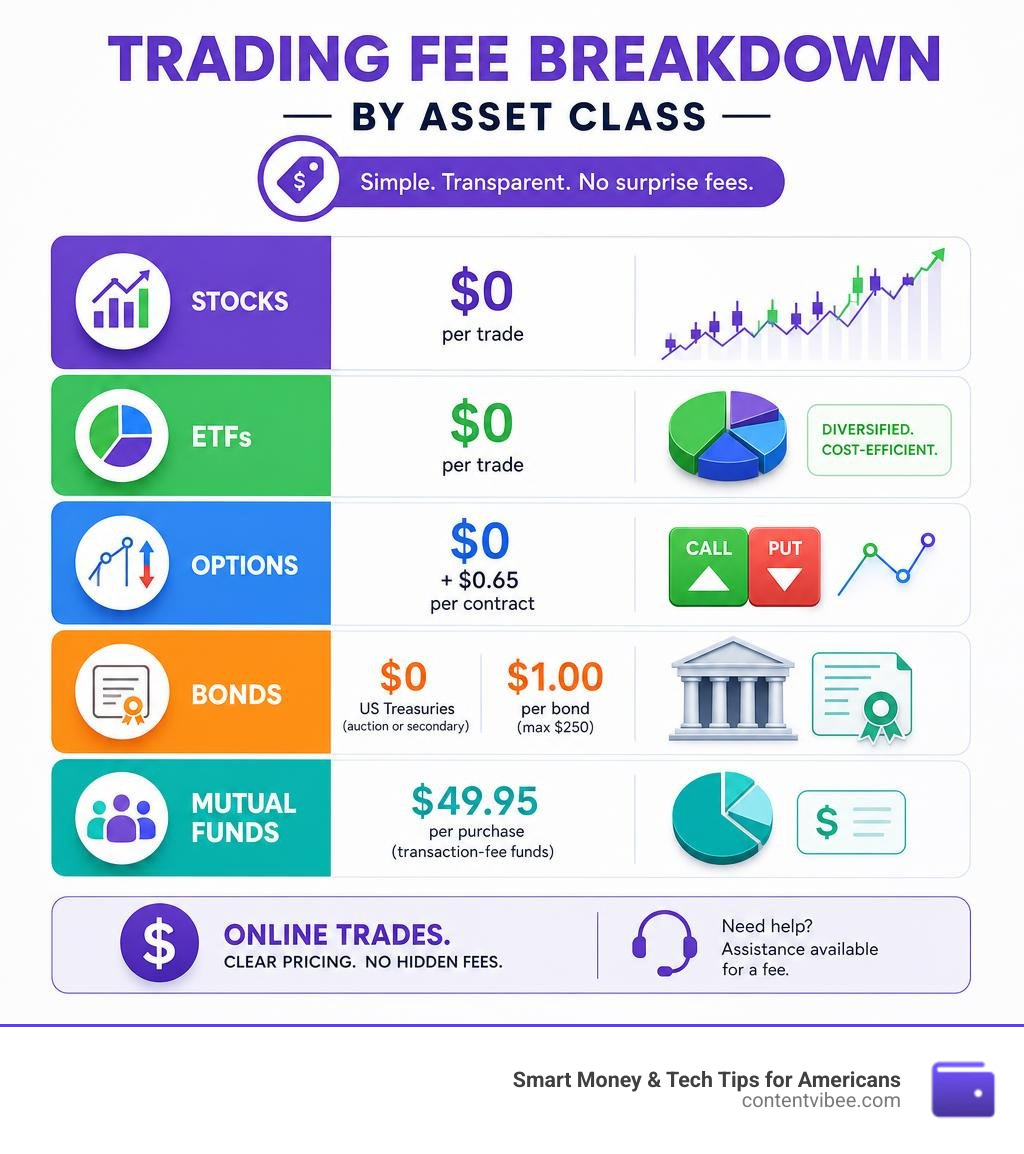
Quick answer: Here’s what Fidelity charges by trade type
| Trade Type | Online Cost |
|---|---|
| US stocks and ETFs | $0 |
| Options | $0 + $0.65 per contract |
| US Treasuries (auction or secondary) | $0 |
| Secondary market bonds/CDs | $1.00 per bond (max $250) |
| Non-Fidelity mutual funds (transaction-fee) | $49.95 per purchase |
| Certain ETFs (new June 2026 policy) | $100 per purchase |
| Phone-assisted trades (FAST) | $12.95 |
| Representative-assisted trades | $32.95 |
So yes — for most everyday stock and ETF trades, Fidelity really is free online. But free comes with asterisks.
There are contract fees, short-term redemption charges, a brand-new $100 fee on more than 120 ETFs, and margin interest rates that vary widely depending on your balance. If you’re nearing retirement and moving money around to optimize your portfolio, these fees can quietly add up in ways that aren’t obvious upfront.
This guide breaks down every fee category clearly, so you know exactly what you’re paying — and what you’re not.
Understanding How Fidelity Charges for Trades

When we look at the modern brokerage landscape, commission-free trading has become the industry standard. However, brokerages are still businesses, and they must generate revenue somehow. To understand how fidelity charges for trades, we first need to look at their broader fee philosophy.
Fidelity operates on what they describe as a transparent and straightforward pricing model. For the vast majority of retail investors trading online, the platform functions with zero-dollar commissions on U.S. stocks, exchange-traded funds (ETFs), and options trades. You can read more about this on Fidelity’s straightforward pricing model.
But how does a company with millions of clients sustain itself without these upfront commissions? The answer lies in alternative revenue streams. These include interest earned on uninvested cash balances, securities lending programs, margin interest, and payment for order flow (PFOF) practices—though Fidelity is notable for not taking PFOF on stock trades, they do receive compensation for directing options orders. This business model often prompts the question: Is Fidelity actually free? The short answer is that while the service is free for basic long-term investors, specialized activities, alternative trade routes, and specific product types carry explicit costs.
Standard Online Commissions and Fidelity Charges for Trades
For standard online self-directed accounts, the base commission rate is $0.00. This zero-commission structure applies to any number of shares or trades you make in a day, whether you are buying a single share of a blue-chip company or executing complex high-volume strategies.
Furthermore, we appreciate that Fidelity supports fractional share trading. Investors can trade fractional shares of more than 7,000 U.S. stocks and ETFs online with a minimum transaction value of just $1. This makes building a diversified portfolio highly accessible, even if you do not have thousands of dollars ready to deploy. However, keep in mind that these $0 fees only apply when you use their digital self-service platforms—such as Fidelity.com, Active Trader Pro, or the Fidelity mobile app. For a deeper look at these standard structures, check out our Fidelity fee per trade details.
Phone-Assisted and Representative-Assisted Fidelity Charges for Trades
While digital trades cost nothing, the moment you step away from your screen and ask for human assistance, the pricing structure changes dramatically. Fidelity provides two primary alternatives to online trading, both of which incur fees:
- FAST (Fidelity Automated Service Telephone): This is an interactive voice-response and touch-tone phone system. Placing a stock or ETF trade using FAST costs $12.95 per trade.
- Representative-Assisted Trades: If you prefer to speak directly with a live broker to execute a trade, the fee jumps to $32.95 per trade.
These charges exist to cover the operational costs of maintaining phone networks and paying licensed professionals to execute trades manually. For retail investors looking to keep costs to an absolute minimum, executing trades online is always the best path. You can read more about these human-assisted options in our guide on broker-assisted trade fees.
The Fine Print on Options, Mutual Funds, and ETFs

While standard equities are straightforward, derivative products and packaged funds require a closer look. If you are trading options or investing in mutual funds, you will encounter a different set of rules. You can review the complete picture on Fidelity’s trading commissions guide.
Options Contract Fees and Buy-to-Close Rules
Options trading at Fidelity features a $0.00 base commission, but you will pay a contract fee of $0.65 per contract for online trades.
There is, however, an investor-friendly exception: buy-to-close orders for options priced between $0.00 and $0.65 are commission-free. If you are closing out a low-value options position to eliminate risk, Fidelity will not charge you the $0.65 contract fee.
Additionally, options trades are subject to minor regulatory fees passed down from self-regulatory organizations (SROs). The Options Regulatory Fee (ORF) typically ranges from $0.02 to $0.04 per contract, which Fidelity passes through to customers as an Options Fee. If you want a thorough breakdown of how these costs behave in multi-leg strategies, take a look at our resource on options fees demystified.
Mutual Fund Transaction Fees and Short-Term Redemption Charges
Mutual funds are another area where pricing depends heavily on the specific fund you choose. Fidelity categorizes mutual funds into three groups:
- Fidelity Funds: There are no transaction fees to buy or sell Fidelity’s proprietary mutual funds, including their popular ZERO expense ratio index funds.
- No-Transaction-Fee (NTF) Funds: Fidelity partners with various fund families to offer thousands of third-party funds with $0 transaction fees.
- Transaction-Fee (TF) Funds: For non-Fidelity funds that do not participate in the NTF program, Fidelity charges a flat fee of $49.95 per purchase when executed online.
To prevent investors from using mutual funds for short-term trading, Fidelity enforces a short-term trading fee of $49.95 on NTF funds. If you sell shares of an NTF fund that you held for less than 60 days, this flat fee will be deducted from your transaction. We always advise long-term buy-and-hold strategies for mutual funds to avoid this penalty. For more details on navigating these charges, check out our analysis of Fidelity mutual fund trade fees.
The New $100 Service Fee on Specific ETFs
One of the most significant recent developments in fidelity charges for trades is a policy that took effect on June 1 (as of our current year, June 2026). Fidelity now charges a $100 service fee on purchase trades for more than 120 exchange-traded funds (ETFs) issued by companies that do not pay asset-based servicing fees to Fidelity.
Historically, ETF sponsors have paid brokerages behind the scenes to keep their funds commission-free for retail investors. When certain smaller or highly specialized ETF issuers declined to pay these platform support fees, Fidelity decided to pass the cost directly to the purchasing investor.
Some notable ETFs impacted by this $100 purchase charge include:
- Roundhill Magnificent Seven ETF (MAGS)
- Roundhill Generative AI & Technology ETF (CHAT)
- Dan Ives Wedbush AI Revolution ETF (IVES)
- Roundhill Innovation-100 0DTE Covered Call Strategy ETF
- Inspire 500 ETF
For a retail investor buying a few shares of a $60 ETF, a $100 purchase fee makes the trade completely impractical. If you plan to buy these specific funds, you may want to look at alternative platforms that do not impose this specific surcharge.
Margin Rates and Interest Charges
For investors who want to trade on leverage, understanding margin rates is critical. Margin rates are tiered based on your outstanding debit balance; the more you borrow, the lower your interest rate.
Fidelity’s current base margin rate is 10.575% (effective since December 12, 2025). The table below outlines the tiered pricing structure:
| Debit Balance Tier | Interest Rate Margin (vs. Base) | Effective Margin Rate |
|---|---|---|
| $0 to $24,999.99 | Base + 1.250% | 11.825% |
| $25,000 to $49,999.99 | Base + 0.750% | 11.325% |
| $50,000 to $99,999.99 | Base + 0.250% | 10.825% |
| $100,000 to $249,999.99 | Base – 0.250% | 10.325% |
| $250,000 to $499,999.99 | Base – 0.500% | 10.075% |
| $500,000 to $999,999.99 | Base – 2.075% | 8.500% |
| $1,000,000+ | Base – 3.075% | 7.500% |
While a 7.50% rate for large balances is competitive, rates for smaller balances exceed 11%. Additionally, if your account falls below maintenance requirements and triggers an automatic liquidation, Fidelity charges a $32.95 margin liquidation fee. You can review the up-to-date rates directly on Fidelity’s margin rates schedule.
Fixed Income, Foreign Stocks, and Specialized Investments
If you trade assets outside of standard U.S. equities, you will encounter distinct fee structures.
For fixed-income investors, online U.S. Treasury trades (both new issue auctions and secondary market transactions) are completely free. For other secondary market bonds and CDs, Fidelity charges $1.00 per bond online, with a maximum cap of $250 per trade. If you require representative assistance for these transactions, a $19.95 markup applies.
When trading foreign stocks, the costs depend on how the shares are settled:
- Foreign Ordinary Share Trading (Non-DTC Eligible): These trades are subject to a foreign settlement fee per transaction to cover local custodial and clearing costs.
- Currency Exchange Fees: If you trade in foreign currencies, Fidelity charges a currency markup ranging from 0.10% to 1.0% of the principal transaction value, depending on the size of the trade.
For retirement plan participants using self-directed brokerage accounts, you can find these details outlined in the Fidelity BrokerageLink commission schedule.
Account Maintenance, Service Fees, and Advisory Costs
Fidelity is highly competitive when it comes to account-level fees. Standard retail brokerage accounts and IRAs feature:
- $0 annual or monthly maintenance fees
- $0 minimum initial investment requirement
- $0 standard IRA closeout fees (though some specialized employer-sponsored plans may carry specific exit costs)
- $0 fee for domestic bank wire transfers initiated online
For managed accounts, Fidelity offers several advisory tiers:
- Fidelity Go (Robo-Advisor): This digital advisory service charges $0 for balances under $25,000. Once your balance reaches $25,000 or more, the annual advisory fee is 0.35%. You can explore how this compares to other automated platforms in our Fidelity Go robo-advisor fees guide.
- Fidelity Wealth Management: For portfolios of $500,000 or more, this service provides dedicated advisors with gross advisory fees ranging from 0.50% to 1.50%.
- Fidelity Private Wealth Management: For clients with $2 million or more, fees range from 0.20% to 1.04%.
To understand how these managed services operate under different advisory models, see our breakdown of Fidelity advisor-directed fees.
Comparing Fidelity’s Fee Structure to Other Major Brokers
To evaluate if Fidelity is the right fit, it helps to compare them to other major discount brokers like Charles Schwab and Vanguard.
| Feature / Fee | Fidelity | Charles Schwab | Vanguard |
|---|---|---|---|
| Online Stock/ETF Commission | $0.00 | $0.00 | $0.00 |
| Option Contract Fee | $0.65 | $0.65 | $0.65 |
| Standard Account Transfer-Out Fee | $0.00 | $50.00 | $0.00 |
| Annual Account Service Fee | $0.00 | $0.00 | $20.00 (waived with e-delivery) |
| Proprietary No-Expense Index Funds | Yes (ZERO Funds) | No | No |
| New ETF Service Fee ($100) | Yes (on ~120+ ETFs) | No | No |
Fidelity stands out positively by not charging account transfer-out fees, whereas Schwab charges a $50 transfer fee. Fidelity also offers the industry’s first zero-expense-ratio index funds, which Vanguard and Schwab do not match. However, Vanguard and Schwab do not currently impose a $100 purchase surcharge on the specific list of third-party ETFs affected by Fidelity’s June 2026 policy.
Frequently Asked Questions About Fidelity Trading Fees
Are there any hidden fees for trading stocks online at Fidelity?
No, there are no hidden brokerage fees for standard online U.S. stock trades. However, all sell transactions across the industry are subject to minor regulatory fees from the SEC and SROs, which Fidelity passes through as an Activity Assessment Fee (typically $0.01 to $0.03 per $1,000 of principal).
What is the short-term redemption fee for mutual funds?
Fidelity charges a flat $49.95 short-term trading fee if you sell shares of a No-Transaction-Fee (NTF) non-Fidelity mutual fund that you have held for less than 60 days. This fee is designed to discourage short-term trading of mutual fund assets.
Why does Fidelity charge a $100 fee on some ETFs?
As of June 2026, Fidelity charges a $100 service fee on purchases of more than 120 specific ETFs. This fee applies to funds from sponsors (such as Roundhill) that have declined to pay asset-based servicing fees to Fidelity to support their distribution on the platform.
Conclusion
For the vast majority of retail investors, fidelity charges for trades are exceptionally low, making it one of the most cost-effective platforms on the market today. By keeping your activity online, choosing Fidelity or NTF mutual funds, and avoiding specialized foreign transactions, you can easily maintain a high-performing portfolio with virtually zero drag from fees.
At Smart Money & Tech Tips for Americans, we encourage you to stay informed about these policy shifts so you can make the smartest decisions for your financial future. If you want to dive deeper into optimizing your trading costs, check out our comprehensive Fidelity fee per trade guide.


