


What Really Happens to Spousal Support After Age 65
Spousal support after age 65 is one of the most misunderstood areas of family law — and the confusion can cost you thousands of dollars.
Here is the quick answer most people need:
Spousal support does NOT automatically end when the paying spouse turns 65 or retires. You must go through the court to change or end payments. Until a judge approves a modification, the original order stays in force.
Here is a fast summary of what determines whether support continues, decreases, or ends:
| Situation | What Typically Happens |
|---|---|
| Payor retires at age 65 (normal retirement) | Court may reduce support based on new income |
| Payor retires early (before 65) voluntarily | Court may impute income as if still working |
| Payor’s income drops significantly at retirement | Strong grounds to petition for modification |
| Recipient remarries or becomes self-sufficient | Support may end regardless of payor’s age |
| Marriage lasted 20+ years (Canada) | Indefinite support likely under Rule of 65 |
| Payor stops payments without court approval | Legally required to keep paying — arrears accumulate |
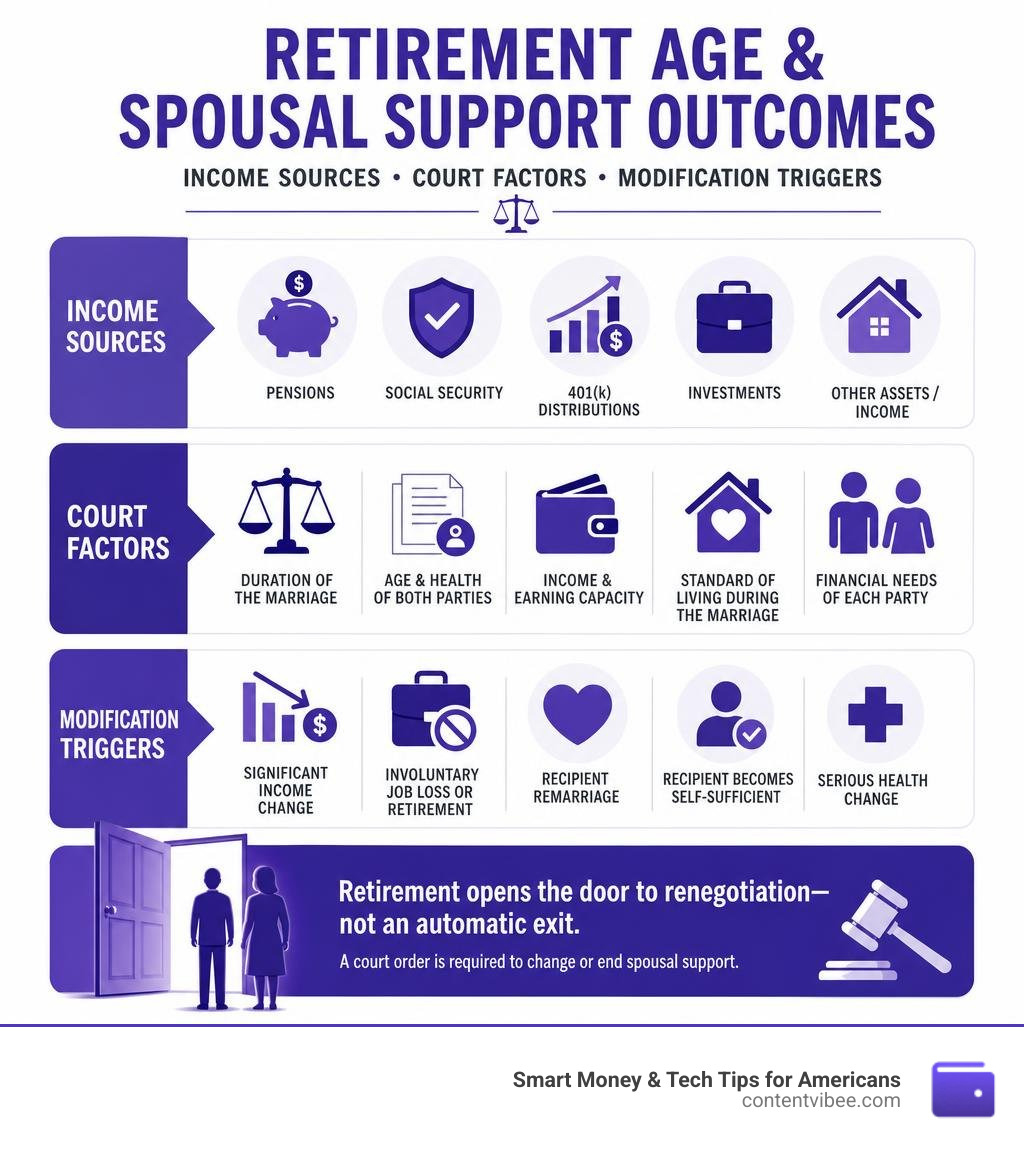
Think of retirement as opening a door to renegotiation — not an automatic exit.
Courts look at your actual income from pensions, Social Security, 401(k) distributions, and investments. They weigh that against what the recipient still needs. The answer is rarely simple, and it varies significantly by state — and country.
Consider this real-world scenario from a California appellate case: after a 37-year marriage, a 66-year-old man who lost his job following a serious health issue successfully appealed a court ruling that would have forced him to keep paying $3,500 per month in spousal support. The court held that no one can be compelled to work past the normal retirement age of 65 just to maintain a prior support level. But note — his support was reduced, not eliminated outright.
That distinction matters enormously for both payors and recipients planning their finances.
Does Spousal Support Automatically End at Retirement?
One of the most persistent myths in family law is that blowing out 65 candles on your birthday cake magically dissolves your alimony check. We hear this from worried retirees all the time. But the law does not work on autopilot.
If you have a court-ordered support agreement, it remains a binding legal contract until a judge signs off on a change. If you unilaterally decide to stop writing checks the moment you collect your first pension payment, you are setting yourself up for a legal headache. The court can hold you in contempt, garnish your bank accounts, and charge hefty interest on the arrears that accumulate.
To change or terminate your payments, you must proactively file a motion to modify the support order. The court will then evaluate whether your retirement qualifies as a valid reason to alter the original agreement. Even then, the transition must be handled carefully, as explained in recent case reviews on When Does Spousal Support End After Retirement in Ontario? .
Retirement as a Material Change in Circumstances
To modify any existing spousal support order, the spouse asking for the change must prove there has been a “material” or “substantial” change in circumstances. Under statutes like Illinois’s 750 ILCS 5/510, a major shift in employment status and income is the classic definition of a substantial change.
However, courts will scrutinize the nature of your retirement. They want to make sure it is a “good faith” retirement.
- Voluntary vs. Involuntary: If you are laid off at age 66, have health issues, or your company forces you out, courts are highly sympathetic. This is an involuntary change in circumstances.
- Good Faith: If you are healthy, in your peak earning years, and decide to retire at 55 simply to stop paying your ex-spouse, the court will likely deny your request. They will view this as a bad-faith move designed to evade your legal obligations.
Early Retirement vs. Normal Retirement at Age 65
The age at which you choose to retire plays a massive role in how a judge views your modification request.
In the United States, age 65 is generally accepted as the “normal” retirement age. Courts rarely expect a person to continue working past this milestone if they wish to retire. If you retire at 65 or older, the court will typically recalculate your support obligations based on your actual retirement income rather than what you used to make.
If you retire early (say, at age 58), the legal hurdle is much higher. Unless you have a compelling reason—such as severe health issues or a physical inability to perform your job—the court may “impute” income to you. This means the judge will calculate your support payments based on your earning capacity (what you should be making) rather than your actual retired income.
For those navigating these career transitions, we highly recommend checking out The Ultimate Guide to Working Past 65 and Beyond to understand how staying in the workforce impacts your financial and legal standing.
Navigating Spousal Support After Age 65: State-by-State Rules
Because family law is governed at the state level in the U.S., your geographic location heavily influences how your support payments are handled in retirement. There is no single federal rule for spousal support after age 65.
To show you how much these rules can vary, we have mapped out the key differences in how states handle alimony modifications at retirement:
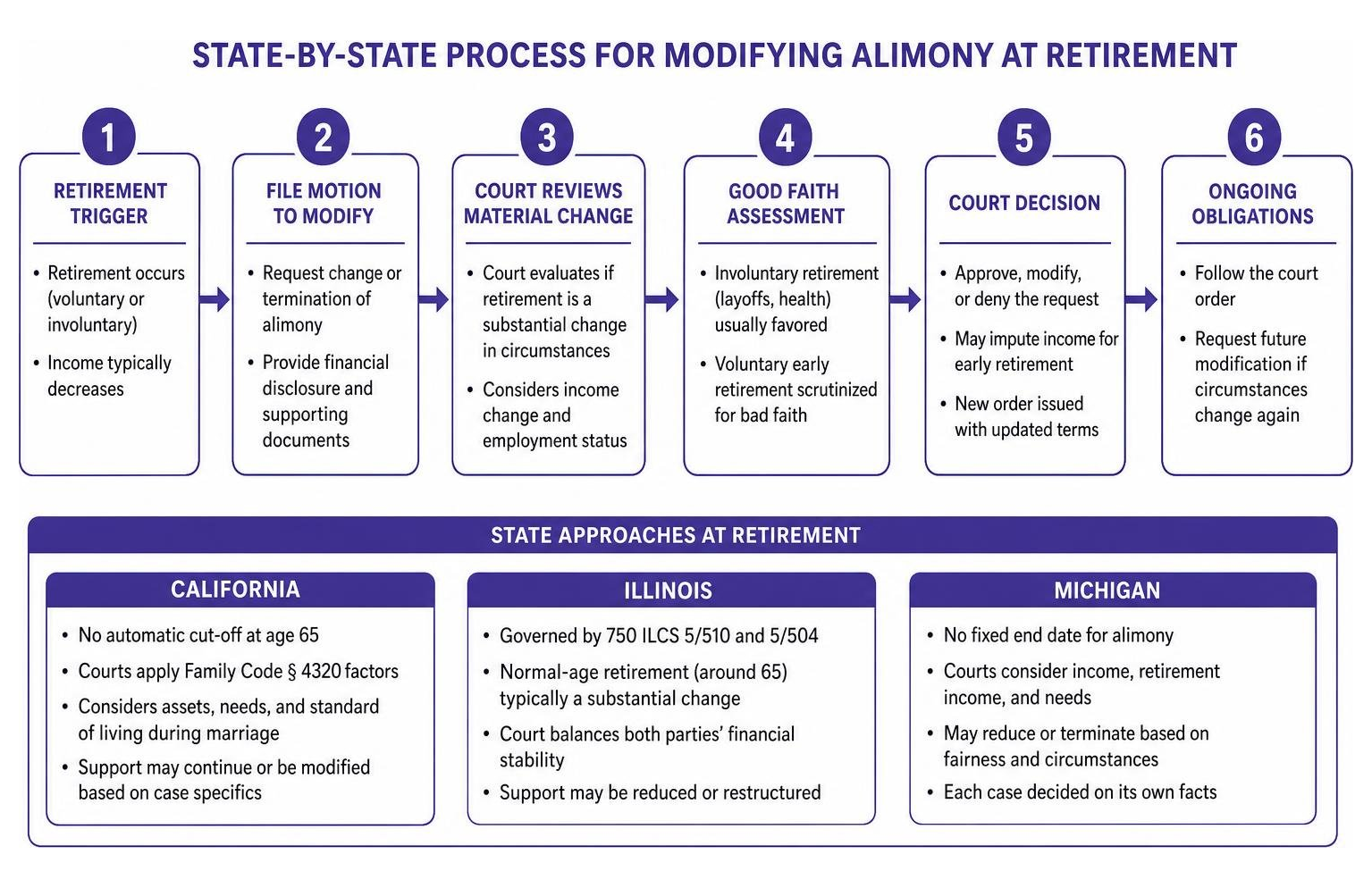
California, Illinois, and Michigan Standards for Spousal Support After Age 65
In California, judges must weigh the factors listed under Family Code Section 4320. While the state does not expect you to work past 65 to pay alimony, it also does not offer an automatic cut-off. The court will look at your assets, your ex-spouse’s needs, and the standard of living established during the marriage.
In Illinois, the court relies on 750 ILCS 5/510 and 750 ILCS 5/504 to evaluate modifications. A reduction in income due to a normal-age retirement is almost always considered a substantial change in circumstances, but the judge will perform a balancing act to ensure both parties remain financially stable.
In Michigan, even if your divorce decree labels your spousal support as “permanent,” those payments may still end or reduce significantly at retirement. This typically happens when the parties begin sharing in pension or retirement benefits that were previously divided during the property settlement phase of the divorce.
Texas, New Jersey, and Other State Variations
Texas has some of the strictest spousal maintenance rules in the country. Under Texas law, court-ordered maintenance is capped at the lesser of $5,000 per month or 20% of the payor’s gross monthly income. Furthermore, even for marriages that lasted 30 years or more, maintenance is strictly capped at a maximum of 10 years (unless a spouse cannot work due to a physical or mental disability).
In New Jersey, the law was updated to create a rebuttable presumption that alimony should terminate when the payor reaches full Social Security retirement age. However, the recipient can challenge this by proving they still have a significant financial need that outweighs the payor’s retired status.
States like Colorado and Pennsylvania use specific guidelines and statutory lists of factors—such as age, health, and independent assets—to recalculate support rather than cutting it off entirely.
The Rule of 65 and Indefinite Support in Canada
If your separation or divorce falls under Canadian jurisdiction, the rules take a very different, highly formulaic turn. Canada uses the Spousal Support Advisory Guidelines (SSAG) to determine both the amount and duration of support. One of the most famous and powerful elements of these guidelines is the “Rule of 65.”
You can read a complete breakdown of this rule in The Rule of 65 Explained: When Spousal Support Becomes Indefinite in Ontario .
How the Rule of 65 Determines Indefinite Spousal Support
Under the SSAG, spousal support usually has a time limit. However, support can become “indefinite” (meaning there is no automatic end date) if one of two triggers is met:
- The 20-Year Rule: The marriage lasted 20 years or longer.
- The Rule of 65: The marriage lasted at least 5 years, and the recipient’s age at the date of separation plus the years of marriage equals 65 or more.
For example, if a wife is 52 years old at the time of separation and the marriage lasted 15 years:
- 52 (Age) + 15 (Years of Marriage) = 67.
- Because 67 is greater than 65, she qualifies for indefinite support.
That “indefinite” does not mean “permanent” or “forever.” It simply means the order does not have a built-in expiration date. The payor can still request a review or modification when they retire, as outlined by Rule Of 65 – Finkelstein Law Corporation .
Common-Law Couples and the Rule of 65
Does this rule apply if you were never legally married? Yes. In provinces like Ontario and British Columbia, the SSAG and the Rule of 65 apply equally to common-law couples.
Instead of using the date of legal marriage, the court calculates the duration based on the consecutive years of cohabitation. Because of this, the exact date of separation becomes a highly strategic and heavily debated timeline. Moving out a few months earlier or later can be the difference between paying support for a set number of years or paying it indefinitely.
How Courts Recalculate Alimony and Pensions
When a payor reaches age 65 and requests a modification, the court does not just look at their empty paychecks. Judges will examine every dollar flowing into both households.
According to Retirement – Spousal Support Advisory Guidelines: The Revised User’s Guide , courts must carefully weigh how new retired income streams replace employment earnings.
Key Factors in Recalculating Spousal Support After Age 65
When recalculating support, the court will evaluate:
- Pensions and 401(k) / IRA Distributions: Regular payouts from retirement accounts are treated as income.
- Social Security Benefits: Both the payor’s and recipient’s Social Security benefits are factored into the new financial equation.
- Investment Income: Dividends, interest, and capital gains.
- The Recipient’s Assets: If the recipient has substantial assets or their own healthy retirement accounts, their need for ongoing support may be greatly reduced.
To help you navigate how these government benefits factor into the equation, we recommend reading our Spousal Support Social Security Guide 2026 and learning How to Claim Spousal Retirement Benefits Without Losing Your Mind.
The Boston v. Boston Principle and Preventing Double-Dipping
One of the most critical legal protections for a paying spouse’s pension is the “double-dipping” rule, established by the landmark Canadian Supreme Court case Boston v. Boston (and widely adopted in various forms across U.S. jurisdictions).
This principle is thoroughly explored in The Spousal Support Advisory Guidelines: A New and Improved User’s Guide to the Final Version | Canadian Justice Review Board .
The core idea is simple: you cannot divide an asset as property during a divorce and then count that same asset as income to calculate spousal support later.
If a husband’s pension was already divided 50/50 during the divorce, the wife has already received her share of that asset. When the husband retires, the court cannot use his remaining portion of the pension to calculate ongoing spousal support payments. Doing so would be “double-dipping” into the same asset. However, any undivided portion of the pension or new assets accumulated after the divorce are still fair game for support calculations.
Practical Retirement Planning and Legal Steps for Both Parties
Whether you are the one writing the checks or the one receiving them, retirement requires proactive planning. You should never wait until the month you retire to start thinking about how your spousal support will change.
For married or formerly married couples, understanding these rules is essential. We suggest reading Double the Fun: Understanding Your Spousal Social Security Benefits to maximize your household income streams.
How Recipients Can Plan for Potential Support Reductions
If you rely on spousal support to cover your monthly bills, you must prepare for the very real possibility that these payments will shrink or disappear when your ex-spouse turns 65.
- Assess Your Own Benefits: Find out if you qualify for benefits on your ex-spouse’s record. Read At What Age Can I Claim My Spouse’s Social Security? and our Detailed Guide to Spousal Benefits Eligibility to secure alternative income.
- Build an Independent Nest Egg: Do not treat alimony as a permanent retirement plan. Use the years leading up to age 65 to maximize your own retirement savings.
- Prepare for a Modification Challenge: If your ex-spouse files to end support, gather evidence of your ongoing financial needs, health challenges, or career sacrifices that prevent you from being fully self-sufficient.
Actionable Steps for Payors Preparing to Retire
If you are the paying spouse and plan to retire at or after age 65, follow these steps to protect yourself legally:
- Review Your Original Decree: Look for specific clauses regarding retirement. Some agreements have automatic reduction steps or explicit “review clauses” built in.
- File Early: Do not stop payments on your own. File your motion to modify support several months before your actual retirement date so the court has time to process the request.
- Provide Full Disclosure: Be ready to show proof of your retirement date, pension structures, Social Security statements, and a detailed post-retirement budget.
- Demonstrate Good Faith: If you are retiring before 65, ensure you have medical records or company layoff notices to prove your retirement is necessary and not an attempt to dodge support.
Frequently Asked Questions About Spousal Support After Age 65
Can a court force me to work past age 65 to pay alimony?
Generally, no. In the vast majority of jurisdictions (including California and Illinois), courts recognize 65 as a reasonable retirement age. A judge cannot impute your old working income to force you to stay employed past this age. However, they can still order you to pay support out of your new retirement income sources.
Does the Rule of 65 guarantee lifetime spousal support?
No. The Rule of 65 in Canada simply means your support order is “indefinite,” meaning it has no set end date. It can still be modified, reduced, or terminated if there is a material change in circumstances, such as the payor’s retirement, the recipient finding a high-paying job, or the recipient remarrying.
How does the Boston v. Boston rule protect my pension?
It prevents “double-dipping.” If your pension was already split as marital property during your divorce, the court cannot look at your half of that pension as “income” to calculate how much spousal support you must pay in retirement. It ensures that divided assets are not taxed twice for support purposes.
Conclusion
Navigating spousal support after age 65 requires balancing legal requirements with smart financial planning. At ContentVibee, we specialize in helping you make sense of complex financial transitions—whether that means adjusting to the SECURE Act 2.0’s RMD changes, managing your investment portfolio, or handling post-divorce retirement assets.
By understanding your rights, filing the correct legal petitions, and coordinating your benefits, you can transition into retirement with confidence and financial security. For more information on how to optimize your retirement income, explore our comprehensive guide on How Social Security Spousal Benefits Work for Married Couples.


