


Why Money Management for Retirees Can Make or Break Your Financial Future
Money management for retirees is one of the most important financial challenges you’ll ever face — and it’s very different from saving during your working years.
When you were working, a bad financial decision meant you had time to recover. In retirement, the stakes are higher. You’re drawing down savings instead of building them up. Markets can drop. Costs keep rising. And you might need that money to last 30 years or more.
Here’s a quick overview of the key areas to get right:
- Withdrawal rate — Start around 3.9–4% per year to avoid outliving your savings
- Social Security timing — Delaying to age 70 can increase your benefit by up to 76% compared to claiming at 62
- Investment balance — Keep enough in growth assets to beat inflation over the long run
- Healthcare costs — A 65-year-old couple may need $330,000–$345,000 just for healthcare, not counting long-term care
- Tax strategy — The order you withdraw from accounts (taxable, traditional IRA, Roth) can save tens of thousands of dollars
- Housing and lifestyle — Downsizing or relocating can free up significant cash
- Emergency planning — Keep 2–3 years of expenses in cash so you don’t sell investments during a market drop
The numbers are sobering. 45% of Americans don’t believe their savings will last through retirement. Yet research shows that people who actually calculate what they need feel far more confident — 89% of those who ran the numbers reported feeling secure about their financial future.
This guide walks you through every major decision, from withdrawal strategies to healthcare planning to Social Security timing, so you can build a plan that holds up for decades.
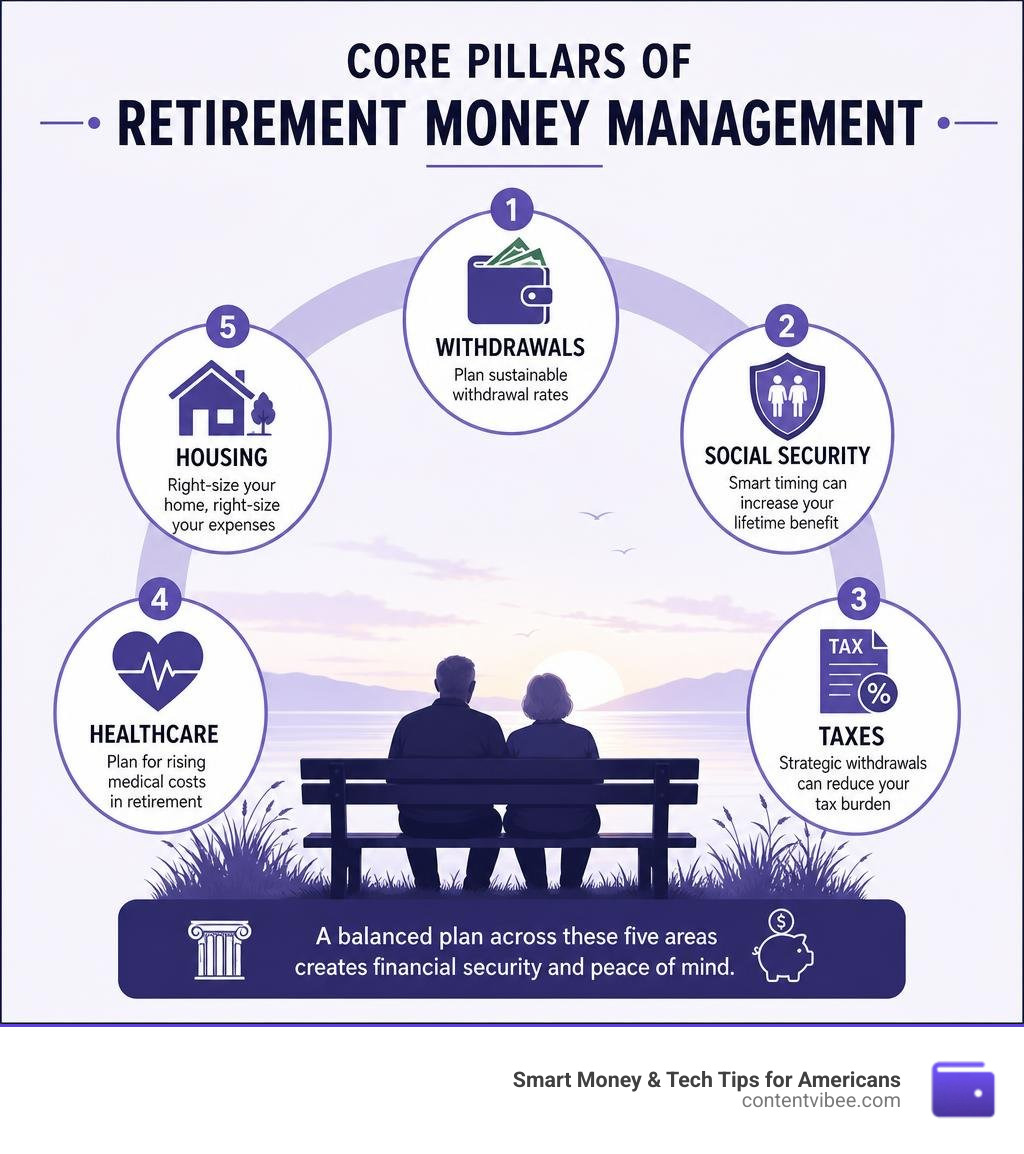
Basic money management for retirees vocab:
The Core Pillars of Money Management for Retirees
Transitioning from the accumulation phase (saving money) to the decumulation phase (spending money) is a major psychological shift. For decades, you watched your account balances grow. Now, you have to systematically dismantle those accounts to fund your daily life. To do this successfully without panic, you need a structured framework.
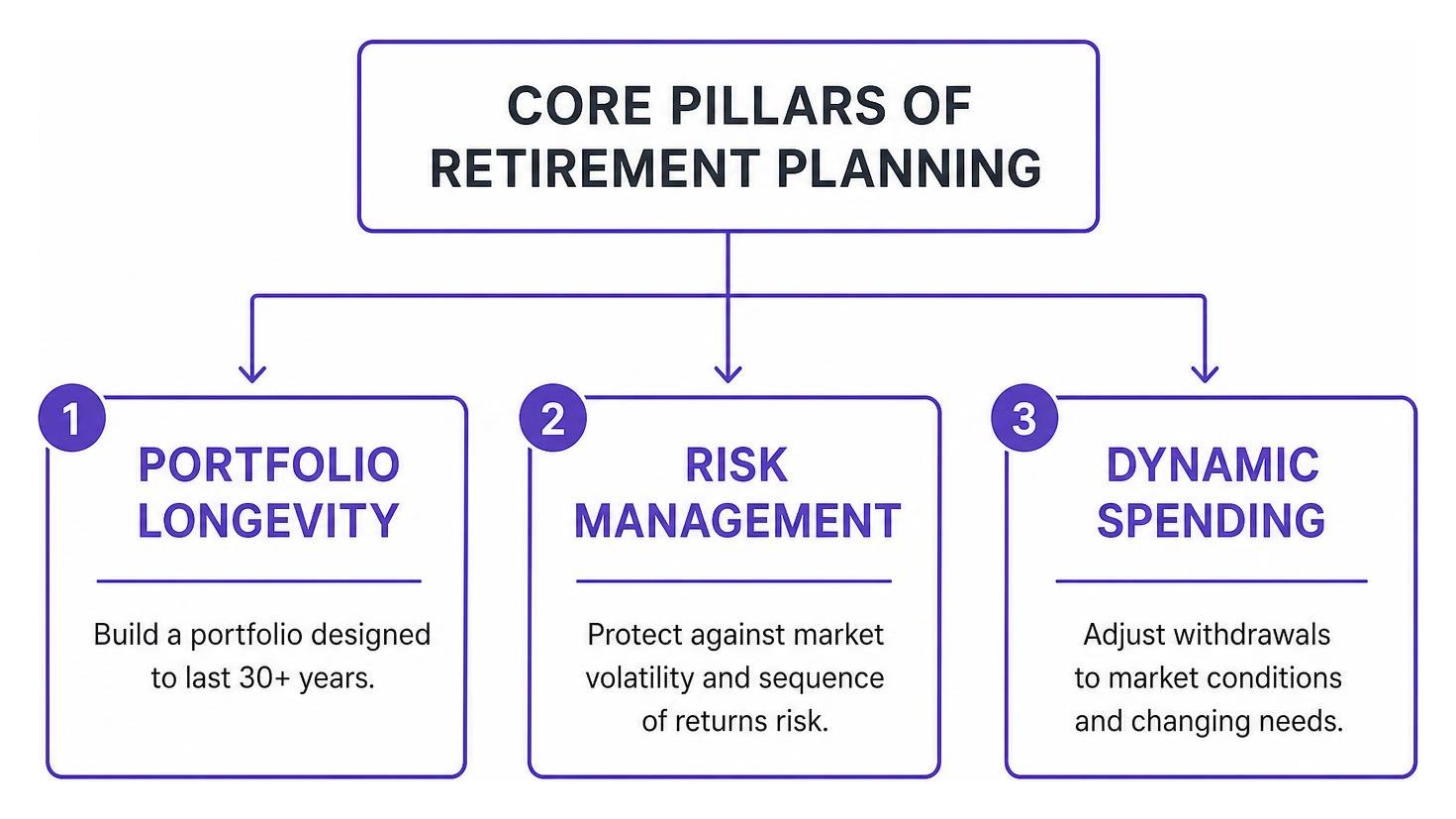
At ContentVibee, we believe that successful money management in this stage rests on understanding portfolio longevity, managing sequence-of-returns risk, and maintaining dynamic spending flexibility.
When you stop receiving a traditional paycheck, you essentially become your own payroll department. You must decide which accounts to draw from, when to trigger guaranteed income, and how to protect your nest egg from market crashes. This process is beautifully detailed in this Retirement Income Planning Guide, which outlines how to transition your hard-earned savings into a reliable, consistent stream of income.
Establishing a Sustainable Withdrawal Rate
The foundation of any retirement plan is your withdrawal rate—the percentage of your portfolio you take out each year. For decades, the “4% rule” (developed by William Bengen in 1994) was the gold standard. Under this rule, if you have a $1 million portfolio, you withdraw $40,000 in your first year of retirement and adjust that dollar amount for inflation every year thereafter. Historically, this gave portfolios a 90% chance of lasting 30 years.
However, market dynamics change. As we look at the financial landscape in July 2026, researchers and institutions like Morningstar suggest a slightly more conservative safe starting withdrawal rate of 3.9% for a 30-year horizon, assuming a balanced 30% to 50% equity allocation.
Rather than treating any percentage as a rigid law, the smartest retirees use dynamic spending rules. This means being flexible:
- If the market experiences a severe downturn, you might reduce your discretionary spending by 10% to 15% to let your portfolio recover.
- If the market performs exceptionally well, you can safely enjoy a little extra travel or lifestyle spending.
To see how these rates apply directly to your current nest egg, you can run your own numbers with our Retirement Calculator: Estimate Savings Needed.
Adjusting for Longevity and Inflation in Money Management for Retirees
One of the greatest risks retirees face is “longevity risk”—the very real possibility of outliving your money. A 65-year-old couple today has a 50% probability that at least one spouse will live past age 92, and a 25% chance one will live past 97. If you retire at 65, you must plan for your money to last 30 to 35 years.
During those three decades, inflation will silently erode your purchasing power. Consider this: a 2% rise in annual inflation can reduce the purchasing power of $1 million in cash to just $603,465 over 25 years. If inflation averages 3% or 4%, your costs will double in 18 to 24 years.
To combat this, retirees cannot afford to put all their money into “safe” assets like cash or short-term certificates of deposit (CDs). While cash feels safe today, it loses value tomorrow. You must maintain a portion of your portfolio in inflation-hedging assets, such as:
- Broad-market equities (which historically outpace inflation over long horizons)
- Treasury Inflation-Protected Securities (TIPS)
- Real estate investment trusts (REITs) or rental properties, where rental income naturally rises alongside living costs
Balancing Investment Growth with Risk Management
To survive a 30-year retirement, your portfolio must perform a delicate balancing act. It needs to grow fast enough to beat inflation, yet remain stable enough that a sudden stock market crash won’t wipe out your daily living expenses. Finding this balance requires a deeper look at risk management, as outlined in the Guide to Retirement | J.P. Morgan Asset Management .
The Three-Bucket Strategy for Liquidity
One of the most effective ways to manage risk and ease financial anxiety is the Three-Bucket Strategy. This framework divides your nest egg into three distinct “buckets” based on when you will need the money:
Bucket 1: The “Now” Bucket (Years 1–3)
- Purpose: Covers your immediate essential living expenses that aren’t met by guaranteed income (like Social Security or pensions).
- Assets: High-yield savings accounts, money market funds, and short-term Treasury bills.
- Benefit: If the stock market drops 20% tomorrow, you won’t care. You have up to three years of cash sitting safely on the sidelines, meaning you never have to sell equities at a loss to pay your mortgage.
Bucket 2: The “Soon” Bucket (Years 4–10)
- Purpose: Replenishes Bucket 1 and funds medium-term goals.
- Assets: Conservative income-producing vehicles, such as certificates of deposit (CD) ladders, short-duration corporate bonds, and dividend-paying stocks.
- Benefit: Earns a higher yield than cash while keeping volatility relatively low.
Bucket 3: The “Later” Bucket (Years 11+)
- Purpose: Long-term growth to combat inflation and ensure your money lasts decades.
- Assets: Growth equities, real estate, and diversified index funds.
- Benefit: Because you don’t need this money for at least a decade, you can patiently ride out temporary stock market downturns.
This structure protects you from sequence-of-returns risk—the danger of experiencing a major market downturn in the first few years of retirement. Selling stocks during a down market permanently reduces the size of your portfolio, making it mathematically difficult for your savings to recover. A solid cash buffer acts as your shield.
Shifting Asset Allocation as Retirement Approaches
As you transition into retirement, your asset allocation should shift from pure growth to a mix of stability and income. However, a common mistake is swinging too far into conservative investments. Shifting 100% of your portfolio into bonds and cash actually increases the risk of running out of money because your portfolio won’t grow fast enough to keep up with rising prices.
Many financial planners recommend a bond tent strategy. This involves increasing your bond allocation in the 5 years leading up to retirement to protect against sequence risk, and then gradually shifting back into a slightly higher equity allocation (50% to 60%) during retirement to maintain long-term growth.
Maximizing Income Sources and Social Security Timing
Managing your money isn’t just about spending what you’ve saved; it’s about optimizing the guaranteed income streams you’ve earned over your lifetime.

Strategic Social Security Claiming Decisions
Deciding when to claim Social Security is easily a six-figure decision. While you can claim benefits as early as age 62, doing so permanently reduces your monthly check by 25% to 30% compared to your Full Retirement Age (FRA).
Conversely, for every year you delay claiming past your FRA up to age 70, your benefit increases by approximately 8% per year.
- Claiming at 62: You receive 70% to 75% of your full benefit.
- Claiming at 70: You receive up to 124% to 132% of your full benefit.
This means delaying from age 62 to 70 can result in a 76% increase in your monthly benefit. For a worker entitled to $2,000 a month at FRA, claiming at 62 yields $1,400, while waiting until 70 yields $2,480.
Over a 20- to 30-year retirement, this decision can translate to a difference of $150,000 to over $250,000 in lifetime benefits. The break-even age for waiting until 70 is typically around age 80 to 82. If you are in good health and have a family history of longevity, delaying Social Security is one of the best ways to secure a guaranteed, inflation-adjusted income floor.
Alternative Income Streams and Bridging the Gap
If you retire before age 70 but want to delay Social Security to maximize your benefits, you may need a “bridge.” This can be funded by drawing down taxable investment accounts, working part-time, or generating rental income.
Many retirees find that “phased retirement”—working a few hours a week doing something they enjoy—keeps them mentally sharp, socially active, and financially secure. To explore creative ways to supplement your income, check out our guide on Alternative Ways to Save for Retirement That Actually Work.
Navigating Taxes and Healthcare Costs in Retirement
Many new retirees are shocked to find that their tax bills don’t simply disappear when they stop working. In fact, without careful planning, taxes and healthcare premiums can eat up a massive portion of your hard-earned savings.
For a broad look at preparing your overall retirement strategy, refer to the resources in the Retirement Planning | Preparing For Retirement guide.
Tax-Efficient Withdrawal Sequencing
The order in which you withdraw money from your accounts matters immensely. A default “traditional IRA first” strategy can push you into higher tax brackets and trigger extra charges. To keep your lifetime tax bill as low as possible, we generally recommend withdrawing in this sequence:
- Required Minimum Distributions (RMDs): You must take these first once you reach age 73 (or 75 if born in 1960 or later) to avoid massive penalties.
- Taxable Brokerage Accounts: Capital gains rates are lower than ordinary income tax rates (and can even be 0% for married couples with taxable income under certain thresholds).
- Traditional IRAs and 401(k)s: Withdrawals are taxed as ordinary income.
- Roth IRAs and Roth 401(k)s: These withdrawals are entirely tax-free and should generally be left to grow as long as possible.
To visualize the tax differences between your accounts, review this comparison:
| Account Type | Contribution Tax Benefit | Withdrawal Tax Treatment | RMD Requirements? |
|---|---|---|---|
| Traditional IRA / 401(k) | Pre-tax (reduces current income) | Taxed as ordinary income | Yes (starts at age 73 or 75) |
| Roth IRA / 401(k) | Post-tax (no immediate benefit) | 100% Tax-Free | No (for Roth IRAs) |
| Taxable Brokerage Account | None (funded with after-tax cash) | Taxed at capital gains rates (0%, 15%, or 20%) | No |
By strategically blending withdrawals from these different accounts, you can manage your taxable income and stay in lower tax brackets. You can learn more about choosing between these accounts in our The Great Retirement Debate: Roth vs Traditional 401k Calculator Guide.
Planning for Healthcare and Long-Term Care Costs
Healthcare is often the single largest wild card in retirement budgeting. Even with Medicare, out-of-pocket costs add up fast.
- Medicare Part B: The average cost is about $175 per month for most people, but high earners may pay more due to IRMAA (Income-Related Monthly Adjustment Amount) surcharges.
- Medigap Plan G: The average cost is around $124.83 per month at age 65 to help cover deductibles and copays.
But the real budget-buster is long-term care. About 70% of Americans age 65 and older will need some form of long-term care.
- The median annual cost for an assisted living facility is $54,000.
- The average annual cost for a semi-private room in a nursing facility is $111,325 (and a private room averages $108,405).
Because Medicare does not cover long-term custodial care, retirees must plan ahead. Options include purchasing hybrid long-term care insurance policies (which combine life insurance with long-term care benefits) or earmarking a portion of their home equity to fund future care.
Housing, Lifestyle, and Course-Correcting Your Plan
Your home is likely your largest asset, and how you manage it will directly affect your retirement lifestyle and financial security.
Housing Decisions and Their Financial Impact
As you plan your retirement lifestyle, ask yourself: Should we stay put, downsize, or relocate?
- Aging in Place: Staying in your current home provides comfort and familiarity, but you must budget for future accessibility modifications and ongoing maintenance.
- Downsizing: Moving to a smaller, more efficient home can slash utility bills, property taxes, and maintenance costs while freeing up equity to invest.
- Relocating: Moving to a state with no income tax or a lower cost of living can stretch your retirement dollar significantly. For example, a $1.2 million portfolio can support a much more comfortable lifestyle in Texas than in California or New York due to state tax differences.
If you have significant home equity, you might also consider a reverse mortgage as a tool to supplement your retirement income, though these require careful evaluation of fees and long-term inheritance goals. For a wonderful, candid look at both the financial and emotional realities of these choices, read Retirement 101: A Beginner’s Guide to Retirement .
What to Do If Your Savings Fall Short
If you run the numbers and realize your nest egg is smaller than you’d like, don’t panic. You have several highly effective levers to pull:
- Catch-Up Contributions: If you are 50 or older, you can contribute extra money to your 401(k) and IRA.
- Work Just One or Two Years Longer: This shortens your retirement drawdown period, allows your existing savings to grow, and increases your Social Security benefits.
- Trim the Fat: Use smart budgeting tools to identify and cut unnecessary expenses. (And while we have a guide on Smart Budgeting Apps to Keep College Students Out of Debt for your grandkids, the same principles of tracking and cutting waste apply beautifully to retirees!)
To help you identify where you stand and find the right path forward, explore our favorite Stop Guessing and Start Planning with the Best Retirement Planning Tools.
Ongoing Plan Reviews and Advisor Coordination in Money Management for Retirees
Your retirement plan is not a “set-it-and-forget-it” document. Tax laws change, markets fluctuate, and life happens. We highly recommend reviewing your financial plan at least once a year.
Working with a flat-fee, fiduciary financial advisor can help you navigate complex decisions like Roth conversions, tax-bracket management, and Medicare IRMAA limits, ensuring your money continues to work as hard as you did.
Frequently Asked Questions about Retirement Money Management
How much money does the average retiree need per month?
There is no single magic number, but most retirees need to replace 70% to 90% of their pre-retirement income to maintain their lifestyle. If you earned $8,000 a month while working, you should target a retirement income of $5,600 to $7,200 per month from all sources combined (Social Security, pensions, and portfolio withdrawals).
What is the safest investment for a retiree’s cash bucket?
For your immediate cash needs (Bucket 1), focus on safety and liquidity. The best options include high-yield savings accounts (HYSAs), U.S. Treasury bills, and short-term Certificates of Deposit (CDs). These keep your money safe from stock market drops while still earning a competitive yield to help offset short-term inflation.
How do Roth conversions help minimize taxes in retirement?
A Roth conversion involves moving money from a traditional IRA/401(k) to a Roth IRA and paying taxes on the converted amount today. This is highly effective during the “retirement tax window”—the years between when you retire and when your RMDs and Social Security benefits start. By converting money at lower tax rates now, you secure tax-free growth for the future, eliminate future RMD requirements on those funds, and protect your heirs from a large tax bill.
Conclusion
Managing your money in retirement doesn’t have to be overwhelming. By establishing a safe withdrawal rate, structuring your assets into a simple bucket strategy, and making smart, patient decisions about Social Security and taxes, you can build a financial plan that stands the test of time.
At ContentVibee, our goal is to help you cut through the noise and make smart, actionable money decisions. Take control of your retirement today by using our free Finance Calculator to model your cash flow, run tax scenarios, and ensure your nest egg keeps you comfortable for decades to come.