What Is the 2026 Max SEP Contribution? (Quick Answer)
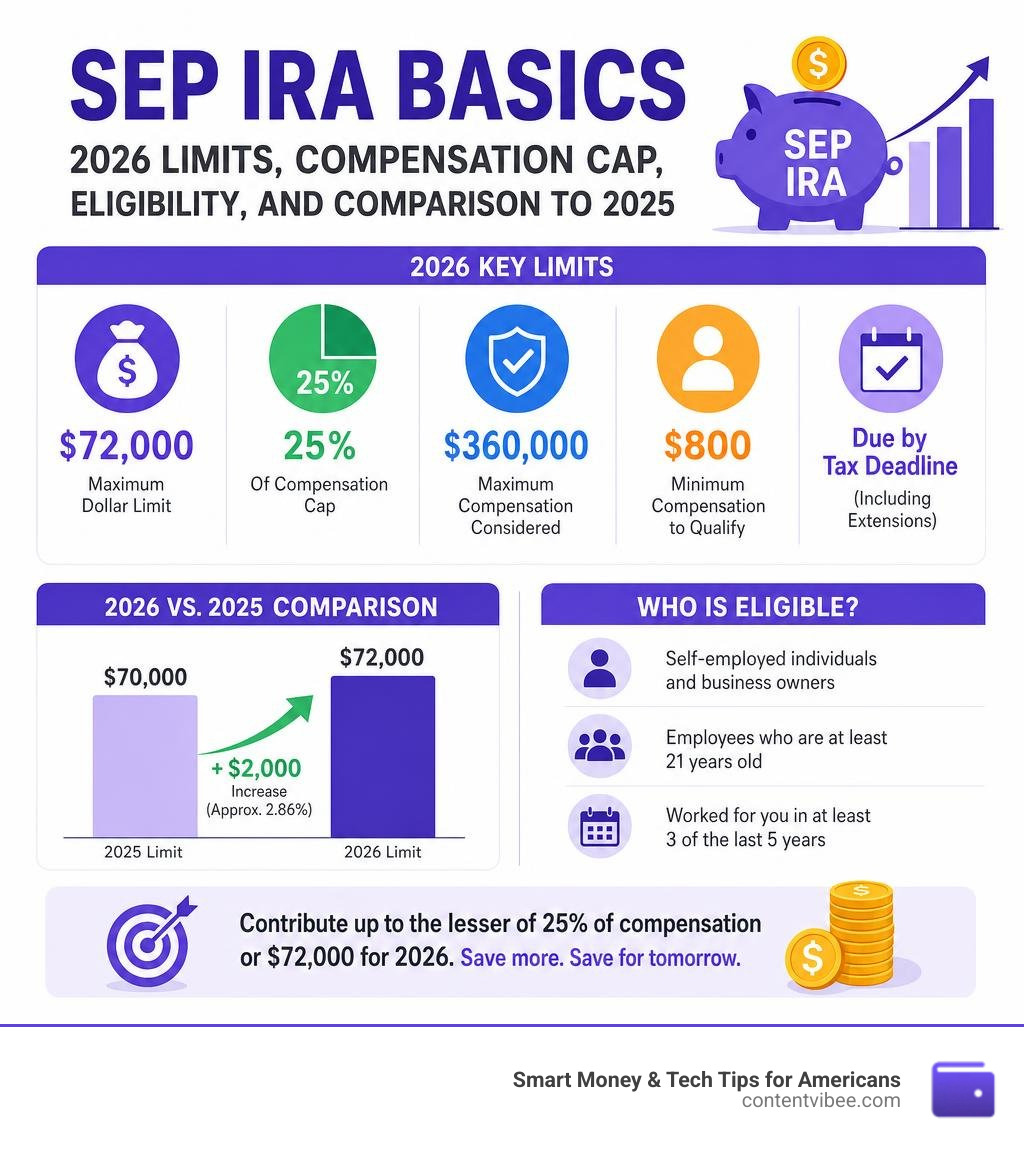
The 2026 max SEP contribution is $72,000 — or 25% of an employee’s compensation, whichever is less. This limit applies to both business owners and their eligible employees.
Here’s a fast-reference snapshot:
| Detail | 2026 Amount |
|---|---|
| Maximum dollar limit | $72,000 |
| Percentage of compensation cap | 25% |
| Maximum compensation considered | $360,000 |
| Minimum compensation to qualify | $800 |
| Prior year limit (2025) | $70,000 |
| Increase from 2025 | $2,000 (approx. 2.86%) |
If you’re a self-employed person or small business owner looking to lower your tax bill and build retirement savings, the SEP IRA is one of the most powerful tools available to you right now.
The 2026 limit jumped from $70,000 to $72,000 — a $2,000 increase driven by IRS cost-of-living adjustments. That means more room to shelter income from taxes this year.
But knowing the limit is just the starting point. How you calculate your contribution, who qualifies, and when you must fund the account can make or break your tax strategy.
This guide covers everything you need to know to take full advantage.
Discover more about 2026 max sep contribution:
Understanding the 2026 Max SEP Contribution Limits
Every autumn, the Internal Revenue Service (IRS) adjusts retirement plan limits to account for inflation. As we navigate through the 2026 tax year, these adjustments have presented business owners with an even larger tax shelter than before.
Under the official IRS guidelines, the 2026 max sep contribution is capped at the lesser of:
- 25% of the participant’s eligible compensation, or
- $72,000.
To keep high-earning individuals from receiving disproportionately massive tax-deferred benefits, the IRS also places a strict limit on the amount of compensation that can be factored into this equation. For 2026, the maximum considered compensation is $360,000.
If you earn more than $360,000, you cannot use those excess earnings to calculate your contribution. For example, 25% of $360,000 is exactly $72,000. Therefore, once your eligible compensation hits $360,000, you have maxed out your SEP IRA contribution potential for the year.
These adjustments are detailed in the official IRS cost-of-living notices, which you can explore further through the Understanding the 2026 Retirement Plan Contribution Limits — Ascensus resources.
Key Changes: 2025 vs. 2026 SEP IRA Limits
Comparing the 2026 limits to those of 2025 reveals a steady upward trend. This incremental growth is designed to protect your purchasing power in retirement against the eroding effects of inflation.
Let’s look at how the limits have evolved:
- Maximum Contribution Cap: Increased from $70,000 in 2025 to $72,000 in 2026. This represents a solid 2.86% increase, giving you an extra $2,000 of tax-deductible contribution room.
- Maximum Considered Compensation: Climbed from $350,000 in 2025 to $360,000 in 2026.
- Minimum Eligibility Compensation: Rose from $750 in 2025 to $800 in 2026. If you have part-time employees, they must earn at least $800 from your business in 2026 to be eligible for plan participation.
These official adjustments are part of the broader federal cost-of-living updates, which you can verify directly via the COLA increases for dollar limitations on benefits and contributions | Internal Revenue Service portal.
Comparing the 2026 Max SEP Contribution to Other Retirement Plans
When deciding where to park your hard-earned business revenue, it helps to see how the SEP IRA stacks up against other popular retirement vehicles. While a standard 401(k) or a traditional IRA relies heavily on employee salary deferrals, the SEP IRA is funded entirely by the employer.
Here is a side-by-side comparison of the limits for the 2026 tax year:
| Retirement Plan Type | Max Individual Contribution (2026) | Max Employer + Employee Combined (2026) | Catch-Up Contribution Allowed (Age 50+)? |
|---|---|---|---|
| SEP IRA | N/A (Employer funded only) | $72,000 | No (Except for grandfathered SARSEPs) |
| Traditional / Roth IRA | $7,500 | $7,500 | Yes ($1,100 extra, total $8,600) |
| 401(k) / Solo 401(k) | $24,500 (Salary deferral) | $72,000 ($80,000 if age 50+ with catch-up) | Yes ($8,000 extra; $11,250 for ages 60–63) |
As you can see, the SEP IRA offers an incredibly high ceiling compared to traditional IRAs. While a traditional IRA limits you to $7,500 in 2026, a SEP IRA allows you to save up to $72,000 if your business earnings support it.
Furthermore, while a Solo 401(k) offers a similar combined limit of $72,000, it comes with higher administrative burdens, such as filing IRS Form 5500 once your plan assets exceed $250,000. The SEP IRA, by contrast, requires no annual reporting to the IRS, making it the king of low-maintenance, high-yield retirement accounts.
For a deeper dive into how 401(k) limits are structured, you can read our comprehensive piece, The Ultimate Guide to Calculating Your 401k Contributions. For more context on the broader IRA and 401(k) adjustments, refer to the official statement on how the 401(k) limit increases to $24500 for 2026, IRA ….
Rules and Calculations for Self-Employed vs. Employees
One of the most critical aspects of managing a SEP IRA is understanding the relationship between employer and employee. A SEP IRA is an employer-sponsored plan. This means only the employer makes contributions. Employees cannot defer a portion of their salary into a standard SEP IRA.
If you have employees, you must follow the equal contribution rule. This rule states that if you contribute to your own SEP IRA, you must contribute the exact same percentage of compensation to the SEP IRA of every single eligible employee.
For example, if you decide to contribute 15% of your own net business earnings to your SEP account, you must also contribute 15% of each eligible employee’s compensation to their respective accounts. You cannot favor highly compensated employees or give yourself a higher percentage than your staff.
Because of this rule, SEP IRAs are exceptionally popular among sole proprietors, freelancers, and small businesses with very few or no employees. If you have a large workforce, a uniform 25% contribution can become incredibly expensive.
To optimize your business tax strategy and ensure you are choosing the right plan, check out our guide on Smart Strategies to Defer Taxes and Boost Your Retirement Savings.
How to Calculate Your 2026 Max SEP Contribution
Calculating your contribution is straightforward if you are an employee receiving a W-2. You simply multiply your gross W-2 earnings by the chosen percentage (up to 25%), ensuring the total does not exceed the $72,000 cap.
However, if you are self-employed (a sole proprietor, a single-member LLC, or a partner in a partnership), the calculation is slightly more complex. You cannot simply multiply your net Schedule C profit by 25%. Instead, the IRS requires you to calculate your contribution based on net earnings from self-employment.
To find this number, you must:
- Start with your net business profit from Schedule C.
- Subtract one-half of your self-employment tax (which is a standard deduction on Schedule 1 of your Form 1040).
- Multiply the resulting amount by an adjusted rate.
Because your retirement contribution itself reduces your net earnings, your maximum effective contribution rate is actually 20% of your net self-employment earnings (which is mathematically equivalent to 25% of your post-contribution earnings).
Let’s map out this process visually:
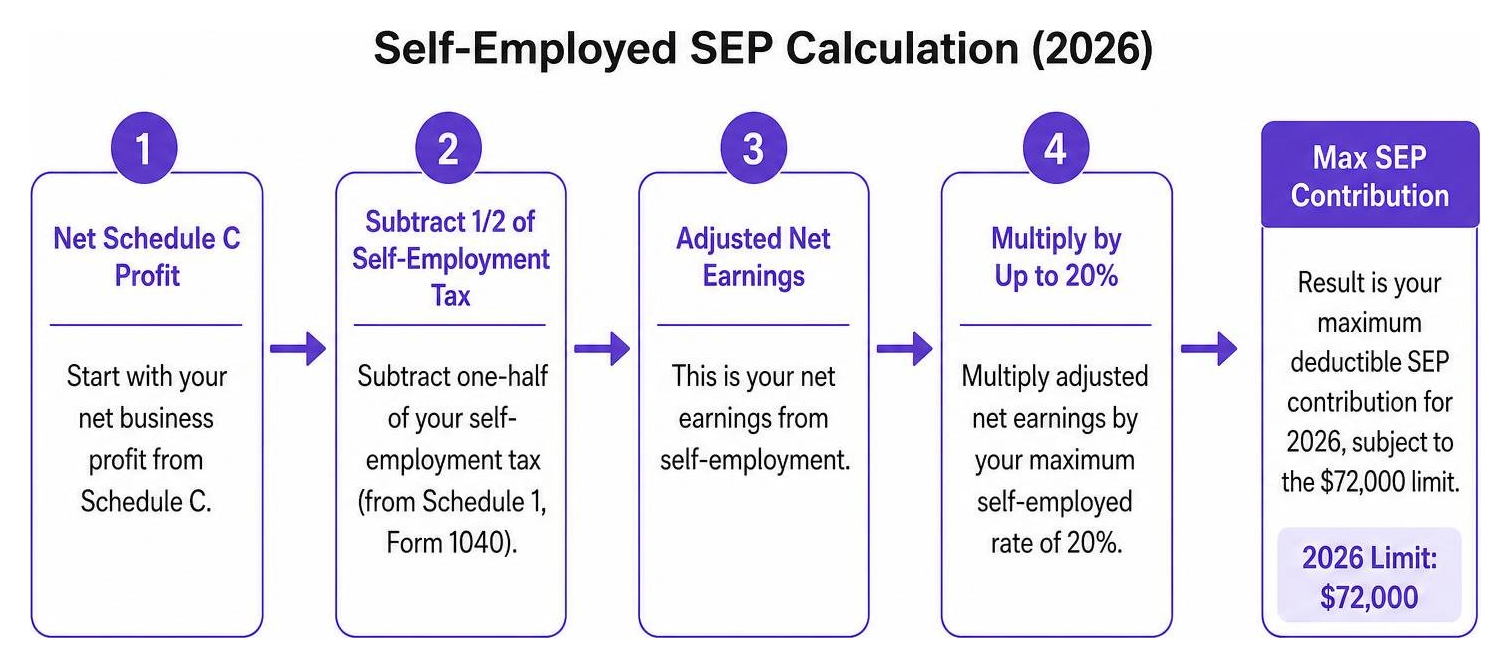
Let’s look at a quick real-world example. If your net Schedule C profit is $100,000, and one-half of your self-employment tax is $7,000, your adjusted net earnings would be $93,000. Multiplying $93,000 by your maximum self-employed rate of 20% gives you a maximum deductible contribution of $18,600 for the 2026 tax year.
For more information on maximizing your retirement accounts and navigating tax-deferred versus post-tax math, explore our resource on After-Tax Contributions: How to Maximize Your Retirement Nest Egg.
Special Rules for Grandfathered SARSEPs
Before 1997, employers could establish a variation of the SEP called a Salary Reduction Simplified Employee Pension (SARSEP) plan. While the IRS has prohibited the creation of new SARSEPs since December 31, 1996, plans established before that date are “grandfathered” and can continue to operate.
Unlike standard SEPs, SARSEPs allow employees to make voluntary salary deferrals. For the 2026 tax year, the elective salary deferral limit for a SARSEP is $24,500 (or 25% of compensation, whichever is less).
Furthermore, SARSEPs do allow catch-up contributions. If an employee participating in a grandfathered SARSEP is age 50 or older, they can contribute an additional $8,000 in catch-up deferrals for 2026, bringing their total deferral limit to $32,500.
If you operate or participate in one of these rare plans, you can review the official parameters via the IRS guide on SEP contribution limits (including grandfathered SARSEPs) | Internal Revenue Service.
Deadlines, Documentation, and Excess Contributions
Setting up and maintaining a SEP IRA requires very little red tape, but you must keep a close eye on the calendar and your documentation.

Deadlines and Setup Requirements
To establish a SEP IRA, you do not need to file any complicated paperwork with the IRS. You simply need to:
- Complete an IRS model communications form—typically Form 5305-SEP (Simplified Employee Pension-Individual Retirement Accounts Contribution Agreement).
- Provide your eligible employees with information about the plan.
- Set up a SEP IRA account for yourself and each eligible employee at a qualified financial institution.
One of the greatest advantages of the SEP IRA is its flexible setup and funding deadline. Unlike other plans that must be established by December 31 of the tax year, a SEP IRA can be established and funded as late as the due date of your business’s federal income tax return, including extensions.
This means for the 2026 tax year, if you are a sole proprietor, you have until April 15, 2027 to set up and fund your account. If you file for an extension, your deadline stretches all the way to October 15, 2027. This flexibility allows you to calculate your exact tax liability first, and then decide exactly how much to contribute to lower your tax bill.
Handling Excess Contributions
With a high contribution ceiling, it is easy to make a mathematical error and accidentally over-contribute. If you contribute more than the 2026 max sep contribution limit of $72,000 (or exceed 25% of an employee’s compensation), the IRS views the excess as an underpayment of taxes.
If you catch the error early—before your tax filing deadline—you can withdraw the excess contributions plus any earnings generated by those excess funds. The earnings will be subject to income tax in the year they are withdrawn, but you will avoid penalties on the principal over-contribution.
If you discover the error after filing your taxes, you may need to utilize the IRS Employee Plans Compliance Resolution System (EPCRS) to correct the mistake and avoid severe penalties. It is always wise to work closely with a qualified CPA or tax professional to ensure your calculations are flawless before making your final deposits.
Frequently Asked Questions about SEP IRAs
Can I contribute to both a SEP IRA and a Traditional or Roth IRA in 2026?
Yes! You can absolutely contribute to both. However, keep in mind that a SEP IRA is considered an employer-sponsored plan. Because you are an “active participant” in an employer plan, your ability to deduct contributions to a personal Traditional IRA may be limited or phased out depending on your Modified Adjusted Gross Income (MAGI).
For 2026, you can still contribute up to $7,500 ($8,600 if age 50+) to your personal Traditional or Roth IRA in addition to your SEP IRA contributions, provided you meet the standard income eligibility requirements.
Does a SEP IRA contribution reduce my self-employment tax?
No. While your SEP IRA contribution reduces your federal and state income taxes, it does not reduce your self-employment tax. Your self-employment tax (which funds Social Security and Medicare) is calculated based on your net business earnings on Schedule C before your SEP contribution is subtracted.
Nevertheless, the income tax savings alone are usually substantial enough to make the contribution highly worthwhile.
What is the minimum compensation required to be eligible for a SEP IRA in 2026?
For 2026, the minimum compensation threshold is $800. Under IRS rules, you must include any employee in your SEP plan who:
- Is at least 21 years old.
- Has worked for you in at least three of the immediately preceding five years.
- Has received at least $800 in compensation from your business during the 2026 tax year.
This “three-of-five” rule gives employers some breathing room, allowing them to exclude seasonal or short-term employees who haven’t established long-term tenure with the business.
Conclusion
Maximizing your retirement savings while keeping your tax burden low is the ultimate financial win-win. With the 2026 max sep contribution limit set at a generous $72,000, business owners have an incredible opportunity to secure their financial future while keeping more of their hard-earned revenue out of Uncle Sam’s hands.
At ContentVibee, we are dedicated to helping you make smart, actionable decisions about your money. Whether you are running a solo freelance business or managing a small team, implementing a SEP IRA is a simple, low-cost way to optimize your tax strategy.
As you plan your long-term retirement map, it is also important to understand how taxes will impact your income down the road. To get a head start on your retirement tax planning, read our guide on Uncle Sam’s Cut: Understanding Taxes on Social Security.