


What You Need to Know About Social Security Common Law Marriage
Social security common law marriage recognition can unlock thousands of dollars in spousal, survivor, and Medicare benefits — but only if you know the rules.
Here’s the short answer if you’re trying to claim benefits right now:
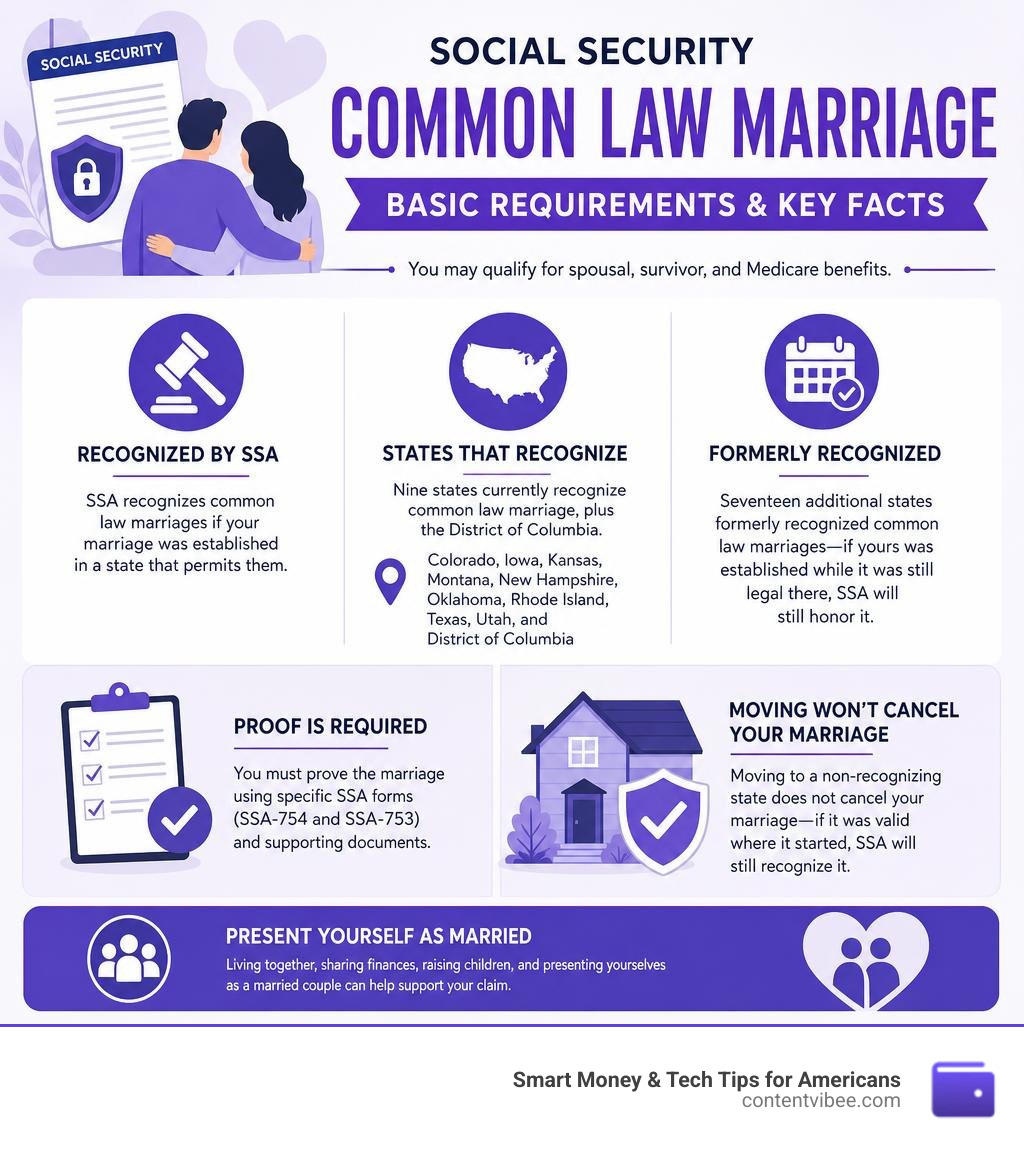
- Yes, SSA recognizes common law marriages — but only if your marriage was established in a state that permits them.
- Nine states currently recognize common law marriage: Colorado, Iowa, Kansas, Montana, New Hampshire, Oklahoma, Rhode Island, Texas, and Utah, plus the District of Columbia.
- Seventeen additional states formerly recognized common law marriages — if yours was established while it was still legal there, SSA will still honor it.
- You must prove the marriage using specific SSA forms (SSA-754 and SSA-753) and supporting documents.
- Moving to a non-recognizing state does not cancel your marriage — if it was valid where it started, SSA will still recognize it.
Many couples spend years together, share finances, raise children, and present themselves publicly as married — but never file a marriage certificate. As retirement approaches, that missing paperwork can suddenly feel very high-stakes.
The good news? A formal ceremony is not required to claim Social Security benefits. But the SSA does require clear evidence that your relationship meets the legal definition of marriage under your state’s law.
This guide walks you through exactly what you need to prove, document, and file — so you don’t leave benefits on the table.
What is a Social Security Common Law Marriage?
At its core, a common law marriage is a legally binding marriage created without a formal religious or civil ceremony. But don’t let the simplicity fool you. You cannot establish a common law marriage simply by living together for a certain number of years. That is one of the most persistent myths in personal finance!
Instead, the Social Security Administration (SSA) looks to state laws to determine if a valid non-ceremonial marriage exists. According to the SSA’s official policy outlined in SSA – POMS: GN 00305.060 – Common-Law Marriage — General, a valid common law marriage generally requires:
- Mutual Consent and Agreement: Both partners must have a present, mutual agreement to be married. This means you don’t just plan to marry in the future; you consider yourselves married right now.
- Cohabitation: You must live together as husband and wife (or spouses).
- Holding Out to the Public: You must present yourselves to your community, friends, and family as a married couple. This includes using the same last name, filing joint tax returns, or introducing each other as “my spouse.”
- Legal Capacity: Both of you must be legally free to marry. This means you are of legal age and neither of you is currently married to someone else.
Understanding these fundamentals is the first step toward securing your hard-earned benefits. If you want to dive deeper into how these rules intersect with traditional retirement plans, check out our guide on How Social Security Spousal Benefits Work for Married Couples.
State-by-State Recognition of Social Security Common Law Marriage
Because Social Security is a federal program that relies on state definitions of marriage, your geographic history matters. As of June 2026, only a handful of jurisdictions allow you to form a new common law marriage.
However, if you established a valid common law marriage in a state back when it was legally recognized, the SSA will still respect that marriage for benefit purposes today.
Here is a quick-reference table comparing the states that currently recognize common law marriages against those that formerly did:
| Currently Recognizing States (as of June 2026) | Formerly Recognizing States (with cutoff dates) |
|---|---|
| Colorado | Alabama (Before January 1, 2017) |
| Iowa | Alaska (Before January 2, 1964) |
| Kansas | Georgia (Before January 1, 1997) |
| Montana | Idaho (Before January 1, 1996) |
| New Hampshire (For inheritance/survivor purposes only) | Indiana (Before January 1, 1958) |
| Oklahoma | Ohio (Before October 10, 1991) |
| Rhode Island | Pennsylvania (Before January 1, 2005) |
| Texas | South Carolina (Before July 24, 2019) |
| Utah | Florida (Before January 1, 1968) |
| District of Columbia | And 8 other states with older cutoff dates. |
Note: In New Hampshire, common law marriage is only recognized upon the death of one of the partners for the purpose of joint property and survivor benefits.
Moving Across State Lines and Out-of-State Recognition
What happens if you establish a valid common law marriage in Texas and later pack up and move to California—a state that has never allowed couples to start a common law marriage?
Fortunately, the U.S. Constitution’s “Full Faith and Credit” clause has your back. If your common law marriage was legally valid in the state where it was contracted, other states must recognize it as valid too.
For example, the SSA legal precedent in SSA – POMS: PR 05605.006 – California – 12/19/2019 details a case where a couple lived in Texas, met all the elements of an informal marriage, and later moved to California. Because California recognizes out-of-state marriages that were validly contracted, the SSA approved the surviving spouse’s claim for widow’s benefits.
The SSA also recognizes what is called a “sojourn.” If you live in a non-recognizing state but spend a significant, continuous amount of time in a recognizing state (like traveling or working there temporarily) and hold yourselves out as married while there, you may under very specific circumstances be considered to have established a valid marriage.
Knowing these interstate rules is highly beneficial for optimizing your household’s financial future. Learn more about how location and timing affect your retirement options in The Ultimate Guide to Spousal Social Security Eligibility.
Proving Your Relationship to the SSA: Required Forms and Evidence

When you apply for benefits under a social security common law marriage, the burden of proof is entirely on you. The SSA will not simply take your word for it. You must establish the existence of your marriage by a “preponderance of the evidence.” This is a legal standard meaning your evidence must prove that it is more likely than not that you are legally married.
The administrative rules for this process are strictly laid out under federal law in 404.726. Evidence of common-law marriage.. If you are looking to claim benefits alongside your partner, understanding these evidentiary standards is crucial. You can read more about how joint claims work in our article Can a Married Couple Both Collect Social Security?.
Preferred Evidence for a Living Couple Seeking Social Security Common Law Marriage
If both you and your spouse are alive when you apply for benefits, the SSA requires specific “preferred evidence” to validate your claim. According to SSA – POMS: GN 00305.065 – Development of Common-Law (Non-Ceremonial) Marriages – 08/10/2023, you will need to submit:
- Form SSA-754-F5 (Statement of Marital Relationship): Filled out and signed independently by each spouse. On this form, you will answer detailed questions about your living arrangements, agreements, and how you present yourselves to the community.
- Form SSA-753 (Statement Regarding Marriage): This form must be completed by a blood relative of each spouse. The relative must explain in their own words why they believe you are married and confirm that you hold yourselves out as a married couple.
Completing these forms carefully is essential to avoid delays in your payouts. For a strategic look at how these forms fit into your broader spousal benefit plan, check out Double the Fun: A Guide to Social Security Spousal Benefits for Couples.
Proving Marriage After the Death of a Spouse
Proving your marriage becomes slightly more complex if your partner has passed away and you are applying for survivor benefits.
In this scenario, you must submit:
- Form SSA-754-F4: Completed by you, the surviving spouse.
- Form SSA-753 from a blood relative of yours.
- Two separate Form SSA-753s from blood relatives of your deceased spouse.
The SSA places a high value on statements from the deceased partner’s family to ensure there are no conflicting claims to the estate or benefits. For example, in Texas, the SSA will closely analyze whether the couple met the three core elements of informal marriage up until the date of death, as illustrated in SSA – POMS: PR 05110.048 – Texas – 08/04/2020.
Losing a partner is incredibly difficult, and securing survivor benefits quickly is vital for your financial peace of mind. To understand how timing affects these claims, read Social Security Spousal Benefits Timing Is Everything.
Alternative and Corroborating Evidence
What happens if you do not have the “preferred” evidence, or if the SSA requests additional proof? You should gather as much supporting documentation as possible to build a rock-solid case.
Strong corroborating evidence includes:
- Joint financial documents: Shared bank accounts, credit cards, or active investment portfolios.
- Shared property: Mortgages, property deeds, or lease agreements listing both of your names as co-owners or co-tenants.
- Insurance policies: Life, health, or auto insurance policies where one partner is named as the spouse or primary beneficiary.
- Tax filings: Federal or state joint tax returns (filing as “Married Filing Jointly” is incredibly strong proof).
- Other legal designations: Wills, powers of attorney, or healthcare proxies referring to each other as husband, wife, or spouse.
Be aware that consistency is key. In the federal ruling SSR 86-13c, a claimant’s case was denied because the couple had previously divorced and continued living together, but because they believed their original ceremonial marriage was still active, they legally could not form a “new” agreement to marry. The court ruled that without a conscious, new agreement to marry, no common law marriage existed. Keep your records clear, consistent, and continuous!
Special Rules: Same-Sex Couples, Medicare, and Divorce
As the legal landscape evolves, so do the rules governing non-traditional marriages. Whether you are navigating same-sex marriage rights, looking to enroll in Medicare, or facing a separation, specific rules apply to your social security common law marriage.
To see how these milestones fit into a holistic retirement plan, read The Smart Couples Guide to Social Security Strategies.
Medicare Eligibility and Enrollment Delays
Many people do not realize that proving a common law marriage also directly impacts your healthcare in retirement.
If you are 65 or older, you can typically delay enrolling in Medicare Part B without penalty if you are covered under a spouse’s group health plan through an employer. If you have a valid common law marriage, you are treated exactly like any ceremonially married spouse and can delay enrollment safely.
However, be careful: if your employer only covers you as a “domestic partner” rather than a legal spouse, the federal government may not recognize this for Medicare Part B enrollment delay purposes. Proving your common law marriage to your employer and the SSA ensures you avoid costly lifelong Part B late-enrollment penalties.
For more details on maximizing these benefits, read The Golden Rules: Can a Spouse Collect SS Spousal Benefits?.
Separation, Divorce, and Terminating Benefits
Here is a critical legal fact: there is no such thing as a “common law divorce.”
Once a common law marriage is legally established, it is just as valid and permanent as any ceremonial marriage. The only way to end it is through a formal, legal divorce or annulment proceeding in court.
If you separate from your common law spouse, you cannot simply walk away and claim you were never married. If you want to claim divorced spouse benefits down the road, you must show:
- Your common law marriage was legally established.
- You went through a formal legal divorce.
- Your marriage lasted at least 10 continuous years before the divorce was finalized.
Additionally, pay attention to state-level time limits. For example, as outlined in SSA – POMS: GN 00305.076 – Applying State Law Time Limits to Common-Law (Non-Ceremonial) Marriages – 08/08/2023, Texas law applies a rebuttable presumption that no marriage existed if the couple separates and does not initiate legal proceedings to prove the marriage within two years. Utah has a strict one-year limit after the relationship ends to get a court or administrative order recognizing the marriage, or else the relationship is legally treated as if it never existed.
To learn more about how dual earnings and divorce impact your final monthly check, read His, Hers, and Ours: The Ultimate Guide to Dual Social Security Benefits.
Frequently Asked Questions about Common-Law Marriage and Social Security
Navigating the bureaucratic maze of the SSA can raise plenty of questions. We have compiled some of the most common questions couples ask to help you optimize your benefits. For a deeper dive into maximizing your payouts, check out The Ultimate Guide to Social Security Benefit Optimization.
Can we claim benefits if our state doesn’t recognize common-law marriage?
For standard Title II benefits (retirement, survivor, and disability insurance), the answer is generally no—you must have lived in a state that recognizes common law marriage at some point during your relationship.
However, there is a major exception for Supplemental Security Income (SSI). Under federal law SSR 76-27 and Section 1614(d)(2) of the Social Security Act, if a couple holds themselves out to their community as husband and wife, the SSA must treat them as married for SSI purposes, regardless of whether their home state recognizes common law marriage.
Be aware that being deemed married for SSI means your partner’s income and assets will be “deemed” to you, which could lower your SSI payment or affect your eligibility.
What if we cannot get statements from blood relatives?
If your blood relatives are deceased, estranged, or simply unreachable, do not panic. You can submit a written explanation to the SSA explaining why you cannot provide Form SSA-753 from a relative.
In these cases, the SSA will accept Form SSA-753 completed by non-relatives (such as long-time neighbors, employers, or close friends) who have personal knowledge of your relationship, alongside other strong corroborating documents like joint bank statements and tax returns.
Are children of a common-law marriage eligible for survivor benefits?
Yes! Children born of a valid common law marriage are fully eligible for dependent and survivor benefits.
Even if the parents’ common law marriage is contested or fails to meet the strict state-specific time limits for spousal benefits (for example, under Texas time-limit rules), the children are still considered legitimate from birth under state law and remain eligible for child’s insurance benefits.
Conclusion
Securing your financial future through a social security common law marriage claim requires a bit of legwork, but the financial payoff can be life-changing. By understanding your state’s laws, gathering your documents, and filling out the necessary SSA forms correctly, you can confidently claim the spousal and survivor benefits you deserve.
At ContentVibee, we are dedicated to helping you navigate the complexities of retirement planning with clear, actionable advice. Don’t leave your hard-earned money to chance! Use our interactive Finance Calculator today to project your retirement income, map out your spousal benefit strategies, and build a secure, prosperous future for you and your loved ones.


