


The Rise of Working Past Retirement Age: What You Need to Know in 2026
Working past retirement age is now the new normal for millions of Americans — and the numbers prove it.
Here’s a quick snapshot of what you need to know:
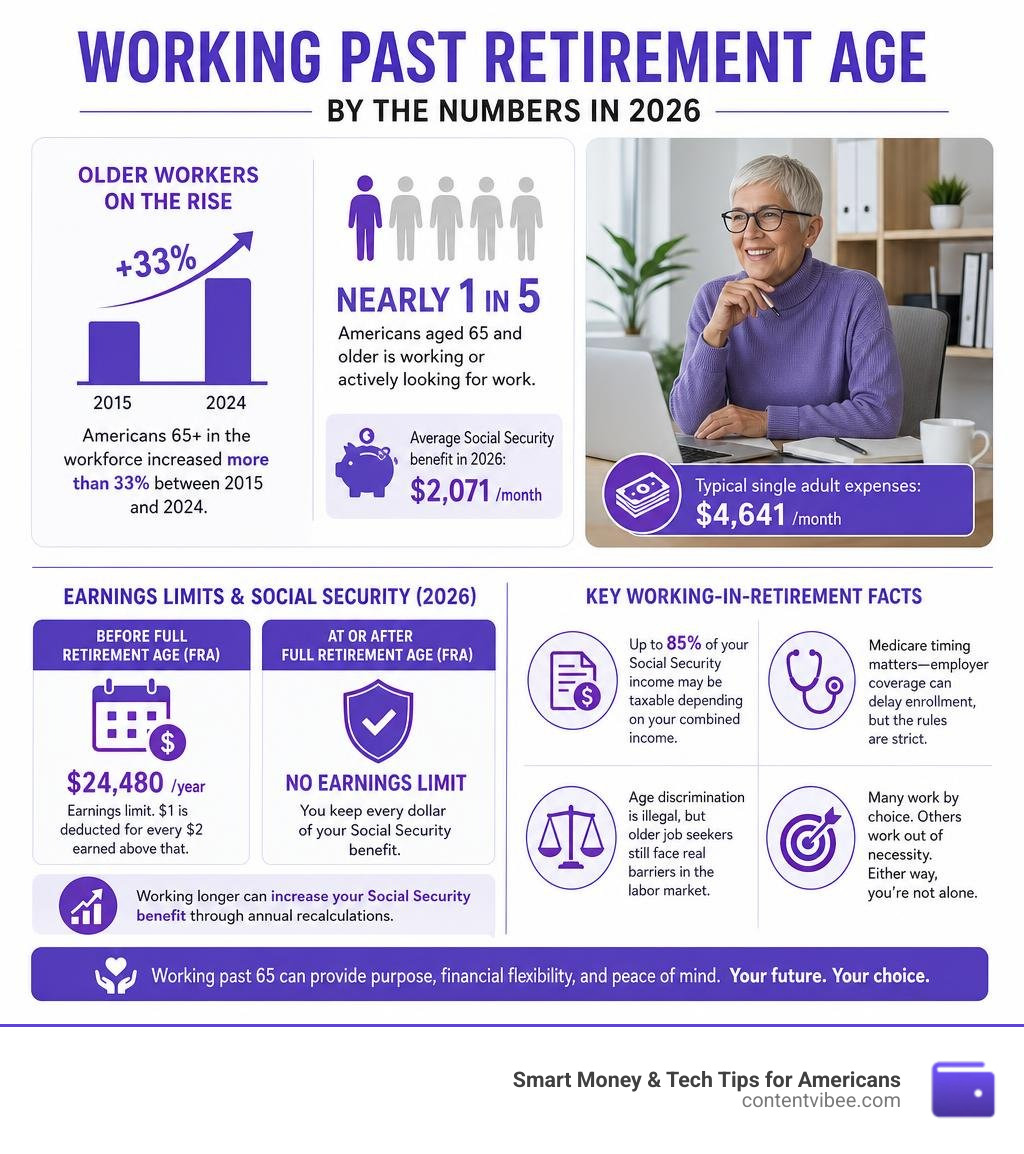
- You can work and still collect Social Security — but earnings limits apply if you haven’t reached Full Retirement Age (FRA)
- In 2026, the earnings limit before FRA is $24,480/year ($1 deducted per $2 earned above that)
- After FRA, there is no earnings limit — you keep every dollar of Social Security
- Working longer can increase your Social Security benefit through annual recalculations
- Up to 85% of your Social Security income may be taxable depending on your combined income
- Medicare timing matters — employer coverage can delay enrollment, but the rules are strict
- Age discrimination is illegal, but older job seekers still face real barriers in the labor market
The retirement landscape has shifted dramatically. In 1991, the average retirement age was just 57. Today, nearly 1 in 5 Americans aged 65 and older is still working or actively looking for work. The number of Americans 65+ in the workforce surged more than 33% between 2015 and 2024 — far outpacing overall labor force growth of less than 9% in the same period.
Some people keep working by choice. Others have no real option. With the average Social Security benefit sitting around $2,071 a month in 2026 — and the typical single adult spending roughly $4,641 a month — it’s easy to see why so many retirees find themselves heading back to work.
Whether you’re still employed and wondering how it affects your benefits, or you’re weighing whether to un-retire, this guide breaks it all down clearly.
Related content about working past retirement age:
Why More Seniors Are Working Past Retirement Age
The traditional “hard stop” at age 65 is fading fast. Instead, we are seeing retirement transform into a gradual transition, or “glide path.” But what exactly is driving this massive demographic shift?

According to comprehensive data published by the Pew Research Center, labor force participation for older adults has steadily risen over the past decade. Today, as many as 51 percent of retirement-age adults expect to work indefinitely, and roughly 1 in 4 U.S. adults over 50 say they expect to never retire at all.
While only 29% of today’s retirees do some work for pay, a whopping 75% of pre-retirees expect to work after they officially retire. In fact, a recent AARP survey revealed that 7% of retirees have re-entered the labor force in the past six months, up from 6% in the summer of 2025.
The reasons for staying in or returning to the workforce generally fall into two categories: financial necessity and personal fulfillment.
Financial Necessity and Cost of Living
Let’s face it — inflation has taken a bite out of everyone’s nest egg. Many older adults find that their retirement savings simply cannot keep up with the rising cost of everyday goods, housing, and healthcare.
As reported by CNBC on the unretiring trend, nearly half (48%) of those choosing to un-retire cite financial necessity or a poor economic outlook as their primary motivator. When Social Security only covers a fraction of basic living expenses, bringing home a paycheck becomes a straightforward way to bridge the gap.
Longevity and Portfolio Protection
We are living much longer lives than previous generations. A 65-year-old man today can expect to live to 82.5 on average, while a 65-year-old woman can expect to live past 85. Planning for a retirement that could easily last 30 years requires a massive amount of capital.
By working past retirement age, you can protect your investment portfolio. Every dollar you earn from a part-time job or consulting gig is a dollar you don’t have to withdraw from your 401(k) or IRA. This gives your investments more time to compound and grow, ensuring you don’t outlive your money.
Mental Sharpness and Social Connection
It’s not all about the money, though! Many older adults continue working because they genuinely love what they do. Work provides structure, a sense of identity, and regular social interaction.
Leaving the workforce abruptly can sometimes lead to isolation and cognitive decline. Staying employed keeps your mind sharp, your social calendar full, and your body active. If you want to dive deeper into how work keeps you young, check out our guide on Why Seniors Are Staying in the Workforce.
How Working Affects Your Social Security Benefits
One of the most common questions we get at ContentVibee is: “Can I collect my Social Security benefits while I’m still working?”
The short answer is yes. However, if you are working past retirement age and claim benefits before you reach your Full Retirement Age (FRA), your earnings could trigger the Social Security administration to temporarily withhold a portion of your monthly checks.
To understand how this works, we must look at the official rules outlined by the Social Security Administration (SSA). The SSA uses an “earnings test” to determine if your benefits should be reduced based on your earned income.
| Your Age in 2026 | 2026 Annual Earnings Limit | Benefit Reduction Rule |
|---|---|---|
| Under Full Retirement Age (All Year) | $24,480 | $1 withheld for every $2 earned over the limit |
| The Year You Reach Full Retirement Age | $65,160 | $1 withheld for every $3 earned over the limit (only counts earnings before your birthday month) |
| At or After Full Retirement Age | No Limit | No benefit reductions, regardless of how much you earn |
If you want to avoid these reductions entirely, we highly recommend reading our detailed breakdown on How to Avoid the Dreaded Social Security Earnings Limit Penalty as well as The Ultimate Guide to the Earnings Test.
The Financial Impact of Working Past Retirement Age Under FRA
If you choose to claim Social Security early and continue working, you need to keep a close eye on your “earned income.”
For 2026, the annual earnings limit is $24,480. If you earn even one dollar over this limit, the SSA will withhold $1 of your benefits for every $2 you earn above the threshold.
What counts as earned income?
- Wages from an employer (gross wages)
- Net earnings from self-employment
- Bonuses, commissions, and accrued vacation pay
What does NOT count as earned income?
- Pension payments or annuities
- Investment income, dividends, and capital gains
- Interest earned on savings accounts
- Government or military veteran benefits
If your benefits are withheld under this rule, don’t panic! The money isn’t gone forever. Once you reach your Full Retirement Age, the SSA will recalculate your monthly benefit upward to account for the months they withheld your checks.
Maximizing Benefits When Working Past Retirement Age After FRA
Once you blow out the candles on your Full Retirement Age birthday (which is between age 66 and 67, depending on your birth year), the handcuffs come off. You can earn millions of dollars at your job, and the SSA will not withhold a single penny of your retirement benefits.
In fact, continuing to work after reaching FRA can actually increase your monthly checks in two ways:
- Benefit Recalculation: The SSA calculates your benefit using your highest 35 years of indexed earnings. If your current salary is higher than one of your earlier working years, the SSA will automatically replace the lower-earning year, boosting your monthly payout.
- Delayed Retirement Credits: If you decide to delay claiming your Social Security benefits past your FRA while you continue working, your future benefit will increase by 8% for each year you delay, up to age 70.
Tax Implications and Healthcare Coordination for Older Workers
Earning a paycheck while collecting retirement benefits can introduce some unexpected financial twists, particularly when it comes to your tax bill and health insurance.

The Taxability of Social Security Benefits
Many seniors are shocked to find out that Uncle Sam can tax their Social Security benefits. Whether your benefits are taxed depends on your “combined income” (which is your Adjusted Gross Income + nontaxable interest + half of your Social Security benefits).
- If you file as an individual and your combined income is between $25,000 and $34,000, you may pay income tax on up to 50% of your benefits. If it’s above $34,000, up to 85% of your benefits may be taxable.
- If you file a joint return and your combined income is between $32,000 and $44,000, you may pay tax on up to 50% of your benefits. Over $44,000, up to 85% may be taxable.
As highlighted in an article by AOL on why retirees return to work, failing to plan for these tax brackets can quickly wipe out the financial advantages of taking on a post-retirement job. Always speak with a tax professional before deciding how much to work.
Coordinating Medicare and Employer Health Insurance
When you turn 65, you become eligible for Medicare. However, if you are still working and receive health insurance through your employer (or your spouse’s employer), you have some decisions to make:
- Large Employers (20+ employees): Your employer’s group health plan is primary, and Medicare is secondary. You can usually delay enrolling in Medicare Part B and Part D without facing late-enrollment penalties.
- Small Employers (Under 20 employees): Medicare is primary. You must enroll in Medicare Part A and Part B when you turn 65, or you could face permanent coverage gaps and premium penalties.
- Health Savings Accounts (HSAs): Be careful! Once you enroll in any part of Medicare (including premium-free Part A), you can no longer contribute tax-free dollars to a Health Savings Account (HSA).
Navigating Retirement Accounts, Pensions, and Estate Planning
As you blow past age 65, managing your retirement accounts and estate plans requires a bit of strategic finesse.
Required Minimum Distributions (RMDs)
Even if you are still working, the IRS eventually forces you to start taking withdrawals from your tax-deferred retirement accounts, such as traditional IRAs and 401(k)s. In 2026, the age to begin taking these Required Minimum Distributions (RMDs) is 73.
However, there is a handy loophole known as the “still-working” exception. If you are still employed at age 73 and you do not own more than 5% of the company you work for, you can delay taking RMDs from your current employer’s 401(k) plan until you actually retire. This exception does not apply to your traditional IRAs or 401(k) plans from previous employers.
Pension Offsets and Working
If you are lucky enough to have a traditional pension, you need to check your plan’s specific rules before returning to work. Some pension plans will suspend or reduce your monthly payouts if you return to work for the same employer or within the same industry.
To learn more about how to navigate these specific employer rules, read our comprehensive guide: Do You Have to Be Retired to Collect a Pension?.
Estate Planning and Incapacity
Working longer means you are continuing to build wealth, which makes your estate planning even more critical. Ensure you have updated your will, designated beneficiaries on your retirement accounts, and established a financial power of attorney and healthcare proxy. These legal documents ensure that if you experience a sudden health crisis while still employed, your trusted loved ones can manage your affairs without delay.
Overcoming Challenges and Finding the Right Post-Retirement Job
While the benefits of working in your golden years are clear, the road isn’t always smooth. Older job seekers frequently face systemic barriers, including age discrimination.
According to a report by PBS NewsHour on older workers, society often sends mixed signals — praising seniors for staying active, while simultaneously criticizing them for “holding onto jobs” that younger generations want.
To bypass these hurdles, many seniors are turning to highly flexible, independent, or remote work options.
Great Post-Retirement Job Fields
If you’re ready to jump back into the workforce on your own terms, you don’t have to settle for stocking shelves (unless you want to!). Here are some fantastic paths to consider:
- Consulting: Leverage your decades of industry expertise by offering project-based consulting. To get started, read How to Work on Your Own Terms with Post-Retirement Consulting.
- The Gig Economy: Drive, deliver, or complete local tasks on a schedule that fits your life. See our tips on How to Master the Gig Economy in Retirement.
- Bridge Jobs: Take a lower-stress, part-time position in an entirely new field to ease your transition out of full-time work. Check out Bridge Jobs to Help You Ease into Retirement.
- Remote Work: Avoid the commute altogether by looking into customer service or digital marketing. Learn more with our guides on Remote Retirement Customer Service Jobs and The Best Retirement Jobs for Seniors to Stay Active and Earn.
Frequently Asked Questions about Working in Later Life
Can I work and collect a pension at the same time?
Yes, in most cases you can. However, if you return to work for the same employer who pays your pension, they may suspend your benefits during your employment. If you work for a completely different company, your pension is generally safe. Always check your pension administrator’s guidelines first.
Does working past 65 increase my future Social Security benefits?
Yes, it can. Since Social Security is calculated using your highest 35 years of earnings, any high-earning years you accumulate now can replace lower-earning years from your youth, resulting in a permanent benefit increase.
How does working affect my Medicare premiums?
If your post-retirement job pushes your income above certain thresholds ($106,000 for single filers or $212,000 for joint filers in 2026), you may be subject to the Income Related Monthly Adjustment Amount (IRMAA). This is a surcharge that increases your monthly Medicare Part B and Part D premiums.
Conclusion
Whether you are working past retirement age to keep up with the cost of living, protect your retirement portfolio, or simply keep your mind active, navigating this landscape requires careful planning. From Social Security earnings tests to tax brackets and Medicare coordination, every decision you make impacts your bottom line.
At ContentVibee, we are dedicated to providing you with clear, actionable advice to help you maximize your benefits and secure your financial future in 2026 and beyond.
Before you take on that new job, make sure you understand how your income could affect your household’s overall benefits. Read our crucial guide on Working in Retirement: Are Spousal Benefits Reduced by Working? to ensure your family’s financial plan remains completely secure.