


Why Social Security Taxable Income Catches So Many Retirees Off Guard
Social Security taxable income is something roughly half of all Social Security recipients deal with — yet most people are surprised when their benefits show up on a tax bill.
Here’s the quick answer:
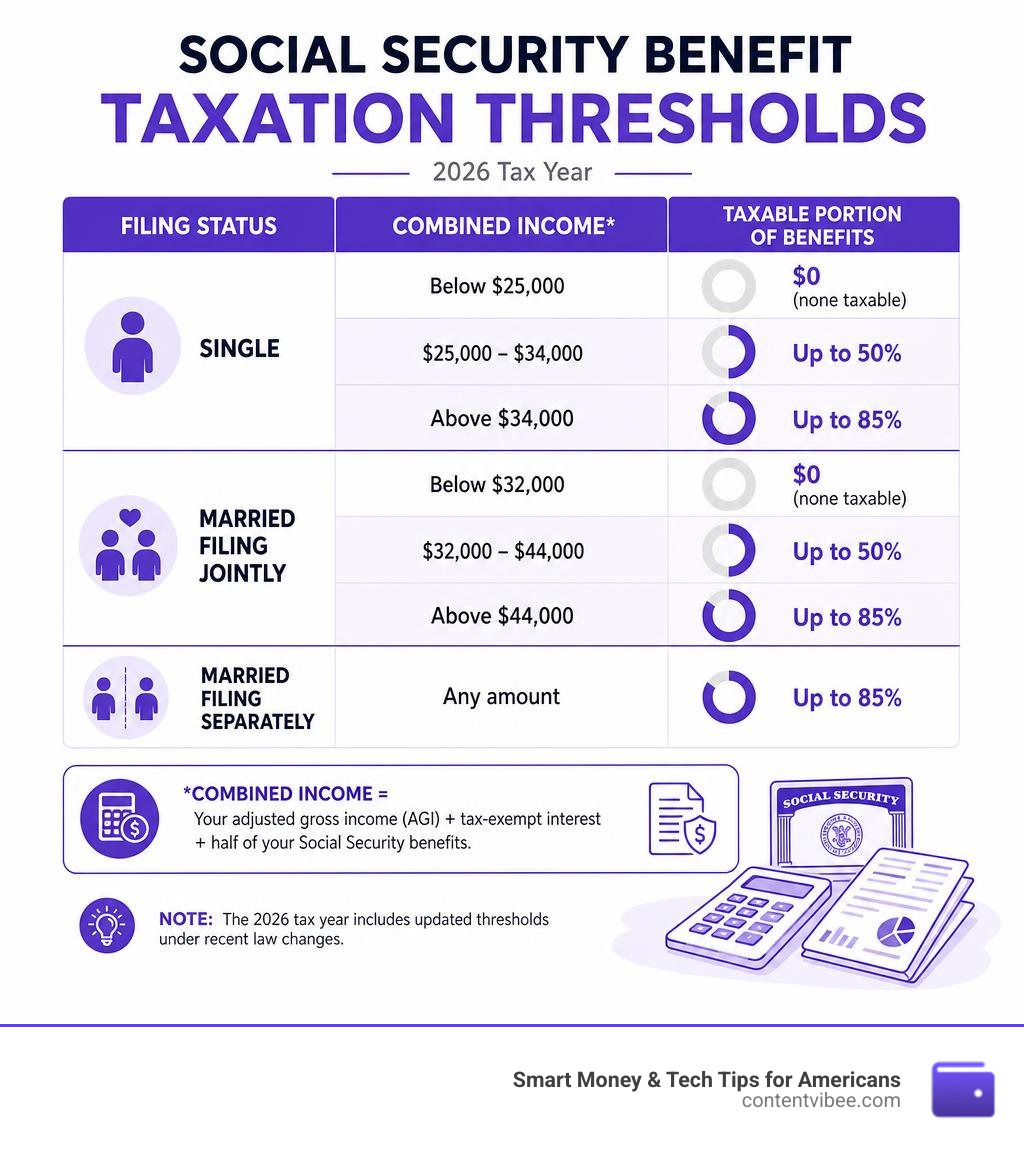
How much of your Social Security benefit is taxable?
| Your Filing Status | Combined Income | Taxable Portion of Benefits |
|---|---|---|
| Single | Below $25,000 | $0 (none taxable) |
| Single | $25,000 – $34,000 | Up to 50% |
| Single | Above $34,000 | Up to 85% |
| Married Filing Jointly | Below $32,000 | $0 (none taxable) |
| Married Filing Jointly | $32,000 – $44,000 | Up to 50% |
| Married Filing Jointly | Above $44,000 | Up to 85% |
| Married Filing Separately | Any amount | Up to 85% |
Combined income = your adjusted gross income (AGI) + tax-exempt interest + half of your Social Security benefits.
Note: The 2026 tax year includes updated thresholds under recent law changes — covered in detail below.
The surprise hits hardest for people who are still working, drawing a pension, or taking IRA withdrawals on top of their benefits. Add a spouse’s income into the mix, and suddenly a large share of your benefits become taxable — sometimes pushing your effective marginal tax rate well above your normal bracket.
In fact, people in the 22% federal tax bracket can face marginal rates as high as 40.7% once Social Security taxation is factored in. That’s not a typo.
This guide breaks down exactly how the rules work, what’s changed in 2026, and what you can do about it.
Social Security Taxable Income terms explained:
What is Social Security Taxable Income and How is it Calculated?
Calculating your Social Security taxable income is not as straightforward as looking at your tax bracket. The IRS uses a unique metric called “provisional income” (also known as “combined income”) to determine if your benefits are taxable and, if so, how much of them will be subject to ordinary income tax.
Many retirees mistakenly believe that if their income is modest, their benefits are completely safe from Uncle Sam. While that is true for low-income households, even a small amount of extra income can cross the threshold. When this happens, a portion of your monthly benefit is treated as taxable income, meaning it is added to your tax return and taxed at your ordinary marginal tax rate.

To understand how the federal government evaluates your retirement income, let’s look at how the tax thresholds have shifted. For decades, the income thresholds for taxing benefits remained completely frozen, leading to more and more retirees paying taxes each year due to inflation. However, under the 2026 tax law changes, these thresholds received a major update to help ease the burden on seniors.
| Filing Status | Historic 0% Threshold | New 2026 0% Threshold |
|---|---|---|
| Single Filers | $25,000 | $34,000 |
| Married Filing Jointly | $32,000 | $54,000 |
These updated 2026 thresholds have significantly reduced the tax burden for millions of retirees, saving single filers an estimated $800 to $2,400 annually, and married couples between $1,200 and $4,100.
Defining Combined Income for Social Security Taxable Income
Your combined income is the specific formula the IRS uses to see where you fall on the taxation ladder. It consists of three parts:
- Your Adjusted Gross Income (AGI): This includes your wages, pension payments, traditional IRA withdrawals, 401(k) distributions, taxable interest, capital gains, and dividends.
- Your Tax-Exempt Interest: Even though municipal bond interest is exempt from federal income tax, the IRS still forces you to add it back into your provisional income calculation.
- One-Half (50%) of your Social Security benefits: Only half of what you receive from the Social Security Administration (SSA) is factored into this calculation.
You can read the Official SSA policy on determining taxable benefits to see exactly how these components are legally defined under Section 86 of the Internal Revenue Code.
To see how this works in the real world, consider Maria, a single retiree in 2026. She receives $24,000 in annual Social Security benefits and has $41,000 in other income (from a pension and traditional IRA withdrawals).
- Her AGI is $41,000.
- She adds half of her Social Security benefits ($12,000).
- Her combined income is $53,000 ($41,000 + $12,000).
Because her combined income exceeds the single threshold, a portion of her benefits will be taxed. Fortunately, under the new 2026 rules, her taxable Social Security amount is reduced from approximately $21,850 under the old rules to $18,650, saving her hundreds of dollars in taxes. For a deeper look at how the government views these rules, check out Taxing Your Golden Years: A Guide to Social Security Tax on Benefits.
The 2026 Income Thresholds for Taxing Benefits
The taxation of benefits is tiered. If your combined income is below the base threshold, you owe $0 in taxes on your benefits. If your income falls between the lower and upper thresholds, up to 50% of your benefits can be taxed. If your income exceeds the upper threshold, up to 85% of your benefits can be taxed.
Under the landmark “One Big Beautiful Bill Act” that went into effect for the 2026 tax year, these thresholds were increased by roughly 40% and indexed for inflation going forward. This is a massive win for retirees, as it ensures that future Cost-of-Living Adjustments (COLAs) won’t automatically push them into higher tax brackets.
Here are the official 2026 thresholds:
- Single Filers:
- Combined income under $34,000 pays 0% tax on benefits.
- Combined income between $34,000 and $44,000 may see up to 50% of benefits taxed.
- Combined income over $44,000 may see up to 85% of benefits taxed.
- Married Filing Jointly:
- Combined income under $54,000 pays 0% tax on benefits.
- Combined income between $54,000 and $68,000 may see up to 50% of benefits taxed.
- Combined income over $68,000 may see up to 85% of benefits taxed.
- Married Filing Separately: If you are married, file a separate return, and lived with your spouse at any time during the year, your base threshold is $0. This means up to 85% of your benefits will be taxable regardless of your income.
Additionally, for the tax years 2025 through 2028, a new enhanced senior deduction of $6,000 applies to qualifying seniors age 65 and older with incomes under $75,000 (single) or $150,000 (joint), providing even more relief. For official guidance on how to report these amounts, you can refer to the IRS guidance on Social Security taxation.
How Other Retirement Income Sources Trigger Taxation
When you retire, your income shifts from a single paycheck to a mosaic of different streams. How you piece this mosaic together determines how much of your Social Security is taxed.

Many retirees are shocked to find that taking a withdrawal from their traditional IRA or 401(k) to pay for a vacation or home repair suddenly makes their Social Security benefits taxable. Because every dollar of traditional retirement withdrawals increases your AGI, it directly increases your combined income, pushing you closer to—or over—the taxation thresholds.
The Impact of Wages, Pensions, and Tax-Exempt Interest
Every source of taxable retirement income acts as a catalyst for taxing your Social Security.
- Pensions and Wages: If you have a part-time job or a guaranteed pension, those are taxed as ordinary income. They form the “base” of your AGI.
- Tax-Exempt Interest: Municipal bonds are often marketed as “tax-free.” While they are free from standard federal income taxes, the IRS specifically includes tax-exempt interest in your combined income. Buying municipal bonds will not help you avoid Social Security taxation.
- Capital Gains and Dividends: Selling stock or receiving taxable dividends also raises your AGI, indirectly increasing your taxable benefits.
This interaction creates what financial planners call the “tax torpedo.” Because an extra dollar of retirement income can cause an extra $0.85 of your Social Security benefits to become taxable, your actual marginal tax rate can spike dramatically. If you are in the 22% tax bracket, a $1,000 withdrawal from your IRA could make $850 of your Social Security taxable. Instead of paying $220 in tax, you pay $407—an effective marginal tax rate of 40.7%!
To see how your various income sources might interact, you can use our Social Security Calculator: Estimate Your Benefit Amount.
Working in Retirement and the Earnings Test
If you decide to keep working while drawing Social Security, you face a double whammy: increased taxation and the Social Security earnings test.
First, your earned wages will increase your combined income, likely subjecting up to 85% of your benefits to federal income tax. Second, if you claim benefits before reaching your Full Retirement Age (FRA), the SSA will temporarily reduce your benefit amount if you earn over a certain limit.
- Before Full Retirement Age: In 2026, if you earn more than the annual limit, the SSA will deduct $1 from your benefit payments for every $2 you earn over the limit.
- The Year You Reach FRA: In the months leading up to your FRA, the SSA will deduct $1 for every $3 you earn over a separate, higher limit.
- At and After FRA: There is no earnings limit. You can earn as much as you want without any benefit reduction.
It is vital to note that this reduction is not permanent. Once you reach your FRA, the SSA recalculates your monthly benefit upward to credit you for the months your benefits were withheld. To make sure you do not get caught off guard by these complex guidelines, read The Complete Guide to Benefit Rules.
Tax Planning, State Taxes, and Withholding Strategies
Thankfully, you do not have to just sit back and let the tax torpedo sink your retirement budget. With proactive tax planning, you can minimize the taxable portion of your benefits and keep more of your hard-earned money.
Strategies to Minimize Your Social Security Taxable Income
We recommend several strategies to keep your combined income below the taxation thresholds:
- Leverage Roth Accounts: Unlike traditional IRAs and 401(k)s, qualified distributions from a Roth IRA or Roth 401(k) are entirely tax-free and are not included in your AGI or combined income.
- Execute Strategic Roth Conversions: Convert traditional IRA assets to a Roth IRA before you claim Social Security (for example, between early retirement and age 73 when Required Minimum Distributions begin). This allows you to pay taxes on the money now at lower rates, so you can withdraw it tax-free later without triggering taxes on your benefits.
- Time Your Withdrawals: If you need extra cash for a large expense, consider pulling from non-retirement cash reserves or taxable brokerage accounts instead of traditional IRAs to avoid a sudden jump in your AGI.
- Use Qualified Charitable Distributions (QCDs): If you are 70½ or older, you can direct up to $105,000 per year directly from your traditional IRA to a qualified charity. This satisfies your RMD requirements without adding a single penny to your AGI.
For more details on optimizing your claiming strategy, take a look at The Ultimate Guide to Social Security benefit optimization.
Managing Lump-Sum Retroactive Payments
Sometimes, the SSA takes months or even years to process a claim, resulting in a large retroactive lump-sum payment. If you receive a lump-sum payment, it must be reported on your tax return for the year you receive it.
Receiving a large check all at once could easily push your combined income into the 85% taxation bracket. Fortunately, the IRS allows a special election that lets you calculate the taxable portion of the retroactive payment using your income levels from the prior years the benefits were actually for.
By checking the box on line 6c of Form 1040, you can use this lump-sum election method to see if it lowers your overall tax liability. The IRS explains this process step-by-step with worksheets in Publication 915 (2025), Social Security and Equivalent Railroad Retirement Benefits | Internal Revenue Service.
State-Level Taxation and Voluntary Withholding
While we have focused heavily on federal taxes, you must also consider state taxes. As of 2026, the vast majority of states do not tax Social Security benefits. However, nine states still impose state-level income taxes on at least a portion of your benefits:
- Colorado
- Connecticut
- Minnesota
- Montana
- New Mexico
- Rhode Island
- Utah
- Vermont
- West Virginia
Each of these states has its own specific exemptions, deductions, and income thresholds, so be sure to check your local tax laws.
To avoid a surprise tax bill in April, you can elect to have federal income taxes withheld directly from your monthly Social Security payments. You can do this by filling out Form W-4V (Voluntary Withholding Request) and mailing it to your local SSA office, or by managing your withholding preferences online.
For quick access to withholding management, read the Official SSA FAQ on taxing benefits.
Frequently Asked Questions about Social Security Taxable Income
Are Supplemental Security Income (SSI) payments taxable?
No. Supplemental Security Income (SSI) payments are completely non-taxable. Unlike regular Social Security retirement, survivor, or disability benefits (Title II), SSI is a need-based program funded by general Treasury revenues, not payroll taxes. It is never included in your combined income calculations.
How do I calculate my provisional income?
To calculate your provisional (combined) income, use this simple formula: $$\text{Provisional Income} = \text{AGI} + \text{Tax-Exempt Interest} + (0.50 \times \text{Annual Social Security Benefits})$$ You can use Worksheet A in IRS Publication 915 to quickly check if your benefits are taxable. If the total is under $34,000 (single) or $54,000 (joint) in 2026, none of your benefits are taxable.
Can children’s survivor benefits be taxed?
Yes, legally they can be, but it is highly uncommon. If a child receives survivor benefits, those benefits are associated with the child’s legal right to receive them, meaning they are filed under the child’s tax return, not the parent’s. A child rarely earns enough additional income to exceed the single filer threshold of $34,000, meaning their benefits remain tax-free in almost all cases.
Conclusion
Navigating Social Security taxable income can feel like trying to solve a puzzle where the pieces keep changing shape. However, understanding how combined income is calculated and staying on top of the updated 2026 tax thresholds will help you avoid the dreaded “tax torpedo” and keep more of your retirement money.
At ContentVibee, we believe that retirement should be about enjoying your golden years, not stressing over tax forms. By taking advantage of Roth conversions, managing your retirement account withdrawals strategically, and setting up voluntary tax withholding, you can confidently optimize your retirement income.
For a complete look at maximizing your retirement, read A Comprehensive Guide to Social Security Benefits.


