


More Americans Are Working Past Full Retirement Age Than Ever Before
Working past full retirement age and collecting Social Security at the same time is not only allowed — it’s more common than most people think.
Here’s the quick answer:
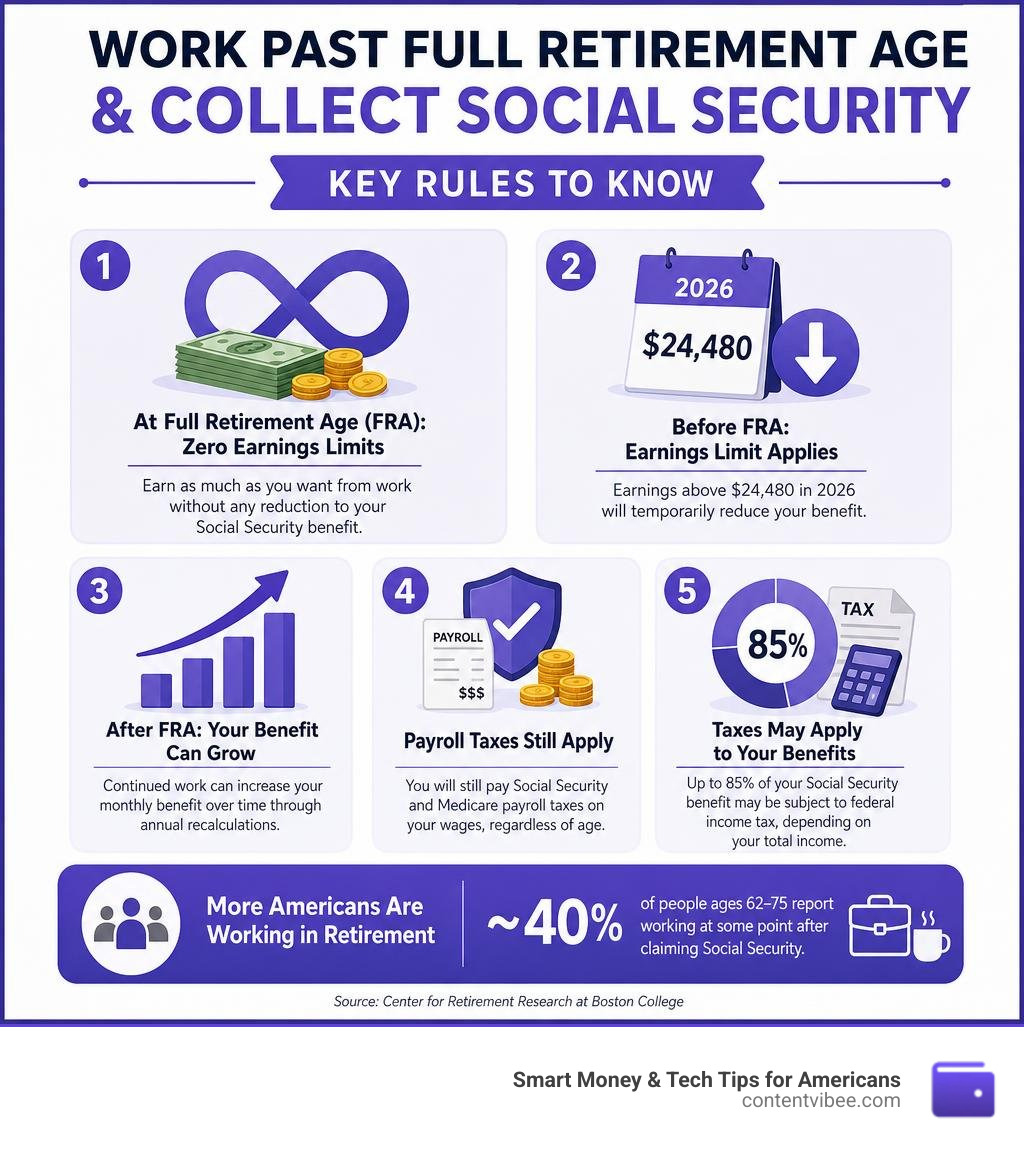
- Once you reach your full retirement age (FRA), there are zero earnings limits. You can earn as much as you want from work without any reduction to your Social Security benefit.
- Before FRA, earnings above $24,480 in 2026 will temporarily reduce your benefit.
- After FRA, continued work can actually increase your monthly benefit over time through annual recalculations.
- You will still pay Social Security and Medicare payroll taxes on your wages, regardless of age.
- Up to 85% of your Social Security benefit may be subject to federal income tax, depending on your total income.
This matters because roughly 40% of people ages 62–75 report working at some point after claiming Social Security, according to research from the Center for Retirement Research at Boston College. And for many households, earnings make up about 40% of total income even after claiming benefits.
In other words, “retired” and “working” aren’t opposites anymore. Many people — especially those with a working spouse — are navigating both at the same time.
This guide breaks down exactly how the rules work, what to watch out for, and how to make the most of your situation.
Key working past full retirement age and collecting social security vocabulary:
- can you collect a pension and still work full-time
- retirement jobs for seniors
- seniors working past retirement
Working Past Full Retirement Age and Collecting Social Security: The Golden Rules

When we talk about working past full retirement age and collecting social security, we are entering a financial sweet spot. For decades, retirees believed that claiming benefits meant they had to completely step away from the workforce. Today, that is a myth we want to bust.
The first thing to understand is your Full Retirement Age (FRA). Your FRA is the age at which you are entitled to 100% of your primary insurance amount (your baseline monthly benefit). If you were born in 1960 or later, your FRA is exactly 67. If you were born earlier, your FRA is somewhere between 66 and 67. To find your exact milestone, you can read our guide on Understanding Your Social Security Full Retirement Age.
Once you cross that FRA threshold, the Social Security Administration (SSA) shifts its stance. They no longer penalize you for working. You can make millions of dollars as a corporate consultant, open a successful local business, or work part-time at a bookstore, and your monthly check will remain completely untouched.
To make sure you understand the official boundaries, we always recommend checking the Official SSA rules on working while receiving benefits. But the golden rule is simple: after your birthday month in the year you reach FRA, the earnings limits disappear entirely.
What Happens to Your Benefits at Full Retirement Age?
The moment you reach your exact FRA, the Social Security Retirement Earnings Test (RET) is turned off.
Before you reach FRA, the government uses the earnings test to withhold a portion of your benefits if your wage income is too high. But starting the very month you reach your full retirement age, you can earn an unlimited amount of money with zero benefit reductions.
If you had benefits withheld in the years prior to reaching your FRA because you earned too much, those benefits are not gone forever. When you reach your FRA, the SSA automatically recalculates your monthly benefit upward to account for the months they withheld payments. Essentially, they recalculate your benefit to “pay you back” over your remaining life expectancy. For a deeper look at how this transition works, check out our article on How to Avoid the Dreaded Social Security Earnings Limit Penalty.
The 2026 Earnings Limits Before Reaching Full Retirement Age
If you are currently working but have not yet reached your FRA, you must pay close attention to the annual earnings limits. For 2026, these limits have been adjusted upward to reflect wage inflation:
- If you are under FRA all year (2026): The annual earnings limit is $24,480. If you earn more than this, the SSA will withhold $1 in benefits for every $2 you earn over the limit.
- In the year you reach FRA (2026): The earnings limit is much higher at $65,160. During this year, the SSA only counts the money you earn in the months before your birthday month. If you exceed this limit prior to reaching FRA, they will withhold $1 in benefits for every $3 you earn over the limit.
Let’s look at a quick example. If you are 63 in 2026 and earn $34,480 from a part-time job, you are $10,000 over the limit. The SSA will withhold $5,000 of your benefits for that year ($1 for every $2 over).
To see how these limits are calculated month-by-month, you can read The Ultimate Guide to the Earnings Test.
How Continued Employment Affects Your Benefit Calculations and Taxes
Many working seniors ask us: “If I am already collecting my retirement benefits, do I still have to pay payroll taxes on my new job?”
The short answer is yes. There is no age exemption for Federal Insurance Contributions Act (FICA) taxes. As long as you are working as an employee, you will pay a 7.65% combined tax rate on your earned income (6.20% for Social Security up to the annual wage base limit, and 1.45% for Medicare with no earnings limit). If you are self-employed, you will pay the full self-employment tax rate of 15.3%.
While paying taxes is never fun, continuing to pay into the system can actually work in your favor.
How Working Past Full Retirement Age and Collecting Social Security Affects Your Monthly Benefit
Your baseline Social Security benefit is calculated using your 35 highest-earning years, adjusted for inflation.
When you continue working past full retirement age and collecting social security, your current earnings are still reported to the SSA. Every year, the SSA performs an automatic annual record review. If your earned income this year is higher than one of the 35 years originally used to calculate your benefit, the SSA will replace that lower-earning year with your new, higher-earning year.
This means your monthly benefit check will be recalculated and increased. The SSA will notify you of any increase, and the adjustment is retroactive to January of the year following your high earnings. You can read more about this automatic recalculation on the Official SSA FAQ on working and benefits.
Tax Implications of Working Past Full Retirement Age and Collecting Social Security
While your benefits won’t be reduced by the earnings test after FRA, they might be taxed by the IRS. Your earned income from work, combined with your Social Security benefits, can push you over the thresholds where your benefits become taxable.
To determine if you owe federal income tax on your benefits, you must calculate your provisional income (also known as combined income):
$$\text{Provisional Income} = \text{Adjusted Gross Income (AGI)} + \text{Nontaxable Interest} + 50\% \text{ of your Social Security benefits}$$
Based on this number, the IRS taxes your benefits as follows:
- Single Filers:
- If your provisional income is between $25,000 and $34,000, up to 50% of your benefits may be taxable.
- If your provisional income is over $34,000, up to 85% of your benefits may be taxable.
- Married Filing Jointly:
- If your joint provisional income is between $32,000 and $44,000, up to 50% of your benefits may be taxable.
- If your joint provisional income is over $44,000, up to 85% of your benefits may be taxable.
To manage this tax liability, some retirees choose to shift their investments. For example, moving money from high-interest CDs (which produce taxable interest that counts toward provisional income) into tax-deferred vehicles like annuities can help keep your provisional income below these tax thresholds.
Maximizing Your Income: Delayed Retirement Credits and Retirement Accounts
If you are healthy, active, and plan on working past your full retirement age, you have a major strategic decision to make: should you start collecting your benefits at FRA, or should you wait?
If you choose not to claim your benefits at your FRA, you will earn Delayed Retirement Credits (DRCs). These credits increase your future monthly benefit by 8% per year (or 2/3 of 1% for each month) you delay claiming, up to age 70.
For many seniors, waiting is the single best financial move they can make. To explore this strategy, check out our guide on Why Waiting for Social Security Age 70 Benefits Might Be Your Best Move.
How Delayed Retirement Credits Work
The 8% annual increase applies to anyone born in 1943 or later. This increase stops automatically when you reach age 70, so there is absolutely no benefit to delaying your claim past your 70th birthday.
If you decide to claim your benefits after reaching your FRA but before age 70, some of your delayed credits may not appear on your check immediately. The SSA typically applies credits for the current year in the following January.
Additionally, keep in mind that the SSA will not pay retroactive benefits for more than six months in the past, and they cannot pay retroactive benefits for any month before you reached your FRA. For a complete breakdown of how these credits accumulate, read the Official SSA guide on delayed retirement credits.
Contributing to IRAs and 401(k)s While Working
Working past your FRA also gives you an excellent opportunity to keep building your personal retirement nest egg.
As long as you have earned income (wages or self-employment net profit), you can continue to contribute to retirement savings accounts:
- 401(k) and 403(b) Plans: You can continue to make contributions to your employer-sponsored plan. If you are 50 or older, you can also take advantage of annual catch-up contributions.
- Traditional and Roth IRAs: There is no age limit for contributing to a Traditional or Roth IRA.
Using these accounts can also help you manage your taxes. Contributions to a traditional 401(k) or traditional IRA reduce your Adjusted Gross Income (AGI), which in turn lowers your provisional income and can reduce the taxes you pay on your Social Security benefits.
To learn more about how different retirement income sources interact, see our article on Working After Retirement: Do You Have to Be Retired to Collect a Pension?.
The Impact of Earned Income on Medicare and IRMAA
While working past your FRA can significantly boost your income, it can also trigger an unexpected expense: higher Medicare premiums.
Most Americans enroll in Medicare at age 65. Your monthly premium for Medicare Part B (medical insurance) and Part D (prescription drug coverage) is based on your income from two years prior. If your earned income from working past your FRA pushes your modified adjusted gross income (MAGI) past certain thresholds, you will be hit with the Income-Related Monthly Adjustment Amount (IRMAA) surcharge.
Below is an overview of the projected 2026 Medicare Part B premiums and IRMAA brackets based on your tax filing from two years prior:
| 2024 Individual MAGI | 2024 Joint MAGI | 2026 Monthly Part B Premium | Monthly IRMAA Surcharge |
|---|---|---|---|
| $106,000 or less | $212,000 or less | $185.00 (Base) | $0.00 |
| $106,001 to $133,000 | $212,001 to $266,000 | $259.00 | $74.00 |
| $133,001 to $166,000 | $266,001 to $332,000 | $370.00 | $185.00 |
| $166,001 to $199,000 | $332,001 to $398,000 | $481.00 | $296.00 |
| Over $199,000 | Over $398,000 | $592.00 | $407.00 |
If you plan to work full-time or take on high-paying consulting projects past your FRA, keep these thresholds in mind so you aren’t caught off guard by higher Medicare bills down the road.
Frequently Asked Questions about Working in Retirement
Do I still pay Social Security and Medicare taxes if I work past full retirement age?
Yes. There is no age limit or retirement status that exempts you from paying FICA payroll taxes on your earned wages. Even if you are 85 years old and actively collecting Social Security, 7.65% of your paychecks will still be withheld for Social Security and Medicare.
What counts as “earnings” under the Social Security earnings test?
Only “earned income” counts toward the Social Security earnings limits. This includes:
- Gross wages from an employer
- Net earnings from self-employment
- Bonuses, commissions, and accrued vacation pay
The following income sources do not count as earnings:
- Pension payments or government retirement benefits
- Traditional IRA or 401(k) distributions
- Investment dividends, interest, and capital gains
- Annuity payments
- Unemployment benefits or veterans benefits
Are benefits withheld under the earnings test lost forever?
No. If you claim benefits early (before your FRA) and have some of your benefits withheld because you exceed the annual earnings limit, those funds are not lost. Once you reach your Full Retirement Age, the SSA will recalculate your monthly benefit amount upward to credit you for the months you did not receive a payment. Over time, you will receive those withheld funds back in the form of higher monthly checks.
Conclusion
At ContentVibee, we believe that retirement planning should be about flexibility, opportunity, and maximizing every dollar you’ve worked so hard to earn. Working past full retirement age and collecting Social Security is one of the most effective ways to secure your financial future, stay active, and enjoy the best of both worlds.
Before you make your final claiming decision, it is always a good idea to look at how your choices will affect your entire household. Learn more about how working in retirement affects spousal benefits to ensure you and your partner are fully protected.


