


Why Your Retirement Portfolio Withdrawal Strategy Can Make or Break Your Retirement
A solid retirement portfolio withdrawal strategy is one of the most important financial decisions you’ll make — and most people don’t think about it until it’s too late.
Quick Answer: What is a retirement portfolio withdrawal strategy?
| Strategy | How It Works | Best For |
|---|---|---|
| 4% Rule | Withdraw 4% in year one, adjust for inflation each year | Simple baseline for 30-year retirements |
| Proportional Withdrawals | Pull from all account types based on their share of total savings | Reducing lifetime taxes |
| Dynamic Guardrails | Adjust withdrawals up or down based on portfolio performance | Maximizing income with flexibility |
| Bucket Strategy | Split savings into short-, mid-, and long-term buckets | Managing market volatility |
| RMD-Based | Let IRS required minimum distribution rules drive withdrawals | Simplifying post-73 planning |
Here’s the core idea: how much you withdraw matters, but so does which accounts you pull from and when.
Two retirees can withdraw the exact same dollar amount and end up with very different tax bills — simply because of the order they tapped their accounts. Research from Fidelity shows that switching from a traditional sequential withdrawal approach to a proportional strategy can cut lifetime taxes by over 45% and stretch a portfolio by nearly a full year.
For a working spouse nearing retirement, this is especially important. Your income, your Social Security timing, and your spouse’s benefits all affect which withdrawal approach makes the most sense for your household.
And the stakes are high. Morningstar’s 2025 research puts the base-case safe withdrawal rate at just 3.9% for a 30-year retirement — meaning a $1 million portfolio supports roughly $39,000 per year. Get the strategy wrong, and you risk running short. Get it right, and you could withdraw significantly more while paying less in taxes.
This guide walks you through every major strategy, side by side, so you can choose what fits your situation.
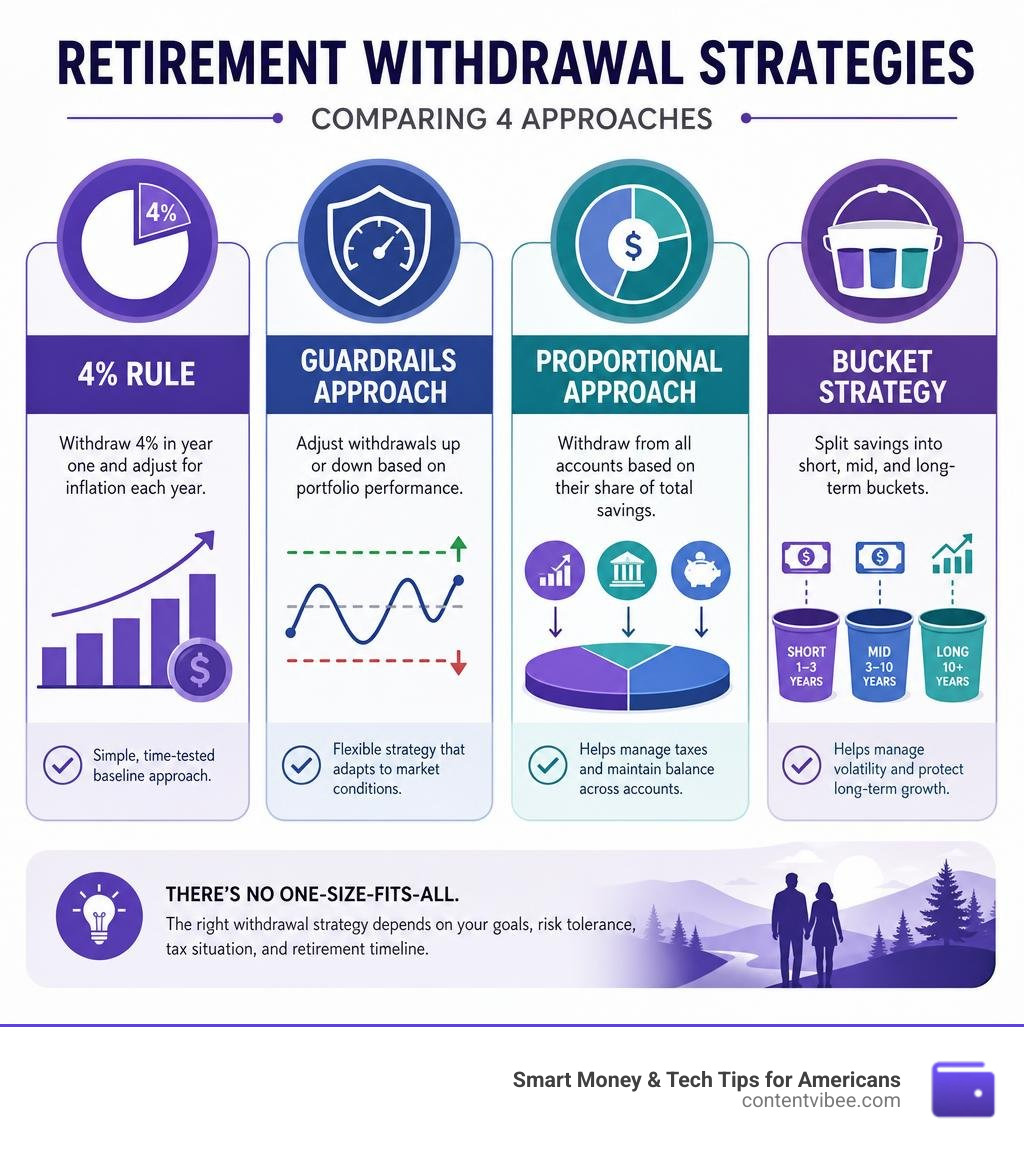
Simple retirement portfolio withdrawal strategy word guide:
Stock Market vs Real Estate: Generating Retirement Income
When building your ideal retirement blueprint, the debate often comes down to two primary asset classes: the stock market and real estate. Both are powerful tools for building wealth, but they behave very differently when it comes to generating reliable income during your golden years.
To help visualize how these two powerhouses stack up against each other, consider this comparison table:
| Feature | Stock Market Portfolio | Real Estate Assets |
|---|---|---|
| Liquidity | High (can buy/sell instantly) | Low (takes weeks or months to liquidate) |
| Cash Flow Type | Dividends, interest, capital gains | Monthly rental checks |
| Passive Nature | Highly passive (especially with indexing) | Semi-active to highly active (property maintenance) |
| Leverage | Generally low/risky in retirement | High (mortgages can amplify returns) |
| Tax Treatment | Capital gains, ordinary income on pre-tax | Depreciation, 1031 exchanges, capital gains |
Choosing between these two options requires understanding your personal capacity for active management and your need for immediate cash flow. As noted in the expert strategies for withdrawing money in retirement from TIAA, combining multiple income streams can provide a robust buffer against economic shifts. Let’s dive deeper into how each of these assets behaves.
Stock Market Liquidity and Systematic Income
The stock market’s greatest superpower is liquidity. If you need cash to cover a sudden medical bill or fund an impromptu trip, you can sell mutual funds, exchange-traded funds (ETFs), or individual dividend stocks and have the cash in your bank account in a matter of days.
With a systematic stock market approach, you can set up automated monthly transfers. This mimics a regular paycheck, making budgeting straightforward. However, to make this work, you must first understand your baseline numbers. Utilizing a retirement calculator estimate savings needed is a crucial first step in determining whether your nest egg can support your target lifestyle.
Another advantage of stock portfolios is the low cost of transaction fees. Modern brokerage platforms offer commission-free trading for most stocks and ETFs, meaning you won’t lose a chunk of your retirement income to transaction costs when adjusting your holdings.
Real Estate Cash Flow and Rental Yields
Real estate, on the other hand, is prized for its direct, tangible cash flow. Owning rental properties can deliver a steady stream of monthly income that often rises with inflation. Furthermore, real estate allows you to use leverage (borrowed money) to purchase larger assets, which can accelerate wealth accumulation before you retire.
However, real estate has a distinct downside: illiquidity. You cannot easily sell 5% of a rental house to pay for an emergency car repair.
Additionally, real estate is rarely truly passive. Property management, tenant disputes, leaky roofs, and vacancy periods require active oversight or the added expense of a professional property manager. If you want a hands-off retirement, managing a portfolio of physical properties might feel more like a second job than a relaxing retirement.
Designing a Retirement Portfolio Withdrawal Strategy for Stocks and Bonds
If you decide to rely primarily on a traditional portfolio of stocks and bonds, your primary challenge is managing portfolio longevity. You need to ensure that your annual withdrawals do not deplete your assets prematurely.
To achieve this, you must establish an appropriate asset allocation. According to historical models, finding the right balance between growth (stocks) and stability (bonds) is essential.

Understanding the fundamental retirement withdrawal rules and strategies from BlackRock can help you construct a baseline framework that balances growth with capital preservation.
The 4% Rule as a Baseline Retirement Portfolio Withdrawal Strategy
The 4% rule is the classic starting point for retirement planning. Originating from historical market studies, this rule suggests that you can withdraw 4% of your total portfolio value in your first year of retirement, and then adjust that dollar amount for inflation in each subsequent year.
For example, if you retire with a $1 million portfolio, you would withdraw $40,000 in Year 1. If inflation runs at 3% that year, you would increase your Year 2 withdrawal to $41,200, regardless of how the stock market performed.
While the 4% rule has a strong historical track record of keeping portfolios solvent over 30-year horizons, it has limitations. It was designed around worst-case economic scenarios, such as retiring right before a prolonged market crash.
Fidelity suggests a slightly broader guideline, recommending that retirees withdraw no more than 4% to 5% from savings in their first year, and then adjust annually for inflation. To see how this applies to your specific savings, you can explore the math behind it by demystifying the 4 percent retirement withdrawal calculator.
Dynamic Guardrails: A Flexible Retirement Portfolio Withdrawal Strategy
In the real world, rigid rules can sometimes lead to unnecessary underspending or, conversely, heightened risk during severe market downturns. This is where dynamic, flexible withdrawal strategies come into play.
According to Morningstar’s 2025 research, the base-case safe withdrawal rate for a 30-year retirement with a 90% probability of success is 3.9%, assuming a balanced portfolio of 40% equities and 60% fixed-income. This baseline is conservative, but it ensures that your money is highly likely to last.
However, if you are willing to adopt a more flexible approach, you can significantly increase your initial spending. Morningstar’s forward-looking models show that implementing a probability-based guardrails strategy can boost your starting safe withdrawal rate up to 5.7% while maintaining that same 90% success rate.
Under a guardrails system, you adjust your spending based on how your portfolio performs:
- The Prosperity Rule: If your portfolio performs exceptionally well and your current withdrawal rate drops below a certain threshold, you can increase your annual spending by 10%.
- The Capital Preservation Rule: If the market experiences a downturn and your withdrawal rate spikes too high, you proactively reduce your spending by 10% to protect your remaining principal.
This dynamic approach is detailed in Morningstar’s guide on How to Find Your Perfect Withdrawal Rate Strategy, demonstrating that flexibility is often your greatest asset in volatile markets.
Tax Implications: Stock Withdrawals vs. Real Estate Cash Flow
It is not just about how much you withdraw; it is about how much you keep after the tax collector takes their share. Managing your tax brackets in retirement is a critical component of any sustainable retirement portfolio withdrawal strategy.

Understanding the nuances of tax-savvy withdrawals in retirement from Fidelity Investments is essential to keeping your lifetime tax bill as low as possible.
Tax-Efficient Sequencing and Proportional Withdrawals
The traditional “sequential” approach to withdrawals is simple: retirees first empty their taxable brokerage accounts, then tap their tax-deferred traditional IRAs or 401(k)s, and finally touch their tax-free Roth accounts.
While this sounds logical, it often creates a massive “tax bump” in mid-retirement. When taxable accounts are exhausted, retirees are forced to make large withdrawals from traditional accounts, pushing them into higher tax brackets and potentially increasing their Medicare premiums.
A proportional withdrawal strategy solves this by pulling money from taxable, traditional, and Roth accounts simultaneously each year, based on each account’s share of your total net worth.
Consider this compelling comparison from real-world modeling:
- Traditional Sequential Approach: A hypothetical retiree’s savings lasted nearly 23 years, with just over $56,000 paid in total lifetime taxes.
- Proportional Withdrawal Approach: By spreading the tax burden and smoothing out tax brackets, the same retiree extended their portfolio’s life to almost 24 years and slashed their total lifetime taxes by over 45% to approximately $34,000.
To optimize your taxable accounts further, you can combine this with tax loss harvesting the secret weapon of robo advisors to offset capital gains and lower your adjusted gross income.
Real Estate Tax Advantages and Depreciation
Real estate offers some of the most generous tax benefits in the U.S. tax code. The most notable is depreciation, which allows you to deduct the cost of the building’s value over 27.5 years. This “paper loss” can often offset your actual rental income, allowing you to pocket monthly cash flow that is virtually tax-free on your annual return.
Additionally, real estate investors can use a 1031 exchange to defer paying capital gains taxes when selling a property, provided they reinvest the proceeds into a new “like-kind” investment property.
For the 2026 tax year, single filers with taxable income up to $49,450 qualify for a 0% long-term capital gains tax rate. This makes strategic stock sales and real estate capital gains incredibly lucrative if you can keep your ordinary income below this threshold.
Managing Risks: Sequence of Returns vs. Property Volatility
Every investment carries risk, but the types of risk you face in retirement differ dramatically depending on where your money is parked.
With stocks, your biggest enemy is sequence-of-returns risk. If the stock market crashes during the first few years of your retirement and you are forced to sell shares at a loss to fund your living expenses, your portfolio may never recover.
Conversely, with real estate, your primary risks are property-specific: extended vacancies, catastrophic maintenance issues (like a failed foundation), or localized economic downturns that depress property values. To keep your investments running smoothly without constant manual oversight, it is worth exploring whether automated financial systems can assist you. You can read more about this in our guide on best autopilot investing strategies for beginners who hate math.
Mitigating Stock Volatility with the Bucket Strategy
To protect against sequence-of-returns risk without abandoning the growth potential of stocks, many retirees use the bucket strategy. This method divides your nest egg into three distinct “buckets” based on when you will need the cash:
- The Cash Bucket (Short-Term): Holds 1 to 3 years’ worth of living expenses in highly liquid, safe assets like high-yield savings accounts, CDs, or money market funds. This ensures you never have to sell stocks during a market downturn.
- The Income Bucket (Medium-Term): Holds 3 to 10 years’ worth of expenses in conservative, income-producing assets like corporate bonds, preferred stocks, or conservative dividend funds.
- The Growth Bucket (Long-Term): Holds the remainder of your portfolio in diversified stock funds. Since you have up to a decade of income secured in Buckets 1 and 2, this bucket has ample time to ride out stock market volatility and grow.
Managing this distribution manually can be complex. If you are looking to simplify this process, you might ask yourself: is automated portfolio management right for you? Automated tools can help rebalance these allocations behind the scenes, ensuring your buckets stay properly funded.
Managing Real Estate Risks and RMDs
While real estate does not suffer from daily price fluctuations like the stock market, it does face unique regulatory and operational hurdles.
A major consideration for retirees is managing Required Minimum Distributions (RMDs). Under current tax laws, RMDs generally begin at age 73 for traditional IRAs and most workplace retirement plans. For younger retirees, this age increases to 75 for those who turn 74 after 2032.
Because RMDs force you to withdraw a specific percentage of your tax-deferred accounts each year, they can push you into a higher tax bracket. If the bulk of your wealth is tied up in illiquid physical real estate, you may struggle to find the liquid cash necessary to satisfy your RMD requirements, potentially forcing an unwanted property sale or refinancing.
Frequently Asked Questions about Retirement Withdrawals
What is the safest starting withdrawal rate for a stock portfolio in 2026?
According to Morningstar’s 2025 research, the safest starting withdrawal rate for a traditional 30-year retirement is 3.9%. This assumes a balanced asset allocation of 40% equities and 60% fixed-income, aiming for a 90% probability of portfolio success without running out of money. If you need a higher starting rate, incorporating a flexible guardrails strategy can safely push that initial rate up to 5.7%.
How does a proportional withdrawal strategy reduce lifetime taxes?
A proportional withdrawal strategy reduces taxes by pulling a percentage of your annual retirement income from taxable, tax-deferred (traditional), and tax-free (Roth) accounts simultaneously. This prevents the “tax bump” that occurs when you completely empty taxable accounts and are forced to take large, highly taxed distributions from traditional accounts. In historical modeling, this approach cut lifetime taxes by over 45% and extended portfolio longevity by a full year.
Can I combine real estate income with a stock portfolio withdrawal plan?
Absolutely. A hybrid approach is often the most resilient strategy. You can use steady, predictable real estate rental yields to cover your essential living expenses (like housing and healthcare) while relying on a flexible stock portfolio withdrawal plan to fund your discretionary spending (like travel and hobbies). This hybrid model integrates beautifully with guaranteed income sources like Social Security to create an incredibly stable retirement income stream.
Conclusion
Building the perfect retirement portfolio withdrawal strategy is not a one-time event; it is an ongoing process of adjustment, optimization, and tax management. Whether you lean heavily into the liquidity of the stock market, the tangible cash flows of real estate, or a balanced combination of both, the key to success is staying proactive.
At ContentVibee, we believe that clear, actionable financial planning is the key to a worry-free retirement. By aligning your spending needs, tax-bracket management, and asset allocation, you can confidently transition from saving wealth to enjoying it.
If you are currently planning your transition into retirement, don’t forget to look at how your working decisions could impact your household benefits. Be sure to check out our deep-dive guide: Are spousal benefits reduced by working past retirement? to ensure you and your spouse are maximizing your lifetime benefits.


