


Why a Monthly Compound Interest Calculator Can Change Your Financial Future
A compound interest calculator monthly is one of the most powerful free tools available for anyone trying to grow their savings or plan for retirement. Here’s a quick answer to what it does and why it matters:
How to calculate monthly compound interest growth:
- Enter your starting balance (e.g., $10,000)
- Add your monthly contribution (e.g., $500/month)
- Set your annual interest rate (e.g., 7%)
- Choose your time horizon (e.g., 20 years)
- Select monthly as your compounding frequency
- The calculator shows your projected balance — in this case, roughly $318,000
The math is simple to run but the results are often stunning. At 7% compounded monthly, a $10,000 deposit grows to about $40,387 in 20 years — without adding a single extra dollar. Add $200 a month and that number jumps to around $227,000.
For pre-retirees especially, this tool answers the most important question: “Will my money last?”
As Albert Einstein is often (if apocryphally) credited with saying, compound interest is “the eighth wonder of the world.” Whether he said it or not, the math backs it up.
The key insight is this: monthly compounding means your interest earns interest every single month — not once a year. Over decades, that difference is enormous.
Discover more about compound interest calculator monthly:
Understanding the Compound Interest Calculator Monthly
To understand why we use a compound interest calculator monthly, we first have to look at the mechanics of “interest on interest.”
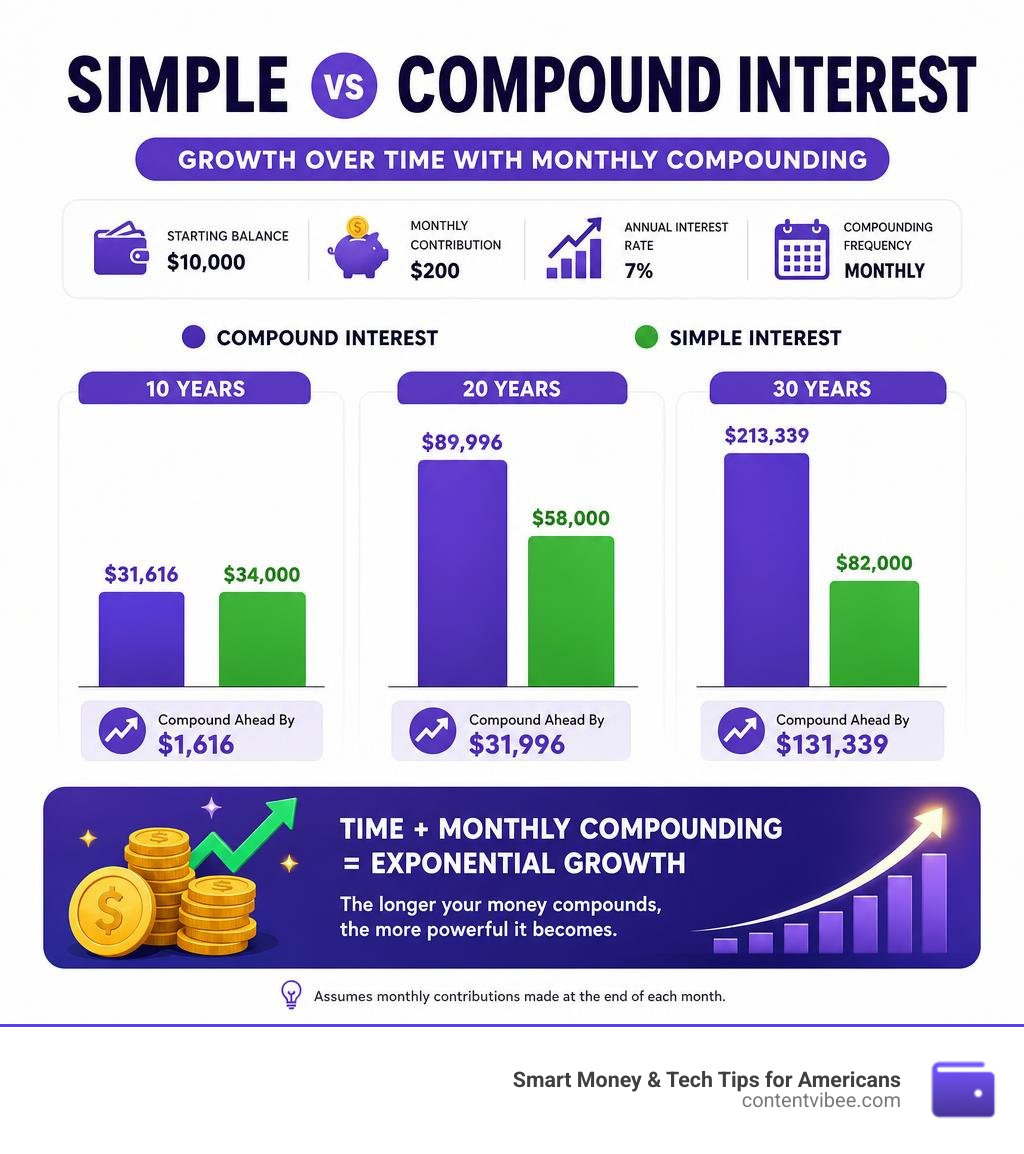
In simple interest systems, you only earn returns on your original principal. If you put $10,000 into an account that pays 7% simple interest, you earn $700 every single year. After 30 years, you have your original $10,000 plus $21,000 in interest, totaling $31,000.
With compound interest, the game changes completely. At the end of the first compounding period, the interest you earned is added back into your principal. In the next period, you earn interest on your original principal plus the interest you just earned.
Over short periods, the difference feels minor. But over decades, this compounding cycle turns your wealth accumulation into an exponential curve. Instead of a flat, straight line, your balance shoots upward. That same $10,000 at 7% compounded monthly grows to $81,165 over 30 years without any extra deposits. That is over $71,000 in interest alone compared to just $21,000 with simple interest!
In the real world, monthly compounding is the practical default for most of our financial lives. It is the frequency used by high-yield savings accounts, certificates of deposit (CDs), standard investment accounts, and retirement vehicles like 401(k)s and IRAs.
Because we earn our paychecks monthly and make our savings contributions monthly, using a calculator configured for monthly compounding gives us the most realistic projection of our actual financial behavior.
Compounding Frequencies: Monthly vs. Daily vs. Annual
Many people wonder how much compounding frequency actually matters. Does daily compounding make you rich overnight compared to monthly?
To put this in perspective, let’s look at how a $10,000 investment at a 7% annual percentage rate (APR) grows over 20 years under different compounding frequencies:
| Compounding Frequency | Ending Balance | Total Interest Earned |
|---|---|---|
| Annual | $38,697 | $28,697 |
| Monthly | $40,387 | $30,387 |
| Daily | $40,545 | $30,545 |
| Continuous | $40,552 | $30,552 |
As the table shows, the jump from annual compounding to monthly compounding is significant. It adds an extra $1,690 to your final balance. However, the jump from monthly to daily compounding only adds another $158 over two full decades.
This is because monthly compounding captures roughly 99.6% of the absolute mathematical limit of compounding (continuous compounding) at this rate and time horizon.
While daily compounding is technically the most profitable, chasing daily compounding isn’t nearly as important as chasing a higher interest rate, lower fees, or simply giving your money more time to grow. For all practical planning purposes, monthly compounding is the ideal sweet spot for modeling long-term investments.
How to Use a Compound Interest Calculator Monthly
Using a monthly compound interest calculator is incredibly straightforward. You only need to know four basic inputs to generate a highly accurate projection:
- Initial Investment (Principal): This is the starting amount of money you have right now to save or invest. It can be $0, $1,000, or $100,000.
- Monthly Contribution: How much money you plan to add to this account every month. Even small, consistent contributions can completely transform your long-term results.
- Estimated Interest Rate (APY/Annual Return): The annual rate of return you expect to earn. For a high-yield savings account in 2026, this might be 3.5% to 4.5%. For long-term stock market investments, a conservative estimate is 6% to 7% after adjusting for inflation.
- Time Horizon (Years): How long you plan to let the money grow before you start withdrawing it.
To see these variables in action, you can use the free Compound Interest Calculator – Investor.gov. By testing different scenarios—such as raising your monthly contribution by just $50 or extending your time horizon by 5 years—you can immediately see how small changes today lead to massive differences down the road.
The Math and Mechanics of Monthly Compounding
Behind the clean user interfaces of online calculators lies a series of classic financial formulas. Understanding how this math works can take the mystery out of exponential growth and help you build better financial models.

The Monthly Compounding Formula Explained
To calculate the future value of a one-time lump sum with monthly compounding, we use the standard compound interest formula:
$$A = P \left(1 + \frac{r}{n}\right)^{nt}$$
Where:
- $A$ = the future value of the investment (your ending balance)
- $P$ = the principal investment amount (your starting balance)
- $r$ = the annual interest rate (decimal format, so 7% is 0.07)
- $n$ = the number of compounding periods per year (for monthly compounding, this is always 12)
- $t$ = the time the money is invested for, in years
If you are also making regular monthly contributions, the math requires a second formula to calculate the future value of those periodic deposits. We then add the two results together to find your total balance:
$$\text{Future Value of Contributions} = \text{PMT} \times \frac{\left(1 + \frac{r}{n}\right)^{nt} – 1}{\frac{r}{n}}$$
Where $\text{PMT}$ is your monthly contribution amount.
Let’s look at a real-world example. Imagine you open a savings account with a $1,000 initial deposit at a 3.85% annual rate compounded monthly.
- If you contribute $50 a month for 2 years, you will earn $125.24 in interest, leaving you with a total balance of $2,325.24.
- If you step that up to $100 a month for 2 years, you will earn $170.00 in interest, ending with a total balance of $3,570.58.
These formulas prove that compounding works silently but aggressively in the background, converting your steady monthly habits into a growing pile of free money.
Quick Estimates Using the Rule of 72
If you don’t have a calculator handy but want to make a quick mental estimate of how fast your money will grow, you can use a classic financial shortcut called the Rule of 72.
The Rule of 72 tells you approximately how many years it will take for your money to double at a given interest rate. The formula is incredibly simple:
$$\text{Years to Double} \approx \frac{72}{\text{Annual Interest Rate}}$$
For example, if you expect your investments to earn a 7% annual return:
$$\frac{72}{7} \approx 10.3 \text{ years}$$
Your money will double roughly every 10 years. This means a $10,000 investment will grow to $20,000 in 10 years, $40,000 in 20 years, and $80,000 in 30 years.
This mental-math trick is highly accurate for interest rates between 4% and 12%. However, keep in mind that the Rule of 72 only works for a fixed lump sum with no additional contributions. If you are adding money every month, you will want to use a full monthly compound interest calculator to get the true picture.
Real-World Projections and Retirement Planning
When it comes to retirement planning, a compound interest calculator monthly is an indispensable tool. It shows us that time—not just the raw amount of money we save—is our greatest financial asset.
Modeling Retirement and Savings Goals
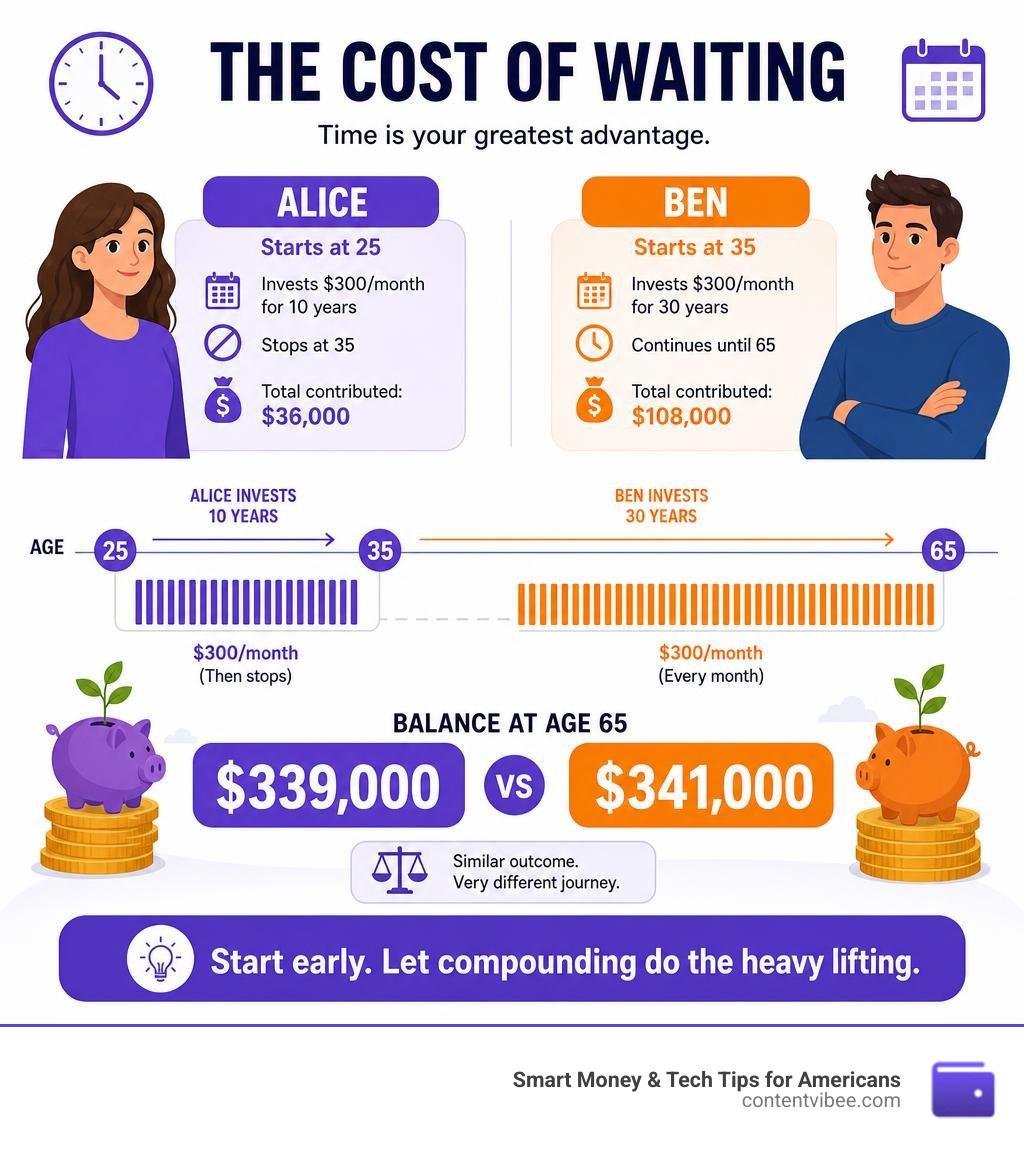
The most striking lesson of monthly compounding is the “cost of waiting.” Let’s compare two hypothetical investors, both aiming for age 65:
- Early Investor (Alice): Starts saving at age 25. She invests $300 a month at a 7% annual return compounded monthly. She does this for just 10 years and stops completely at age 35, never adding another penny. In total, she contributed $36,000. By age 65, her balance has compounded to $339,000.
- Late Investor (Ben): Waits until age 35 to start. To make up for lost time, he invests $300 a month every single month for 30 years until he turns 65. In total, he contributed $108,000 (three times as much as Alice). Yet, at age 65, his balance sits at $341,000.
Despite contributing $72,000 more of his own hard-earned money, Ben ends up with virtually the same retirement balance as Alice, simply because Alice gave her money an extra 10 years to compound in silence.
To build your own personalized retirement projection, you can combine these compounding insights with our Retirement Calculator Estimate Savings Needed and explore safe retirement withdrawal strategies using our guide on Demystifying The 4 Percent Retirement Withdrawal Calculator.
The Impact of Taxes, Fees, and Inflation on Your Projections
While compound interest calculators are fantastic for showing the math of growth, real-world investing has three major opponents: taxes, fees, and inflation. If you don’t account for these, your future purchasing power might be much lower than the numbers on your screen.
- Taxes: In a standard taxable brokerage account, you owe taxes on capital gains and dividends along the way. This creates a “tax drag” that slows compounding. For example, a $100 investment at 6% for 20 years grows to $320.71 tax-free, but only reaches $239.78 if subjected to a 25% annual tax rate. To protect your compounding from taxes, utilize tax-advantaged accounts like Traditional or Roth 401(k)s and IRAs.
- Fees (Expense Ratios): If you invest in mutual funds or ETFs with high fees, those fees compound against you. Over 40 years, a 1% fee difference on a $100,000 investment can cost you over $468,874 in lost growth! Always look for low-cost index funds with expense ratios under 0.10%.
- Inflation: Inflation erodes the purchasing power of your money. If inflation averages 3% per year, $100,000 in 20 years will only buy what about $55,368 buys today. To see your true future wealth, run your calculations using a “real” rate of return (your nominal rate minus expected inflation). For example, if you expect a 10% stock market return and 3% inflation, use 7% in the calculator to see your future balance in today’s dollars.
Understanding these variables is crucial when evaluating the reliability of any online planning tool. For a deeper look at whether popular retirement calculators are giving you realistic projections, check out our analysis: Is The Dave Ramsey Investment Calculator Accurate.
Common Mistakes to Avoid with a Compound Interest Calculator Monthly
To get the most out of your financial projections, avoid these common analytical traps:
- Overestimating Returns: While the historical nominal average return of the S&P 500 is around 10%, it is highly volatile. Assuming a guaranteed 10% or 12% return year-after-year in your calculator can lead to severe under-saving. It is always safer to use a conservative estimate of 6% to 7% for long-term planning.
- Ignoring the Variable Nature of Rates: High-yield savings account APYs are variable. Just because an account pays 4.5% today doesn’t mean it will pay that same rate for the next 10 years. In 2026, interest rates have been trending downward as the Federal Reserve adjusts its benchmark rates. Always model lower-rate scenarios to keep your savings goals realistic.
- Panic Selling During Market Drops: The math of compounding only works if you stay invested. Investors who panic and sell their stocks during a market downturn miss out on the subsequent recovery. Continuing to make your consistent monthly contributions during market drops actually accelerates your long-term compounding because you are buying shares “on sale.”
Frequently Asked Questions About Monthly Compounding
What are the best free monthly compound interest calculators?
There are several excellent, free calculators available online depending on your goals:
- For a clean, government-backed tool with no ads or sales pitches, use the Compound Interest Calculator – Investor.gov.
- For a versatile, multi-purpose tool built specifically to help you optimize your personal finances, try our own ContentVibee Finance Calculator.
Does the S&P 500 compound monthly?
Technically, no. The S&P 500 is an index that tracks the stock prices of 500 of the largest U.S. companies. It does not have a fixed interest rate, and stock prices fluctuate every second the market is open.
However, the S&P 500 exhibits compounding behavior over time through two mechanisms:
- Earnings Reinvestment: The companies within the index reinvest their profits to grow their businesses, which increases their share value over time.
- Dividend Reinvestment: Most S&P 500 companies pay quarterly dividends. If you set up your investment account to automatically reinvest those dividends to buy more shares, your portfolio will compound.
For long-term financial modeling, it is perfectly reasonable to treat stock market investments as compounding monthly at an average historical real rate of 7%.
How do monthly contributions affect my final balance?
Monthly contributions are the ultimate accelerant for compound growth. While a lump sum grows on its own, adding fresh cash every month starts new mini-compounding journeys for every dollar deposited.
To see the dramatic difference monthly contributions make, let’s look at what happens to a $10,000 starting balance at an 8% annual return compounded monthly over different timelines:
- No Monthly Contributions:
- 10 Years: $22,196
- 20 Years: $49,268
- 30 Years: $109,357
- Adding $200/Month:
- 10 Years: $59,040 (Your contributions: $24,000 | Interest: $25,040)
- 20 Years: $167,495 (Your contributions: $48,000 | Interest: $109,495)
- 30 Years: $409,037 (Your contributions: $72,000 | Interest: $327,037)
- Adding $500/Month:
- 10 Years: $114,305 (Your contributions: $60,000 | Interest: $44,305)
- 20 Years: $344,835 (Your contributions: $120,000 | Interest: $214,835)
- 30 Years: $858,557 (Your contributions: $180,000 | Interest: $668,557)
Notice how in the 30-year scenario with $500 monthly contributions, your actual out-of-pocket deposits are only $180,000, yet your final balance is over $858,000. Nearly $669,000 of that total is pure compound interest! This is the compounding crossover point where your money begins doing far more heavy lifting than your physical labor ever could.
Conclusion
At ContentVibee, our mission is to provide you with concise, actionable insights to optimize your retirement, master your taxes, and make smart money decisions. Understanding the math behind a compound interest calculator monthly is the foundation of that financial freedom.
The numbers don’t lie: compound interest is a patient investor’s best friend. By starting early, automating your monthly contributions, minimizing fees, and utilizing tax-advantaged accounts, you can turn a modest monthly savings habit into a secure retirement nest egg.
Ready to see what your financial future looks like? Head over to our easy-to-use ContentVibee Finance Calculator to run your own numbers and take control of your financial journey today!


