


Why Your Loan Payoff Schedule Could Save You Thousands
A loan payoff schedule is a month-by-month table that shows exactly how each payment is split between interest and principal — and when your debt will finally be gone.
Here’s what a loan payoff schedule tells you at a glance:
| Column | What It Shows |
|---|---|
| Payment number | Which month or installment you’re on |
| Payment amount | Your fixed payment due that period |
| Interest portion | How much goes to the lender as interest |
| Principal portion | How much reduces your actual balance |
| Remaining balance | What you still owe after that payment |
| Payoff date | The month your balance hits zero |
Most borrowers only look at the monthly payment. That’s a costly mistake.
On a $250,000 mortgage, your monthly payment might feel manageable — but the full schedule reveals you’ll pay $318,861 in total interest over 30 years. That’s more than the loan itself.
Knowing your schedule puts you in control. You can spot exactly how much extra a small additional payment saves, find your estimated balance at any future date, and compare loan offers before you sign anything.
Whether you’re approaching retirement or already there, carrying debt while trying to protect income is stressful. This guide breaks down everything you need to map out your payoff timeline clearly and confidently.
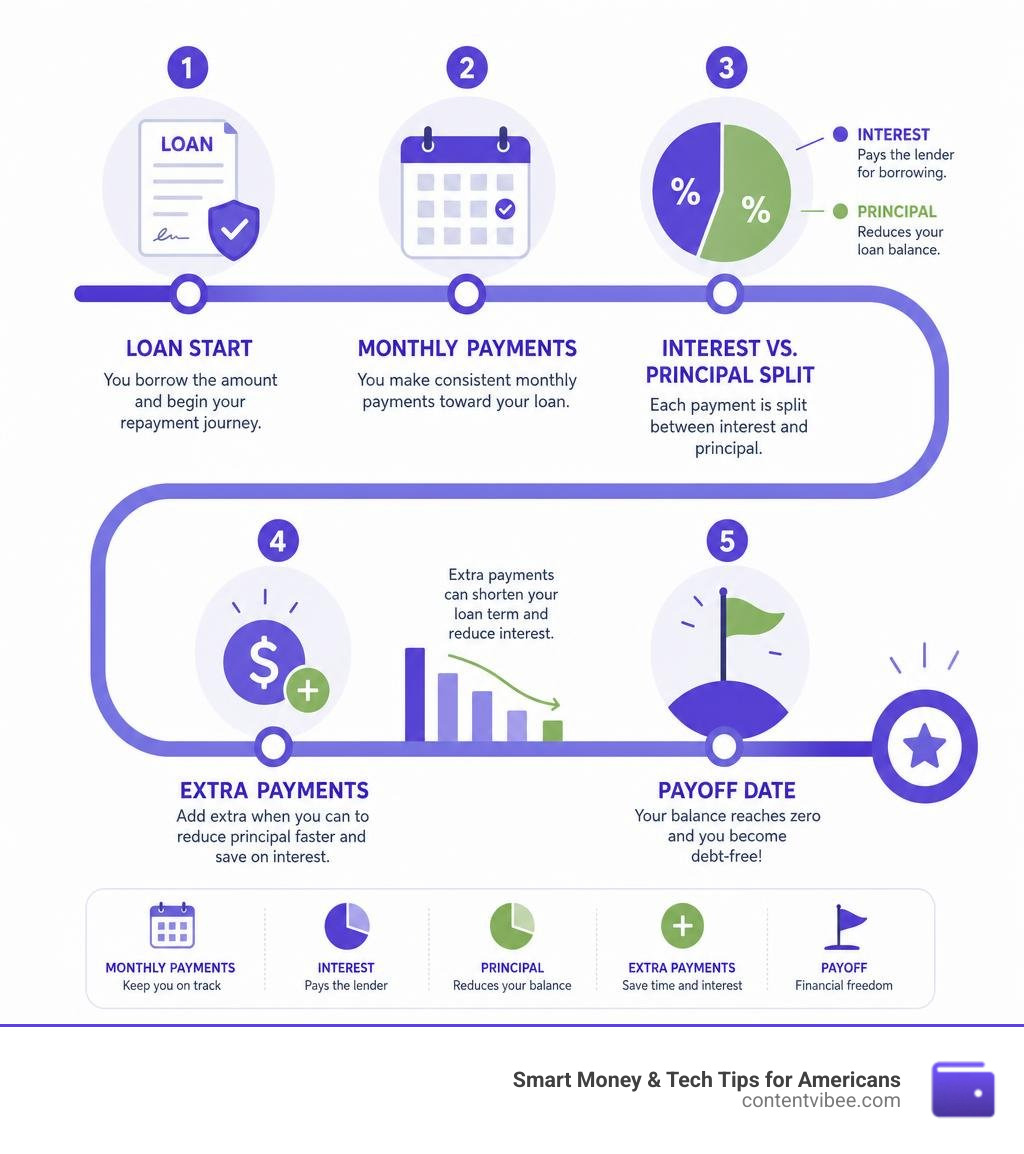
Loan payoff schedule vocabulary:
What is a Loan Payoff Schedule and How Does It Work?
At its core, a loan payoff schedule is the mathematical roadmap of your debt. For standard installment loans—such as your mortgage, car loan, or personal loan—the repayment process relies on a system called amortization.
Amortization is just a fancy financial term for killing off debt over time through structured, regular payments. With a fixed-rate installment loan, your monthly payment remains exactly the same. However, behind the scenes, the math is dynamic. Every single month, the lender calculates the interest owed on your remaining principal balance. The rest of your payment goes toward reducing that principal.
As your principal balance shrinks, the amount of interest accrued the following month decreases. Consequently, a larger share of your next payment is directed toward the principal. This continuous shift is the engine that drives your loan toward its final payoff date.
Loan Payoff Schedule vs. Basic Loan Calculators
Many people confuse a basic loan calculator with a complete payoff schedule, but they serve entirely different purposes. A basic calculator is a static tool. You input your loan amount, interest rate, and term, and it spits out a single, unchanging number: your estimated monthly payment.
While that is helpful for basic budgeting, it leaves you in the dark about the long-term reality of your debt. It doesn’t show you how much of your hard-earned money is slipping away to interest in those crucial early years, nor does it help you model the real-world impact of making extra payments.
A dynamic loan payoff schedule, on the other hand, provides a complete month-by-month breakdown of your debt’s lifecycle. It shows you the exact state of your loan at any given moment. If you want to know what your remaining balance will be in exactly three years, or how much interest you will save by rounding up your payment, a static calculator can’t help you—but a payoff schedule can.
To see this dynamic math in action and model your own debt, you can Take control of your financial future with our comprehensive suite of financial tools. For specialized planning, resources like the FWD Tools Loan Payoff Calculator or the Daily Calcs Loan Repayment Schedule offer excellent ways to visualize your personal payoff timeline.
Key Inputs Required to Calculate Your Payoff Timeline
To generate an accurate payoff schedule, you need to gather a few essential pieces of information. If you miss even one of these variables, your timeline will be off:
- Principal Balance: This is the actual amount of money you borrowed (or the remaining balance you still owe today).
- Interest Rate (or APR): The annual cost of borrowing the money, expressed as a percentage.
- Loan Term: The length of time you have to pay back the loan (e.g., 5 years, 15 years, or 30 years).
- Start Date: The date of your first payment, which establishes the calendar timeline for your payoff date.
By feeding these inputs into a high-quality tool, you can instantly map out your entire debt journey. To get started with your own numbers, try our Take Control of Your Debt with a Monthly Loan Repayment Calculator to see where you stand.
Decoding the Anatomy of an Amortization Table
When you look at a full amortization table, the sheer volume of numbers can feel overwhelming. However, once you know what to look for, the table tells a clear and logical story about your money.
Principal vs. Interest Split Over Time
The most important pattern to recognize in your payoff schedule is the front-loaded nature of interest. Because your interest charge is calculated based on your remaining balance, your very first payments are the most interest-heavy. As your balance decreases, the interest charges shrink, allowing more of your payment to chip away at the principal.
Let’s look at a real-world example. Imagine you take out a $20,000 car loan at an 8% interest rate for 5 years. Your monthly payment is roughly $406.
- In Month 1, about $133 of your payment goes directly to interest, while only $273 goes to reducing your principal.
- By Month 36, the balance has dropped, so your interest charge for the month is down to roughly $64, meaning $342 of your payment goes straight to principal.
- In Month 60, your final payment is almost entirely principal, with only a few dollars of interest remaining.
Over the life of this 5-year loan, you will pay a total of $4,332 in interest. Understanding this front-loaded structure highlights why making early extra payments is so incredibly powerful: it stops interest from compounding in its tracks.
How Fees, APR, and Compounding Impact Your Real Cost
When analyzing your payoff schedule, you must look beyond the base interest rate and understand the role of your Annual Percentage Rate (APR). The interest rate only dictates the monthly interest charge on your principal. The APR, however, represents the true annual cost of your loan because it includes the interest rate plus any mandatory upfront fees, such as origination fees or administrative costs.
Additionally, the way your interest compounds plays a massive role in your payoff timeline. Most standard consumer loans compound monthly, but some compound daily. With daily compounding, interest accrues every single day based on your current principal balance. This means that paying even a few days early each month can slightly reduce the total interest you pay.
Conversely, if your monthly payment is not large enough to cover the interest accrued during that period, you can find yourself in a dangerous situation known as negative amortization. In this scenario, your unpaid interest is added to your principal balance, causing your debt to grow over time rather than shrink. To avoid these traps and ensure you are calculating your auto debt correctly, check out The Ultimate Guide to Using a Car Loan Rates Calculator.
Accelerating Your Timeline: The Power of Extra Payments
If you simply make your minimum monthly payments, you will pay off your loan exactly on the lender’s schedule while paying the maximum amount of interest. But you don’t have to accept that passive timeline. By making extra payments, you can take control of your financial destiny.
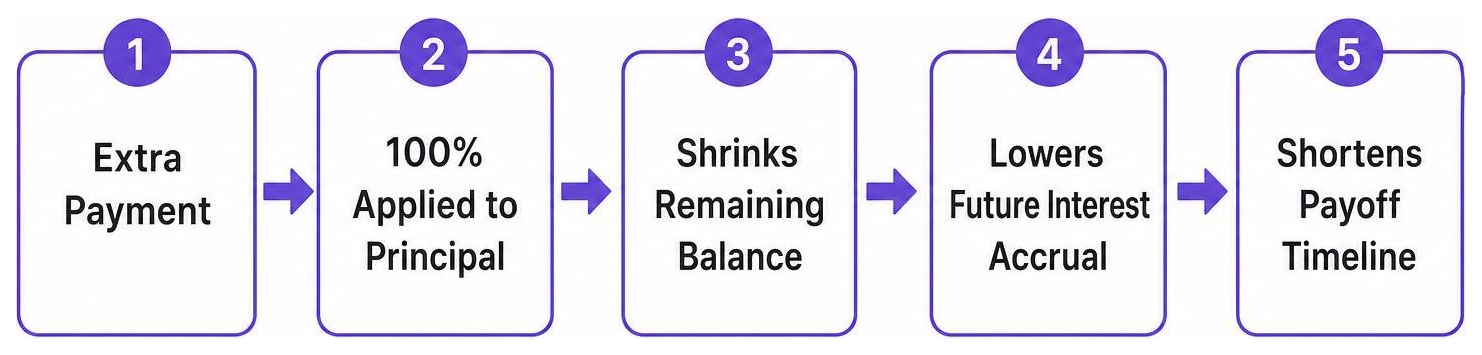
How Extra Payments Reshape Your Loan Payoff Schedule
When you make an extra payment—and explicitly instruct your lender to apply it to your principal balance only—you bypass the interest calculation entirely. Every single extra dollar goes straight toward shrinking your debt. This immediate reduction in principal means that every future interest calculation will be based on a smaller number, triggering a cascading effect of savings.
Let’s look at the math for a $10,000 personal loan at an 11% APR with standard monthly payments of $250. Without any extra payments, it will take you about 47 months to pay off the loan, and you will pay $1,714 in total interest.
Here is how adding extra money each month completely reshapes your payoff timeline:
| Scenario | Monthly Payment | Payoff Timeline | Total Interest Paid | Total Interest Saved | Time Saved |
|---|---|---|---|---|---|
| Baseline | $250 | 47 months | $1,714 | $0 | 0 months |
| +$50/month | $300 | 42 months | $1,334 | $380 | 5 months |
| +$100/month | $350 | 38 months | $1,054 | $660 | 9 months |
The financial impact is even more dramatic on larger, longer-term loans. For example, on a $25,000 loan at 10% over 5 years, adding just $100 extra per month saves you $1,320 in interest and knocks 15 months off your timeline.
Timing matters, too. Making extra payments early in your loan’s life delivers a much higher return than making them later on. An extra payment made in Year 1 of a 5-year loan saves roughly four times more interest than the exact same payment made in Year 4, because that early reduction has more years to compound in your favor.
To model these scenarios for your own vehicle or personal loans, try utilizing The Early Bird Gets the Title: Your Guide to Car Loan Prepayment Calculators or check out external resources like the U.S. Bank Amortization Extra Payment Calculator.
Comparing Payment Frequencies: Monthly, Biweekly, and Weekly
Another highly effective way to accelerate your payoff date is to change your payment frequency. While monthly payments are the standard in the United States, switching to biweekly or weekly payments can yield surprising benefits.
However, you must understand the difference between a standard biweekly schedule and an accelerated biweekly schedule:
- Standard Biweekly: You split your monthly payment in half and pay that amount every two weeks. Because there are 52 weeks in a year, you will make 26 half-payments. This is equivalent to 13 full monthly payments instead of the usual 12. This simple shift effectively sneaks one extra full payment into your principal every year without you feeling the pinch.
- Semimonthly: You pay twice a month (usually on the 1st and 15th), resulting in exactly 24 half-payments (12 full payments) per year. This does not provide the benefit of an extra annual payment.
To see how payment frequency impacts a $25,000 loan at a 7% interest rate over a 5-year term, let’s compare the schedules:
- Monthly (12 payments/year): ~$495.03 payment, totaling $4,701.80 in interest.
- Biweekly (26 payments/year): ~$228.18 payment, totaling $4,663.40 in interest.
- Weekly (52 payments/year): ~$114.03 payment, totaling $4,647.80 in interest.
While the interest differences on a 5-year term are modest, the gap widens significantly on a 30-year mortgage. For instance, on a $300,000 mortgage at 6.5%, switching to an accelerated biweekly payoff strategy can save you over $77,820 in interest and shave four to five years off your term!
Before making this switch, always confirm with your loan servicer how they handle partial payments. Some lenders will hold your half-payment in a holding account until the second half arrives, which completely negates the daily compounding interest benefits.
To evaluate these payment frequencies side-by-side, you can Take control of your financial future with our comprehensive suite of financial tools.
Applying Payoff Schedules Across Different Loan Types

Different types of debt carry unique rules, terms, and structures. Understanding these nuances is essential for building a successful payoff strategy.
Personal Loans and Auto Debt Strategies
Personal loans are typically unsecured, meaning they aren’t backed by collateral. Because of this, they often carry higher interest rates than secured loans. If you have a personal loan with an interest rate above 10%, prioritizing its payoff is a smart financial move that offers a guaranteed, tax-free return on your money.
Auto loans, on the other hand, are secured by your vehicle. Because cars are rapidly depreciating assets, it is highly common for borrowers to find themselves “underwater” or “upside down” on their loans—meaning they owe more than the car is actually worth.
Using a loan payoff schedule for your car loan helps you track your equity and ensure you cross the break-even point as quickly as possible. Most auto loans and personal loans do not carry prepayment penalties, but you should always double-check your contract before sending extra funds.
To map out your car payoff strategy, read our comprehensive guide, The 5-Year Car Loan Roadmap: Navigating 15k, 30k and 50k Auto Loans or learn How to Drive Away with a 15k Car Loan Without Wrecking Your Budget.
Student Loans and Mortgages
Student loans and mortgages represent some of the largest debts Americans carry, but they also come with unique protections and long-term structures.
Federal student loans are legally prohibited from charging prepayment penalties, allowing you to pay them off as fast as you want. However, they also offer unique protections, such as income-driven repayment plans and forgiveness programs, which you might lose if you refinance into a private loan. If you have private student loans, refinancing to a lower interest rate can dramatically alter your payoff schedule for the better.
Mortgages are the ultimate long-term commitment. Because mortgage terms are so long (typically 15 or 30 years), even minor adjustments to your payment strategy can yield massive savings. For example, if you have a 30-year mortgage, making just one extra payment per year can shave years off your timeline and save you tens of thousands of dollars.
If you are a business owner managing commercial real estate or business debt alongside your personal liabilities, you can navigate those unique schedules using our Commercial Loan Calculator Guide for Smart Business Owners.
Frequently Asked Questions About Loan Repayment
What is the difference between a current balance and a 10-day payoff amount?
Your current balance is simply the principal amount you still owe on your loan. However, because interest accrues daily, your current balance is not the amount required to fully pay off your loan.
A 10-day payoff amount is an official quote from your lender that includes your current principal balance plus the exact amount of daily interest that will accrue over the next ten days (calculated as [Principal × Annual Rate] ÷ 365 × 10). This buffer ensures that by the time your final payment check is received and processed by the bank, the loan is fully paid to zero. Always request an official payoff quote before sending a final lump-sum payment.
Will paying off my loan early hurt my credit score?
It might cause a small, temporary dip, but it is nothing to worry about. When you pay off an installment loan, that account is officially closed. This can cause a temporary score drop of 5 to 10 points because it reduces your active credit mix and can slightly shorten the average age of your active accounts.
However, your score typically rebounds within three to six months. More importantly, the guaranteed interest savings of paying off a loan early almost always outweigh a minor, temporary fluctuation in your credit score.
Are there prepayment penalties for paying off a loan early?
For most standard consumer loans in the United States, the answer is no. Under the Dodd-Frank Act, prepayment penalties were severely restricted on conventional, qualified mortgages originated after January 2014.
Furthermore, federal student loans, most major auto loans, and personal loans from reputable national lenders carry zero prepayment penalties. However, some smaller regional banks, subprime lenders, or RV/boat lenders may still include prepayment penalties in their contracts. Always review your loan agreement under the “prepayment” section before making large lump-sum payments.
Conclusion
At ContentVibee, our mission is to empower you with concise, actionable financial insights so you can make smart money decisions. Mapping out your loan payoff schedule is one of the most effective ways to take control of your financial destiny, protect your income, and build lasting wealth.
By understanding how your payments are split, leveraging the power of extra payments, and choosing the right payoff strategy for your lifestyle, you can save thousands of dollars and achieve true financial freedom years ahead of schedule.
Ready to take the next step and see the math for yourself? Take control of your financial future with our comprehensive suite of financial tools.


