


What You’re Really Paying When You Trade OTC Stocks at Fidelity
Understanding the fidelity fee for OTC stocks is simpler than most investors expect — but there are a few important exceptions that can cost you real money.
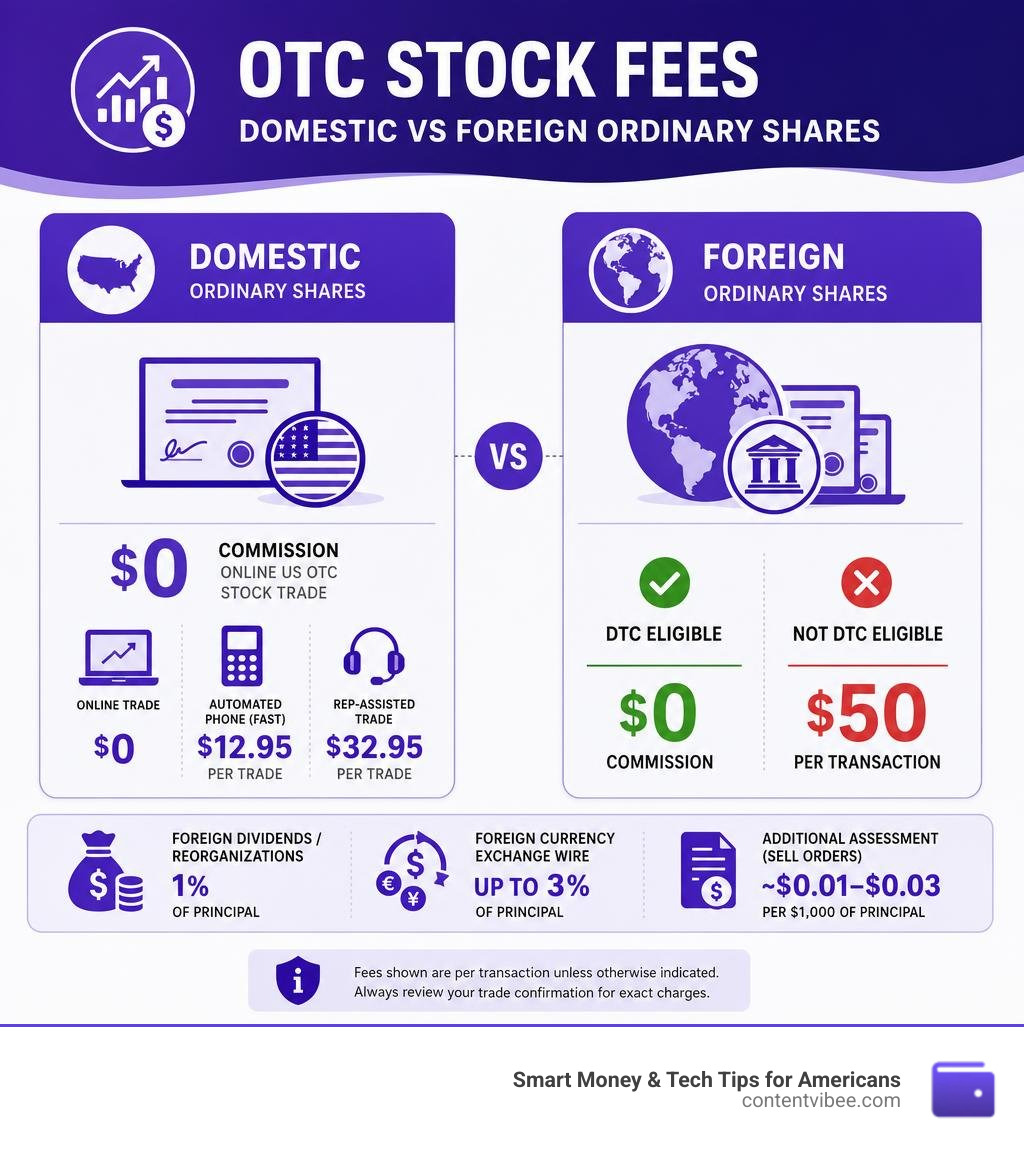
Quick Answer: Fidelity OTC Stock Fees at a Glance
| Trade Type | Fee |
|---|---|
| Online US OTC stock trade (domestic) | $0 commission |
| FAST (automated phone) trade | $12.95 per trade |
| Representative-assisted trade | $32.95 per trade |
| Foreign ordinary stock (DTC eligible) | $0 commission |
| Foreign ordinary stock (NOT DTC eligible) | $50 per transaction |
| Foreign dividends / reorganizations | 1% of principal |
| Foreign currency exchange wire | Up to 3% of principal |
| Additional Assessment (sell orders) | ~$0.01–$0.03 per $1,000 of principal |
For most investors, trading domestic OTC stocks online at Fidelity costs nothing in commissions. Fidelity’s $0 online commission applies to US-listed and OTC-traded domestic equities alike.
But the story gets more complicated with foreign OTC stocks, penny stocks, and non-DTC eligible securities.
Many investors assume that “commission-free” means truly free. It usually is — until you buy a foreign ordinary share that isn’t DTC eligible, and a $50 per-trade fee quietly appears on your confirmation. Or until you convert dollars to a foreign currency and lose up to 3% of your principal on the exchange.
This guide breaks down every fee you might encounter when trading OTC stocks at Fidelity, so you know exactly what to expect before you place your next trade.
Fidelity fee for otc stocks terms simplified:
Understanding OTC Stocks vs. Exchange-Listed Securities
Before we dive headfirst into the fee schedules, let’s make sure we are speaking the same language. If you have ever bought shares of giant companies like Apple or Microsoft, you did so on a major stock exchange like the New York Stock Exchange (NYSE) or the Nasdaq.
Over-the-Counter (OTC) stocks are a completely different animal.
What Are Over-the-Counter (OTC) Stocks?
OTC stocks are securities that are not listed on a major, centralized national exchange. Instead, they trade through a decentralized network of broker-dealers who negotiate directly with one another.
These stocks are often referred to as “penny stocks,” which the SEC loosely defines as any stock trading below $5 per share with a relatively small market capitalization. However, not all OTC stocks are tiny, struggling startups. You can find everything from speculative early-stage biotech firms to massive international conglomerates trading on the OTC markets.
The OTC market is divided into tiers based on the level of disclosure and regulation required:
- OTCQX (The Best Market): This is the top tier. Companies here must meet stringent financial standards, undergo regular audits, and remain current in their disclosures.
- OTCQB (The Venture Market): Designed for early-stage or developing companies. These businesses must be current in their reporting but do not have the same strict financial requirements as OTCQX.
- Pink Open Market (Pink Sheets): The wild west of the OTC world. Companies trading here have no financial standards or reporting requirements. They are categorized by the timeliness of their information, ranging from “Current Information” to “No Information.”
Because of the vast differences in how these companies operate, we always recommend keeping a close eye on which tier your target stock belongs to.
Key Differences in Liquidity and Disclosure
Why do some companies trade OTC while others live on the NYSE? It usually comes down to cost, size, and regulatory compliance.
National exchanges require companies to pay hefty listing fees and meet strict SEC disclosures. Many smaller companies simply cannot afford the administrative costs of maintaining these listings.
This lack of strict reporting leads to a few structural differences that you must navigate as an investor:
- Liquidity: Listed stocks have massive pools of buyers and sellers. OTC stocks often suffer from incredibly low liquidity, meaning there may be hours (or even days) where very few shares change hands.
- Bid-Ask Spreads: Because liquidity is low, the gap between what a buyer wants to pay (the bid) and what a seller wants to receive (the ask) can be massive. This spread acts as an invisible transaction cost.
- Transparency: Finding reliable financial statements for Pink Sheet companies can feel like looking for a needle in a haystack.
If you want to take a deeper dive into how these general trading mechanisms affect your wallet, check out our comprehensive guide on how to buy and sell stocks without losing your shirt to fees.
The Fidelity Fee for OTC Stocks Explained
Now, let’s talk numbers. When you use Fidelity to trade, how does the pricing actually break down for OTC securities?
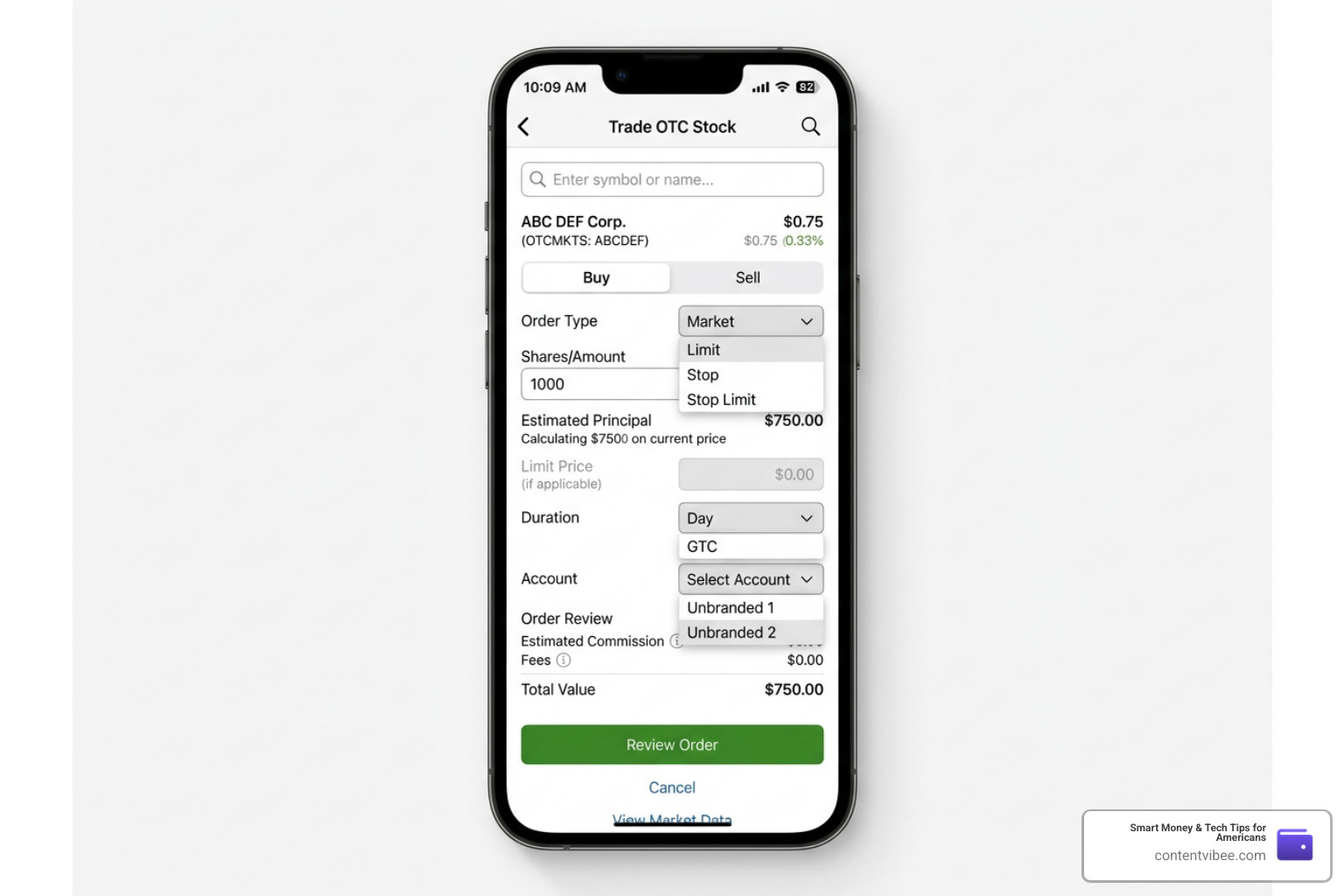
Online Commission Rates and the Fidelity Fee for OTC Stocks
Here is the good news: for standard, domestic OTC stocks, Fidelity is incredibly generous.
While some brokerages charge flat fees of $4.95 to $6.95 per trade for OTC transactions, Fidelity maintains a $0.00 online commission for domestic stock trades. This means if you are sitting at your computer or using the mobile app to buy a US-based penny stock trading on the OTC market, you will not pay a base commission.
This commitment to low-cost trading is part of why they are highly regarded for retail investors. You can verify this flat-rate structure directly on the Fidelity Trading Commissions and Margin Rates page.
However, as we will explore in the next section, “online” is the magic word here. If you step away from your screen and need a human to help you, those costs will climb. To understand how these base rates compare to other types of assets, read our breakdown of the Fidelity fee per trade.
FAST and Representative-Assisted Trading Costs
Sometimes, technology fails, or you find yourself in a situation where you cannot access the internet to place a trade. In those moments, you have two alternative routes, both of which carry a cost:
- FAST (Fidelity Automated Service Telephone): This is Fidelity’s automated phone system. If you place your OTC trade using this voice-recognition system, you will be charged a flat fee of $12.95 per trade.
- Representative-Assisted Trades: If you want to speak to a living, breathing human being to place your order, the price tag jumps to $32.95 per trade.
For a detailed look at when and why these fees are applied, we have written a complete guide on the broker-assisted trade fee at Fidelity.
Hidden Costs and Foreign Settlement Fees on OTC Trades
If domestic OTC trades are free, where do investors get tripped up? The answer lies in the global market. Many of the most popular OTC stocks are actually “foreign ordinaries”—shares of international companies that trade in the US over-the-counter market.
How Foreign Ordinaries Impact the Fidelity Fee for OTC Stocks
Foreign ordinary shares trade on the US OTC market using five-character ticker symbols that end in the letter “F” (for example, Tencent trades under the symbol TCEHY as an ADR, but its foreign ordinary share trades under TCTZF).
When you trade these “F” symbols, you need to look out for DTC eligibility.
The Depository Trust Company (DTC) is a US central securities depository that handles the electronic clearing and settlement of trades. If a foreign stock is DTC eligible, it can be settled quickly and cheaply. Fidelity passes this ease of access on to you by charging $0 commission for online trades.
However, if a foreign ordinary stock is not DTC eligible, settling the trade requires physical or specialized international clearing. When this happens, Fidelity charges a steep $50.00 foreign settlement fee per trade.
Imagine you decide to buy $100 worth of a promising Canadian mining stock. If that stock is not DTC eligible, you will pay $100 for the shares plus a $50 transaction fee. If you sell those shares next week, you will pay another $50 fee. Just like that, you have spent $100 in fees on a $100 investment!
To avoid this, always check the DTC eligibility of a foreign security before hitting the “Buy” button. You can review the complete rules in the Fidelity Brokerage and Commission Fee Schedule.
Additional Assessment Fees and Currency Exchange Surcharges
Even on “free” domestic trades, there are tiny regulatory costs that you cannot escape.
Whenever you sell a stock, Fidelity is required to pay transaction fees to the Securities and Exchange Commission (SEC) and various Self-Regulatory Organizations (SROs). Fidelity passes this cost to you as an Additional Assessment fee on sell orders.
This fee is incredibly small—typically ranging from $0.01 to $0.03 per $1,000 of principal—but it is still a cost to keep in mind. You can learn more about how these micro-fees can quietly add up in our article on how to not get short-changed by hidden commissions in stock market trades.
Additionally, if you deal with foreign OTC stocks, you may run into these extra charges:
- Foreign Dividends and Reorganizations: If your foreign stock pays a dividend or undergoes a corporate reorganization (like a stock split), Fidelity charges 1% of the principal per transaction to process it.
- Foreign Currency Exchange Wires: If you need to convert USD to a foreign currency to wire funds internationally, the exchange rate markup can be up to 3% of the principal.
For a broader perspective on how these administrative charges compare to other accounts, see our Fidelity brokerage account fees review.
Risks and Requirements for Trading Penny Stocks on Fidelity
Because OTC and penny stocks carry significantly higher risks than standard exchange-listed equities, Fidelity does not just let anyone trade them out of the gate.
Enabling Penny Stock Trading on Your Account
If you try to buy an OTC stock on a brand-new Fidelity account, you will likely see an error message blocking the trade. To bypass this, you must explicitly enable penny stock trading on your account.
This process is straightforward but serves as an important legal shield for the broker:
- Log into your account on Fidelity’s website.
- Navigate to the search bar and type “Enable Penny Stocks.”
- You will be directed to a page where you must read and sign a risk acknowledgment agreement.
- Once you agree to the terms, the restriction is lifted, and you can place your trades.
By signing this, you acknowledge that you understand these assets are highly volatile and that you could lose your entire investment.
Managing Bid-Ask Spreads and Volatility
When trading OTC stocks, the price you see on your screen is rarely the price you actually get. This is due to the bid-ask spread.
For example, a low-volume penny stock might have a “bid” of $1.00 and an “ask” of $1.20. If you place a standard market order to buy, you will pay $1.20. If you immediately turn around and sell it, you will only receive $1.00. That is an instant 16.6% loss just from the spread!
To protect yourself from these wild swings, we highly recommend using limit orders instead of market orders. A limit order allows you to set the maximum price you are willing to pay (or the minimum you are willing to accept when selling), ensuring you do not get caught off guard by a sudden price spike.
To make sure you are fully prepared for the exit strategy of these volatile trades, read our guide on how to not get caught off guard by stock selling fees.
Frequently Asked Questions about Fidelity OTC Fees
FAQ 1: Is there a fee to trade penny stocks online at Fidelity?
No. For domestic US penny stocks, online trades are completely commission-free ($0). However, if you place the trade via their automated phone system (FAST), it costs $12.95, and speaking to a representative costs $32.95.
FAQ 2: What is the $50 foreign settlement fee at Fidelity?
This is a fee charged on transactions involving foreign ordinary stocks (usually five-letter tickers ending in “F”) that are not eligible for electronic clearing through the Depository Trust Company (DTC). If the stock is DTC eligible, the fee is waived.
FAQ 3: How do I enable OTC penny stock trading on Fidelity?
You must log into your Fidelity account, search for “Enable Penny Stock Trading,” and complete the electronic risk disclosure agreement. This confirms that you understand the high-risk nature of these low-priced securities.
Conclusion
Trading OTC stocks at Fidelity is one of the most cost-effective routes available for retail investors in 2026. With $0 online commissions on domestic penny stocks and DTC-eligible foreign ordinaries, you can build a diverse portfolio without losing a chunk of your capital to basic transaction fees.
However, the key to successful OTC trading is awareness. Always double-check the ticker symbol of your target stock. If it ends in “F”, make sure it is DTC eligible so you can avoid the dreaded $50 foreign settlement fee. Use limit orders to protect yourself from wide bid-ask spreads, and always ensure you have enabled penny stock trading on your account before market hours.
If you are looking to optimize your broader financial planning and want to make sure you aren’t leaking cash elsewhere in your portfolio, check out our deep-dive analysis on the Fidelity Fee Per Trade to keep your investing strategy sharp, cheap, and highly profitable.


