


Why Your RMD Age Schedule Determines How Much You Owe the IRS
Understanding your RMD age schedule is one of the most important steps you can take before — or during — retirement.
Here’s the quick answer most people need:
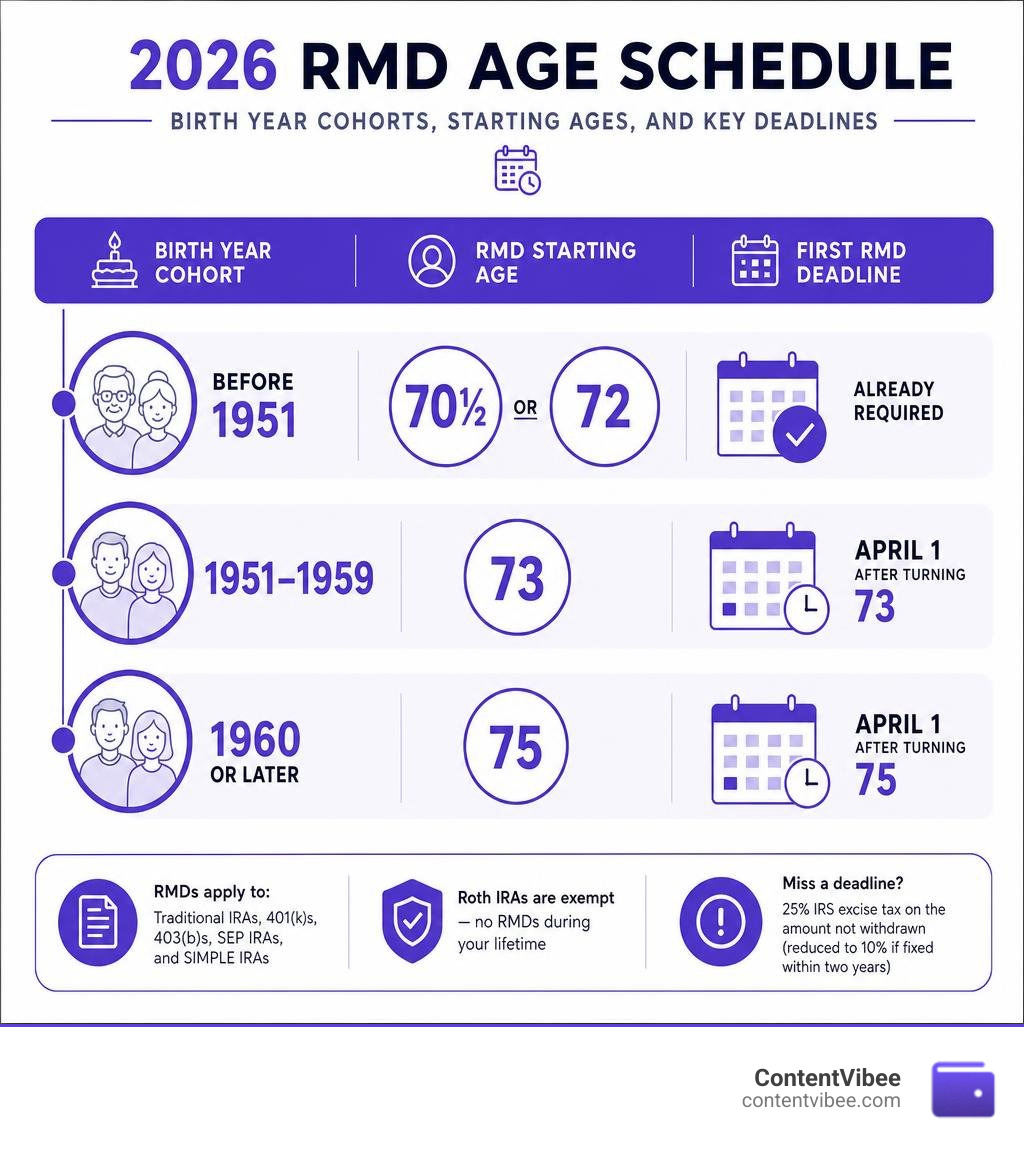
RMD Starting Age by Birth Year (2026)
| Birth Year | RMD Starting Age | First RMD Deadline |
|---|---|---|
| Before 1951 | 70½ or 72 | Already required |
| 1951–1959 | 73 | April 1 after turning 73 |
| 1960 or later | 75 | April 1 after turning 75 |
A few things worth knowing right away:
- RMDs apply to traditional IRAs, 401(k)s, 403(b)s, SEP IRAs, and SIMPLE IRAs
- Roth IRAs are exempt — no RMDs during your lifetime
- Miss a deadline? The IRS charges a 25% excise tax on whatever you didn’t withdraw (reduced to 10% if you fix it within two years)
The rules sound simple. But the details — which table to use, when to take the first one, how to avoid a double tax hit in year one — trip people up constantly.
The SECURE 2.0 Act changed the RMD starting age twice, created a quirk for people born in 1959 versus 1960, and reshaped the penalty structure. If you haven’t reviewed your RMD plan recently, there’s a real chance your timeline has shifted.
This guide walks you through everything: the exact formula, the IRS table factors, the deadlines, the penalties, and the strategies that can lower your tax bill significantly.
Understanding the New SECURE 2.0 RMD Age Schedule
The rules governing when you must begin withdrawing money from your tax-deferred retirement accounts have undergone a massive shift. Under the SECURE 2.0 Act, passed by Congress to modernize retirement rules, the starting age for Required Minimum Distributions (RMDs) has been pushed back.
This delay is a double-edged sword. On one hand, it allows your investments to benefit from additional years of tax-deferred growth. On the other hand, a larger account balance later in life can mean larger mandatory withdrawals when they finally kick in, potentially pushing you into a higher tax bracket.
The official roadmap for these rules is managed by the federal government, and you can always verify specific plan rules through the Retirement topics – Required minimum distributions (RMDs) | Internal Revenue Service).
How the RMD Age Schedule Has Changed Over Time
The RMD age schedule has increased four times since 2019. To understand where we are in July 2026, it helps to look at the four distinct “RMD eras”:
- Pre-SECURE Act Era: For decades, the RMD starting age was fixed at 70½. This fractional age caused endless confusion for retirees trying to calculate exactly when their first withdrawal was due.
- The SECURE Act (2019): This legislation eliminated the half-year rule, raising the RMD starting age to 72 for anyone born on or after July 1, 1949.
- SECURE 2.0 (First Phase – 2023): This law raised the starting age to 73, effective for individuals who turned 72 after December 31, 2022.
- SECURE 2.0 (Second Phase – 2033): The starting age is scheduled to rise to 75 starting in 2033 for those born in 1960 or later.
To see how these historical shifts might affect your broader retirement timeline, check out The Essential Guide to RMD Age Table Guide for Smart Retirees.
Birth Year Cohorts and the 1959-1960 Gap
The transition rules under SECURE 2.0 created a highly unusual mathematical quirk often referred to as the “1959–1960 gap.”
Because the RMD age jumps from 73 to 75, individuals born in 1959 are subject to an RMD age of 73, while those born in 1960 do not have to begin RMDs until age 75. This creates an abrupt three-year gap in tax-deferred compounding for people born only days or weeks apart.
For example, a retiree born in December 1959 must begin taking RMDs at age 73 (in 2032). Meanwhile, a retiree born in January 1960 does not have to take their first RMD until age 75 (in 2035). This gives the 1960 cohort two additional years of tax-deferred growth.
| Birth Year | RMD Age | First Distribution Year |
|---|---|---|
| 1950 or earlier | 70½ or 72 | Already in progress |
| 1951–1959 | 73 | Year you turn 73 |
| 1960 or later | 75 | Year you turn 75 |
Which Retirement Accounts Require RMDs and Which Are Exempt?
Not all retirement accounts are treated equally by the IRS. The government wants its tax revenue eventually, which is why tax-deferred accounts are subject to mandatory annual drawdowns.
The following accounts are subject to lifetime RMDs:
- Traditional IRAs
- SEP IRAs (Simplified Employee Pension)
- SIMPLE IRAs
- Traditional 401(k), 403(b), and 457(b) plans
If you hold assets across multiple account types, managing these withdrawals is a critical part of your overall financial strategy. For more details on structuring your overall portfolio, see The Ultimate Guide to Retirement Money Management.
Traditional vs. Roth Account Rules
The most significant distinction in the RMD world is between Traditional (tax-deferred) and Roth (tax-free) accounts.
- Roth IRAs: These remain the gold standard for RMD planning. Original account owners are entirely exempt from RMDs during their lifetime. Your money can stay in the account and grow tax-free indefinitely.
- Roth Employer Plans (Roth 401(k) / 403(b)): Historically, designated Roth accounts in employer-sponsored plans were subject to lifetime RMDs, forcing retirees to roll them over into a Roth IRA to avoid withdrawals. Fortunately, SECURE 2.0 Section 325 eliminated lifetime RMDs for Roth 401(k) and Roth 403(b) accounts starting in 2024. This major change leveled the playing field between Roth IRAs and Roth employer plans.
To maximize your tax-free growth potential, you can read more about contribution strategies in The Ultimate Guide to Your 2026 Max Roth IRA Contribution.
The Still-Working Exception Explained
If you are still employed past your normal RMD starting age, you may be able to delay taking distributions from your active employer’s retirement plan. This is known as the “still-working exception.”
To qualify for this exception, you must meet the following criteria:
- You must still be actively employed by the company sponsoring the 401(k) or 403(b) plan.
- You must not own more than 5% of the business sponsoring the plan.
- Your employer’s specific plan documents must explicitly allow this delay (most do, but it is vital to verify).
Note: This exception only applies to your current employer’s plan. It does not apply to Traditional IRAs, SEP IRAs, SIMPLE IRAs, or 401(k) plans left behind at previous employers.
To understand how continuing to work affects your retirement savings and planning, read The Ultimate Guide to Calculating Your 401k Contributions.
Step-by-Step: How to Calculate Your Required Minimum Distribution
Calculating your RMD is a straightforward two-step mathematical process, but you must use the correct inputs to avoid costly calculation errors.
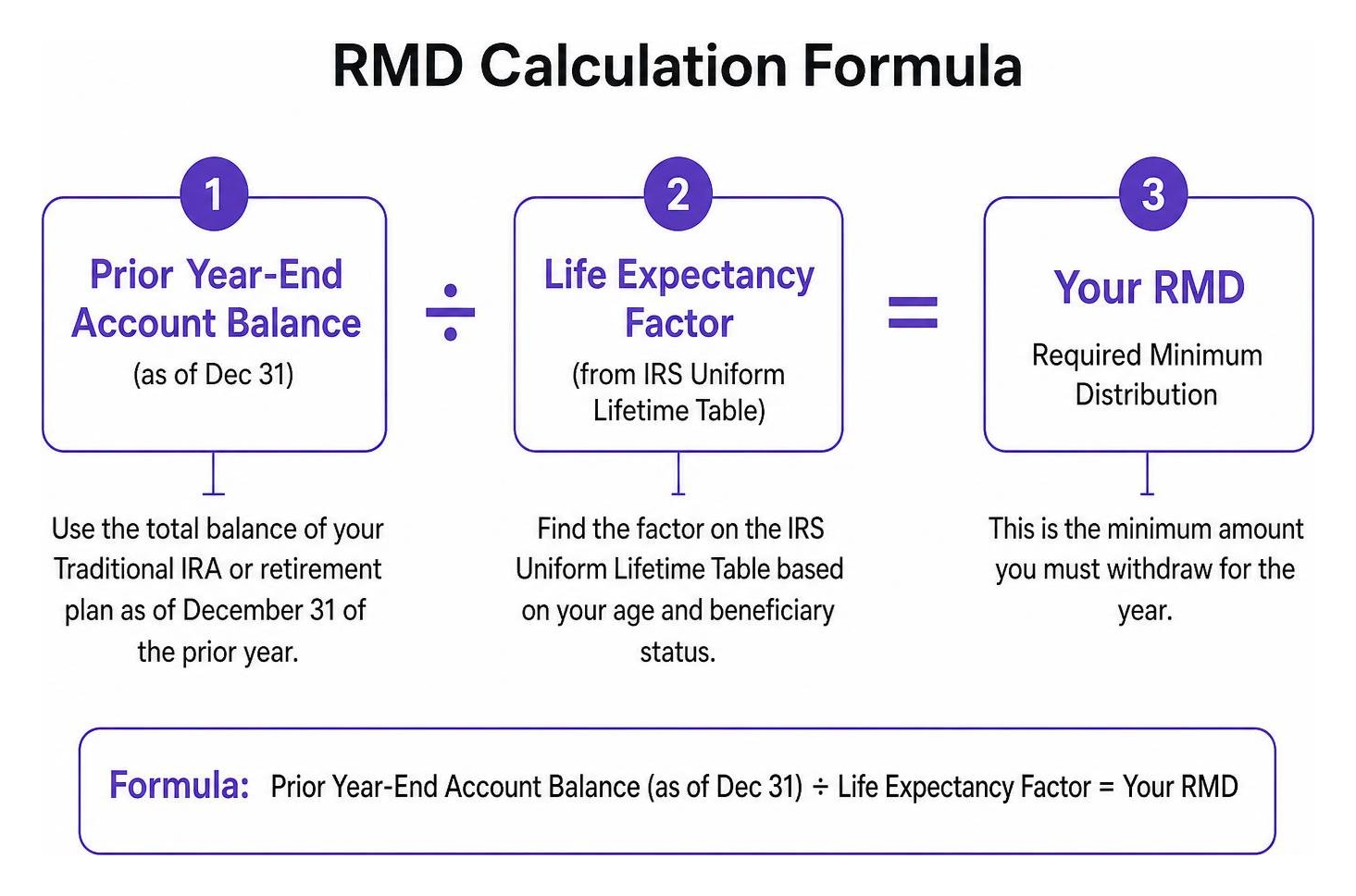
The basic formula is:
Prior Year-End Account Balance (as of Dec 31) ÷ Life Expectancy Factor = Your RMD
Finding Your Factor on the IRS Uniform Lifetime Table
For the vast majority of retirees, the IRS Uniform Lifetime Table (found in IRS Publication 590-B) is the tool used to determine the life expectancy factor. This table assumes you have a beneficiary who is not more than 10 years younger than you.
Exception: If your sole beneficiary is your spouse, and they are more than 10 years younger than you, you must use the Joint Life and Last Survivor Expectancy Table instead. This table provides a larger life expectancy factor, which results in a smaller required withdrawal.
As you age, your life expectancy factor decreases, which means the percentage of the account you are forced to withdraw increases each year. For instance, at age 73, the factor is 26.5 (representing a 3.77% withdrawal rate). By age 85, the factor drops to 16.0 (a 6.25% withdrawal rate).
To see how these age limits and factors interact with other retirement rules, explore The Ultimate Guide to Retirement Contribution Catch-Up Limits.
The Exact RMD Formula in Action
Let’s look at a real-world example to see how this works.
Suppose Sarah is 75 years old in 2026. Her Traditional IRA balance on December 31 of the prior year (December 31, 2025) was exactly $500,000.
- Identify the Balance: $500,000
- Identify the Factor: Looking at the Uniform Lifetime Table, the distribution period factor for a 75-year-old is 24.6.
- Run the Math: $500,000 ÷ 24.6 = $20,325.20
Sarah must withdraw at least $20,325.20 from her Traditional IRA by December 31, 2026, to satisfy her RMD requirement. This represents approximately 4.07% of her total account balance.
For context on how these account balances grow and what limits apply to active savers, see The New 2026 Maximum 401k Contribution Limits Explained.
Deadlines, Penalties, and the Cost of Delaying Your First Withdrawal
Timing is everything when it comes to RMDs. Missing a deadline by even a single day can trigger harsh financial penalties from the IRS.

The April 1 Deadline and the Double-Taxation Trap
For your very first RMD, the IRS grants a one-time grace period. You have until April 1 of the calendar year following the year you reach your RMD starting age to take your first distribution. For all subsequent years, the deadline is strictly December 31.
While delaying your first RMD until April 1 of the following year can be tempting, it often triggers a “double-taxation trap.”
If you delay your first withdrawal to April 1, you must still take your second RMD by December 31 of that same calendar year. This means you will receive two fully taxable distributions in a single tax year.
Because RMDs are taxed as ordinary income, stacking two distributions into one year can easily push you into a higher federal tax bracket, increase your state taxes, and trigger premium surcharges on Medicare.
For business owners managing retirement timelines, see The 2026 Max SEP Contribution Guide for Savvy Entrepreneurs.
Missed RMD Penalties Under SECURE 2.0
Historically, the penalty for failing to take an RMD was one of the most punitive in the entire tax code: a whopping 50% excise tax on the amount you failed to withdraw.
Fortunately, SECURE 2.0 reduced this excise tax penalty:
- The standard penalty is now 25% of the undistributed amount.
- The penalty is further reduced to 10% if you correct the mistake within the “correction window” (generally within two years of the error, before the IRS assesses the tax).
To correct a missed RMD, you must withdraw the missed amount immediately and file IRS Form 5329 with your federal tax return, along with a letter explaining the oversight to request a waiver of the penalty.
Strategic Ways to Minimize the Tax Impact of Your Withdrawals
Because RMDs are treated as ordinary income, they can have a massive ripple effect across your entire retirement portfolio.
Large distributions can increase your Adjusted Gross Income (AGI), which can trigger:
- Higher taxes on your Social Security benefits.
- Medicare IRMAA (Income-Related Monthly Adjustment Amount) surcharges, which raise your Part B and Part D premiums.
- The Net Investment Income Tax (NIIT) of 3.8% if your income exceeds certain thresholds.
To understand how your taxable income interacts with federal programs, read The Ultimate Guide to Social Security Benefit Optimization.
Tax-Reduction Strategies for Your RMD Age Schedule
There are several highly effective strategies you can deploy to lower the tax impact of your RMDs:
- Strategic Roth Conversions: Convert portions of your Traditional IRA to a Roth IRA during your “gap years” — the period between your retirement date and your RMD starting age. While you will pay taxes on the converted amount now, you will reduce the overall balance of your tax-deferred accounts, lowering your future RMDs.
- Qualified Charitable Distributions (QCDs): If you are charitably inclined and at least 70½ years old, you can utilize a QCD. This strategy allows you to transfer up to $111,000 per year (the limit for 2026, indexed for inflation) directly from your Traditional IRA to an eligible 501(c)(3) charity. The transfer counts toward your RMD but is completely excluded from your taxable income.
- Tax Bracket Filling: Carefully monitor your tax bracket each year. If you have room in your current bracket, consider taking voluntary distributions from your Traditional accounts before your RMD age to smooth out your tax liability over time.
For additional insight into how various states tax retirement income, read The Ultimate Guide to State Pension Tax Breaks and Exemptions.
Inherited IRA Rules and the 10-Year Rule
If you inherit an IRA, the rules change dramatically. Under the original SECURE Act, most non-spouse beneficiaries (such as children or grandchildren) are subject to the 10-year rule, which requires the entire inherited account to be fully distributed by the end of the tenth year following the owner’s death.
Furthermore, under IRS regulations, if the original owner had already reached their rmd age schedule and begun taking RMDs, the beneficiary must also take annual distributions during years 1 through 9 of that 10-year period, rather than waiting until year 10 to empty the account.
Exceptions to this 10-year rule apply to “Eligible Designated Beneficiaries,” which include:
- Surviving spouses
- Minor children of the account owner (until they reach the age of majority)
- Disabled or chronically ill individuals
- Individuals not more than 10 years younger than the deceased owner
To see how earnings and beneficiary income limits interact, review The Ultimate Guide to the Earnings Test.
Frequently Asked Questions About RMDs
What is the current RMD starting age in 2026?
In 2026, the RMD starting age is 73 for those born between 1951 and 1959. If you were born in 1960 or later, your starting age will be 75 under the SECURE 2.0 transition rules.
Can I aggregate my RMDs from multiple accounts?
Yes, but only for certain account types:
- Traditional IRAs: You must calculate the RMD for each IRA separately, but you can add the totals together and withdraw the entire amount from one IRA or any combination of them.
- 403(b) Plans: Similar to IRAs, you can aggregate your 403(b) RMDs and take them from a single 403(b) account.
- 401(k) and 457(b) Plans: You cannot aggregate these. You must calculate and withdraw the RMD separately from each individual employer plan.
Are Roth 401(k)s subject to RMDs?
No. Starting in 2024, SECURE 2.0 Section 325 officially eliminated lifetime RMD requirements for designated Roth 401(k) and Roth 403(b) accounts, matching the rules that have long applied to Roth IRAs.
Conclusion
Navigating the rmd age schedule doesn’t have to be a headache. By understanding your birth year cohort, tracking your December 31 account balances, and using the IRS Uniform Lifetime Table, you can easily stay in compliance and avoid costly penalties.
At ContentVibee, we are dedicated to helping you simplify your retirement planning. Taking proactive control of your distributions today is the best way to secure your financial peace of mind for tomorrow.
Ready to build a comprehensive roadmap for your retirement years? Explore our Complete 2026 Retirement Benefits Guide.


