


What Are Fidelity’s Fees and Commissions in 2026?
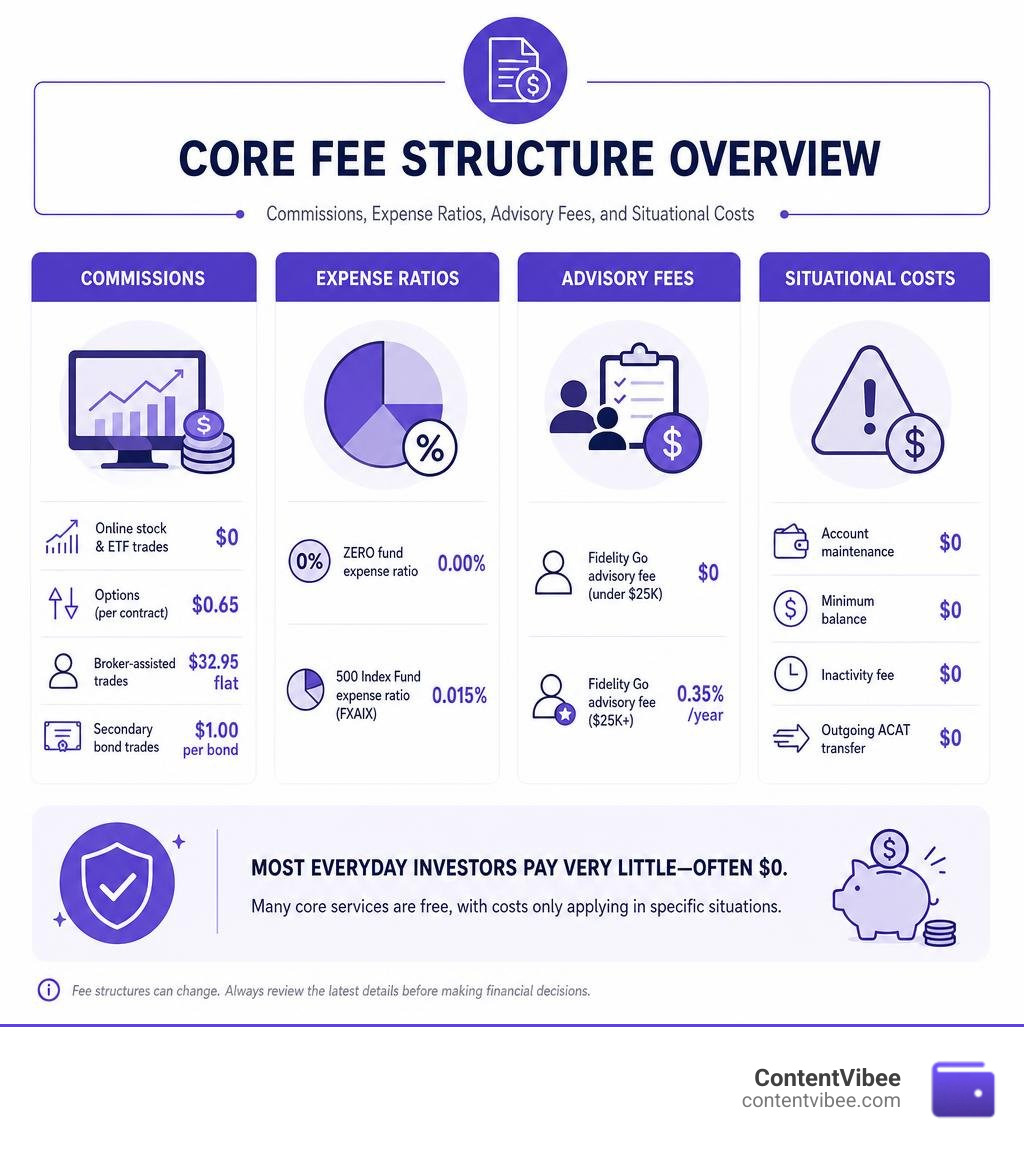
Understanding fidelity fees and commissions is simpler than most people expect. Here’s a quick snapshot of what most investors actually pay:
| Fee Type | Cost |
|---|---|
| Online stock & ETF trades | $0 |
| Options (per contract) | $0.65 |
| Account maintenance | $0 |
| Minimum balance | $0 |
| Inactivity fee | $0 |
| FIDELITY ZERO fund expense ratio | 0.00% |
| Fidelity 500 Index Fund (FXAIX) expense ratio | 0.015% |
| Broker-assisted trades | $32.95 flat |
| Secondary bond trades | $1.00 per bond |
| Fidelity Go advisory fee (under $25K) | $0 |
| Fidelity Go advisory fee ($25K+) | 0.35%/year |
| Outgoing ACAT transfer | $0 |
For most everyday investors, the total cost of trading stocks and ETFs at Fidelity is literally zero.
But “mostly free” isn’t the same as “always free.” There are specific situations — margin trading, broker-assisted calls, mutual fund short-term redemptions, wire transfers — where real costs apply. If you’re rolling over a 403(b) or moving into a Roth IRA, some of those situational fees could catch you off guard.
This guide breaks down every fee category in plain language, so you know exactly what you’re paying and when.
The Complete Breakdown of Fidelity Fees and Commissions
When you open a self-directed brokerage account, the first thing you want to know is how much of your hard-earned money will be chipped away by transaction costs. At ContentVibee, we believe in pulling back the curtain on financial jargon.
Fidelity uses an “à la carte” pricing structure. This is actually great news for you: it means you only pay for the specific services you actively use, rather than being hit with a blanket monthly fee just for keeping your account open.
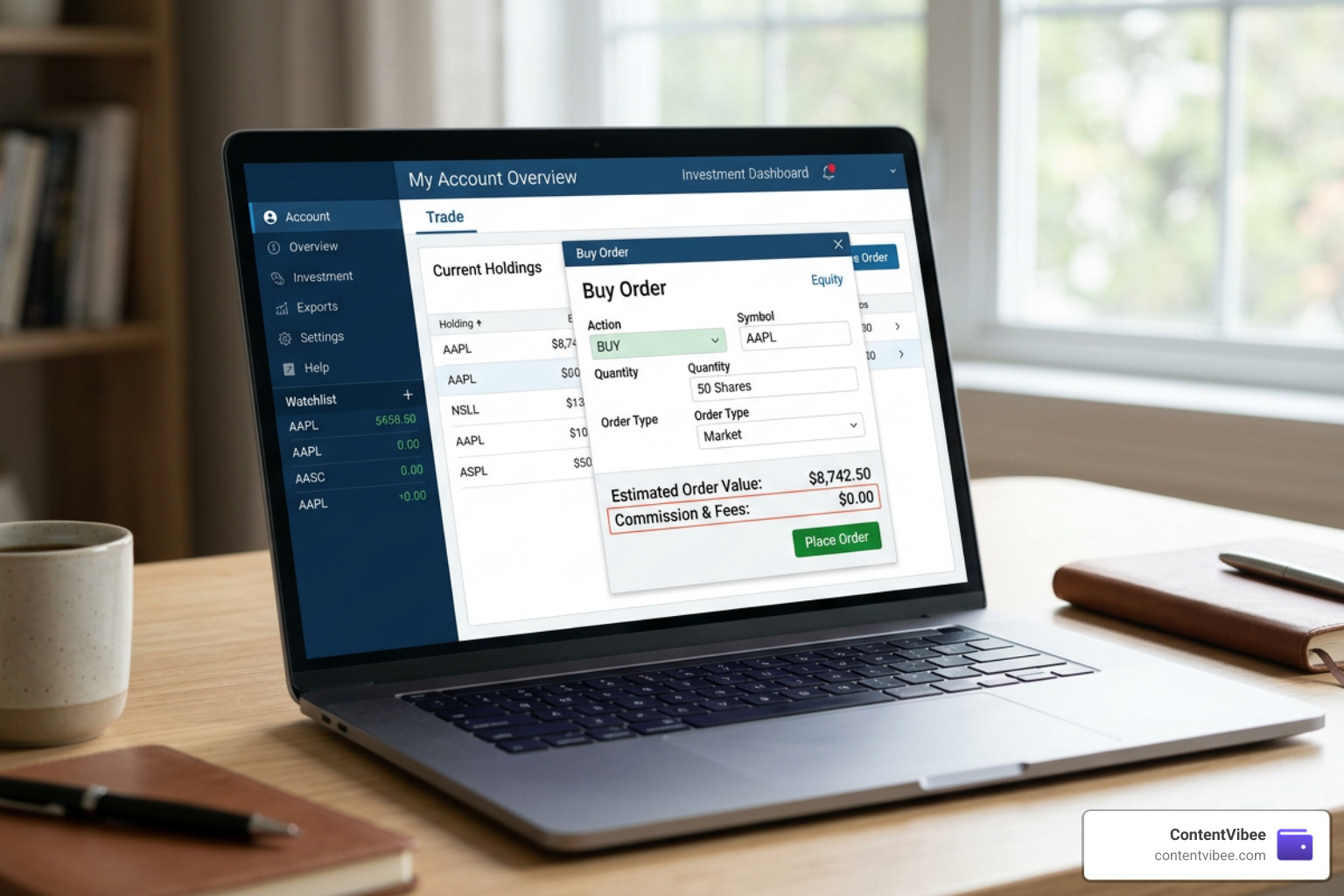
If you are standard retail investor trading online, you can access Straightforward and Transparent Pricing – Fidelity that is incredibly tough for other traditional brokerages to beat. But to maximize your savings, you have to know where the guardrails are. Let’s look closer at how these charges function in daily practice and explore if there are any catches in our review of Are Fidelity Trades Really Free Demystifying The Fees.
How Online Stock Trades Avoid Fidelity Fees and Commissions
For standard online U.S. stock and ETF trades, the commission is a clean $0.00. It doesn’t matter if you are buying one share of a tech giant or 10,000 shares of an index ETF; online trades executed through Fidelity.com, Active Trader Pro, or the Fidelity mobile app carry no base commission fee.
This zero-commission setup also extends to fractional share trading. Fidelity allows you to buy stocks and ETFs in dollar-based amounts (as little as $1.00) rather than whole shares. This is a game-changer for building a diversified portfolio on a budget without worrying about transaction costs eating into your principal.
However, there is a tiny, practically invisible regulatory fee on sell orders. This is known as the “Additional Assessment” fee, which offsets fees charged to brokerages by regulatory bodies like the SEC and self-regulatory organizations (SROs). It typically amounts to just $0.01 to $0.03 per $1,000 of principal when you sell a security. To learn more about how these micro-fees function, check out our guide on Fidelity Fees For Buying Stocks Whats The Catch.
Options Trading Fees and Contract Costs
If you trade options, the base commission to open or close a position online is still $0.00. However, you will pay a $0.65 per contract fee.
Let’s look at how this works in the real world:
- If you buy 5 options contracts, your fee is $3.25 (5 x $0.65).
- If you buy 10 options contracts, your fee is $6.50 (10 x $0.65).
There is a very customer-friendly exception here: buy-to-close orders for low-priced options (valued between $0.00 and $0.65) are completely commission-free and contract-fee-free. This makes it incredibly cheap to close out winning or nearly expired positions to manage your risk.
That high-volume professional options traders may face additional fees (such as an extra $0.50 per contract), and exchange-specific regulatory fees (like the Option Regulatory Fee, which fluctuates between $0.02 and $0.04 per contract) are passed through to the investor. For a deeper dive into these contract costs, read our detailed analysis of the Fidelity Fee Per Trade.
Fixed Income and Bond Trading Rates
For fixed-income investors, Fidelity offers some of the best deals in the industry.
- U.S. Treasuries: If you buy U.S. Treasury bonds or participate in Treasury auctions online, the transaction fee is $0.00.
- Secondary Market Bonds and CDs: For corporate bonds, municipal bonds, and CDs traded on the secondary market online, Fidelity charges a flat $1.00 per bond (with a maximum charge of $250 per trade).
This $1.00 per bond fee is highly competitive and translates to an average savings of about $13 per bond compared to traditional full-service brokers. If you prefer to trade bonds over the phone with a representative, note that additional broker-assisted charges will apply. For a step-by-step breakdown of how these fixed-income charges are calculated, refer to A Step By Step Guide To Fidelity Share Dealing Fees And Commissions.
Mutual Funds and the Zero Expense Ratio Revolution
Fidelity shook up the asset management industry by introducing the first-ever ZERO expense ratio index mutual funds offered directly to retail investors.
These funds carry an expense ratio of exactly 0.00%. That means every single dollar you invest goes directly toward tracking the index, with absolutely zero management fees taken out by Fidelity. The four primary ZERO funds are:
- Fidelity ZERO Total Market Index Fund (FZROX)
- Fidelity ZERO Large Cap Index Fund (FNILX)
- Fidelity ZERO Extended Market Index Fund (FZIPX)
- Fidelity ZERO International Index Fund (FZILX)
These ZERO funds have no minimum investment requirements, but there is a slight catch: they are proprietary funds, meaning you can only buy and hold them inside a Fidelity brokerage account. You cannot transfer them to another brokerage in-kind; you would have to liquidate them (which could trigger capital gains taxes in a taxable account) before moving your assets elsewhere.
Aside from the ZERO funds, Fidelity’s standard index funds are incredibly cheap. For example, the massive Fidelity 500 Index Fund (FXAIX) has an expense ratio of just 0.015%, costing you roughly $1.50 per year for every $10,000 invested.
For plan participants using a BrokerageLink account, check the official FIDELITY BROKERAGELINK® COMMISSION SCHEDULE to see how mutual fund fees are structured within your specific employer-sponsored retirement plan.
Comparing Mutual Fund Costs to Standard Fidelity Fees and Commissions
While proprietary Fidelity mutual funds and thousands of partner funds on the “FundsNetwork” are free to buy and sell, third-party mutual funds can carry steep transaction fees if you aren’t careful.
Fidelity groups mutual funds into three main categories:
- No Transaction Fee (NTF) Funds: Over 3,500 funds from various fund families that cost $0 to buy and sell online.
- Transaction Fee (TF) Funds: Funds that are not part of the NTF program. Buying these funds online triggers a flat $49.95 transaction fee per purchase (selling them is free).
- Load Funds: Funds that carry sales charges established by the fund sponsor itself (not Fidelity).
To prevent traders from abusing the NTF system, Fidelity enforces a short-term trading fee. If you sell shares of an NTF fund that you held for less than 60 days, you will be charged a flat $49.95 early redemption fee online. If you execute this short-term sale via the automated phone system (FAST), the fee is 0.5625% of the principal (up to $187.50). If you use a live representative, it climbs to 0.75% of the principal (up to $250).
To avoid these painful charges, always verify a fund’s transaction status before buying and plan to hold NTF funds for at least two full months. Learn more in our guide on Fidelity Mutual Fund Trade Fee When Is Free Not Actually Free.
Margin Rates and Account Maintenance Costs
If you want to borrow against the value of your securities to purchase more investments, you will need to apply for a margin account. Unlike its near-zero commission structure, margin interest is an area where Fidelity’s costs can add up quickly if you maintain a large debit balance.
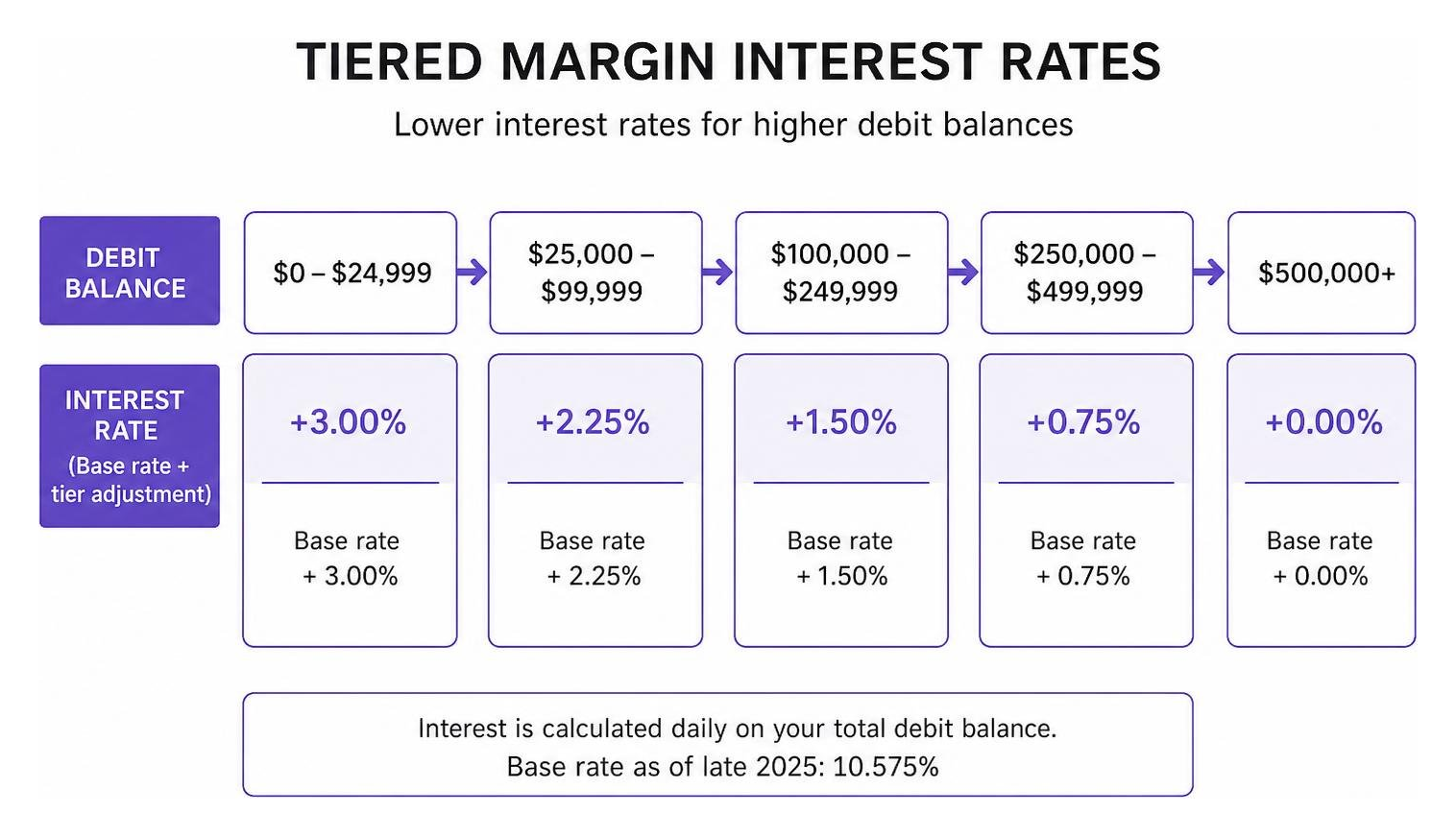
Fidelity’s margin interest rates are tiered: the more money you borrow, the lower your interest rate becomes. To see the most up-to-date tiers, you can visit the official Trading Commissions and Margin Rates | Fidelity page.
Tiered Margin Interest Rates
Fidelity calculates margin interest daily based on a base rate, which was established at 10.575% as of late 2025. A tiered premium or discount is then applied depending on your total debit balance:
- Balances under $25,000: Base Rate + 1.250% = 11.825%
- Balances of $25,000 to $49,999: Base Rate + 0.750% = 11.325%
- Balances of $100,000 to $249,999: Base Rate + 0.250% = 10.825%
- Balances of $1,000,000 or more: Base Rate – 3.075% = 7.500%
Because these interest rates are relatively high for smaller debit balances, margin trading is best reserved for experienced investors who understand the risks of leverage and margin calls. Additionally, if your account experiences a margin liquidation (where Fidelity has to sell your positions to cover a margin call), a $32.95 margin liquidation fee is applied. For a broader overview of account-level rules, see our Fidelity Brokerage Account Fees Review What You Need To Know.
Account Maintenance and Inactivity Fees
On the bright side, non-trading fees at Fidelity are virtually nonexistent. For standard retail brokerage accounts and IRAs:
- Annual/Monthly Maintenance Fees: $0
- Inactivity Fees: $0 (your account can sit empty or inactive for years without penalty)
- Account Minimums: $0 (you can open an account with no initial deposit)
This makes Fidelity an incredibly low-pressure environment for beginner investors who want to start small and contribute money at their own pace.
Hidden, Situational, and Managed Account Fees
While everyday investing is free, there are several situational fees that apply to specialized services or managed accounts. Reviewing the complete Fidelity Brokerage and Commission Fee Schedule | Trading information is always a smart move before requesting specialized services, but we have highlighted the most common ones below. You can also explore our companion guide on What Does It Really Cost To Trade On Fidelity.
Situational Fees and Broker-Assisted Trades
If you prefer to place trades over the phone with a live representative rather than using the website or app, you will pay a steep $32.95 broker-assisted trade fee per transaction. This fee applies to stocks, ETFs, and options, and it can quickly wipe out the benefits of commission-free trading. If you want to automate trades but avoid the live broker fee, using the FAST automated telephone service is a cheaper middle ground ($12.95 per trade). To understand when these representative fees are waived or charged, read Broker Assisted Trade Fee Fidelity.
Other situational fees to keep in mind include:
- Outgoing ACAT Transfers: $0. Unlike many brokerages that charge $50 to $75 to transfer your assets to another firm, Fidelity charges absolutely nothing to leave. This is a massive point of transparency that gives investors complete freedom.
- Domestic Wire Transfers: $0 (incoming and outgoing wires are completely free at Fidelity, though your receiving bank might charge a fee).
- Foreign Currency Wires: Up to 3% of the principal amount.
- Precious Metals Storage: If you buy physical gold or silver through Fidelity, there is a quarterly storage fee of 0.125% of the total value (or a $3.75 quarterly minimum).
Managed Accounts and Robo-Advisor Pricing
If you prefer to have your money managed for you, Fidelity offers several managed portfolio tiers:
- Fidelity Go (Robo-Advisor): This digital advisory service builds and manages a portfolio of Fidelity Flex mutual funds (which have zero expense ratios).
- Balances under $25,000: $0 advisory fee.
- Balances of $25,000 and above: 0.35% annual advisory fee (billed quarterly).
- Fidelity Wealth Management: For investors with a minimum of $500,000 in assets, this service provides a dedicated financial advisor. The advisory fees range from 0.50% to 1.50% per year depending on the size of your portfolio.
- Fidelity Private Wealth Management: Designed for ultra-high-net-worth clients with $2 million to $10 million+ in investable assets. Advisory fees range from 0.20% to 1.04% per year.
Frequently Asked Questions
Does Fidelity charge any monthly or annual account fees?
No. Standard retail brokerage accounts, traditional IRAs, Roth IRAs, and Rollover IRAs have no monthly or annual account maintenance fees, and no inactivity fees.
What is the expense ratio on Fidelity’s index funds?
Fidelity’s proprietary ZERO index funds (such as FZROX and FNILX) carry a 0.00% expense ratio. Their standard index funds are also incredibly cheap; for example, the Fidelity 500 Index Fund (FXAIX) has an annual expense ratio of just 0.015%.
Does Fidelity charge a fee to transfer my account out?
No. Fidelity is one of the few major brokerages that charges $0 for outgoing ACAT transfers, allowing you to move your cash and securities to another institution without a transfer-out penalty.
Conclusion
At ContentVibee, our goal is to give you clear, actionable financial advice so you can plan for retirement with confidence. When looking at the total cost of ownership, Fidelity’s fee structure is one of the most investor-friendly options on the market in July 2026.
By utilizing online trading channels, holding onto your mutual funds for at least 60 days, and avoiding high-interest margin accounts, you can run a highly sophisticated investment portfolio at Fidelity for virtually zero cost.
Ready to optimize your portfolio and keep more of your returns? Check out The Ultimate Guide To Fidelity Trading Fees And Savings for our step-by-step strategies on minimizing investment friction.


