Why More Retirees Are Choosing Bridge Jobs in 2026
Retirement bridge jobs examples are more varied — and more common — than most people expect. If you want a quick look at what counts as a bridge job, here are some of the most popular options:
Common Retirement Bridge Jobs:
| Job Type | Examples | Typical Arrangement |
|---|---|---|
| Healthcare support | Home health aide, pharmacy technician, nurse assistant | Part-time |
| Office and admin | Administrative assistant, receptionist, bookkeeper | Part-time or contract |
| Retail and service | Sales associate, cashier, customer service rep | Part-time |
| Professional/consulting | Freelance consultant, remote advisor, paralegal | Contract or self-employed |
| Care and community | Nanny, school bus driver, security guard | Part-time |
These roles fall into two broad categories: career bridge jobs (similar to your pre-retirement work) and non-career bridge jobs (something different, often lower stress). Research shows most retirees choose the second option.
Working in retirement might sound contradictory. But it’s increasingly the norm.
By 2026, people of retirement age are projected to make up more than 25% of the labor market. And most aren’t going back to demanding, full-time careers. They’re choosing flexible, lower-pressure roles that fit their lives — not the other way around.
According to research on bridge employment, the majority of retirees who return to work do so within six months of retiring. Most prefer part-time or contract arrangements. And the vast majority actively downshift their career ambitions — trading status and salary for flexibility, meaning, and reduced stress.
This guide walks you through the most practical bridge job options, what the research says about why retirees choose them, and how to find the right fit for your situation.
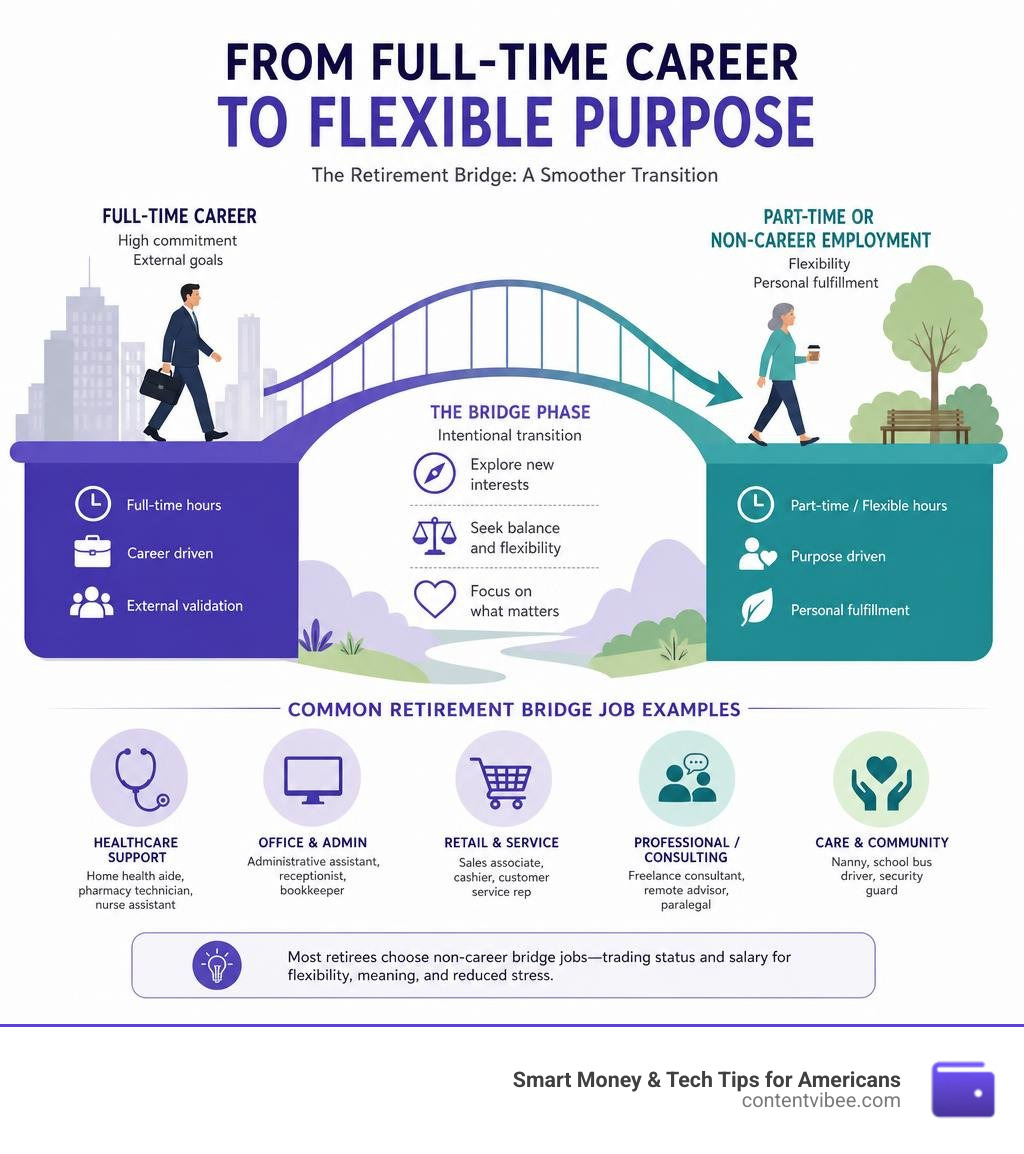
Redefining Retirement: The Psychology of the Bridge Phase
The traditional view of retirement was simple: you work hard for forty years, get a gold watch, and completely exit the labor force. But today, we are witnessing a massive cultural shift. Retirees are actively reconstructing the meaning of retirement. Instead of viewing it as an abrupt exit or a period of decline, they see it as a “frontier” or a “graduation event.” It is a boundary line between a life dominated by external obligations and a life dedicated to self-directed goals and self-enhancement.
To understand this psychological shift, we can look to the Kaleidoscope Career Model (KCM). The KCM describes how our career decisions are driven by three core parameters that shift in importance over our lifetimes:
- Authenticity: The desire to be true to oneself and do work that aligns with personal values.
- Balance: The need to integrate work with personal life, family, and leisure.
- Challenge: The search for stimulating work and professional growth.
In our pre-retirement career years, the drive for challenge and upward mobility often takes center stage. We chase promotions, manage heavy workloads, and tolerate high stress to build financial security.
However, when we cross the retirement tipping point, our priorities undergo a dramatic recalibration. Authenticity and balance become the dominant forces. Retirees use the “Bridge Phase” to seek out work that is personally meaningful but does not consume their entire identity or schedule.
This phase is beautifully described in The Bridge Phase – by Cheryl Clark – Fresh Horizons Journey, which highlights how a portfolio career—monetizing various skills in flexible ways—allows us to stay active without the burdens of traditional career ladders.
For many, the first step in planning this transition is calculating what they actually need. Before you step away from your primary career, it is highly beneficial to Estimate Your Monthly Retirement Benefits In 5 Easy Steps so you know exactly how much income your bridge job needs to generate.
Top Retirement Bridge Jobs Examples to Consider
When exploring retirement bridge jobs examples, it helps to understand that you do not have to stick to your old industry. In fact, research shows that between 50% and 60% of older career workers utilize bridge jobs before fully withdrawing from the labor market. Furthermore, a substantial portion of these workers change their occupational field entirely.
According to longitudinal studies, about 48% of men and 39% of women change their two-digit occupational codes when transitioning from a career job to a bridge job. When we factor in those who either change occupations or transition to part-time hours, nearly 80% of all retirement transitions qualify as genuine, self-directed retirement bridges rather than simple career extensions.
This flexibility is great news for your financial health and social engagement. In fact, economic research from Bridge Employment and Inequality | ECOnorthwest indicates that bridge employment does not exacerbate wealth inequalities later in life; instead, it serves as a highly beneficial pathway that offers continued financial security and vital social connections.
To find the right fit, you can look at the Top 25 Part-Time Jobs for Retirees in 2026 – AARP to see which roles match your energy levels and income goals. It is also wise to explore Alternative Ways To Save For Retirement That Actually Work to ensure your bridge income is working as hard as possible for you.
Non-Career Retirement Bridge Jobs Examples for Low-Stress Income
For many retirees, the goal of a bridge job is to downshift. In academic interviews with bridge employees, an overwhelming 22 out of 26 participants expressed a strong preference to downshift their career aspirations. Only a tiny minority (4 out of 26) remained interested in career progression, highly challenging tasks, or matching their previous corporate compensation.
Non-career bridge jobs are perfect for this style of working. They offer reduced accountability, clear boundaries (you leave your work at the door when your shift ends), and opportunities to interact with your local community.
Popular non-career bridge jobs include:
- Retail Sales Associate: Working in a local boutique, hardware store, or garden center.
- Customer Service Representative: Answering questions and helping people solve straightforward problems.
- Administrative Assistant or Receptionist: Managing schedules, greeting visitors, and keeping offices organized.
- School Bus Driver or Crossing Guard: Serving local families with split-shift schedules that leave the middle of the day completely free.
To help you decide which path makes sense for your lifestyle, here is a comparison of how these roles differ from career-based options:
| Feature | Career Bridge Jobs | Non-Career Bridge Jobs |
|---|---|---|
| Primary Motivation | Utilizing specialized skills, maintaining professional status | Flexibility, social interaction, low stress |
| Stress Level | Moderate to High (often involves project deadlines) | Low (tasks are completed during shift hours) |
| Accountability | High (responsible for business outcomes or clients) | Low (focused on executing specific daily tasks) |
| Schedule Flexibility | Variable (may require being “on-call” or meeting deadlines) | High (structured shifts, easy to swap hours) |
| Occupational Change | None (remaining in the same field) | High (exploring entirely new, simpler roles) |
Professional and Remote Retirement Bridge Jobs Examples
If you prefer to leverage your hard-earned professional expertise but want to ditch the long commute and endless corporate meetings, remote and professional bridge jobs are an exceptional choice.

Many retirees transition into part-time consulting or freelance project work. This allows you to set your own hourly rates and choose projects that genuinely interest you.
Some unique, modern bridge roles are emerging directly within corporate HR departments to assist other workers. For example, you might look for positions like a Retirement Transition Partner-Fully Remote Part-time | Hirevector. In this kind of role, experienced professionals help guide team members through the emotional, logistical, and administrative steps of planning their own retirements—without providing formal financial advice.
Other professional options include:
- Freelance Bookkeeper: Keeping the books for small, local businesses on a flexible, remote schedule.
- Paralegal or Contract Researcher: Helping law firms or research organizations on a project-by-project basis.
- Remote Advisory Roles: Offering industry-specific consulting to companies that need experienced, temporary guidance.
Designing Retiree-Friendly Workplaces: Implications for Employers
As the labor market shifts and workers aged 65 and older make up a larger portion of the workforce, organizations must rethink how they recruit and retain mature talent. Traditional Human Resource Development (HRD) policies often rely on generalized, age-neutral Equality, Diversity, and Inclusion (EDI) approaches. However, these generic frameworks fail to address the unique motivations of bridge employees.
To successfully attract experienced workers, employers should design targeted, value-aligned opportunities. This means moving away from rigid full-time structures and moving toward:
- Phased Retirement Programs: Allowing employees to gradually scale back their hours rather than making an abrupt exit.
- Mentorship and Knowledge-Transfer Roles: Creating positions where retirees can train successors, preserving institutional knowledge without the stress of daily operational management.

Furthermore, research on gender differences, such as the insights found in BRIDGE JOBS AS PATHS TO WORKING LONGER: DO GENDER …, indicates that men and women often navigate these late-career transitions differently. Women may seek different types of flexibility or community-oriented roles, meaning HR policies must be highly personalized and person-centered.
By understanding that mature workers prioritize authenticity and balance over upward progression, companies can design training and retention programs that respect their boundaries. For retirees, aligning these work opportunities with a solid decumulation strategy is vital. We recommend using tools like the Demystifying The 4 Percent Retirement Withdrawal Calculator to see how part-time bridge income can protect your nest egg from early drawdowns.
Frequently Asked Questions About Bridge Jobs
What is the difference between a career bridge job and a non-career bridge job?
A career bridge job involves staying within your established professional industry but working under different terms, such as reducing your hours to part-time or transitioning into a contract consulting role. A non-career bridge job involves a complete occupational change. You step into an entirely different, often less demanding field—such as retail, hospitality, or basic administration—specifically to downshift your responsibilities and enjoy a lower-stress work environment.
How does taking a bridge job affect my Social Security benefits?
If you claim Social Security benefits before reaching your Full Retirement Age (FRA) and continue to work, your benefits may be temporarily reduced if your earnings exceed the annual Social Security earnings limit. However, once you reach your FRA, these withheld benefits are recalculated to increase your monthly check. If you are already at or past your FRA, you can earn as much as you want through a bridge job without any reduction in your benefits.
How soon after retiring should I start a bridge job?
Academic research indicates that the majority of retirees who choose bridge employment start their first bridge job within six months of leaving their primary career. This quick transition often helps retirees maintain a consistent daily routine, preserve their social connections, and avoid the psychological “shock” that sometimes accompanies a sudden shift into complete leisure. However, taking a short sabbatical first can be a wonderful way to clear your mind before starting your search.
Conclusion
At ContentVibee, we believe that retirement shouldn’t mean turning off your professional brain or losing your daily sense of purpose. Instead, utilizing retirement bridge jobs examples can help you build a custom-tailored lifestyle that perfectly balances financial health, mental stimulation, and personal freedom.
Whether you decide to consult from a home office, help customers at a local nursery, or mentor the next generation of workers, a bridge job is a powerful tool to help you control your transition.
To make sure your financial plan is completely aligned with your working-retirement goals, take a moment to use our Retirement Calculator Estimate Savings Needed and try out our Retirement Math Made Easy With A 401K Balance Calculator.
Additionally, before you finalize your plans, make sure to Learn how working in retirement affects your spousal benefits so you can maximize every single dollar you have earned!