


More Retirees Are Working — And Winning at It
The best jobs after retirement aren’t just about extra cash. They’re about staying sharp, connected, and in control of your time.
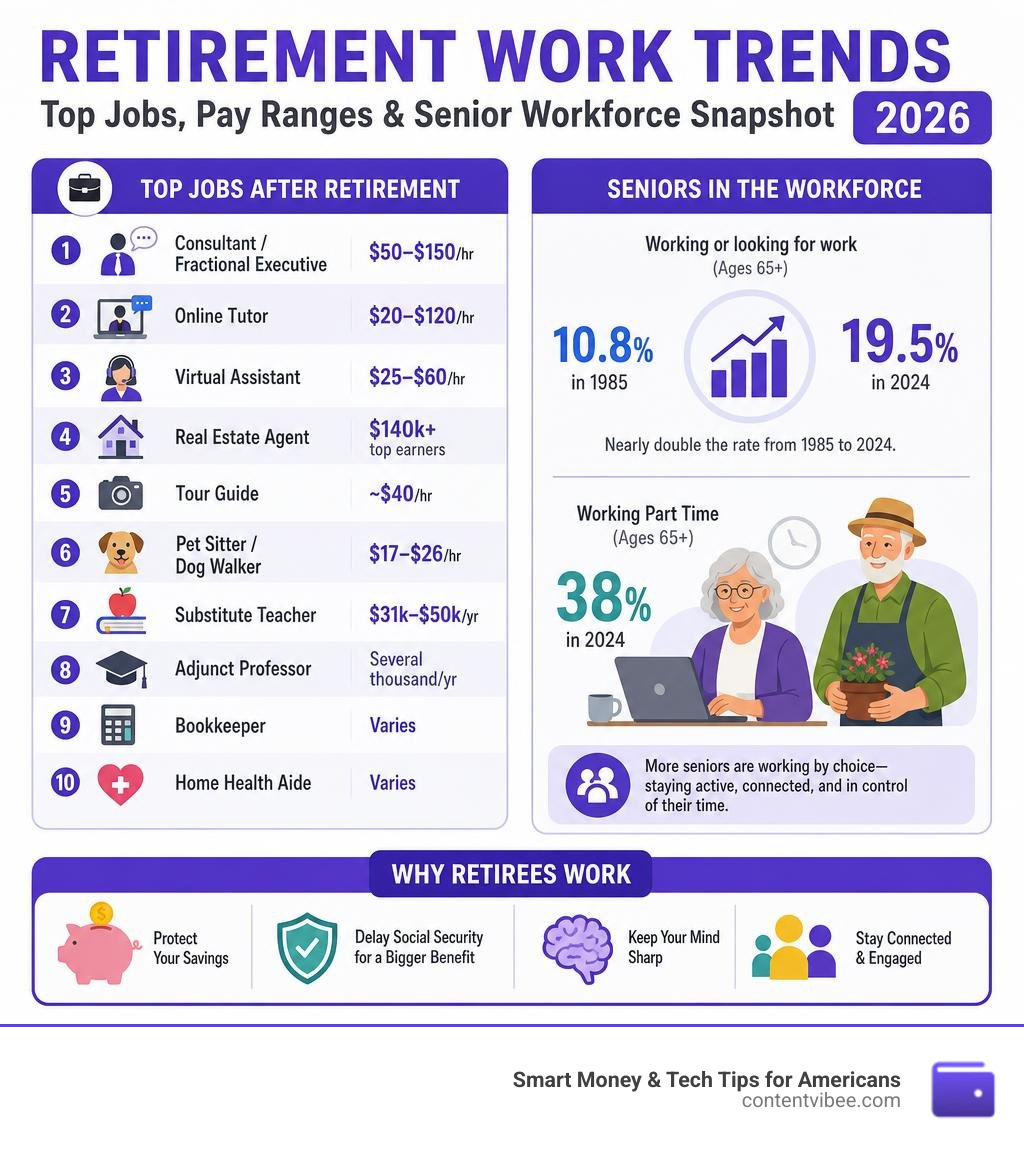
Here’s a quick look at the top options:
| Job | Avg. Pay | Stress Level | Physical Demand |
|---|---|---|---|
| Consultant / Fractional Executive | $50–$150/hr | Low | Very Low |
| Online Tutor | $20–$120/hr | Low | Very Low |
| Virtual Assistant | $25–$60/hr | Low | Very Low |
| Real Estate Agent | $140k+ top earners | Medium | Low |
| Tour Guide | ~$40/hr | Low–Medium | Medium |
| Pet Sitter / Dog Walker | $17–$26/hr | Very Low | Low–Medium |
| Substitute Teacher | $31k–$50k/yr | Medium | Low |
| Adjunct Professor | Several thousand/yr | Low | Very Low |
| Bookkeeper | Varies | Very Low | Very Low |
| Home Health Aide | Varies | Medium | Medium–High |
In 2024, 19.5% of Americans aged 65 and older were working or looking for work — nearly double the 10.8% rate recorded in 1985, according to Bureau of Labor Statistics data. And around 38% of adults 65+ worked part time that same year.
This isn’t a sign that retirement is broken. For many people, it’s a sign that retirement has evolved.
Working a few hours a week can protect your savings, delay Social Security claims (boosting your monthly check), and keep your mind engaged. But here’s what matters most: the right job fits your life, not the other way around.
Whether you’re a working spouse approaching retirement, or already there and looking for flexible income that doesn’t trigger the Social Security earnings test, this guide is built for you.
Why Seniors Are Returning to the Workforce in 2026
The traditional finish line of work has shifted. In June 2026, retirement is no longer a hard stop; instead, it is a transition into a self-directed “second act.”
According to a report from the Transamerica Center for Retirement Studies, 53% of workers who expect to retire at age 70 or later say they plan to continue working in retirement. This trend is driven by several economic and psychological realities:
- The Death of the Traditional Pension: Most modern workplaces have swapped defined-benefit pensions for market-dependent 401(k) plans, leaving many retirees vulnerable to market volatility.
- Rising Costs of Living: Persistent inflation over the last few years has made everyday necessities more expensive, eating into fixed-income budgets.
- Longer Lifespans: We are living longer, healthier lives. A retirement that lasts 30 years requires a much larger nest egg than one that lasts ten.
- The Desire for Connection: Sitting at home sounds wonderful for the first six weeks, but the novelty can wear off. Working part-time provides physical activity, social connection, and cognitive stimulation.
If you are looking for proactive strategies to shore up your accounts before making the leap, check out our guide on Alternative Ways To Save For Retirement That Actually Work.
The Best Jobs After Retirement: Top Flexible and High-Paying Roles
When evaluating the best jobs after retirement, we must look beyond the hourly wage. The ideal retirement gig should be what we call “boring, flexible, and not physically punishing.”
A great retirement job should not feel like a second prison. It should protect your freedom first. If a job requires you to wake up at 5:00 AM to answer to an aggressive manager, it defeats the purpose of retiring. Hobbies are wonderful, but be careful about monetizing them—turning your favorite woodworking or crafting passion into a high-pressure business can quickly ruin the joy it brings you.
To help you compare, let’s explore the top-ranked retirement roles across key categories compiled from trusted resources like the Top 25 Part-Time Jobs for Retirees in 2026 – AARP and Best Jobs for Retirees – Kiplinger.
High-Paying Consulting and Professional Services
If you spent decades climbing the corporate ladder, managing projects, or advising clients, you possess a highly valuable asset: wisdom. In 2026, companies are increasingly looking for fractional help—highly experienced professionals who can solve specific problems without demanding a full-time salary and benefits package.
As highlighted by the Daily Mail Online, there are lucrative second careers that Americans over 50 can transition into that prioritize life experience over new degrees:
- Business Advisor / Fractional Executive: Startups and mid-sized businesses often need executive-level guidance but cannot afford a full-time C-suite salary. These roles can pay anywhere from $150,000 to over $300,000 annually on a fractional basis, allowing you to work with multiple clients on your own terms.
- Independent Consultant: By offering project-based consulting in your former industry, you can easily charge $100 to $300+ per hour. You control the scope, the timeline, and the number of clients you take on.
- Project Manager: Companies frequently need seasoned leaders to oversee short-term initiatives. With typical pay ranging from $110,000 to $160,000, this role allows you to step in, deliver results, and step out when the project wraps up.
Low-Stress Best Jobs After Retirement in Education and Tutoring
Teaching and tutoring are among the most rewarding ways to stay active. They offer a strong sense of purpose by allowing you to mentor the next generation.
- Adjunct Professor: Local community colleges and universities love hiring retired professionals to teach night or online classes. It requires no research or administrative committee work—just teaching, grading, and sharing your real-world experience.
- Online Tutor: If you prefer working from home, online tutoring platforms connect you with students worldwide. You can teach school subjects, test preparation, or even conversational English to international students. Independent tutors can charge anywhere from $40 to $120 per hour depending on their specialty.
- Substitute Teacher: According to the National Center for Education Statistics (NCES), 76% of public schools struggled to hire certified teachers for the 2025 school year. This staffing crisis means school districts are eager to hire reliable substitute teachers. In many states, you only need a bachelor’s degree and a background check to qualify, and the role offers the ultimate flexibility: you simply say “no” on days you do not wish to work.
For a deeper look at other low-pressure options, read the breakdown of 13 Low-Stress Jobs After Retirement – Willow.
Flexible Best Jobs After Retirement in the Gig Economy
The gig economy has expanded rapidly, and seniors are its fastest-growing demographic. According to recent data, gig participation among those over 55 has grown significantly because it prioritizes flexibility above all else.

- Pet Sitting and Dog Walking: If you love animals, platforms like Rover make it simple to find local pet-sitting or dog-walking gigs. It keeps you physically active and offers high-meaning work (nannies and pet care workers consistently rank among the highest in job satisfaction).
- Virtual Assistant: Many small business owners and entrepreneurs need help with administrative tasks, scheduling, email management, and basic bookkeeping. This is a fully remote role that pays between $25 and $60 per hour and can be done from the comfort of your home.
- Rideshare and Delivery Driving: While driving for platforms like Uber or DoorDash offers complete schedule control, we advise caution. Remember: the car is not free. When you subtract gas, insurance, tires, brakes, and vehicle depreciation, your actual take-home pay may be much lower than the gross earnings shown on the app.
Financial Rules of the Road: Social Security and Taxes
Before you apply for any post-retirement job, you must understand how your earnings will interact with federal benefit rules and tax brackets. Working without a plan can lead to unexpected tax bills or a temporary reduction in your Social Security checks.
1. The Social Security Earnings Test (2026 Limits)
If you have already reached your Full Retirement Age (FRA)—which is between 66 and 67 for most people today—you can earn as much money as you want with absolutely no reduction in your Social Security benefits.
However, if you claim benefits before reaching your FRA, the Social Security Administration applies an earnings test:
- The Under-FRA Limit (2026): The earnings limit is $24,480. If you earn more than this amount, Social Security will withhold $1 in benefits for every $2 you earn over the limit.
- The Year-You-Reach-FRA Limit (2026): If you reach your FRA in 2026, the earnings limit is $65,160. Social Security will withhold $1 in benefits for every $3 you earn over the limit until the month you actually reach FRA.
Note: This withheld money is not lost forever. Once you reach your Full Retirement Age, the government recalculates your monthly benefit upward to account for the payments that were withheld.
To make sure your retirement math is accurate, we highly recommend utilizing our Retirement Math Made Easy With A 401K Balance Calculator and our Retirement Calculator Estimate Savings Needed.
2. Taxes and Self-Employment Gigs
If you choose a gig economy role (like consulting, dog walking, or freelance writing), you will be classified as an independent contractor (1099). This means you must pay the 15.3% self-employment tax on any net earnings over $400.
To protect your earnings, make sure to:
- Track all business expenses on a Schedule C.
- Deduct qualified business mileage (the standard IRS rate is a valuable write-off).
- Take advantage of the 20% Qualified Business Income (QBI) deduction if you qualify.
- Keep your tax brackets in mind. For single filers over 65 in 2026, the standard deduction is $17,750 (including the enhanced senior deduction).
If you are looking to optimize your retirement accounts and minimize your tax burden, read our guide on After Tax Contributions How To Maximize Your Retirement Nest Egg.
Frequently Asked Questions About Working After Retirement
Will working after retirement reduce my Social Security benefits?
Only if you are under your Full Retirement Age (FRA) and your earnings exceed the annual limit ($24,480 in 2026). If you are over your FRA, you can earn an unlimited amount of money without any reduction in your benefits.
How do I find age-friendly employers?
Look for companies that have earned the Certified Age Friendly Employer™ designation from the Age Friendly Foundation (companies like Humana, for example, have held this designation for years). These employers actively value life experience, offer flexible hours, and provide robust onboarding and training programs. You can also use specialized job boards through AARP and Indeed that filter specifically for older workers.
When can you stop working and retire in California?
Determining when you can stop working depends heavily on your location. California has a high cost of living and some of the highest state income taxes in the country, which can impact how long your retirement savings will last. For a detailed breakdown of the unique financial rules, tax structures, and lifestyle considerations in the Golden State, read our comprehensive guide: When Can You Stop Working And Retire In California.
Conclusion
Finding the best jobs after retirement is about matching your skills and schedule with a role that brings you energy rather than draining it. Whether you choose to leverage your corporate expertise as a high-paying consultant, mentor students as an online tutor, or enjoy the fresh air as a dog walker, the power is entirely in your hands.
At ContentVibee, we are committed to helping you navigate this exciting chapter with clear, actionable advice. By planning your post-retirement work around tax rules and Social Security limits, you can enjoy the perfect balance of a purposeful routine and financial security.

Before you accept a new position, make sure you understand how your income could affect your household benefits. Check out our guide on Are spousal benefits reduced by working in retirement? to ensure your family’s financial plan remains perfectly optimized.