


Can You Collect Spousal Social Security Benefits While Working?
Yes — spousal social security benefits while working is absolutely possible. But there are rules that can reduce how much you receive if you haven’t yet reached full retirement age (FRA).
Here’s the quick answer:
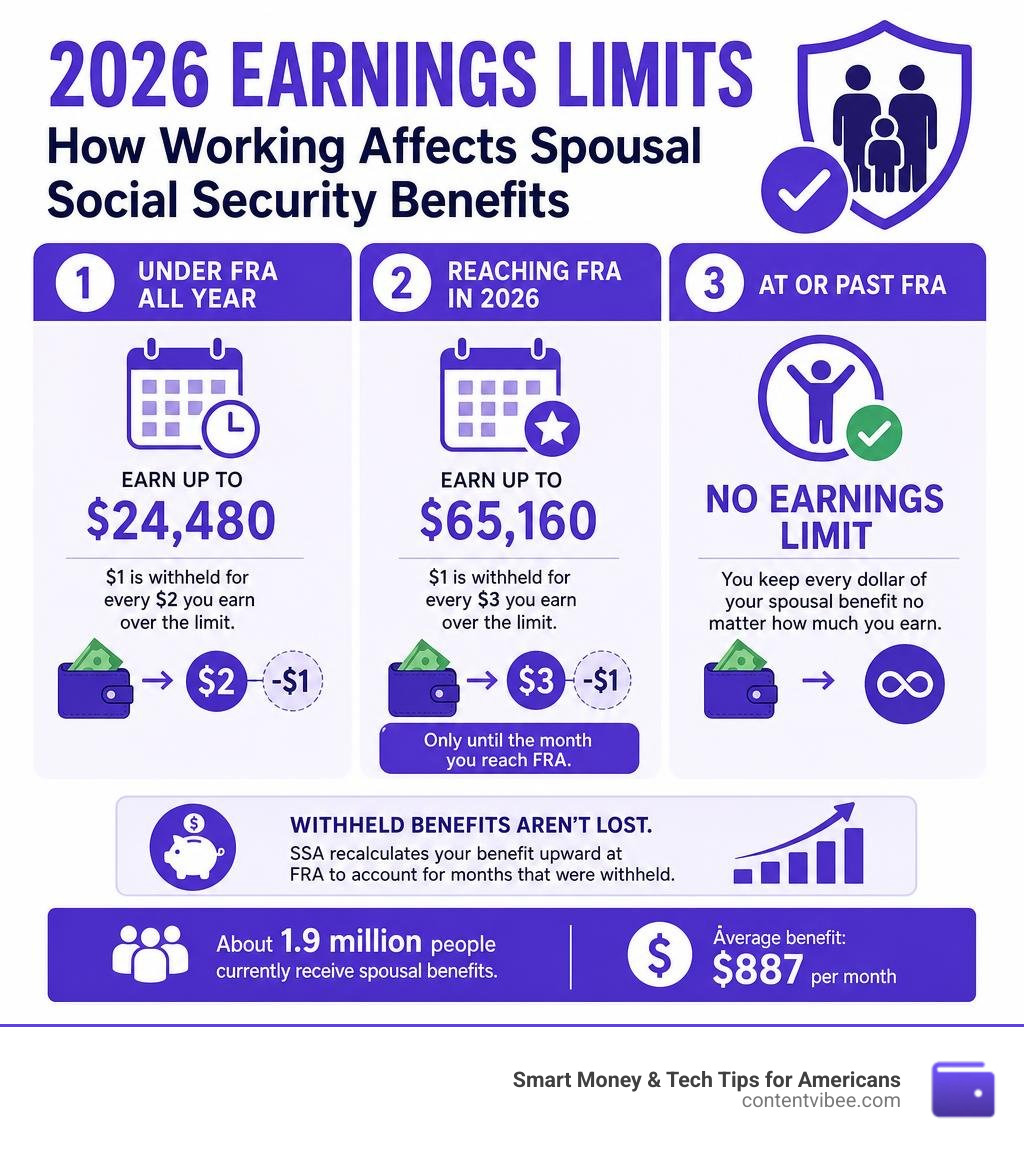
- Under FRA all year in 2026? You can earn up to $24,480 before benefits are reduced. Above that, $1 is withheld for every $2 you earn over the limit.
- Reaching FRA in 2026? The limit rises to $65,160, and only $1 is withheld for every $3 over the limit — but only until the month you hit FRA.
- At or past FRA? No earnings limit applies. You keep every dollar of your spousal benefit no matter how much you earn.
- Withheld benefits aren’t lost. SSA recalculates your benefit upward at FRA to account for months that were withheld.
About 1.9 million people currently receive spousal benefits, averaging $887 per month. Many of them — or their working partners — don’t realize how the earnings test applies, or that the rules change significantly once you hit full retirement age.
If you’re part of a couple trying to figure out when to claim, who should keep working, and how to avoid leaving money on the table, the rules around spousal benefits can feel overwhelming. This guide breaks it all down in plain language.
Simple spousal social security benefits while working glossary:
Understanding Spousal Social Security Benefits While Working
When we talk about spousal benefits, we are looking at a system designed to protect a lower-earning partner’s retirement security. Under the rules of the Social Security Administration (SSA), you can receive a benefit that is worth up to 50% of your partner’s Primary Insurance Amount (PIA) if you claim at your own full retirement age. The best part? Claiming a spousal benefit does not reduce your partner’s own retirement check by a single penny.
However, the math changes if you claim early. If you claim spousal benefits at the minimum age of 62, your monthly check is permanently reduced to as little as 32.5% of your spouse’s PIA. If you want to know exactly how your age impacts your payout, you can read our guide on How To Check Your Eligibility For Spousal Social Security Benefits or utilize the official Benefits for Spouses – Social Security Administration resource.
When you are earning a paycheck, the SSA looks at your age and your earnings to determine if you can keep your full spousal benefit. If you are under your full retirement age, a federal policy known as the Retirement Earnings Test (RET) kicks in. This test acts as a temporary brake on your benefits if your wage or self-employment income exceeds certain annual thresholds.
How the Earnings Test Affects Spousal Social Security Benefits While Working
The earnings test is often misunderstood. Many working spouses believe that if they earn too much, their benefits are gone forever. In reality, the earnings test simply pauses or reduces your monthly payments temporarily.
If you are earning wages or net self-employment income while receiving a spousal benefit, the SSA will apply the earnings test to your individual earnings. For a deeper dive into this specific dynamic, check out our article on Working In Retirement Are Spousal Benefits Reduced By Working.
It is also important to note what counts as “earnings.” The SSA only looks at active work income—meaning your W-2 wages or your net earnings from self-employment. The earnings test does not count:
- Pension payments
- Annuities
- Investment income or stock dividends
- Interest income
- Government or military benefits
For more details on how the SSA tracks these amounts, you can refer to the official Benefits Planner: Retirement | Receiving Benefits While Working | SSA page.
The 2026 Earnings Limits and Reduction Rules
As we navigate through 2026, the SSA has updated the earnings thresholds. If you are receiving spousal benefits and continue to work, your limit depends entirely on how close you are to your full retirement age.
Here is how the reduction rules work in 2026:
| Your Age Status in 2026 | 2026 Annual Earnings Limit | Reduction Rate |
|---|---|---|
| Under Full Retirement Age (All Year) | $24,480 | $1 withheld for every $2 earned over limit |
| Reaching Full Retirement Age (In 2026) | $65,160 | $1 withheld for every $3 earned over limit (only counts earnings before FRA month) |
| At or Past Full Retirement Age | No Limit | No reduction |
Let’s look at a quick example. Suppose you are 64 years old (under FRA all year in 2026) and you qualify for a spousal benefit of $800 per month ($9,600 per year). You decide to keep working a part-time job in California, earning $30,480 this year.
Your earnings are exactly $6,000 over the 2026 limit of $24,480. Under the $1-for-$2 rule, the SSA will withhold $3,000 of your benefits for the year. This means they will pause your $800 monthly check for the first few months of the year until they have withheld the necessary $3,000, and then pay your remaining benefits for the rest of the year.
Claiming Strategies and Coordination for Working Couples
Coordinating when and how to claim benefits is one of the most critical financial moves a married couple can make. Because spousal benefits are tied directly to the primary worker’s record, you cannot claim a spousal benefit until your partner has filed for their own retirement benefits.
This requirement can create a coordination challenge if one spouse wants to keep working to build up their retirement account while the other wants to start collecting spousal benefits. To build an effective roadmap, we recommend reading The Smart Couples Guide To Social Security Strategies and reviewing the planning insights in Spousal Benefits: An Often Overlooked Key to Maximizing Social ….
Can You Claim Spousal Social Security Benefits While Working and Delaying Your Own?
A common question we hear at Smart Money & Tech Tips for Americans is: “Can I claim a spousal benefit while letting my own retirement benefit grow?”
For the vast majority of workers today, the answer is no. Under the Bipartisan Budget Act of 2015, a rule called “deemed filing” was established. Deemed filing means that when you apply for either retirement or spousal benefits, you are “deemed” to be applying for both simultaneously. The SSA will automatically calculate both amounts and pay you the higher of the two. You cannot choose to collect only the spousal benefit while delaying your own worker benefit to accumulate delayed retirement credits.
There is a historical exception: if you were born before January 2, 1954, you could file a “restricted application” at FRA to receive only the spousal benefit while letting your own grow. However, since we are now in 2026, anyone born before that date has already passed their full retirement age, making this loophole virtually obsolete for new claimants. To understand how these rules interact for dual-income households, take a look at His Hers And Ours The Ultimate Guide To Dual Social Security Benefits.
Delaying Claims to Maximize Survivor Benefits
While spousal benefits are capped at 50% of the worker’s PIA at full retirement age, survivor benefits work differently. A surviving spouse can inherit up to 100% of the monthly benefit the deceased partner was collecting at the time of their death.
This makes delaying the higher earner’s claim incredibly valuable. If the higher-earning spouse delays claiming their benefit past their FRA up to age 70, their monthly payout grows by 8% per year. This not only maximizes their own lifetime income but also locks in the highest possible survivor benefit for the remaining spouse.
Coordinating this “split strategy”—where the lower-earning spouse claims early (or at FRA) while the higher earner delays until age 70—is often the most efficient way to maximize total household wealth. You can find excellent coordination tips in Timing Is Everything How Married Couples Can Claim Social Security Simultaneously.
What Happens to Withheld Benefits and Special Exceptions
If the earnings test causes some of your spousal benefits to be withheld, do not panic. Those funds are not gone forever.
When you reach your full retirement age, the SSA automatically recalculates your monthly benefit amount. They will look back at your claiming history and “credit” you for any months where your benefit was withheld due to excess earnings.
For example, if you claimed spousal benefits 36 months before your FRA, your benefit was permanently reduced to account for those 36 months of early claiming. However, if you worked and had 12 months of benefits fully withheld, the SSA will recalculate your benefit at FRA as if you had claimed only 24 months early. This permanently increases your monthly check going forward. You can read more about this recalculation process in the official guide: How Work Affects Your Benefits – Social Security Administration.
The Child-in-Care Exception for Working Spouses
There is a major exception to the early-claiming reduction rules. If you are caring for a child who is under age 16, or a child of any age who was disabled before age 22, you can claim spousal benefits at any age without the standard early-claiming reduction.
Under this “child-in-care” rule, your spousal benefit is paid at the full 50% rate, even if you are only 62. However, keep in mind that the earnings test still applies. If you work while receiving child-in-care spousal benefits, your earnings can still trigger benefit withholding if you exceed the annual limits. Furthermore, unlike standard retirement benefits, spouses who have their benefits withheld under the child-in-care exception do not receive a recalculated benefit increase at FRA. For official policy details, see SSA – POMS: RS 00202.020 – Spouse’s Benefits – Payment – 01/20/2026.
How the Working Spouse’s Earnings Impact the Household
Another crucial rule to keep in mind is whose work affects whose benefits.
- If you receive spousal benefits and you work: Only your own earnings can cause your spousal benefit to be withheld. Your work does not affect your spouse’s retirement check.
- If your spouse (the primary worker) works: If they are under FRA and work, their excess earnings can withhold both their own retirement benefit and your spousal benefit.
This means if the primary earner has high wages that trigger the earnings test, the entire household’s Social Security stream could be temporarily paused. To run the numbers for your specific household income, check out Calculate Your Spousal Benefits The Easy Way.
How to Apply for Spousal Benefits While Employed
Applying for your benefits while you are still working is a straightforward process, but you will need to have your documentation ready to avoid delays.

Before you begin, we highly recommend using the Tools/Finance Calculator/Social Security Spousal Benefit Calculator to estimate your monthly payments and see how your current wages will affect your initial checks.
Step-by-Step Application Guide
To apply for spousal benefits, follow these steps:
- Gather Your Documents: You will need your Social Security number, your spouse’s Social Security number, your marriage certificate, and your recent W-2 forms or self-employment tax returns for the prior year.
- Submit Your Application: The fastest way to apply is online at the SSA website. You can also apply over the phone by calling 1-800-772-1213, or schedule an in-person appointment at your local Social Security office here in California.
- Report Your Estimated Earnings: During the application, the SSA will ask you to estimate your total earnings for 2026. Be as accurate as possible so they can apply the earnings test correctly from month one and avoid overpayment issues later.
For a comprehensive checklist, consult The Ultimate Guide To Spousal Social Security Eligibility.
Frequently Asked Questions About Spousal Benefits
Do withheld spousal benefits get paid back later?
Yes, but not in a lump sum. Instead, when you reach your full retirement age, the SSA recalculates your monthly benefit upward. They adjust your reduction factor to credit you for the months your benefits were withheld due to your work earnings. To learn more about how this timing works, check out At What Age Can I Claim My Spouses Social Security.
Can a divorced spouse receive benefits while working?
Yes. If you were married for at least 10 years, have been divorced for at least 2 consecutive years, and have not remarried, you can claim spousal benefits on your ex-spouse’s record.
Importantly, your ex-spouse does not even need to have applied for their own benefits yet, as long as they are eligible for them and you are at least 62. If you work, the exact same 2026 earnings test limits apply to your divorced spousal benefit. For official guidelines, see SSA – POMS: NL 00711.025 – Wife’s Benefits Paragraphs – 12/22/2003.
Does my spouse’s work affect my spousal benefit amount?
It can. If your spouse is the primary worker, is under FRA, and continues to work, their earnings can cause both their retirement benefit and your spousal benefit to be withheld. However, if your spouse has already reached FRA, their earnings will not affect your spousal benefit. For strategies on how to navigate this, read Maximizing Spousal Benefits Without Leaving Money On The Table.
Conclusion
Navigating spousal social security benefits while working doesn’t have to be a headache. By understanding the 2026 earnings limits—$24,480 if you are under FRA all year, and $65,160 if you reach FRA this year—you and your partner can strategically plan your work hours and claiming timeline to maximize your household income.
At Smart Money & Tech Tips for Americans, we want to help you make informed financial decisions. If you are also planning for the long term and want to understand how survivor benefits protect your household, read our comprehensive guide: Claiming What’s Yours: A Guide to Deceased Spouse Social Security.


