


What You’ll Actually Pay in Fidelity Share Dealing Fees
For American expats living in the UK or US investors managing UK-based portfolios, understanding Fidelity share dealing fees is essential. While Fidelity is a household name in the United States, its UK platform operates under a completely different fee structure. Here’s a quick breakdown of what you’ll pay:
| Fee Type | Cost |
|---|---|
| Standard online trade | £7.50 per deal |
| Phone trade | £30 per deal |
| Regular savings plan / dividend reinvestment | £1.50 per trade |
| Service fee (under £250,000) | 0.35% per year |
| Service fee (£250,000 to £1 million) | 0.20% per year |
| Maximum annual service fee | £2,000 |
| FX charge (international shares, up to £10,000) | 0.75% |
| FX charge (£10,000.01 to £20,000) | 0.50% |
| FX charge (over £20,000) | 0.25% |
| Junior accounts | No service fee |
Investing in shares can feel expensive if you don’t know the fee structure. A single trade here, a service charge there — it adds up fast.
Fidelity is one of the most popular investment platforms in the UK, making it a common choice for US expats adjusting to the UK financial system. Its pricing is mostly transparent, but there are several layers to understand. The flat £7.50 dealing fee is just the starting point. Depending on your account type, how often you trade, and whether you hold international shares, your total costs can vary quite a bit.
The good news? There are real, practical ways to cut those costs significantly — sometimes from £7.50 per trade down to just £1.50.
This guide walks you through every fee you need to know, and exactly how to minimize what you pay.
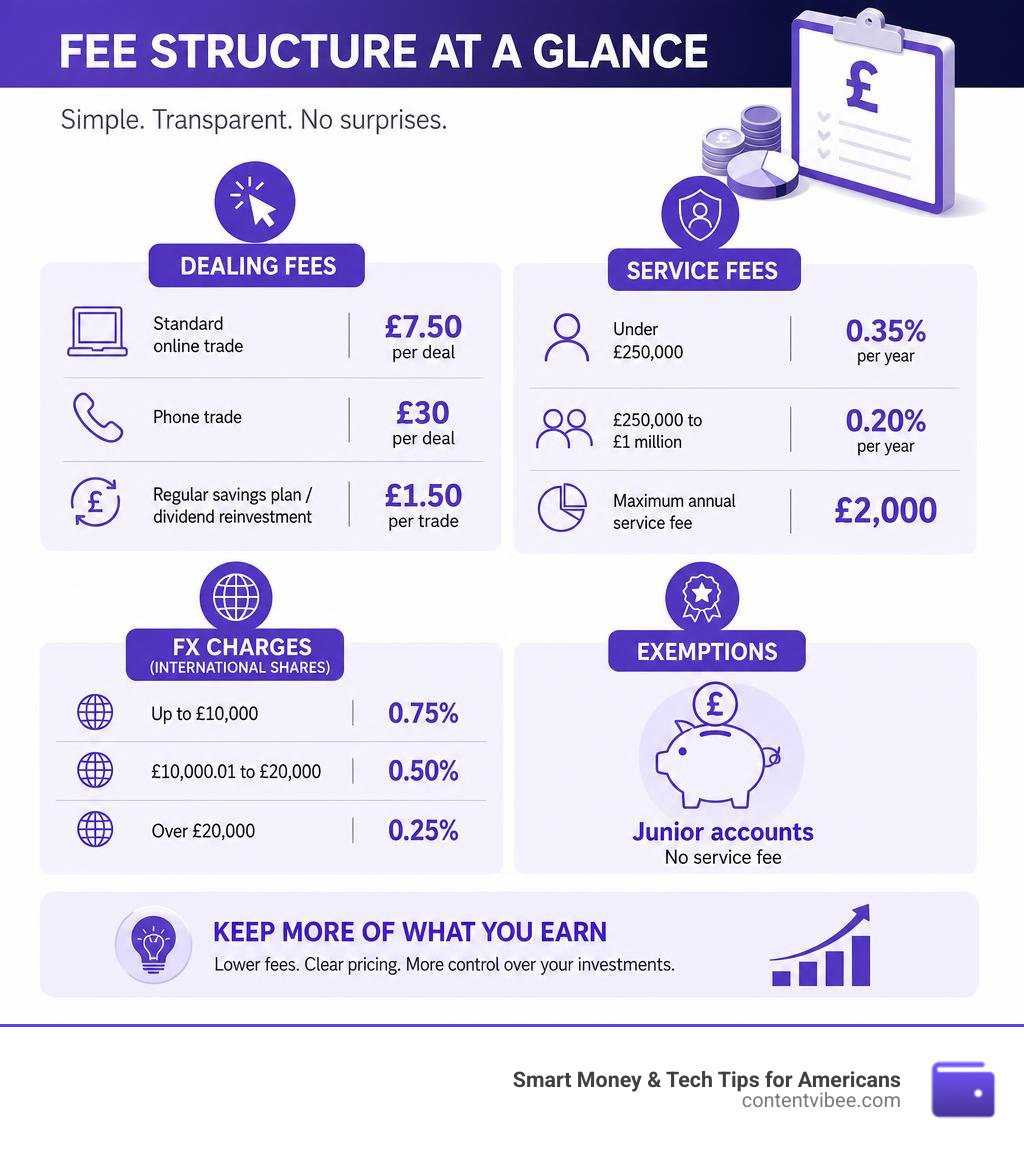
Fidelity share dealing fees terms explained:
Understanding the Core Fidelity Share Dealing Fees
When we look at the total cost of investing through Fidelity, we have to divide the charges into two main categories: dealing fees (what you pay to buy and sell) and service fees (what you pay for holding your investments on their platform).
Many first-time investors make the mistake of only looking at the trade commission. For American expats in the UK, managing these platform fees is especially critical to avoid eroding your international returns. Let’s break down these core charges so you know exactly where your money is going.
Standard Online and Phone Fidelity Share Dealing Fees
The standard fee to buy or sell shares online with Fidelity is £7.50 per trade. This is a flat rate, meaning whether you are investing £500 or £5,000 in a single transaction, the commission remains the same.
However, if you prefer a more personal touch and choose to trade over the phone, the cost rises dramatically to £30 per trade. This is where a lot of capital can be wasted. Unless you have an incredibly complex order that requires human intervention, we always recommend executing your transactions online to keep your costs down.
For those who want automated assistance without paying full broker-assisted prices, Fidelity offers a FAST automated phone service. While not as cheap as trading online, it is another alternative to full phone representative rates. For a deeper look into transaction costs, check out our guide on the Fidelity Fee Per Trade.
To ensure you are getting the best execution possible, Fidelity complies with strict order execution regulations. This means when you place a market order, the platform is legally required to seek out the best available price across multiple market makers within a 15-second window.
Reduced Rates for Regular Savings and Reinvestments
If you are a long-term investor who likes to build wealth slowly and steadily, you can bypass the standard £7.50 fee entirely. Fidelity offers a highly discounted rate of just £1.50 per trade for regular savings plans and automated dividend reinvestments.
By setting up a regular savings plan, you can instruct Fidelity to automatically invest a set amount of cash into your chosen shares or exchange-traded funds (ETFs) each month. Because these trades are bundled and executed in bulk, Fidelity passes the savings back to you.
Similarly, instead of letting your dividend payouts sit as idle cash, you can opt for automatic dividend reinvestment. This automatically purchases more shares of the dividend-paying company as soon as your balance allows, costing you only £1.50 per transaction instead of the standard £7.50. You can learn more about how these automated systems keep money in your pocket in our review of Are Fidelity Trades Really Free Demystifying The Fees.
Tiered Service Fees and Annual Caps
Beyond the cost of individual trades, Fidelity charges an annual platform service fee to cover administration, account maintenance, and platform security. This fee is calculated as a percentage of your total holdings and is billed monthly.
The service fee uses a tiered structure based on the total value of your portfolio:
- Portfolios under £250,000: You will pay an annual service fee of 0.35%.
- Portfolios between £250,000 and £1 million: The rate drops to 0.20% on the entire balance.
- Portfolios of £1 million or more: The service fee is capped at a maximum of £2,000 per year, meaning any assets held above £1 million are effectively free of platform charges.
For exchange-traded investments (like individual shares, investment trusts, and ETFs) held within an ISA or SIPP, there is an incredibly generous fee cap. The service fee portion for these exchange-traded assets is capped at just £7.50 per month, which works out to £90 per year. For a full breakdown of how these caps affect your bottom line, read our Fidelity Cost Transparency Review.
Account-Specific Rules and Exemptions
One of the best features of Fidelity’s fee structure is that certain account types and investment classes are completely exempt from platform service fees.
First, if you hold exchange-traded investments (shares, ETFs, and investment trusts) in a standard, non-tax-wrapped Investment Account, you pay absolutely 0% in service fees on those assets. The £90 annual cap only applies to tax-advantaged accounts like ISAs and SIPPs.
Second, Fidelity charges no service fees on junior accounts, including the Junior ISA and Junior SIPP. This makes it an incredibly cost-effective platform for parents or grandparents looking to build a nest egg for the next generation.
To manage fee collection smoothly, Fidelity utilizes a Cash Management Account (CMA). This is a separate cash holding area within your portfolio designed to pay for your service fees and dealing charges. By keeping a small cash buffer in your CMA, you ensure that Fidelity never has to force-sell your investments to cover your monthly fees. For more details on managing these accounts, consult our Fidelity Brokerage Account Fees Review What You Need To Know.
Step-by-Step Guide to Minimizing Your Trading Costs

Now that we understand the fee landscape, let’s look at how we can actively minimize our fidelity share dealing fees. Whether you are a UK resident or an American expat living abroad, applying these three simple steps can save you hundreds of pounds annually.
Step 1: Use Regular Savings Plans to Lower Per-Trade Costs
The absolute easiest way to slash your trading commissions is to automate your investing. Instead of manually logging into your account every month to buy shares (costing £7.50 per trade), set up a regular savings plan.
- Log into your Fidelity account online or via the mobile app.
- Select the account you wish to trade from (e.g., ISA, SIPP, or Investment Account).
- Navigate to the “Regular Savings” section.
- Choose the shares or ETFs you want to buy and set your monthly contribution amount.
- Save your plan.
By doing this, your transaction fee automatically drops from £7.50 to £1.50 per trade. If you buy three different stocks every month, this simple switch saves you £18 per month, or £216 per year! To see how this strategy fits into a broader cost-saving blueprint, read The Ultimate Guide To Fidelity Trading Fees And Savings.
Step 2: Leverage Limit Orders to Control Execution Prices
During times of high market volatility, executing a standard “market order” (buying immediately at whatever price the market offers) can result in paying more than you expected. To prevent this, you should learn to use limit orders.
A limit order allows you to set the exact maximum price you are willing to pay when buying, or the minimum price you are willing to accept when selling.
- Market Order: Executes within 15 seconds at the best available market price.
- Limit Order: Only executes if the stock hits your specified price. You can set limit orders to remain active for up to 90 days.
Using limit orders ensures you never get caught out by sudden price spikes. For more information on using advanced order types to protect your capital, review Fidelity’s guide on Straightforward and Transparent Pricing.
Step 3: Aggregate Your Holdings Across Accounts
Fidelity calculates your platform service fee based on the total value of your investments across all of your accounts, rather than calculating them individually. This is known as portfolio aggregation.
If you hold an ISA, a SIPP, and a joint Investment Account, Fidelity will group these balances together (excluding adviser-held accounts) to determine your pricing tier.
To maximize this benefit:
- Ensure all your family accounts are linked under a single household profile where possible.
- Keep track of your combined balance. Once your aggregated family portfolio crosses the £250,000 threshold, your annual service fee rate automatically drops from 0.35% to 0.20% across your entire holding.
Additional Costs: Foreign Exchange, Taxes, and Mutual Funds

While standard trading commissions and service fees are the most visible costs, there are other transaction expenses that can sneak up on you if you aren’t careful—which is particularly important for US expats tracking their global investment expenses.
How to Avoid Hidden Fidelity Share Dealing Fees on International Trades
If you want to buy shares of companies listed outside the UK (such as US tech giants), you will need to pay a Foreign Exchange (FX) fee. Because Fidelity accounts can only hold GBP, any international purchase requires a currency conversion.
Fidelity uses a tiered FX fee structure based on the size of your transaction:
- Deals between £0 and £10,000: 0.75% conversion charge
- Deals between £10,000.01 and £20,000: 0.50% conversion charge
- Deals over £20,000: 0.25% conversion charge
If you buy £5,000 worth of US stock, you will pay a £37.50 FX charge in addition to your standard £7.50 trading fee. To minimize these costs, try to bundle smaller international trades into single, larger transactions to qualify for the lower FX fee tiers. For the official breakdown of these currency conversion rules, check out the Share Dealing Charges and Fees page.
Government Taxes and Regulatory Levies
No matter which broker you use, you cannot escape government taxes and regulatory levies. These are legally mandated costs passed directly to the investor:
- UK Stamp Duty: When buying UK-registered shares, you must pay a 0.5% Stamp Duty Reserve Tax (SDRT). This does not apply to ETFs or most AIM-listed shares.
- Irish Stamp Duty: If you buy Irish-registered shares, the stamp duty rate is 1.0%.
- PTM Levy: A flat £1.50 levy applies to all UK share transactions over £10,000. This money goes to the Panel on Takeovers and Mergers to regulate the market.
Mutual Fund Transaction Fees and Short-Term Trading
While buying and selling mutual funds is generally free of transaction fees on Fidelity, there are specific exceptions you must watch out for.
Some funds carry short-term trading fees if you buy and sell them within a short window (typically under 60 days). These fees are designed to discourage day-trading of mutual funds, which harms long-term fund performance. Always read the key investor information document (KIID) before purchasing any fund to ensure you don’t trigger unexpected charges. You can read a complete breakdown of these hidden fund costs in our article Fidelity Mutual Fund Trade Fee When Is Free Not Actually Free.
Frequently Asked Questions About Fidelity Fees
What are the key things that Fidelity does not charge for?
Fidelity is highly competitive because of what it doesn’t charge for. There are zero fees for:
- Setting up an account
- Holding cash in your account
- Closing your account or transferring your assets to another provider (no exit fees)
- Buying or selling mutual funds (excluding potential short-term trading fees on select funds)
- Service fees on Junior ISAs and Junior SIPPs
- Service fees on exchange-traded investments held inside a standard Investment Account
How are service fees calculated and collected?
Fidelity calculates your service fee daily based on the value of your portfolio, and then deducts it around the 1st of every month.
The fee is automatically taken from the cash balance in your Cash Management Account (CMA). If you do not have enough cash in your CMA, Fidelity will look to sell a small portion of your largest investment to cover the fee. They prioritize selling assets in non-tax-wrapped accounts first to protect your ISA and SIPP tax shelters.
Is there a fee to transfer investments to or from Fidelity?
Fidelity does not charge any fees to transfer your investments in or out of their platform.
Even better, if your current broker charges you exit fees to leave them, Fidelity will reimburse those exit charges up to £500 per customer when you transfer a portfolio of at least £100 to them. You just need to submit an exit fee reimbursement claim form within six months of your transfer completing.
Conclusion
At Smart Money & Tech Tips for Americans, we specialize in helping US expats and international investors navigate complex financial landscapes. Minimizing your investment costs is one of the most effective ways to boost your compound growth over time. By shifting your manual trades to regular savings plans, utilizing limit orders to control your entry prices, and keeping an eye on FX conversion tiers, you can keep your fidelity share dealing fees to an absolute minimum.
We want to make sure you keep as much of your hard-earned money as possible, whether you are investing from California or living abroad in the UK. Take action today by reviewing your current trading habits and optimizing your portfolio setup.
Ready to dive deeper into trading commissions and platform savings? Check out our comprehensive analysis of the Fidelity Fee Per Trade to discover more ways to optimize your investment strategy.