


Does Fidelity Charge a Fee to Buy Stocks?
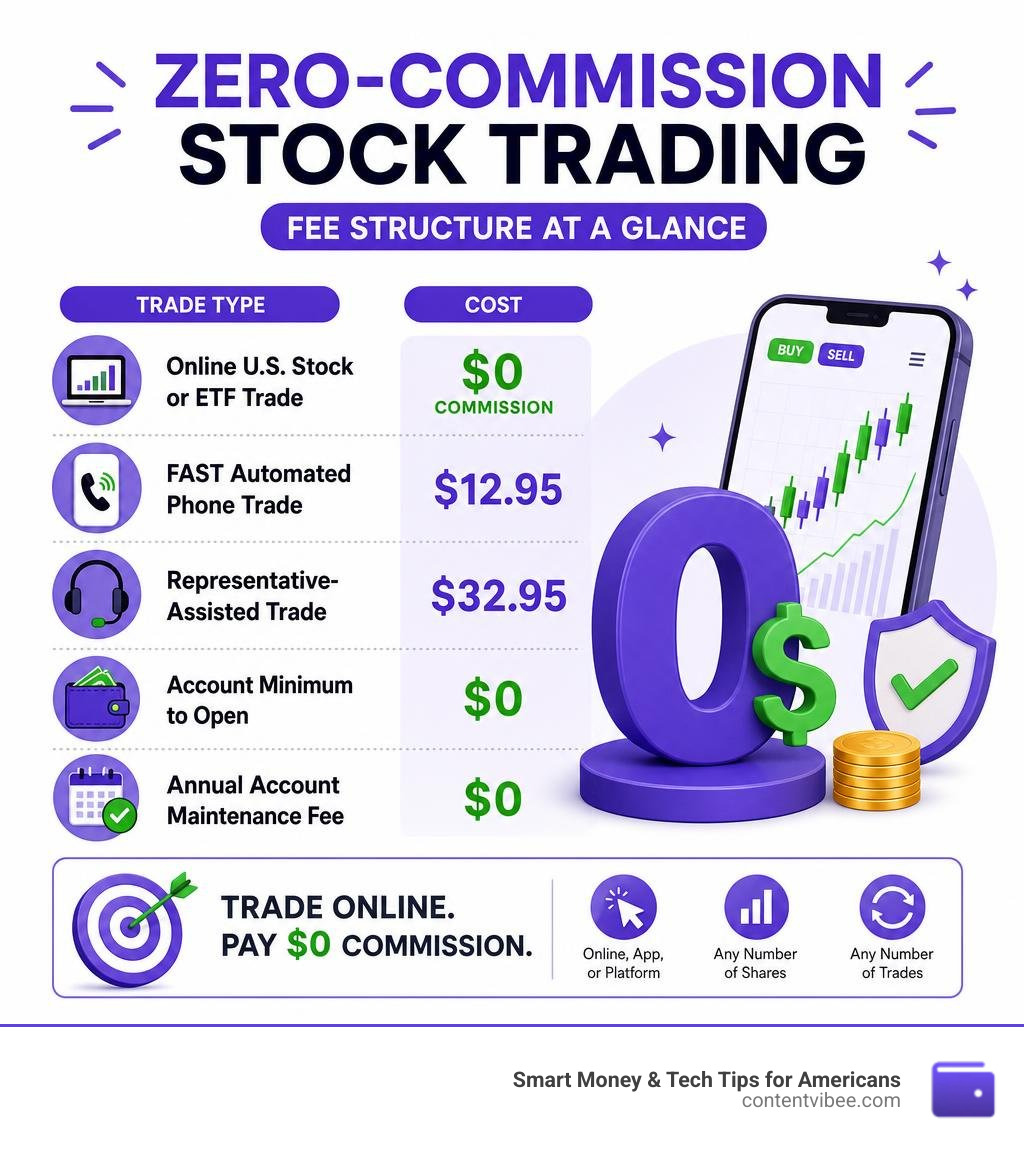
The short answer to the fidelity fee to buy stocks question is straightforward: $0 commission for online U.S. stock trades. Here’s a quick breakdown:
| Trade Type | Fee |
|---|---|
| Online U.S. stock or ETF trade | $0 |
| FAST automated phone trade | $12.95 |
| Representative-assisted trade | $32.95 |
| Account minimum to open | $0 |
| Annual account maintenance fee | $0 |
So if you trade online through Fidelity’s website, app, or Active Trader Pro platform, you pay nothing in commissions — for any number of shares, any number of trades.
But here’s the thing: “free” doesn’t always mean there are zero costs involved.
There are a few smaller fees that apply in specific situations — like regulatory fees on sell orders, fees for phone-assisted trades, and costs tied to certain mutual funds or margin borrowing. They’re not hidden exactly, but they’re easy to miss if you don’t know where to look.
This guide breaks down every cost you might encounter when trading stocks at Fidelity, so you can invest with confidence and no surprises.
Key terms for fidelity fee to buy stocks:
What is the Fidelity Fee to Buy Stocks Online?
When you decide to buy a stock online, you expect the price you see to be the price you pay. For self-directed retail investors in the United States, Fidelity delivers exactly that. The platform charges a flat $0 commission on online trades of U.S. equities and Exchange-Traded Funds (ETFs).
Whether you are buying one share of a tech giant or 10,000 shares of an emerging clean-energy company, the commission fee remains absolutely zero. This flat-rate pricing applies across all of Fidelity’s digital platforms, including their main website, the mobile application, and their advanced desktop software.
But a truly low-cost retail brokerage account needs to offer more than just free stock trades. To keep your cash working for you, we look at the holistic fee structure. Fidelity stands out by requiring:
- $0 account minimums to open a retail brokerage account.
- $0 annual maintenance fees or inactivity fees to keep your account open.
- $0 fees for core cash sweep options like the Fidelity Government Money Market Fund (SPAXX), which automatically earns a competitive yield on your uninvested cash while it sits waiting for your next trade.
To understand how this fits into your broader financial strategy, you can read our deep dive on Are Fidelity Trades Really Free Demystifying The Fees. For official confirmation of these pricing points, you can also review the Trading Commissions and Margin Rates | Fidelity page directly.
The “Catch” — Hidden Costs and Regulatory Fees
If online stock trading is completely commission-free, how does a massive brokerage firm keep the lights on? This is where we have to look past the marketing headlines to find the small operational fees and structural design choices that act as the actual “catch” of modern investing.
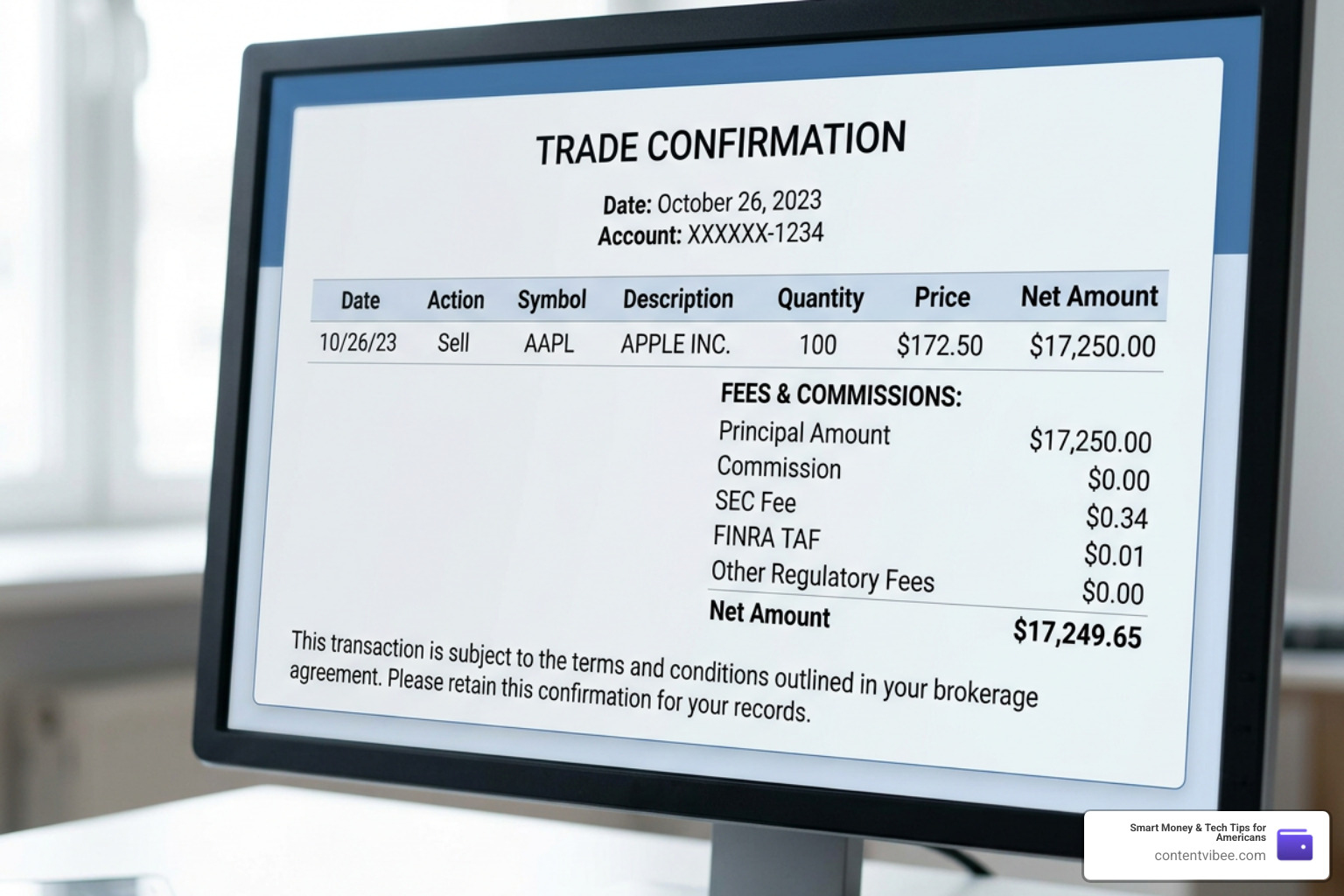
First and foremost, while there is no direct fidelity fee to buy stocks, there are industry-standard regulatory fees applied when you sell stocks. These are not fees designed to line Fidelity’s pockets; rather, they are pass-through fees mandated by federal watchdogs and self-regulatory organizations (SROs).
To see the complete picture of how these small charges are structured, you can explore our Fidelity Cost Transparency Review or view the detailed Fidelity Brokerage and Commission Fee Schedule | Trading information.
How the Additional Assessment Impacts Your Fidelity Fee to Buy Stocks
When you sell a stock or ETF, you will notice a tiny deduction on your trade confirmation labeled as an Additional Assessment (often referred to as the SEC fee or Section 31 fee).
This fee is charged on all sell orders to offset the fees charged to brokerages by the Securities and Exchange Commission (SEC) and various SROs, such as the Financial Industry Regulatory Authority (FINRA).
- The Rate: Typically ranges from $0.01 to $0.03 per $1,000 of principal value.
- How it works: If you sell $10,000 worth of stock, your Additional Assessment will only be a quarter or two.
- Why it matters: While negligible for long-term buy-and-hold investors, high-frequency day traders will find that these fractions of a cent accumulate over thousands of transactions.
For a closer look at how these transaction-level deductions behave, check out our guide on the Fidelity Fee Per Trade.
Payment for Order Flow and the True Fidelity Fee to Buy Stocks
Another quiet way online brokers make money is through Payment for Order Flow (PFOF). Under a PFOF model, a brokerage routes your trade orders to third-party market makers who pay the broker a fraction of a cent per share for the privilege of executing those trades.
While this sounds harmless, PFOF can sometimes result in slightly worse execution prices for you, the investor. If your broker routes your buy order to a market maker who executes it at $100.02 instead of finding you a seller at $100.01, you have effectively paid an invisible two-cent “fee.”
Fidelity takes a highly unique approach here compared to many of its major retail competitors:
- No PFOF on Stocks/ETFs: Fidelity does not accept payment for order flow on online U.S. equity or ETF trades.
- Focus on Price Improvement: Because they do not sell your stock orders to the highest bidder, they can focus on routing trades to find you the best possible execution price.
- The Savings: Fidelity reports that their internal routing technology saves investors an average of $24.50 on a 1,000-share equity order compared to the industry average of $4.34.
This commitment to execution quality is a massive win for retail investors. To learn more about how brokers monetize your trading activity behind the scenes, read our analysis: Is Fidelity Actually Free Or Are You The Product.
Comparing Fidelity’s Trading Costs to Industry Standards
To truly appreciate the value of a broker’s pricing model, you have to compare it to the rest of the market. While most major brokerages have adopted the $0 commission standard for online stock trades, they differ wildly when it comes to secondary fees, margin rates, and administrative costs.
Let’s look at how Fidelity stacks up against industry averages and major competitors:
| Fee Category | Fidelity | Industry Standard Average |
|---|---|---|
| Online Stock/ETF Commission | $0.00 | $0.00 |
| Annual Account Maintenance Fee | $0.00 | $0.00 – $20.00 |
| Account Closeout / Transfer Out Fee | $0.00 | $50.00 – $75.00 |
| Lowest Published Margin Rate | 7.50% (for $1M+ balances) | 10.00% – 10.50% |
| Average Price Improvement (per 1k shares) | ~$24.50 | ~$4.34 |
Fidelity’s decision to charge $0 for account transfers and closeouts is a massive advantage. Many platforms will charge you $75 just to move your money to another broker, effectively locking you into their ecosystem.
For a comprehensive breakdown of these platform-to-platform differences and where you can save the most, check out The Ultimate Guide To Fidelity Trading Fees And Savings. You can also verify their current schedules using the Straightforward and Transparent Pricing – Fidelity Investments portal.
Other Fees to Watch Out For When Trading
While the core fidelity fee to buy stocks online is zero, you can easily run into other charges if you step outside of basic self-directed online trading. Let’s look at the areas where fees still exist.
If you want to read about these auxiliary costs in exhaustive detail, our Fidelity Brokerage Account Fees Review What You Need To Know is an excellent resource.
Broker-Assisted Trades vs. Online Trades
If you prefer to place your trades over the phone, you are going to pay a premium. Fidelity supports two types of telephone-based trading, both of which incur transaction fees to cover the operational overhead of maintaining phone networks and licensing agents:
- FAST (Fidelity Automated Service Telephone): This is an interactive voice-response system. If you execute a stock or ETF trade through FAST, you will be charged $12.95 per trade.
- Representative-Assisted Trades: If you want to speak directly to a live, human broker to place your trade, the fee jumps to $32.95 per trade.
The lesson here is simple: whenever possible, place your trades yourself using the mobile app or web platform to keep your costs at $0.
For a complete breakdown of why these telephone fees exist, check out Broker Assisted Trade Fee Fidelity.
Fractional Shares and Dollar-Based Investing
For investors who do not want to buy an entire share of an expensive stock, Fidelity offers robust fractional share trading (which they call “Stocks by the Slice”).
- The Cost: $0 commission for online fractional trades.
- The Minimum: You can invest in more than 7,000 U.S. stocks and ETFs with a transaction value of as little as $1.
- The Catch: There isn’t one! Unlike some platforms that charge subscription fees to access fractional trading or execute them only once a day in “windows,” Fidelity processes fractional share trades in real-time during standard market hours with zero fees.
You can read our full operational review of this feature at Fidelity Fractional Shares Review Fees Limits And How It Works.
Margin Rates and Borrowing Costs
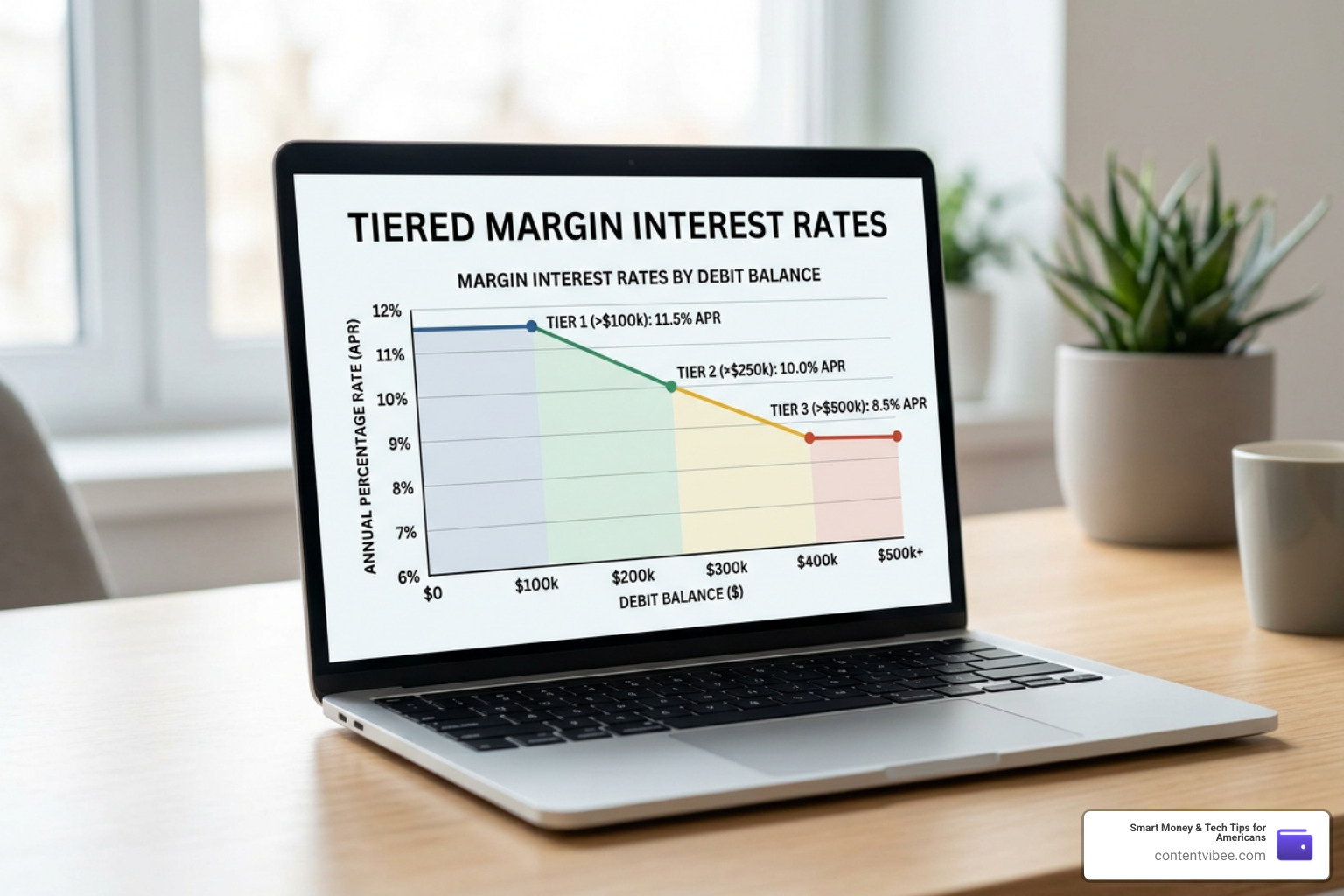
If you decide to trade on margin—meaning you borrow money from Fidelity to buy more stock—you will pay interest on that borrowed balance. Margin rates are highly tiered, meaning the more money you borrow, the lower your interest rate will be.
Fidelity’s base margin rate is highly competitive, and their high-balance tiers represent some of the lowest published margin rates among major traditional brokerages:
- Balances under $25,000: Rates can be on the higher end (often around 11.825% depending on the benchmark interest rate environment).
- Balances over $1,000,000: Rates drop as low as 7.50%.
When compared to competitors like Schwab (over 10%) or E*TRADE (over 10.4%), Fidelity’s high-net-worth margin tiers offer massive institutional-grade savings. However, always remember that margin trading carries immense risk of loss.
To review the exact current tiers and interest calculation methods, reference the Trading Commissions and Margin Rates – Fidelity Investments database.
Mutual Funds and Options Fees
If your portfolio extends beyond basic stocks and ETFs, you will want to keep an eye on mutual fund transaction fees and options contract charges:
- Fidelity Mutual Funds & NTF Funds: You pay $0 to buy or sell Fidelity mutual funds, and $0 for hundreds of partner funds on their No-Transaction-Fee (NTF) network.
- Transaction-Fee Mutual Funds: If you buy a mutual fund that is not on the NTF list, you will face a steep transaction fee of $49.95 per purchase.
- Short-Term Redemption Fees: If you sell an NTF fund that you have held for less than 60 days, Fidelity charges a $49.95 short-term redemption fee to discourage rapid trading of mutual funds.
- Options Trading: While online options trades have a $0 base commission, you must pay a $0.65 per-contract fee. (However, buy-to-close orders for options priced from $0.00 to $0.65 are free of contract charges).
To dive deeper into these specific asset classes, read Fidelity Options Fees Explained And Demystified and Fidelity Mutual Fund Trade Fee When Is Free Not Actually Free.
Frequently Asked Questions about Fidelity Trading Fees
Navigating brokerage fee schedules can feel like reading a foreign language. Here are simple, direct answers to the most common questions investors ask about Fidelity’s charges.
Is there a fee to buy fractional shares at Fidelity?
No. Fidelity does not charge any commissions or administrative fees to buy or sell fractional shares online. You can invest in any of the 7,000+ supported U.S. stocks and ETFs for as little as $1 per transaction with zero added costs.
How much does Fidelity charge for representative-assisted stock trades?
Fidelity charges a flat fee of $32.95 per trade if you place your order with the assistance of a live representative over the phone. If you use their automated FAST telephone system instead, the fee is reduced to $12.95 per trade. Online trades remain completely free.
Does Fidelity charge an annual account maintenance fee?
No. There are no annual account maintenance fees, inactivity fees, or minimum balance requirements for standard retail brokerage accounts at Fidelity.
Conclusion
At Smart Money & Tech Tips for Americans, we believe that understanding where your money goes is the first step toward building true financial freedom. When it comes to the fidelity fee to buy stocks, the reality is highly reassuring: for the vast majority of everyday online investors, trading stocks at Fidelity is genuinely free.
By bypassing payment for order flow on equities and offering robust price improvement, Fidelity actually saves you money on the execution of your trades compared to many of its competitors. Just be sure to watch out for the pass-through regulatory fees on sell orders, stay away from phone-assisted trading, and pay close attention to holding periods on mutual funds.
If you are ready to take control of your financial future in 2026, keeping your transaction costs low is a brilliant place to start. For a final review of per-trade dynamics, check out our guide on the Fidelity Fee Per Trade and start building your wealth today!


