


The Deadline Most People Miss When Rolling Over to a Roth IRA
The rollover to Roth IRA deadline is one of the most misunderstood dates in retirement planning — and missing it can push a major tax event into the wrong year.
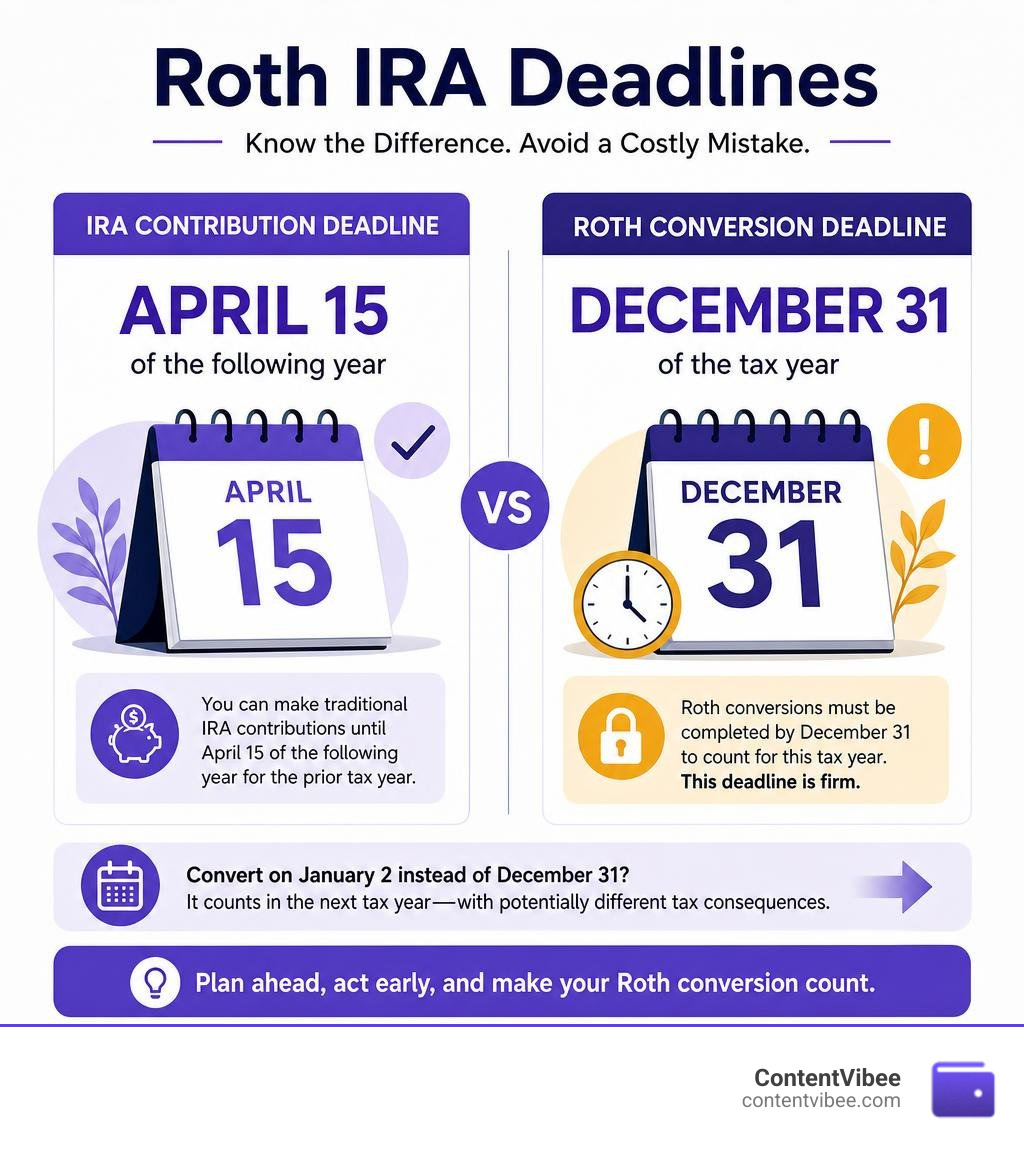
Quick answer: A Roth IRA conversion must be completed by December 31 of the tax year you want it to count for. This is a hard cutoff. Unlike regular IRA contributions, you cannot wait until April 15 of the following year.
Here’s what you need to know at a glance:
| Rule | Deadline |
|---|---|
| Roth IRA conversion (rollover) | December 31 of the tax year |
| Annual IRA contribution | April 15 of the following year |
| 60-day indirect rollover window | 60 days from receiving the distribution |
| Can you undo a conversion? | No — permanent since January 1, 2018 |
If you’re a mid-career professional thinking about moving your 403(b) or traditional IRA into a Roth, the clock matters more than most people realize. A conversion completed on January 2 instead of December 31 lands in a completely different tax year — with potentially very different consequences for your bracket, your Medicare premiums, and your retirement plan.
The stakes are real. Financial advisors often describe December as the month when high-earning clients get the call: “Have you done your Roth conversion yet?” The mechanics are straightforward, but the timing is everything.
This guide breaks down exactly how the deadline works, what taxes you’ll owe, how the pro-rata rule can blindside you, and how to execute a clean rollover — whether you’re converting a 401(k), a 403(b), or using the backdoor Roth strategy for 2026.
Simple rollover to roth ira deadline glossary:
Understanding the Rollover to Roth IRA Deadline
When it comes to retirement accounts, the IRS loves deadlines, but they do not treat all deadlines equally. The most critical point to understand about the rollover to roth ira deadline is that it is strictly tied to the calendar year.
If you want a Roth conversion to count for your 2026 taxes, the funds must physically leave your traditional account and land in your Roth IRA by December 31, 2026.
This is not a “postmarked by” situation. If you initiate a transfer on December 30 and the paperwork doesn’t clear until January 2, that transaction belongs to the next tax year. Because financial institutions experience a massive bottleneck of year-end requests, waiting until late December is a recipe for stress. We highly recommend starting your year-end conversions by late November or early December to allow ample processing time.
For official details on how the IRS classifies these transactions, you can consult the guide on Rollovers of retirement plan and IRA distributions | Internal Revenue Service .
Why the Rollover to Roth IRA Deadline is December 31
The IRS operates on a strict calendar-year basis for reporting conversion income. When you convert pre-tax money to a Roth IRA, you are essentially telling the IRS, “I want to pay taxes on this money now so I can enjoy tax-free withdrawals later.”
Because this conversion creates taxable income, the IRS requires it to be reported on the tax return for the calendar year in which the actual distribution occurred.
Additionally, the December 31 deadline is crucial because of how the IRS calculates your total IRA balances. As we will discuss with the pro-rata rule, the IRS takes a snapshot of your traditional, SEP, and SIMPLE IRA balances on December 31 of the conversion year. If your balances are not cleared or structured correctly by the final second of New Year’s Eve, you could face an unexpected tax bill.
Contribution Deadlines vs. the Rollover to Roth IRA Deadline
One of the most common points of confusion is mixing up the deadline for annual IRA contributions with the deadline for Roth conversions.
You have until the tax-filing deadline (typically April 15 of the following year) to make an annual contribution to a traditional or Roth IRA. However, you do not get this extension for conversions.
| Feature | Annual IRA Contribution | Roth IRA Conversion (Rollover) |
|---|---|---|
| 2026 Deadline | April 15, 2027 | December 31, 2026 |
| Income Limits | Yes (for direct Roth contributions) | None |
| Annual Dollar Limit | $7,500 ($8,600 if age 50+) | Unlimited |
| Tax Impact | May be deductible or tax-free | Taxable in the year of conversion |
Why does this timing difference matter? Let’s look at the power of compounding. Making your contributions early in the year rather than waiting until the April deadline of the following year gives your money more time to grow tax-free.
For example, a $7,000 contribution made on December 31 instead of waiting until April 15 of the following year gains 3.5 additional months of tax-free compounding. At a 7% annual return, that translates to approximately $122 of additional tax-free growth per year. Over a 30-year investing horizon, that single timing decision on one year’s contribution compounds to roughly $12,000 in additional tax-free wealth!
Tax Implications and the Pro-Rata Rule

A Roth conversion is a taxable event. The amount you convert from a pre-tax account (like a traditional IRA or 401(k)) is treated as ordinary income in the year of the conversion. It does not qualify for lower capital gains tax rates; instead, it is taxed at your marginal federal and state income tax brackets.
Because a large conversion can easily push you into a higher tax bracket, planning is essential. Many savers choose to convert their accounts in smaller, strategic batches over several years — a strategy known as “bracket topping” — to avoid crossing into a higher marginal tax tier.
The Pro-Rata Rule and Year-End Balances
If you have a mix of pre-tax and after-tax (nondeductible) money across any of your traditional IRAs, you cannot choose to only convert the tax-free, after-tax money. The IRS views all of your traditional, SEP, and SIMPLE IRAs as one giant bucket. This is known as the aggregation rule.
When you perform a conversion, the taxable percentage is calculated pro-rata across all your non-Roth IRAs.
Here is how the math works: Let’s say you have $92,500 in a pre-tax rollover IRA and you decide to make a $7,500 nondeductible contribution to a traditional IRA with the intention of converting just that $7,500 to a Roth IRA.
- Your total IRA balance is $100,000.
- Your after-tax contribution ($7,500) represents only 7.5% of your total IRA assets.
- Therefore, only 7.5% of your conversion ($562.50) will be tax-free. The remaining 92.5% ($6,937.50) will be treated as taxable income!
This is why the December 31 snapshot is so critical. If you want to avoid this tax trap, you must clear out your pre-tax IRA balances before the end of the year. A common workaround is rolling your pre-tax IRA balances into an active employer 401(k) or 403(b) plan, which does not count toward the pro-rata calculation.
To learn how to navigate this complex rule safely, read our comprehensive 2026 Backdoor Roth Guide Dodging the Pro Rata Tax Trap.
Managing Estimated Taxes and Withholding
Because a Roth conversion increases your adjusted gross income (AGI), it can trigger underpayment penalties if you do not pay enough tax throughout the year. The IRS expects you to pay taxes as you earn or receive income.
To avoid underpayment penalties, you should aim to meet the IRS “safe harbor” thresholds. Generally, you will not face a penalty if your total tax withholding and timely estimated payments equal at least:
- 90% of your current year’s tax liability, or
- 100% of your prior year’s tax liability (110% if your AGI was over $150,000).
If you execute a conversion late in the year, you can increase your federal tax withholding on your remaining W-2 paychecks or make an estimated quarterly tax payment by the January 15 deadline. If your income is concentrated in the latter part of the year due to a late-year conversion, you can file Form 2210 with Schedule AI (Annualized Income Installment Method) to show the IRS that your income was earned unevenly, helping you avoid penalties.
Tip: Never have taxes withheld directly from the converted amount to pay the tax bill if you are under age 59½. Doing so treats the withheld taxes as an early distribution, triggering a 10% penalty on that portion.
Strategic Benefits of a Roth Conversion
Despite the immediate tax bill, converting traditional retirement assets into a Roth IRA offers massive long-term advantages:
- Tax-Free Growth and Withdrawals: Once your money is in the Roth IRA, it grows completely tax-free, and qualified withdrawals in retirement are 100% tax-free.
- No Required Minimum Distributions (RMDs): Unlike traditional IRAs and 401(k)s, which force you to start taking withdrawals at age 73 (or age 75 depending on your birth year), Roth IRAs have no RMDs during your lifetime. Your money can stay invested and compound indefinitely.
- Tax Diversification: Having a mix of pre-tax and tax-free accounts gives you maximum flexibility to control your taxable income in retirement, helping you manage your tax bracket and minimize Medicare premium surcharges.
The Five-Year Rule for Roth Conversions
While Roth IRAs are incredibly flexible, you must understand how the five-year rule applies to conversions.
Every single Roth conversion you perform has its own separate five-year holding period. This clock starts on January 1 of the year you complete the conversion.
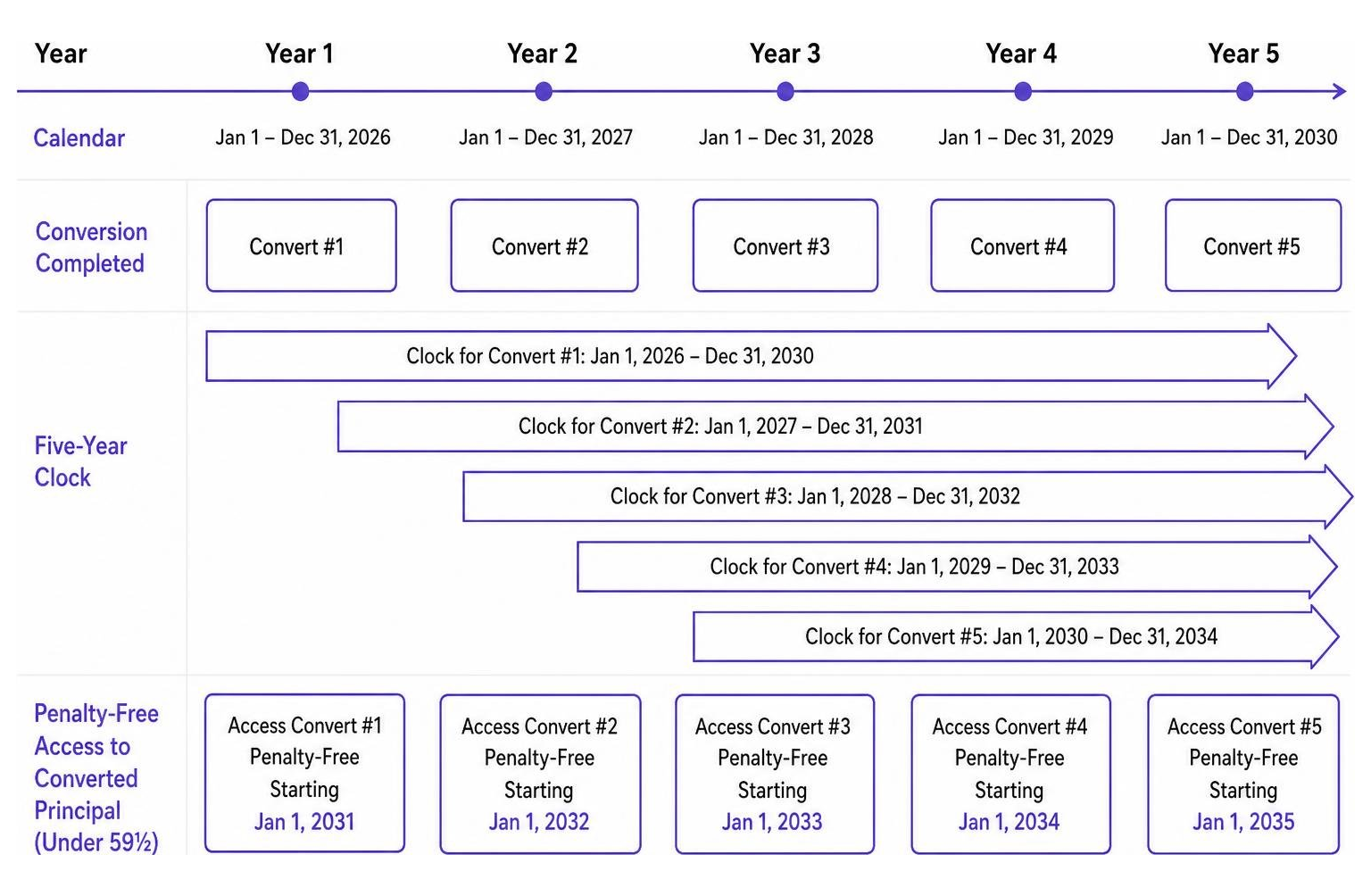
If you are under age 59½ and withdraw converted principal before its specific five-year clock has run, you may face a 10% early withdrawal penalty (unless an exception applies). Once you reach age 59½, the penalty no longer applies to converted principal, though earnings must still satisfy the general five-year rule to be withdrawn tax-free.
This rule is especially important for early retirees who build a “Roth conversion ladder” to fund their early retirement years. By converting assets systematically and waiting five years, they can access their converted principal penalty-free before age 59½.
Converting Workplace Plans: 401(k) and 403(b) Rollovers
If you have an old workplace retirement plan, such as a 401(k) or 403(b), you can roll those assets directly into a Roth IRA. This is a highly effective way to consolidate your accounts and gain access to better investment options.
When moving funds from an employer plan, always opt for a direct rollover (also known as a trustee-to-trustee transfer). With a direct rollover, the money is sent directly from your old plan administrator to your Roth IRA custodian.
If you opt for an indirect rollover, where a check is made out to you personally, the plan administrator is legally required to withhold 20% for federal taxes. You then have a strict 60-day window to deposit the full 100% of the distribution into your Roth IRA, meaning you must come up with the missing 20% out of your own pocket to avoid taxes and penalties on that portion.
For a deep dive into converting workplace plans, check out our step-by-step guides:
- The Ultimate Guide to Converting Your 403b to a Roth IRA
- Can You Move Your 403b to a Roth IRA
- Breaking Up with Your Employer How to Roll a 403b into an IRA
How to Execute a Backdoor Roth Conversion in 2026
For high earners, direct contributions to a Roth IRA are restricted. In 2026, the modified adjusted gross income (MAGI) phase-out ranges are:
- Single Filers: Phase-out starts at $153,000 and ends at $168,000.
- Married Filing Jointly: Phase-out starts at $242,000 and ends at $252,000.
If your income exceeds these limits, you cannot contribute directly to a Roth IRA. However, there is no income limit on conversions. This loophole enables the popular “backdoor Roth IRA” strategy.
To see how the numbers shake out for your specific income level, you can use The Ultimate Backdoor Roth Calculator Guide for High Earners.
Step-by-Step Backdoor Execution
Executing a backdoor Roth conversion requires precision to avoid unnecessary taxes. Here is the recommended sequence:
- Open the Accounts: If you don’t already have them, open both a traditional IRA and a Roth IRA at a financial institution.
- Make a Nondeductible Contribution: Deposit up to $7,500 (or $8,600 if you are age 50 or older in 2026) into your traditional IRA. Ensure you designate this as a nondeductible (after-tax) contribution.
- Keep it in Cash: Leave the contribution in a cash sweep or money market account while it settles. You do not want the money to gain or lose value before the conversion.
- Convert Immediately: As soon as the funds clear (typically one to two business days), initiate a conversion to transfer the entire balance into your Roth IRA.
- Invest the Funds: Once the money lands safely inside your Roth IRA, invest it according to your long-term asset allocation strategy.
For a detailed checklist on preparing your accounts for this process, you can review the guide on Roth Conversion | Convert Retirement Savings to a Roth IRA | Fidelity Investments .
Reporting the Conversion: Form 8606 and Form 1099-R
To keep the IRS happy, you must report your backdoor Roth conversion correctly on your tax return. You will receive two primary tax forms:
- Form 1099-R: Sent by your custodian by late January of the year following your conversion. This form reports the distribution from your traditional IRA.
- Form 8606: This is the form you must file with your Form 1040. It tracks your nondeductible contributions and calculates the taxable portion of your conversion.
Failing to file Form 8606 can result in a penalty and, worse, could lead to the IRS accidentally taxing your nondeductible contribution a second time. Keep clean records of these forms every year you perform a backdoor conversion.
Frequently Asked Questions About Roth Rollovers
Can I undo or recharacterize a Roth conversion?
No. Prior to 2018, taxpayers could “recharacterize” (undo) a Roth conversion if they changed their mind or if the value of the converted assets dropped significantly. However, the Tax Cuts and Jobs Act permanently eliminated this option effective January 1, 2018. Once you convert funds to a Roth IRA, the transaction is completely permanent. Be absolutely certain of your tax situation before pulling the trigger.
How do state income taxes affect my Roth conversion?
Most states with an income tax treat Roth conversion income exactly the same as ordinary income. State tax rates range from 0% (in states like Florida, Texas, and Washington) to over 13% (in California). If you are planning a massive conversion and anticipate moving to a tax-free state in the near future, it may be highly beneficial to delay the conversion until you have officially established residency in your new state.
Can I roll over unused 529 college funds to a Roth IRA?
Yes, thanks to the SECURE 2.0 Act, you can roll over unused 529 plan funds into a Roth IRA for the designated beneficiary. However, strict rules apply:
- The 529 plan must have been open for at least 15 years.
- The rollover amount is subject to annual Roth contribution limits ($7,500 in 2026).
- There is a lifetime maximum rollover limit of $35,000 per beneficiary.
- Contributions made to the 529 plan within the last five years cannot be rolled over.
To learn how to utilize this strategy for your family, read The Ultimate Guide to Moving Unused College Funds to a Roth IRA.
Conclusion
Navigating the rollover to roth ira deadline requires a proactive approach. Waiting until the final days of December to initiate a conversion is a risky gamble that can result in missed deadlines, processing delays, and unexpected tax brackets.
By understanding the rules, planning for the tax liability, and executing your transfers early in the year, you can maximize your tax-free compounding and build a robust, tax-diversified retirement portfolio.
For more guides on navigating complex legal and financial timelines, explore our resource on How Long Do You Have to Sue? Personal Injury Statute of Limitations Explained.