


What You Need to Know Before Moving Your 403(b) to Vanguard
A 403b rollover to vanguard is one of the smartest moves you can make when leaving a job at a school, hospital, or nonprofit — but getting it wrong can cost you real money in taxes and penalties.
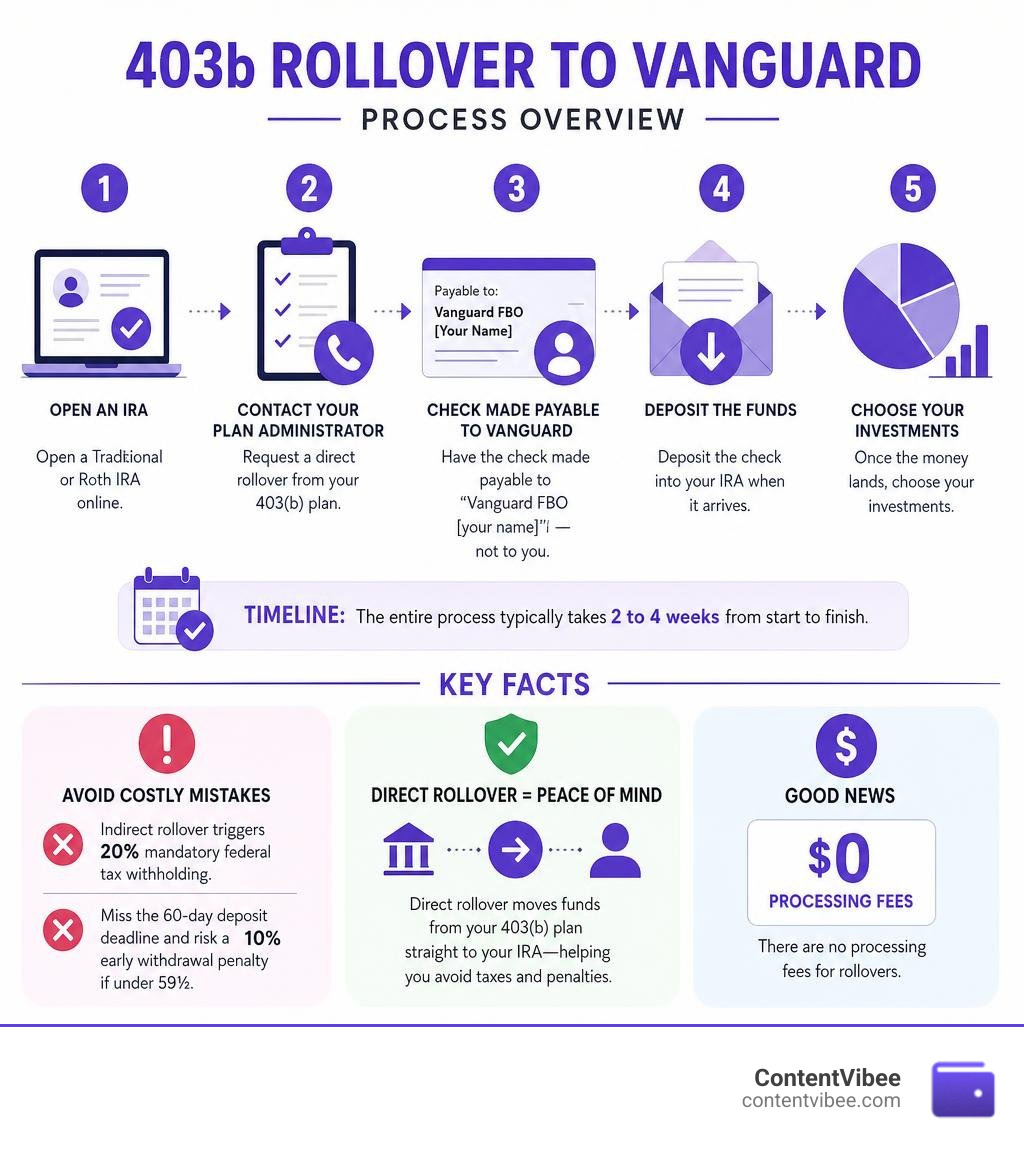
Here’s the quick answer on how to do it:
- Open a Vanguard IRA (traditional or Roth) at vanguard.com
- Contact your 403(b) plan administrator and request a direct rollover
- Have the check made payable to “Vanguard FBO [your name]” — not to you personally
- Deposit the funds into your Vanguard account when they arrive
- Choose your investments once the money lands in your settlement fund
The entire process typically takes 2 to 4 weeks from start to finish.
Most people worry about three things: taxes, deadlines, and hidden fees. Those worries are valid. An indirect rollover — where the check comes to you first — triggers a mandatory 20% federal tax withholding. Miss the 60-day deposit deadline and you could also owe a 10% early withdrawal penalty if you’re under age 59½.
The good news? Vanguard charges $0 in processing fees for rollovers. And a straightforward direct rollover avoids nearly all the tax headaches entirely.
Whether you’re mid-career or just a few years from retirement, this guide walks you through every step — clearly and without the jargon.
403b rollover to vanguard definitions:
Understanding the 403(b) Plan vs. 401(k)
To master your retirement move, we first need to look at what makes your current account tick. A 403(b) plan is a close relative of the more famous 401(k) retirement plan. While they share many similarities, they serve very different workforces.
A 403(b) plan is specifically designed for employees of public school systems, universities, churches, hospitals, and certain tax-exempt 501(c)(3) organizations. In contrast, 401(k) plans are offered by for-profit companies.
Both accounts allow you to build serious tax-advantaged wealth. For the 2026 calendar year, the maximum employee contribution limit for both 403(b) and 401(k) plans is $24,500 (with extra catch-up provisions if you are age 50 or older).
However, the structural differences underneath the hood can make 403(b) plans slightly more complicated when it is time to move your money. Many legacy 403(b) plans are not made up of simple mutual funds. Instead, they often contain individual annuity contracts issued by insurance companies. These contracts can carry unique restrictions, surrender fees, and liquidation schedules that do not exist in a standard 401(k).
Understanding these differences is crucial before you start moving money around. If you want a deep dive into the mechanics of these accounts before initiating a transfer, check out our comprehensive 403b Rollover Guide: Master Your Retirement Account Move.
Why Choose a 403b Rollover to Vanguard?
If you have recently left your job, retired, or transitioned to a new organization, you might wonder why you should go through the trouble of initiating a 403b rollover to vanguard. Why not just leave the money where it is?
The answer usually comes down to three things: fees, investment selection, and historical performance.
Many employer-sponsored 403(b) plans suffer from high administrative fees and limited, expensive investment options. This is especially true for school districts and small non-profits, where insurance companies dominate the 403(b) market. By rolling your funds over to an Individual Retirement Account (IRA) at Vanguard, you break free from those plan-specific limitations.
Vanguard is famous for pioneering low-cost index fund investing. Because Vanguard is client-owned, its interests align directly with yours. Instead of paying high active management fees or expensive administrative wraps, you gain access to institutional-grade index funds and Exchange-Traded Funds (ETFs) with rock-bottom expense ratios.

Consider these powerful statistics regarding Vanguard’s long-term performance:
- 83% of Vanguard funds outperformed their peer-group averages over the last 10 years.
- For the 10-year period ended March 31, 2026, 276 of 333 Vanguard funds outperformed their Lipper peer-group averages.
Consolidating your old retirement accounts into a single Vanguard IRA also simplifies your life. Instead of tracking multiple logins, different tax forms, and scattered asset allocations, you can see your entire retirement picture in a single, clean dashboard.
Best of all, Vanguard does not charge any processing fees to accept your rollover. For a detailed breakdown of how rolling over to an IRA can save you thousands in the long run, read our guide on Breaking Up with Your Employer: How to Roll a 403b into an IRA.
Direct vs. Indirect Rollovers: Which is Best?
When you decide to execute a 403b rollover to vanguard, you must choose how the money travels from your old plan to your new one. There are two primary pathways: a direct rollover and an indirect rollover.
We will make this simple: Always choose a direct rollover if it is available.
Here is why. In a direct rollover (sometimes called a trustee-to-trustee transfer), the money moves directly from your old 403(b) custodian to Vanguard. The old provider either sends the funds electronically or writes a physical check made out directly to Vanguard for your benefit (e.g., Vanguard FBO [Your Name]). Because the money never lands in your personal bank account, the IRS does not consider it a taxable distribution. There is no tax withholding, no penalties, and no stress.
An indirect rollover is a completely different beast. With an indirect rollover, your old plan provider cuts a check made payable directly to you. You deposit those funds into your personal checking account, and you then have exactly 60 days to deposit the entire gross amount into your new Vanguard IRA.
The catch? The IRS mandates that your old provider must withhold 20% of your balance for federal income taxes before sending you the check. To complete the rollover and avoid taxes and penalties on that 20%, you have to find outside cash to make up for that withheld amount when you deposit the funds into your Vanguard IRA. If you fail to deposit the full 100% of the original balance within 60 days, the withheld amount (and any portion you did not deposit) is treated as a taxable distribution, and you may face a 10% early withdrawal penalty if you are under age 59½.
| Feature | Direct Rollover | Indirect Rollover |
|---|---|---|
| Who receives the check? | Vanguard (FBO You) | You personally |
| Mandatory Tax Withholding | 0% | 20% |
| IRS Deadline | No strict deadline | Must deposit within 60 days |
| Risk of Taxes/Penalties | Extremely Low | High (if 60-day window missed) |
| Limit Per Year | Unlimited | Limited to one per 12-month period |
To see how the IRS views these pathways across various retirement accounts, you can refer directly to the official IRS Rollover Chart.
How to Complete Your 403b Rollover to Vanguard
Now that you understand the rules, let’s look at the actual step-by-step sequence to get your money safely moved. While the process is highly secure, it does require a bit of coordination.
Most 403(b) to IRA rollovers take 2 to 4 weeks to fully complete, depending on how quickly your former employer’s plan administrator processes the paperwork.
Step 1: Open Your Vanguard IRA
Before you contact your old plan administrator, you must have a landing pad ready for your funds. If you request a rollover without an active account number at Vanguard, your old provider won’t know where to send the money, which can lead to significant delays.
You will need to choose between a Traditional IRA and a Roth IRA:
- Traditional IRA: If your 403(b) contributions were made on a pre-tax basis, you will want to roll them into a Traditional (or Rollover) IRA. This keeps your tax-deferred status intact, meaning you won’t owe any immediate taxes on the transfer.
- Roth IRA: If you have a Roth 403(b), those after-tax funds must be rolled directly into a Roth IRA to maintain their tax-free growth potential.
Opening an account on Vanguard’s website is straightforward and typically takes less than 10 minutes. You will need your Social Security number, employment information, and basic personal details. For those planning out their broader Roth strategies for the year, take a look at our resource on The Ultimate Guide to Your 2026 Max Roth IRA Contribution.
Step 2: Request a Direct 403b Rollover to Vanguard
Once your Vanguard IRA is open and you have your new account number, it is time to contact the financial institution that manages your former employer’s 403(b) plan (common providers include TIAA, Fidelity, Voya, or MetLife).
Let them know you want to initiate a direct rollover to an IRA. They will ask for your receiving account details. Instruct them to make the physical check payable using the following exact format:
Vanguard FBO [Your Name]
Ask the representative to include your new Vanguard IRA account number directly on the memo line of the check.
Depending on the provider, they may mail the check directly to Vanguard, or they may mail it to your home address. If they mail it to you, do not panic! As long as the check is made out to “Vanguard FBO [Your Name]” and not to you personally, it is still a direct rollover. Once you receive it, you will simply forward it to Vanguard for deposit.
Step 3: Deposit and Invest Your Funds
When Vanguard receives the check, they will deposit the money into your account’s settlement fund (usually a federal money market fund).
Crucial Warning: Your rollover is not “done” just because the money arrived. Once the funds land in your settlement fund, they are essentially sitting in cash. You must log into your Vanguard account and manually purchase the mutual funds or ETFs you want to hold for the long term.
If you leave the money in the settlement fund, it will only earn basic money market interest, missing out on potential market growth. Take some time to determine your asset allocation based on your retirement timeline.
If you are debating the structural differences between pre-tax and Roth growth as you allocate your investments, our guide on The Great Retirement Debate: Roth vs Traditional 401k Calculator Guide offers excellent insights into how these tax treatments impact your long-term wealth.
Tax Implications and Special Considerations
While a direct 403b rollover to vanguard is generally a tax-free event, there are a few scenarios where taxes, penalties, or special rules come into play.
Tax Rules for a 403b rollover to vanguard Roth IRA
If you have a traditional, pre-tax 403(b) and choose to roll it directly into a Vanguard Roth IRA, you are performing what is known as a Roth conversion.
This is a highly effective wealth-building strategy, but it comes with an immediate tax bill. Because you are moving pre-tax money into an after-tax account where withdrawals will eventually be 100% tax-free, the IRS treats the converted amount as ordinary income in the year of the rollover.
We highly recommend consulting a tax professional before doing this to ensure you do not accidentally push yourself into a much higher tax bracket. To help you evaluate if this move makes sense for your personal situation, read our detailed analyses:
Dealing with Annuities and Surrender Charges
This is the single biggest “gotcha” in the 403(b) world. Unlike standard corporate 401(k) plans, which are almost always built on simple mutual funds, many public school and nonprofit 403(b) plans are constructed around individual annuity contracts issued by insurance companies.
These contracts often include steep surrender charges if you try to move your money out of the plan too early. These charges can range from 4% to 7% of your total account balance, gradually scaling down to 0% over a 5-to-7-year period.
Additionally, some insurance-based 403(b) providers charge outgoing transfer fees ranging from $50 to $150 to close your account.
Before you initiate your rollover, call your current plan administrator and ask two specific questions:
- Are my funds held in mutual funds or an annuity contract?
- What is my current surrender charge schedule, and will I owe any fees if I transfer my balance today?
If you find that your current 403(b) has high surrender fees, you may want to wait until those charges expire before moving your money, or evaluate if a different transfer strategy is more appropriate. For more on navigating complex workplace plan transitions, see our guide: Moving On Up: The Step-by-Step Guide to a 403b to 401k Rollover.
Frequently Asked Questions about 403b Rollovers
We know that moving your life savings can feel a bit nerve-wracking. Here are clear answers to the most common questions we receive about the rollover process.
How long does a 403b rollover to vanguard take?
The entire process typically takes 2 to 4 weeks. The actual transfer of funds is usually the fastest part. The bulk of the timeline is consumed by your old plan administrator verifying your identity, liquidating your investments, and cutting and mailing the physical check. Using online portals instead of paper forms can speed up this timeline significantly.
What happens if the rollover check is made out to me?
If the check is made out to you personally, your provider has initiated an indirect rollover and has likely withheld 20% for federal taxes. You have exactly 60 days from the date you received the check to deposit the entire gross amount (including the 20% you must replace out of your own pocket) into your Vanguard IRA. If you miss this window, the IRS will tax the entire amount as a distribution and may slap you with a 10% early withdrawal penalty.
Are there any fees to roll over to Vanguard?
Vanguard charges $0 in processing fees to accept a rollover. However, Vanguard does charge a $25 annual account service fee for brokerage accounts. Fortunately, you can easily waive this fee entirely simply by signing up for e-delivery of your statements and account documents during the setup process.
Conclusion
Taking control of your retirement by executing a 403b rollover to vanguard is a powerful step toward securing your financial future. By moving your hard-earned savings away from expensive, limited workplace plans and into a low-cost, high-performing Vanguard IRA, you keep more of your money working for you.
Just remember to take your time, request a direct rollover to avoid tax withholding, and double-check your old plan for any sneaky annuity surrender charges before you pull the trigger.
At ContentVibee, we are dedicated to helping you navigate your financial journey with clarity and confidence. If you want to explore how your retirement assets fit into your broader household planning, we invite you to use our free tool to Calculate Spouse Retirement Benefits and optimize your family’s long-term financial strategy.


