


What Are Fidelity Option Commissions? (Quick Answer for 2026)
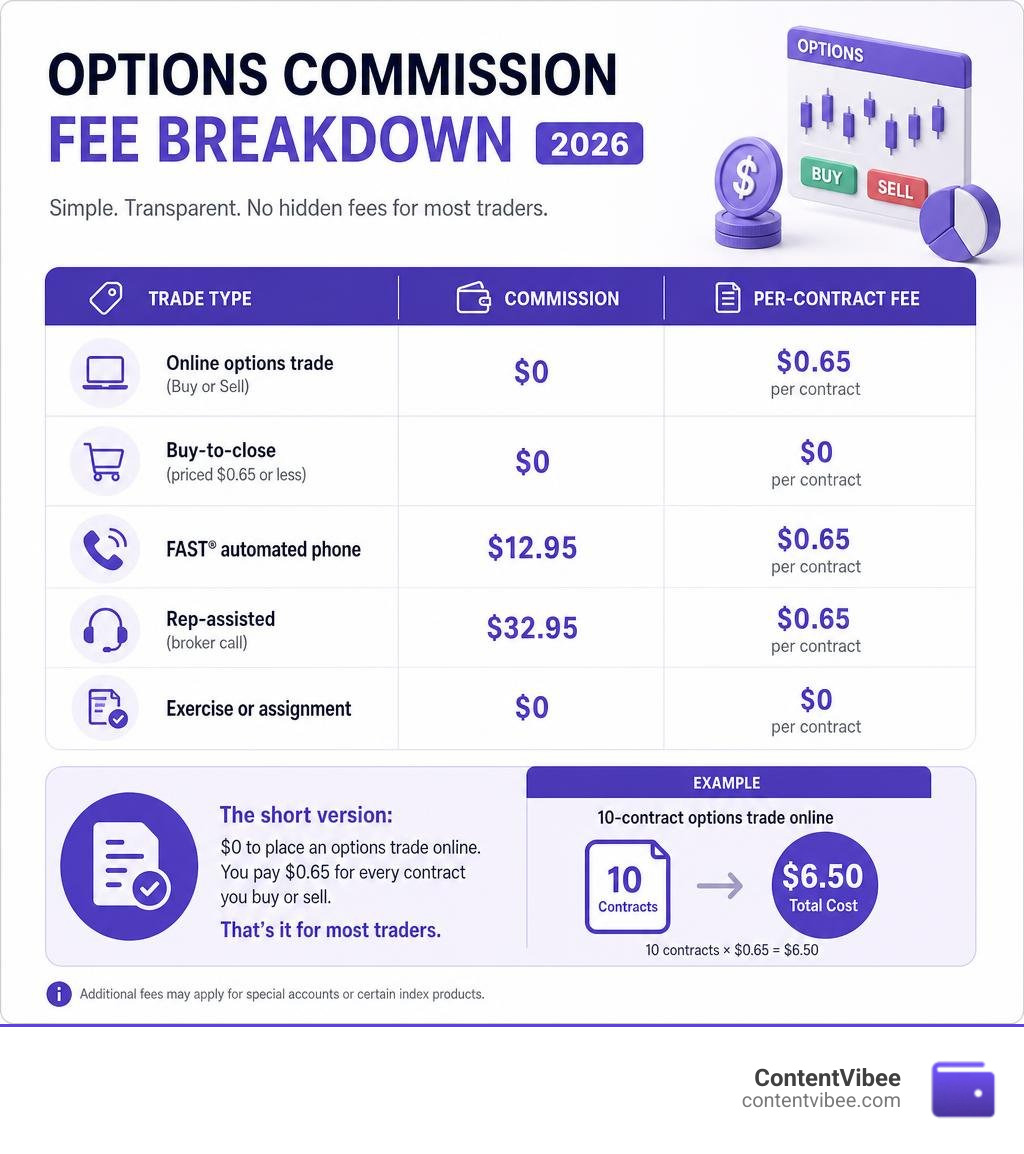
Fidelity option commissions follow a simple structure that most traders can understand in under a minute. Here’s the fast answer:
| Trade Type | Commission | Per-Contract Fee |
|---|---|---|
| Online options trade | $0 | $0.65 per contract |
| Buy-to-close (priced $0.65 or less) | $0 | $0 |
| FAST® automated phone | $12.95 | $0.65 per contract |
| Rep-assisted (broker call) | $32.95 | $0.65 per contract |
| Exercise or assignment | $0 | $0 |
The short version: Fidelity charges $0 to place an options trade online. You pay $0.65 for every contract you buy or sell. That’s it for most traders.
So a 10-contract options trade online costs you $6.50 total. Nothing more, unless you fall into a special category like professional trader status or trade certain index products.
That said, there are a few extra layers worth knowing — especially if you’re approaching retirement and thinking about trading options inside an IRA, or if you’re comparing brokers before moving a 403(b) rollover. The fee structure has some important nuances that can catch people off guard.
This guide breaks it all down clearly, so you know exactly what you’ll pay before placing a single trade.
Simple guide to fidelity option commissions terms:
Understanding Fidelity Option Commissions: The Complete Fee Breakdown
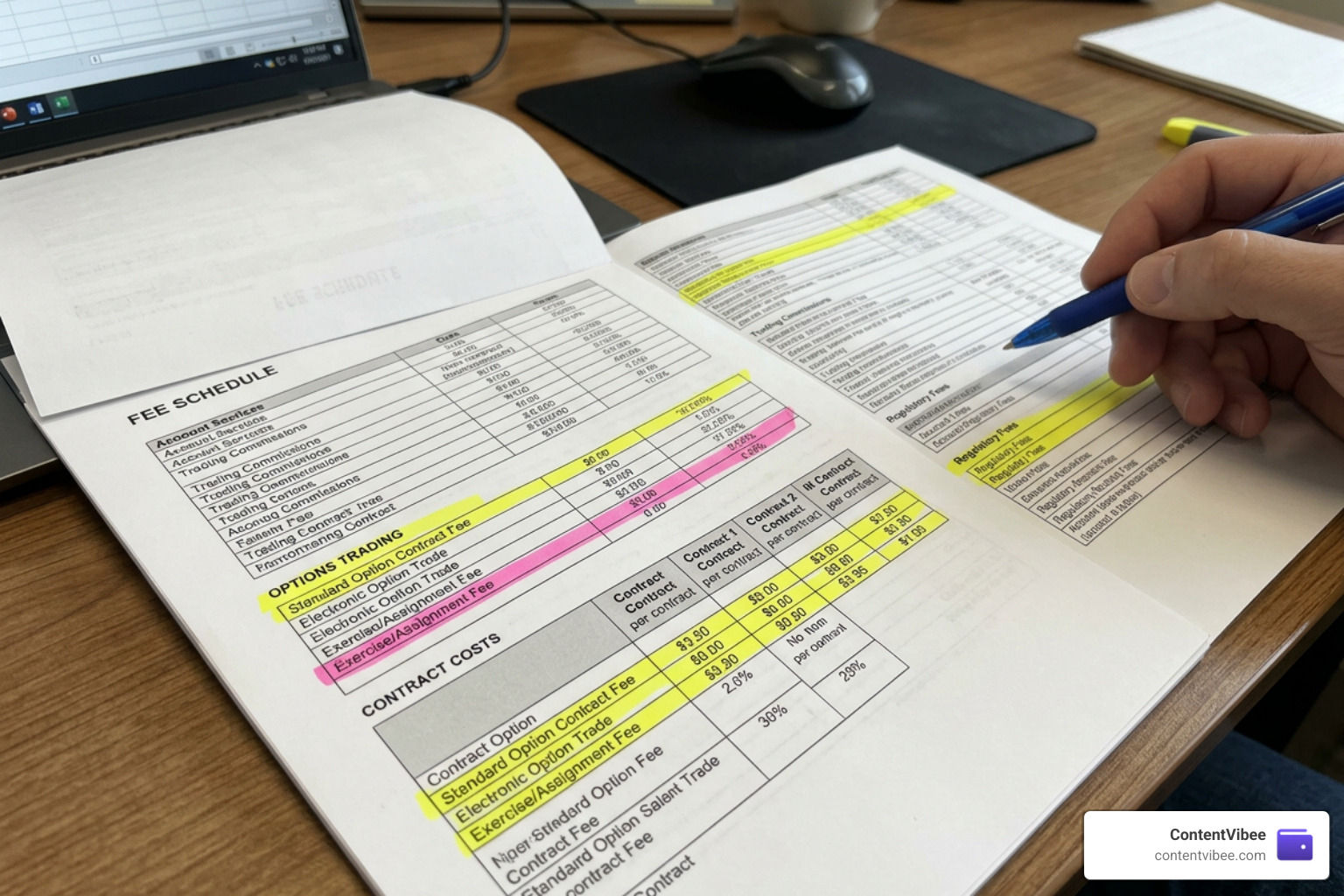
When you trade options at Fidelity, you are operating within one of the most transparent fee structures in the retail brokerage space. However, to truly master your trading costs, you need to look past the “$0 commission” headlines and understand how contract fees, platform choices, and clearing costs interact.
Fidelity makes its full pricing schedule available to the public in the Fidelity Brokerage and Commission Fee Schedule | Trading information . To help you digest this massive document without the headache, we have broken down the core components of fidelity option commissions below. If you want a broader look at how this fits into their overall cost structure, check out our guide on Fidelity Fees And Commissions Explained Without The Fine Print.
Standard Online Fidelity Option Commissions and Contract Fees
For the vast majority of self-directed retail investors trading on web platforms, Active Trader Pro, or the Fidelity mobile app, the commission is exactly $0.00. The only variable cost is the $0.65 per-contract fee.
This means your pricing scales linearly with the size of your order:
- 1 contract: $0.65 total cost
- 5 contracts: $3.25 total cost
- 10 contracts: $6.50 total cost
- 50 contracts: $32.50 total cost
However, how you place your trade matters immensely. If you step away from your computer and use Fidelity’s automated phone system (FAST®) or speak directly to a live broker, those costs skyrocket.
Here is how the standard online fees compare to other methods of execution:
| Execution Method | Base Commission | Per-Contract Fee | Example: 10-Contract Order |
|---|---|---|---|
| Online / App / ATP | $0.00 | $0.65 | $6.50 |
| FAST® Automated Phone | $12.95 | $0.65 | $19.45 |
| Representative-Assisted | $32.95 | $0.65 | $39.45 |
As you can see, utilizing broker assistance can quickly eat into your profits. To understand how these base costs compare to stock trading, take a look at our analysis of Fidelity Fees For Buying Stocks Whats The Catch and our detailed breakdown of the Fidelity Fee Per Trade. If you ever find yourself needing a broker’s help, make sure you read up on the Broker Assisted Trade Fee Fidelity to avoid nasty surprises.
How Multi-Leg Orders Affect Your Fidelity Option Commissions
A multi-leg order is any options strategy that involves buying and selling different contracts simultaneously—such as vertical spreads, iron condors, straddles, or collars.
Fidelity provides a dedicated multi-leg option trading ticket to help traders execute these complex strategies efficiently. Using this ticket is highly recommended because it ensures your entire strategy is executed together, reducing “leg-in” risk (the risk of the market moving against you while you try to execute each leg individually).
From a fee perspective, Fidelity charges the $0.65 contract fee on every single leg and contract executed. There is no “bundle discount” for multi-leg trades.
Let’s look at a clear step-by-step cost sequence for a multi-leg trade:
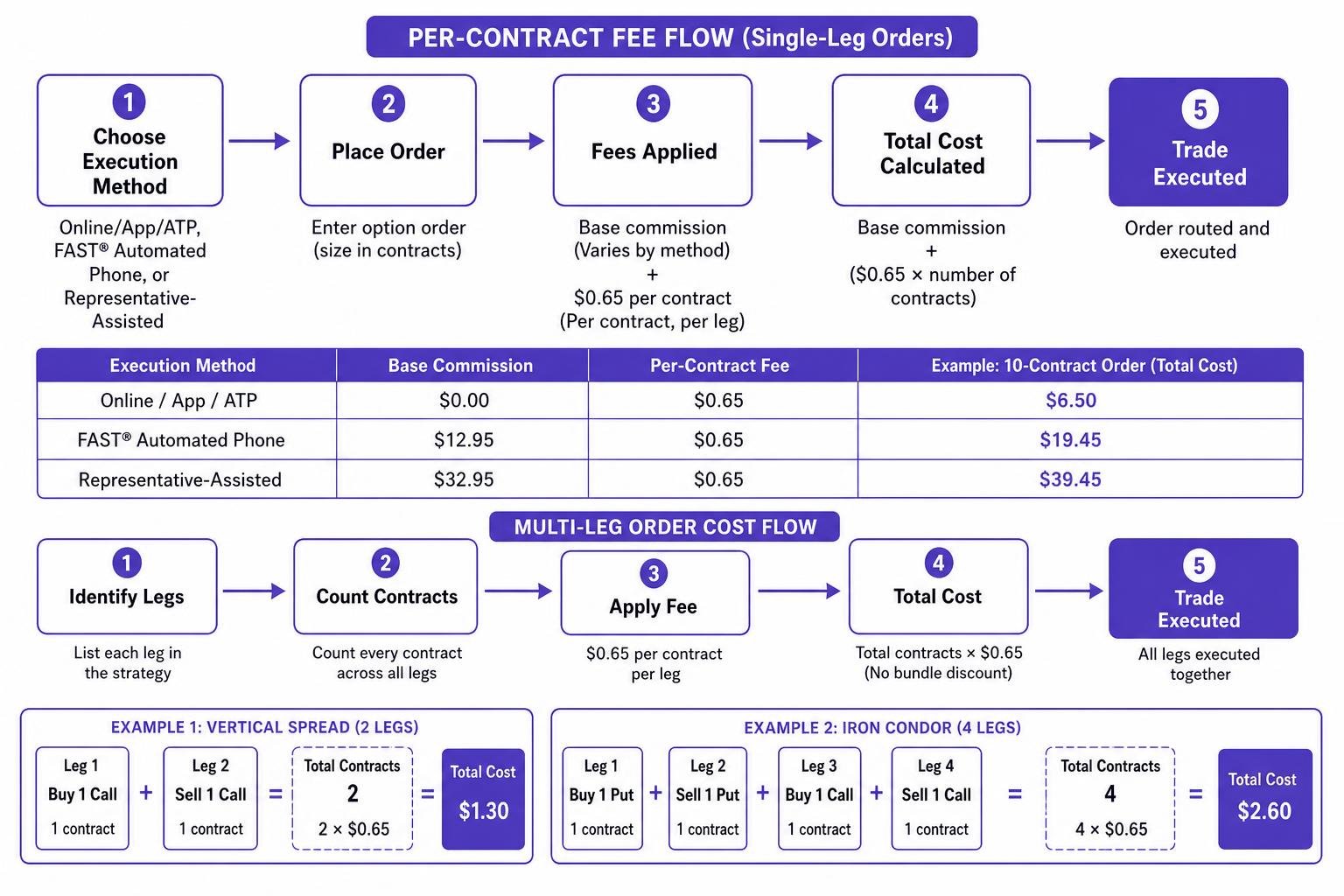
Here is how the math works in practice:
- Vertical Spread (2 legs): Buying 1 Call and Selling 1 Call.
- Calculation: 2 contracts x $0.65 = $1.30
- Iron Condor (4 legs): Buying 1 Put, Selling 1 Put, Buying 1 Call, Selling 1 Call.
- Calculation: 4 contracts x $0.65 = $2.60
- 10-Contract Vertical Spread: Buying 10 Calls and Selling 10 Calls.
- Calculation: 20 total contracts x $0.65 = $13.00
For more details on navigating the platform’s order entry screens for complex trades, you can consult Help .
The Buy-to-Close Fee Waiver and Free Exercises
One of Fidelity’s most investor-friendly features is its buy-to-close fee waiver.
If you write (sell to open) an option contract to collect premium, you normally have to pay another $0.65 contract fee to buy it back (buy to close) and lock in your profits or limit your losses. However, at Fidelity, online buy-to-close orders for options priced at $0.65 or less are completely free. They carry $0.00 in commission and $0.00 in contract fees.
This is an incredible advantage for premium sellers (such as those running covered calls or cash-secured puts) who want to “clear out” low-value, expiring contracts without paying away their remaining profits in fees.
Additionally, if your option is in-the-money at expiration, or if you decide to exercise it early, Fidelity charges $0 for exercises and assignments.
- If you own a call option and exercise it to buy 100 shares of stock, you pay $0.
- If you wrote a covered call and your shares are assigned (sold), you pay $0.
This zero-fee policy on exercises and assignments sets Fidelity apart from several competitors who still charge administrative fees for these events. To see how this fits into the broader picture of “free” trading at Fidelity, read our article Are Fidelity Trades Really Free Demystifying The Fees. And if you do end up selling shares due to an assignment, make sure you Dont Get Caught Off Guard By Stock Selling Fees.
Advanced Options Trading: Tiers, Margin, and Professional Fees
As you gain experience and expand your trading toolkit, you will likely want to trade more complex strategies. However, with greater complexity comes greater risk, which means you will need to navigate Fidelity’s options approval tiers, margin requirements, and potential professional fees.
Before diving into advanced strategies, it is wise to review the general costs of leverage and active trading at Trading Commissions and Margin Rates | Fidelity and read our comprehensive overview of What Does It Really Cost To Trade On Fidelity.
Options Approval Tiers and Account Requirements
Fidelity does not allow just anyone to trade highly leveraged or unlimited-risk options strategies. You must apply for options trading approval, and your account will be designated into one of three tiers based on your financial situation, trading experience, and risk tolerance:
- Tier 1 (Covered): Allows you to write covered calls, buy protective puts, and write cash-secured puts. This tier is typically approved for cash accounts and IRAs.
- Tier 2 (Spreads): Allows all Tier 1 strategies, plus buying calls and puts, and trading spreads (vertical, calendar, diagonal, etc.). Spreads in a non-retirement account require margin approval.
- Tier 3 (Uncovered): Allows all Tier 1 and 2 strategies, plus writing uncovered (naked) equity and index options, and trading straddles or strangles. This tier carries the highest level of risk and requires substantial capital.
To establish these permissions, you must sign and return the official Options Agreement , which outlines your legal obligations and the risks involved.
Margin Rates and Cash Spread Reserve Rules
If you trade spreads or uncovered options, you will need a margin account. While you do not pay interest on options contracts themselves (since you cannot buy options on margin), your margin debit balance (if you borrow cash to buy underlying shares) will incur interest charges.
Fidelity offers competitive, tiered margin rates that decrease as your debit balance increases. In 2026, these rates can go as low as 7.50% for balances over $1 million, while smaller balances under $25,000 may face rates closer to 11.825%.
Additionally, there are unique margin and cash rules for retirement accounts:
- IRA Spreads: You can trade spreads in a Fidelity IRA, but you must maintain a minimum of $2,000 in an interest-bearing Cash Spread Reserve account to cover potential losses.
- Naked Options Requirements: If you are approved for Tier 3 trading in a taxable account, you must maintain a minimum equity balance of $20,000 for naked equity options and $50,000 for naked index options.
Professional Trader Fees and Proprietary Index Charges
If you are a highly active trader or trade specific index products, you may run into specialized fees:
1. Professional Options Trader Designation
If you average 390 or more options orders per day across all your accounts, the exchanges will designate you as a “Professional Options Trader.”
- While standard retail traders pay no exchange fees, exchanges charge professionals between $0.50 and $1.10 per contract.
- To offset this, Fidelity adds an additional $0.50 per-contract fee to all executions for accounts with this designation.
2. Proprietary Index Option Fees
Certain highly popular index options (such as the S&P 500 Index options, symbol .SPX, or Nasdaq 100 options, symbol .NDX) are proprietary products owned by specific exchanges. The exchanges charge surcharge fees to trade them, which Fidelity passes directly to the consumer to align with industry standards:
- .SPX (S&P 500 Index): Additional $0.50 per contract
- .NDX (Nasdaq 100 Index): Additional $0.45 per contract
- .RUT (Russell 2000 Index): Additional $0.15 per contract
You can read more about these specific exchange surcharges directly on the Options Trading | FAQs | Fidelity page.
Frequently Asked Questions About Fidelity Options Fees
Are there any hidden regulatory fees when trading options at Fidelity?
Yes, but they are not unique to Fidelity; they apply to all U.S. brokerage accounts. When you sell an options contract, you will see minor regulatory fees tacked onto your trade confirmation:
- Options Regulatory Fee (ORF): Charged by the Options Clearing Corporation (OCC) to cover the costs of regulation. This fee typically ranges from $0.02 to $0.04 per contract.
- SEC Fee (Section 31 Fee): A nominal fee charged on all stock and options sell orders to fund the government’s regulatory oversight.
- Activity Assessment Fee (TAF): A small fee charged per contract on equity options sales.
Fidelity combines these into an “Options Fee” or “Additional Assessment” on your trade confirmation to offset what they are charged by regulators.
Can you trade options in a Fidelity IRA without extra fees?
Absolutely. Fidelity does not charge any annual account fees or extra setup fees to trade options inside an Individual Retirement Account (IRA).
However, because IRAs are cash-only accounts (you cannot borrow money on margin inside an IRA), your strategies are limited. You can easily get approved for Tier 1 (covered calls and cash-secured puts). If you want to trade spreads (Tier 2) in your IRA, you must sign a Spreads Agreement and maintain the $2,000 Cash Spread Reserve mentioned earlier.
What happens to options commissions if I use broker-assisted trading?
If you place an options trade by calling a Fidelity representative, you will be charged a base broker-assisted commission of $32.95 plus the $0.65 per-contract fee.
For example, if you ask a broker to buy 5 contracts for you, the total cost will be: $$\$32.95 + (5 \times \$0.65) = \$36.20$$
To protect your hard-earned capital, we highly recommend utilizing the online platforms or the mobile app, where the base commission is always $0.00.
Conclusion
Navigating fidelity option commissions doesn’t have to be a headache. By keeping your trades online, taking advantage of the buy-to-close waiver on cheap contracts, and understanding the extra fees associated with proprietary index products, you can keep your trading costs incredibly low.
At ContentVibee, our goal is to provide you with clear, step-by-step financial advice to help you manage your money smarter. Whether you are building a retirement nest egg or actively trading the markets, understanding the fine print of your brokerage fees is one of the easiest ways to boost your long-term returns.
If you want to discover more ways to optimize your portfolio and minimize your investing friction, check out our ultimate resource: The Ultimate Guide To Fidelity Trading Fees And Savings. Happy trading!