What the RMD Penalty 2026 Actually Costs You — and How to Escape It
The rmd penalty 2026 is one of the most expensive tax mistakes a retiree can make — and one of the most fixable.
Here is the quick answer if you need it fast:
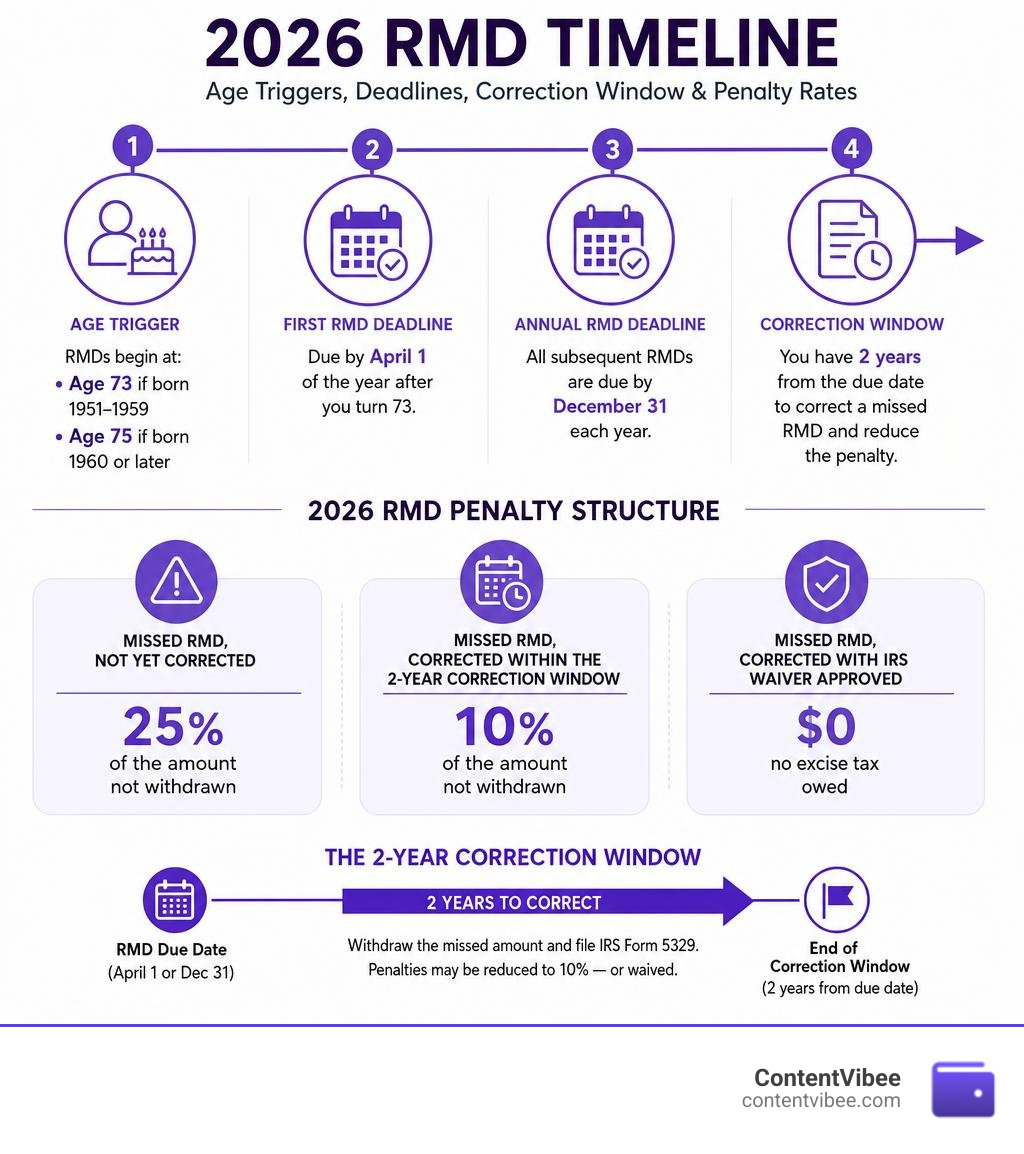
2026 RMD Penalty at a Glance
| Situation | Penalty Rate |
|---|---|
| Missed RMD, not yet corrected | 25% of the amount not withdrawn |
| Missed RMD, corrected within the 2-year Correction Window | 10% of the shortfall |
| Missed RMD, corrected with IRS waiver approved | $0 |
A few key facts to know right now:
- RMDs begin at age 73 if you were born between 1951 and 1959, and at age 75 if you were born in 1960 or later.
- The first RMD is due by April 1 of the year after you turn 73. All others are due by December 31 each year.
- The SECURE 2.0 Act already cut the old 50% penalty down to 25%. Fix it in time, and it drops further to 10%.
- In many cases, the IRS will waive the penalty entirely for a first-time mistake — if you act quickly and file the right paperwork.
Missing an RMD is more common than people think. Retirement accounts have rules that are easy to misread, especially after recent law changes. If you missed a distribution — or you are not sure whether you did — the worst thing you can do is nothing.
This guide walks you through exactly what the penalty is, how the Correction Window works, and the step-by-step process to fix the problem and potentially pay $0 in excise tax.
Rmd penalty 2026 definitions:
Understanding the RMD Penalty 2026 Rules under SECURE 2.0
To understand the rmd penalty 2026 landscape, we have to look at how much the rules have changed in recent years. For decades, the tax code imposed a brutal 50% excise tax on any Required Minimum Distribution (RMD) that was missed or under-withdrawn. If you missed a $20,000 distribution, you owed the IRS $10,000 on top of the ordinary income tax due on the withdrawal.
Fortunately, the SECURE Act 2.0 (specifically Section 302) permanently changed this punitive structure. Starting in 2023, the baseline excise tax was slashed to 25%. Furthermore, if you correct the error within a designated two-year window, the penalty drops to a much more manageable 10%.
This penalty applies to all tax-deferred retirement accounts, including:
- Traditional IRAs
- SEP IRAs
- SIMPLE IRAs
- Traditional 401(k), 403(b), and 457(b) plans
The starting age for these mandatory withdrawals is also in transition. Currently, in July 2026, the RMD age is 73 for those born between 1951 and 1959. If you turn 73 in 2026, you must begin taking RMDs. If you were born in 1960 or later, your starting age will be 75.
To help visualize the shift, here is how the penalty rates compare across the legislative timelines:
| Rule Era | Baseline Penalty Rate | Reduced Penalty Rate (Corrected) |
|---|---|---|
| Pre-SECURE 2.0 (Before 2023) | 50% | N/A (Waiver request required) |
| SECURE 2.0 Era (2023 – Present) | 25% | 10% (Within Correction Window) |
If you are currently managing your retirement income, it is critical to keep these ages straight. You can read more about the specific age brackets in our comprehensive resource, The Essential RMD Age Table Guide for Smart Retirees. For formal government guidance on these rules, you can also consult the IRS RMD FAQ.
The SECURE 2.0 Correction Window: How to Reduce Your Penalty to 10%
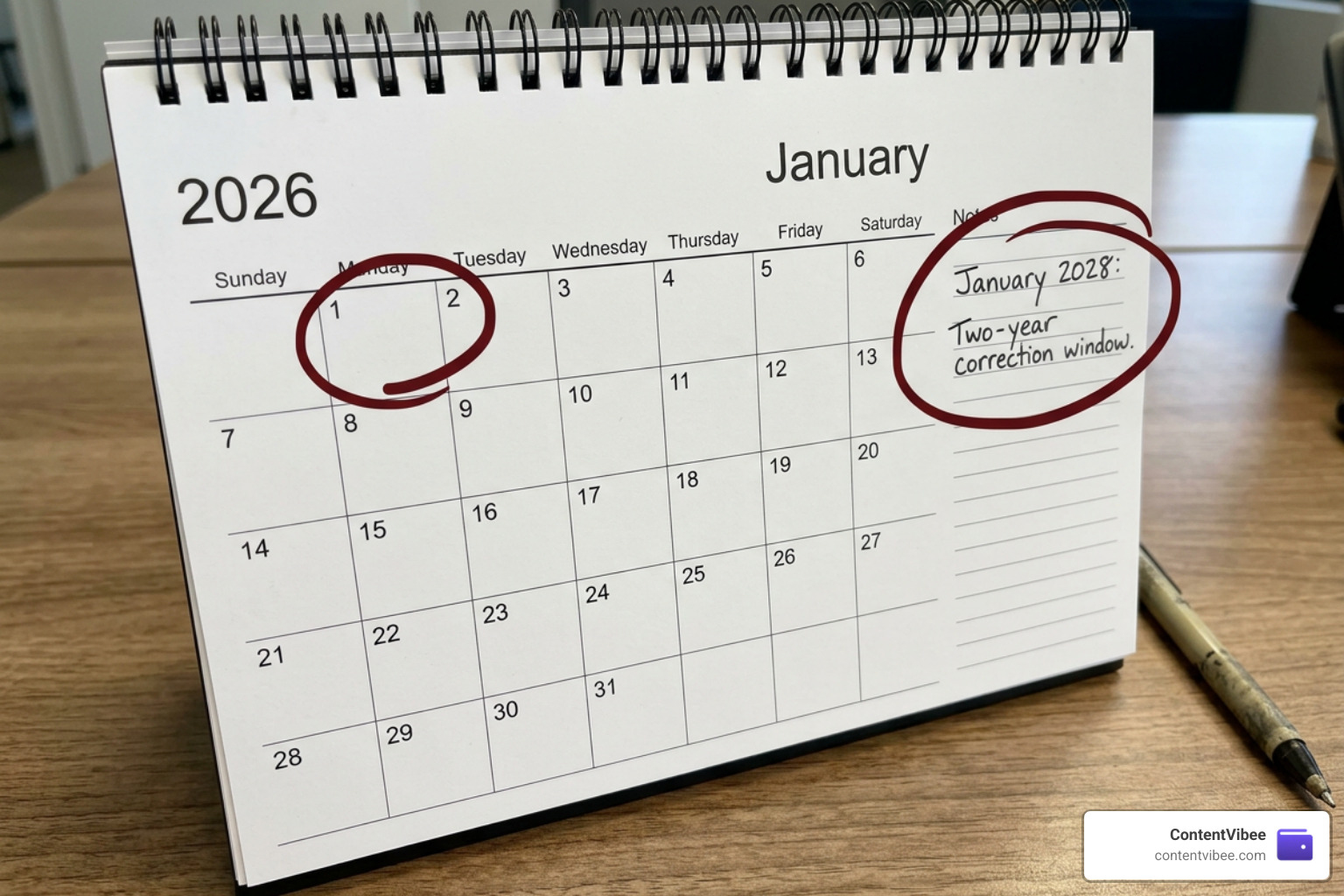
One of the most taxpayer-friendly features of the SECURE 2.0 Act is the creation of a formal “Correction Window.” If you realize you made an error, you do not have to panic. Under the current law, the IRS gives you a statutory right to reduce your rmd penalty 2026 from 25% to 10% simply by fixing the mistake within a specific timeframe.
The Correction Window begins on the day the excise tax is imposed (usually January 1 of the year following the missed RMD). It ends on the earliest of the following dates:
- The date the IRS mails a “notice of deficiency” (an official tax audit letter) regarding the missed distribution.
- The date the IRS officially assesses the excise tax against you.
- The last day of the second taxable year after the year in which the tax is imposed.
For example, if you missed an RMD that was due by December 31, 2024, the excise tax was technically imposed on January 1, 2025. Your Correction Window to claim the 10% rate runs until December 31, 2026, unless the IRS catches the error and contacts you first.
To claim this lower 10% rate, you must take the full make-up distribution from your account and report the correction on IRS Form 5329.
How the RMD Penalty 2026 Reduction Works in Practice
Let’s look at a real-world mathematical example of how this reduction saves you money, and how it can accidentally create a tax-year stacking problem.
Suppose you had a required distribution of $30,000 for 2025, but because of a family emergency, you forgot to take it by the December 31, 2025 deadline.
- The Uncorrected Penalty (25%): If you do nothing and the IRS discovers the error, your penalty is $7,500.
- The Corrected Penalty (10%): If you discover the error in early 2026, quickly withdraw the $30,000 shortfall, and file Form 5329, your penalty drops to $3,000. That is a direct savings of $4,500.
However, we must warn you about tax-year stacking. Correcting a missed RMD does not satisfy or cancel your current-year RMD. If you turn 73 and delay your first RMD until April 1 of the following year, or if you simply miss a deadline and have to take a make-up distribution, you will end up taking two distributions in the same calendar year.
Taking a $30,000 make-up distribution for 2025 alongside your normal $30,000 distribution for 2026 means you will report $60,000 of taxable ordinary income in 2026. This sudden spike in income can push you into a higher federal tax bracket, trigger higher state income taxes, increase the taxation of your Social Security benefits, or even trigger Medicare IRMAA surcharges.
To avoid these math headaches before they start, we recommend using our guide on how to Calculate Your RMD Without the Headache.
Step-by-Step Guide to Correcting a Missed RMD and Requesting a Waiver
If you realize you missed an RMD, you do not have to settle for paying the 10% penalty. The IRS has the authority to waive the penalty entirely ($0) if you can show “reasonable cause” and prove that you took immediate action to fix the error.
We recommend always requesting a full waiver first. If the IRS denies the waiver, you can still fall back on the 10% Correction Window rate. Here is the step-by-step sequence we use to help retirees clean up a missed distribution:

Step 1: Calculate the Shortfall
Look at your prior-year December 31 account balance and divide it by the correct life expectancy factor from the IRS Uniform Lifetime Table. Subtract any amount you actually did withdraw to find your exact shortfall.
Step 2: Take the Corrective Distribution Immediately
You must withdraw the missed amount from the affected account as a standalone, corrective transaction. Do not mix this withdrawal with your current-year RMD. Keep the custodian receipt showing the date and the exact amount of the make-up distribution.
Step 3: File IRS Form 5329
You must file Form 5329 for the tax year in which the RMD was missed. You can file this form with your annual Form 1040 tax return, or as a standalone document if you have already filed your taxes for that year.
To request a waiver, go to Part IX of Form 5329:
- Enter the required minimum distribution amount.
- Enter the amount you actually distributed.
- On the line for the excise tax, enter “RC” (for Reasonable Cause) next to the line, and write “$0” as the tax due.
Step 4: Write and Attach a Reasonable Cause Letter
This is the most critical step. You must attach a physical, written statement to Form 5329 explaining why you missed the deadline, how you corrected it, and how you will prevent it from happening again.
What Qualifies as Reasonable Cause for an RMD Penalty 2026 Waiver?
The IRS does not waive penalties just because you ask nicely; you must demonstrate “reasonable cause.” Fortunately, the IRS is historically quite reasonable and understanding with first-time mistakes, provided you corrected the issue as soon as you discovered it.
According to the IRS Form 5329 Instructions, some of the most commonly accepted reasons for a waiver include:
- Severe Illness or Medical Emergency: You or an immediate family member suffered a serious medical event that disrupted your ability to handle financial affairs during the distribution period.
- Mental Incapacity or Cognitive Decline: The account owner experienced cognitive struggles or transition into assisted living.
- Custodian or Financial Institution Error: Your bank or brokerage firm gave you incorrect information, failed to execute a scheduled automatic withdrawal, or calculated the RMD incorrectly.
- Extreme Family Distress: A death in the immediate family or a sudden natural disaster that upended your life around the December deadline.
- Honest Misunderstanding of Complex Rules: For example, confusion over the changing RMD ages under SECURE 2.0, or a beneficiary inheriting an account and not realizing they were subject to annual distribution rules.
When writing your letter, keep it concise, clear, and professional. State the facts plainly, attach supporting documentation (such as a doctor’s note or custodian correspondence), and outline the steps you have taken to automate your future withdrawals.
Special Rules: Inherited IRAs, Multiple Accounts, and the Statute of Limitations
When dealing with the rmd penalty 2026, there are three complex scenarios where retirees frequently trip up: inherited accounts, account aggregation, and the statute of limitations.
Inherited IRAs and the 10-Year Rule
For non-spouse beneficiaries who inherited an IRA after December 31, 2019, the SECURE Act eliminated the old “stretch IRA” rules and replaced them with a strict 10-year depletion window.
Under the finalized IRS regulations, if the original account owner had already reached their Required Beginning Date (RBD) before they passed away, the beneficiary must take annual RMDs during years 1 through 9 of the 10-year window, and fully empty the account by the end of the 10th year. If the original owner died before reaching their RBD, the beneficiary does not have to take annual distributions but must still empty the account by year 10.
While the IRS waived penalties for missed inherited IRA RMDs from 2021 through 2024 via transitional relief notices, those waivers have expired. Standard penalties apply in full for 2025 and 2026.
The Multiple Account Trap (Aggregation Rules)
Can you calculate your total RMD across all accounts and withdraw the entire sum from just one? The answer depends entirely on the account type:
- Traditional IRAs (including SEP and SIMPLE IRAs): Yes. You must calculate the RMD for each IRA separately, but you can withdraw the total amount from any combination of your Traditional IRAs.
- 403(b) Plans: Yes. You can aggregate your 403(b) RMDs and take the total from one or more of your 403(b) accounts.
- 401(k) and 457(b) Plans: No. You cannot aggregate employer-sponsored 401(k) or 457(b) plans. If you have three different 401(k) accounts from past employers, you must calculate and withdraw the exact RMD from each individual account separately. Taking a double distribution from one 401(k) to cover another will trigger a penalty on the second account.
The New Statute of Limitations
Prior to SECURE 2.0, if you missed an RMD and did not file Form 5329, the statute of limitations for the IRS to assess a penalty never started. The IRS could theoretically audit you 15 years later and demand decades of back-penalties and interest.
SECURE 2.0 fixed this loophole. The filing of your standard Form 1040 tax return now starts a three-year statute of limitations clock for RMD penalties, even if you did not file Form 5329. If three years pass after you file your tax return for a given year, the IRS can no longer assess an RMD penalty for that year.
To understand how these evolving tax codes impact your broader retirement strategy, check out our Retirement Benefits Complete Guide 2026.
Frequently Asked Questions About Missed RMDs
Can I roll over a missed RMD once I withdraw it?
No. The tax code strictly prohibits rolling over any required minimum distribution into another tax-deferred account. Once you withdraw your missed RMD, it must remain in a taxable environment (such as a standard checking account or a taxable brokerage account). The distribution is treated as ordinary taxable income for the year in which you receive it.
Does correcting a missed RMD satisfy my current year requirement?
No, it does not. If you miss your 2025 RMD and withdraw the shortfall in 2026, that withdrawal only satisfies your 2025 obligation. You must still calculate and withdraw your normal 2026 RMD by December 31, 2026.
As mentioned earlier, this creates a “double distribution” year. Be sure to plan ahead for the tax bracket impact and watch out for potential Medicare IRMAA surcharges.
How do RMD rules differ for Roth 401(k)s and Roth IRAs in 2026?
Roth IRAs have never required distributions during the lifetime of the original owner. However, prior to 2024, employer-sponsored Roth 401(k) and Roth 403(b) plans did require lifetime RMDs.
Effective January 1, 2024, the SECURE 2.0 Act eliminated lifetime RMD requirements for all designated Roth accounts in workplace retirement plans, aligning them perfectly with Roth IRAs. This exemption only applies to the original account owner; inherited Roth accounts are still subject to distribution rules.
If you want to maximize your tax-free growth and avoid RMDs entirely, read our guide on The Ultimate Guide to Your 2026 Max Roth IRA Contribution.
Conclusion
Missing a required distribution can feel incredibly stressful, but the rmd penalty 2026 rules are far more forgiving than they used to be. By taking immediate action, withdrawing the shortfall, and filing Form 5329 with a clear explanation of your reasonable cause, you stand an excellent chance of securing a full IRS waiver.
At ContentVibee, we believe that proactive planning is the ultimate defense against IRS penalties. Here are three simple steps you can take today to protect yourself going forward:
- Set up automatic distributions: Most custodians offer a free service that calculates and automatically distributes your RMD in a month of your choosing.
- Schedule a mid-year check: Set a recurring calendar reminder for October or November to verify that your distributions have been processed.
- Coordinate with a professional: Consult a tax advisor or financial planner to align your distributions with your overall tax-bracket strategy.
For a deeper look at optimizing your income, maximizing your Social Security, and avoiding costly retirement traps, explore our Retirement Benefits Complete Guide 2026.