


Why Your Full Retirement Age Benefits Decision Could Define Your Financial Future
Full retirement age benefits are one of the most important — and most misunderstood — pieces of retirement planning in America.
Here’s the quick answer most people are looking for:
Your Full Retirement Age (FRA) by Birth Year:
| Birth Year | Full Retirement Age | Benefit at Age 62 (% of Full) |
|---|---|---|
| 1943-1954 | 66 | 75% |
| 1955 | 66 and 2 months | ~74.2% |
| 1956 | 66 and 4 months | ~73.3% |
| 1957 | 66 and 6 months | ~72.5% |
| 1958 | 66 and 8 months | ~71.7% |
| 1959 | 66 and 10 months | ~70.8% |
| 1960 or later | 67 | 70% |
Key facts at a glance:
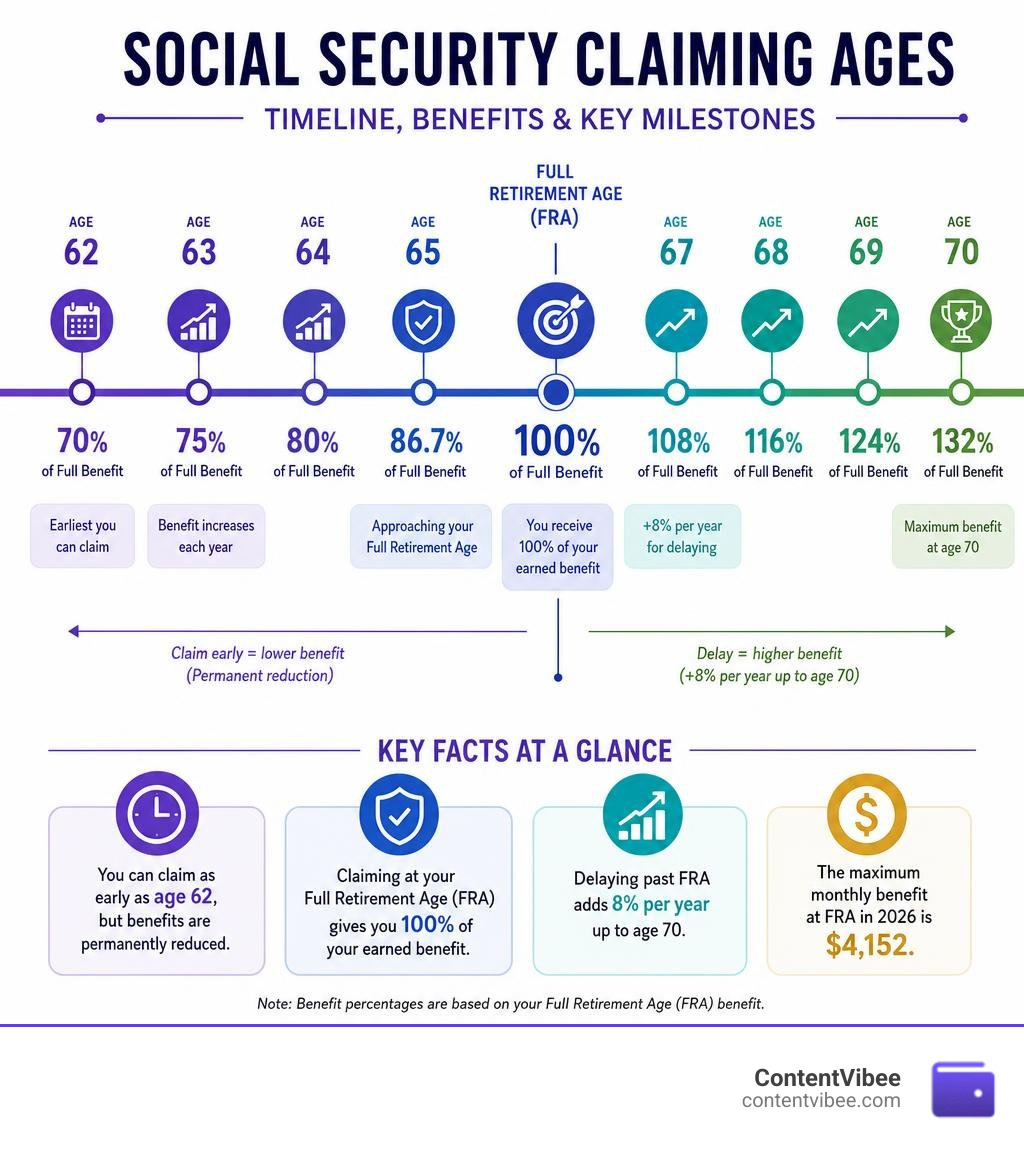
- You can claim as early as age 62, but benefits are permanently reduced
- Claiming at FRA gives you 100% of your earned benefit
- Delaying past FRA adds 8% per year up to age 70
- The maximum monthly benefit at FRA in 2026 is $4,152
Now, here’s why this matters so much.
More than 23.5 million Americans would fall into poverty without Social Security. For 1 in 7 beneficiaries over age 65, it makes up more than 90% of their income. This isn’t just a line item in your retirement plan — for millions of people, it is the retirement plan.
The decision of when to claim is permanent. Claim too early, and you lock in a reduced payment for life. Wait strategically, and you could collect hundreds of dollars more every single month — for decades.
Most people don’t realize how much the timing decision actually costs them. The difference between claiming at 62 versus waiting until 70 can exceed $100,000 in lifetime income depending on your earnings history and how long you live.
This guide breaks down exactly how to maximize what you’ve earned.
Simple guide to full retirement age benefits:
What Are Full Retirement Age Benefits and How Do They Work?
At its core, your full retirement age (FRA) is the specific age designated by federal law when you become eligible to collect 100% of your monthly Social Security retirement benefit. This baseline benefit is technically known as your Primary Insurance Amount (PIA).
According to the Official definition of full retirement age under federal regulations, this is the milestone where no early retirement reductions are applied to your check. If you decide to claim before this point, you are essentially agreeing to a permanent haircut on your monthly income. Conversely, if you wait past this milestone, the government rewards your patience with a permanent boost.
To truly master your retirement roadmap, you must understand how this baseline is calculated and how legislative history has shifted the goalposts over time. For a deeper dive, check out our guide on Understanding Your Social Security Full Retirement Age.
Determining Your FRA by Birth Year
Your FRA is not a one-size-fits-all number. Instead, it is entirely determined by the year you were born.
If you were born between 1943 and 1954, your FRA is exactly 66. For those born between 1955 and 1959, the age creeps up gradually in two-month increments. For anyone born in 1960 or later, your FRA is exactly 67.
These rules are strictly enforced by the Social Security Administration (SSA). You can review the exact parameters on the Social Security Administration guidelines for those born in 1960 or later.
Knowing your specific target age is the foundation of any successful claiming strategy. If you want to explore how these tiers impact your overall planning, our resource on The Complete Guide to Social Security Full Retirement offers a comprehensive breakdown.
The History and Evolution of Full Retirement Age Benefits
Why does this sliding scale exist in the first place? We have the landmark 1983 Social Security Amendments to thank.
Faced with a looming solvency shortfall, Congress passed bipartisan legislation that gradually raised the FRA from 65 to 67 over a 33-year period. By raising the age, the government effectively reduced overall program outlays without technically lowering the monthly benefit formula. Actuarial estimates show that enacting this gradual FRA increase alone reduced Social Security’s long-range shortfall by 18%.
However, raising the retirement age remains a highly debated policy reform. While proponents argue it is a necessary adjustment to account for rising American life expectancies, critics point out that longevity gains have not been shared equally.
For instance, for men born in 1930, those in the highest income quintile had a life expectancy at age 50 that was 5.1 years longer than those in the lowest quintile. For men born in 1960, that discrepancy grew to a staggering 12.7 years. This means raising the retirement age disproportionately impacts lower-income workers who may have shorter life expectancies or physically demanding jobs that make working until 67 incredibly difficult.
How Claiming Early Permanently Reduces Your Monthly Payments
While you can technically start collecting your retirement benefits as early as age 62, doing so comes with a heavy financial penalty. This reduction is not temporary; it permanently lowers your monthly check for the rest of your life.
When you file early, the SSA applies an actuarial reduction to your PIA. This reduction is designed to make your total lifetime benefits roughly equal regardless of whether you claim early (and receive smaller checks for a longer period) or claim late (and receive larger checks for a shorter period). However, as we will see, this “actuarial equivalence” does not always work out in your favor, especially if you live an average or longer-than-average life.
To evaluate how early claiming might impact your long-term plans, read through The Definitive Guide to Social Security Claiming Age.
Calculating the Early Claiming Penalty
The mathematical formula used to calculate your early retirement penalty is highly precise. The SSA reduces your benefit by a fraction of a percent for each month you claim before your FRA:
- For the first 36 months before your FRA, your benefit is reduced by 5/9 of 1% per month (about 6.67% per year).
- For any additional months beyond 36 months (up to a maximum of 24 additional months), your benefit is reduced by 5/12 of 1% per month (5% per year).
For someone born in 1960 or later whose FRA is 67, claiming at exactly age 62 means filing 60 months early.
- The first 36 months yield a 20% reduction (36 x 5/9%).
- The remaining 24 months yield an additional 10% reduction (24 x 5/12%).
Combined, this results in a permanent 30% reduction in your monthly benefit. If your PIA at age 67 was calculated to be $2,000, filing at age 62 means you will only receive $1,400 a month. You can review the official parameters in the Official SSA guide to retirement age and benefit reductions and check the legal formulas in the Official SSA handbook on benefit rate reductions.
Spousal and Survivor Benefit Reductions
It’s not just your personal retirement check that shrinks when you claim early; your spouse’s benefits can also take a massive hit.
Under Social Security rules, a spouse is eligible to receive up to 50% of the working partner’s PIA when claiming at their own FRA. However, if the spouse claims at age 62, that spousal benefit is hit with a steeper reduction formula. For those born in 1960 or later, a spouse’s benefit is reduced to just 32.5% of the worker’s PIA.
Survivor benefits are also heavily influenced by claiming age. If a worker claims retirement benefits early and then passes away, the survivor benefit available to the widow or widower is permanently capped at that lower, reduced amount.
Coordinating these moving parts requires a strategic approach. We highly recommend reading The Smart Couples Guide to Social Security Strategies to protect your household’s joint income.
The Financial Power of Delaying Past Your Full Retirement Age
If early claiming is a financial headwind, delaying your benefits is the ultimate tailwind.
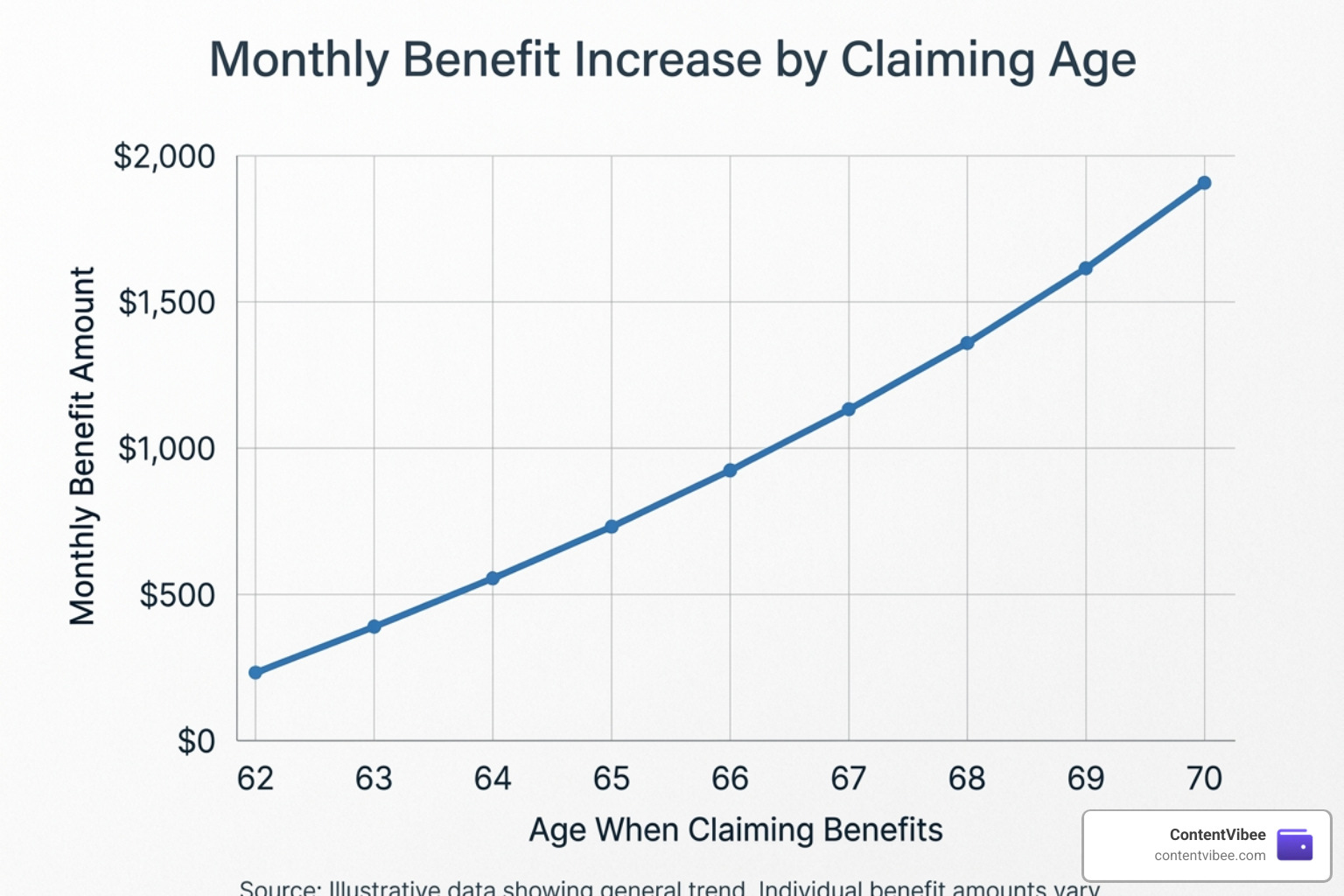
For every month you delay claiming past your FRA, the government awards you Delayed Retirement Credits. These credits accumulate at a rate of 2/3 of 1% per month, which translates to a guaranteed 8% simple interest increase per year.
These credits stop accumulating once you reach age 70, meaning there is absolutely no financial benefit to waiting past your 70th birthday. However, the compound effect of waiting from age 67 to 70 is extraordinary, yielding a permanent 24% increase in your monthly check.
To see how this fits into a comprehensive retirement wealth plan, take a look at The Ultimate Guide to Social Security Benefit Optimization.
Maximizing Your Full Retirement Age Benefits After Age 66
To put this in perspective, let’s look at the maximum possible payments in 2026.
For a high-earning worker claiming Social Security in 2026 at their exact full retirement age, the highest possible monthly payment is $4,152. This is roughly double the estimated average retirement benefit of $2,081 in April 2026.
If that same high-earning worker chose to delay their claim until age 70, their maximum monthly benefit would skyrocket to over $5,100 per month. You can explore the historical and current tables of these maximum limits on the Social Security benefit calculation details page.
Weighing the Pros and Cons of Early vs. Delayed Claiming
Deciding when to pull the trigger is a deeply personal choice. Here is a quick look at the trade-offs:
Claiming Early (Age 62 to FRA):
- Pros: You get immediate access to cash; helps fund early retirement adventures; provides a financial lifeline if you lose your job or suffer poor health.
- Cons: Permanently locks in a lower monthly payment; reduces potential spousal and survivor benefits; subjects you to the strict earnings test if you continue working.
Delaying Benefits (FRA to Age 70):
- Pros: Maximizes your monthly guaranteed, inflation-adjusted income; provides the best possible longevity insurance; maximizes the survivor benefit for your spouse.
- Cons: Requires you to fund your early 60s using other retirement assets; you risk receiving less total lifetime money if you pass away younger than expected.
A standard break-even analysis shows that if you live past age 77 to 80, delaying your claim past FRA will net you more total lifetime cash than claiming early. If you are in good health and have a family history of longevity, waiting is almost always the mathematically superior choice.
How the Social Security Administration Calculates Your Benefit
Before you can decide when to claim, you must understand how your baseline benefit is calculated. The SSA does not simply look at your last few years of work. Instead, they look at your entire lifetime earnings history.
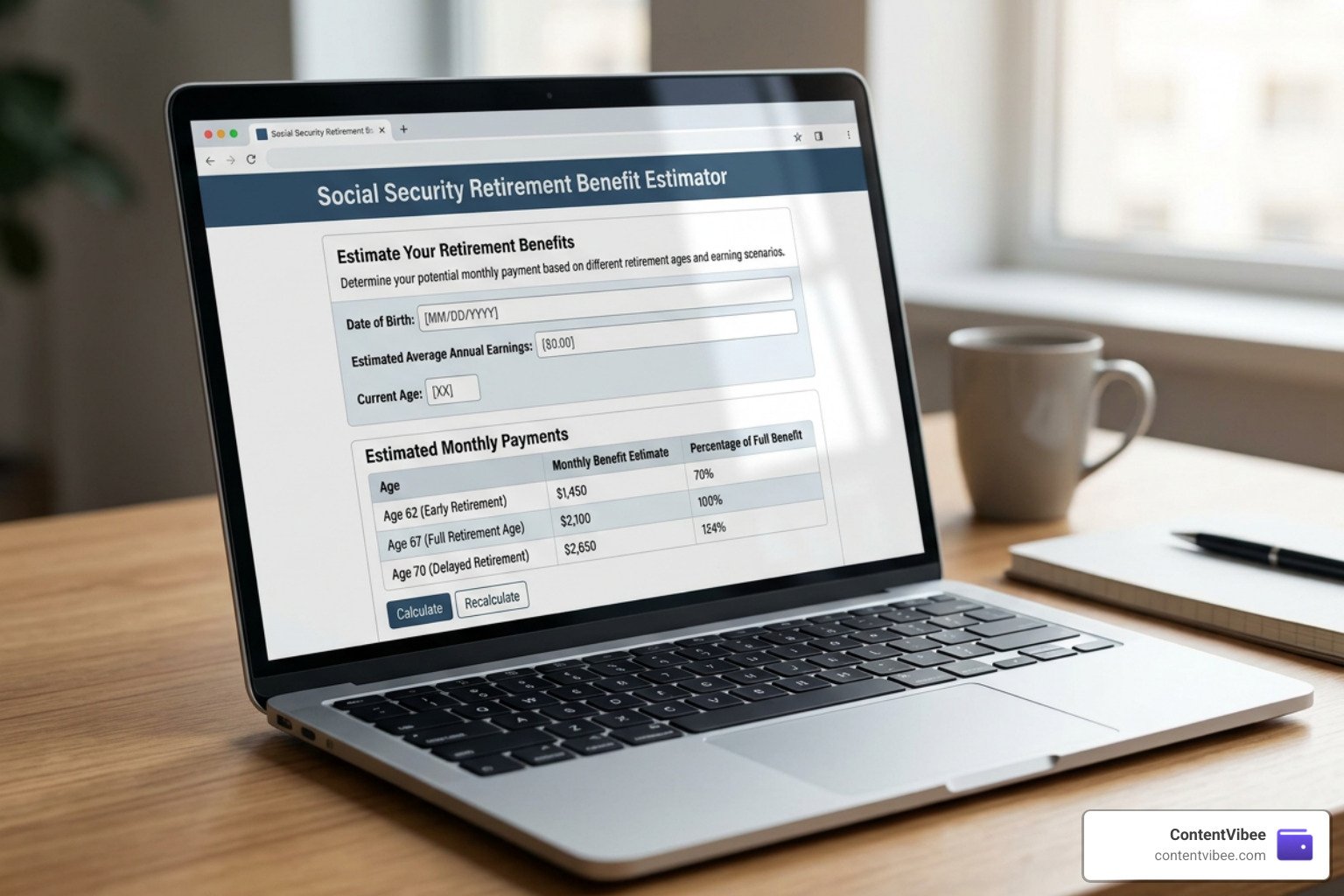
To get a quick estimate of where you stand, try our step-by-step guide: Estimate Your Monthly Retirement Benefits in 5 Easy Steps.
Understanding AIME and PIA
The calculation of your monthly benefit is a two-step process:
- Average Indexed Monthly Earnings (AIME): The SSA takes your historical earnings up to the annual taxable maximum and indexes them to account for changes in average national wages over time. They then select your 35 highest-earning years. If you worked fewer than 35 years, the remaining years are averaged in as zeros. The sum of these 35 indexed years is divided by 420 (the number of months in 35 years) to establish your AIME.
- Primary Insurance Amount (PIA): Once your AIME is established, the SSA applies a progressive formula to determine your PIA. This formula uses “bend points” that change annually. For a worker reaching age 62 in 2026, the bend points are $1,286 and $7,749.
The 2026 formula is calculated as:
- 90% of the first $1,286 of your AIME, plus
- 32% of your AIME between $1,286 and $7,749, plus
- 15% of any AIME exceeding $7,749.
This progressive structure ensures that lower-wage workers receive a higher replacement rate of their pre-retirement income than high-wage workers. You can read the technical manual and see historical calculation worksheets in the Technical guide to computing retired-worker benefits.
The Impact of Non-Covered Pensions and the WEP
If you worked for an employer who did not withhold Social Security taxes from your salary — such as a state or local government agency, a school district, or a foreign employer — your benefit calculation might be subject to the Windfall Elimination Provision (WEP).
The WEP modifies the progressive PIA formula. Because the standard formula is weighted heavily in favor of lower-income workers, a person with a long career in a “non-covered” public sector job might look like a low-wage worker to the SSA’s computer systems.
To prevent these workers from receiving a “windfall,” the WEP reduces the 90% multiplier in the first bend point to as low as 40%, depending on your years of substantial covered employment. However, if you have 30 or more years of substantial earnings where you did pay Social Security taxes, the WEP does not apply to you.
Working, Taxes, and Other Factors That Impact Your Final Payout
Many retirees believe that once they file for Social Security, their monthly check is set in stone. In reality, several external factors — including work, income taxes, and healthcare costs — can significantly alter your take-home pay.
The Social Security Earnings Test Before and After FRA
If you plan to keep working after you claim benefits, timing is everything.
If you claim benefits before your FRA and continue to earn an income, you are subject to the Social Security Earnings Test. Under this test, if your earnings exceed a certain annual threshold, the SSA will temporarily withhold a portion of your benefits:
- If you are under FRA for the entire year: The SSA will withhold $1 in benefits for every $2 you earn above the annual limit.
- In the year you reach FRA: The SSA will withhold $1 in benefits for every $3 you earn above a much higher limit, counting only earnings made in the months before you reach FRA.
Once you reach your exact FRA, the earnings limit disappears entirely. You can earn millions of dollars a year, and your monthly check will not be reduced by a single penny.
Even better, any benefits withheld during your early working years are not lost forever. At your FRA, the SSA automatically recalculates your benefit upward to account for the months your checks were withheld.
To make sure you don’t get caught off guard by these rules, read The Ultimate Guide to the Earnings Test.
Taxes, Medicare, and Your Net Benefit
Your net, take-home Social Security check can also be impacted by taxes and healthcare deductions:
- Income Taxes: If your “combined income” (adjusted gross income + non-taxable interest + half of your Social Security benefits) exceeds $25,000 for single filers or $32,000 for joint filers, you will owe federal income taxes on up to 50% to 85% of your benefits.
- Medicare Premiums: If you are enrolled in Medicare, your Part B premiums are typically deducted automatically from your monthly Social Security check. If your income is high, you may also be subject to the Income-Related Monthly Adjustment Amount (IRMAA), which further increases your Medicare premiums and reduces your net Social Security payout.
Frequently Asked Questions About Full Retirement Age Benefits
Navigating the complexities of Social Security can feel overwhelming. To help clarify your options, we’ve compiled answers to the most common questions our readers ask.
For personalized calculations, check out our Social Security Calculator Estimate Your Benefit Amount.
What is the maximum Social Security benefit in 2026?
For a worker claiming benefits in 2026 at their exact full retirement age, the maximum possible monthly payment is $4,152.
To qualify for this maximum amount, you must have earned the maximum taxable earnings limit set by the SSA for at least 35 years of your working career. If you choose to delay claiming until age 70, your maximum monthly benefit will increase to over $5,100 due to delayed retirement credits.
Can I work full-time and still collect my full retirement age benefits?
Yes! Once you reach your exact full retirement age, there are absolutely no limits on how much you can earn.
You can work a high-paying, full-time job and still collect 100% of your full retirement age benefits. Furthermore, if your current earnings are higher than one of the 35 years used in your original benefit calculation, the SSA will automatically recalculate and increase your monthly benefit.
How does a divorce affect my spousal retirement benefits?
If you were married for at least 10 years, are currently unmarried, and are age 62 or older, you may be eligible to claim spousal benefits based on your ex-spouse’s earnings history.
The maximum divorced spouse benefit is 50% of your ex-spouse’s PIA, provided you wait until your own FRA to claim it. Claiming spousal benefits does not affect your ex-spouse’s personal benefit, nor does it impact any benefits their current spouse might claim.
If you want to compare your options, take a look at our reviews of the Best Free Social Security Calculator Options Your No-Cost Retirement Roadmap and our specialized guide, Do the Math Top Social Security Calculators for Married Couples.
Conclusion
Deciding when to claim your full retirement age benefits is one of the most consequential financial decisions you will ever make. While the temptation to claim early at age 62 is strong, waiting until your FRA — or even delaying until age 70 — can secure an incredibly powerful, inflation-adjusted income stream for the rest of your life.
At ContentVibee, our mission is to provide you with the clear, actionable, step-by-step financial advice you need to build a secure future. Don’t leave your hard-earned money on the table. Take control of your retirement roadmap and Calculate your spouse’s retirement benefits today.