


What Are the 403(b) Contribution Limits in 2026?
Understanding 403b contribution limits is one of the most important steps you can take before deciding how to grow — or move — your retirement savings.
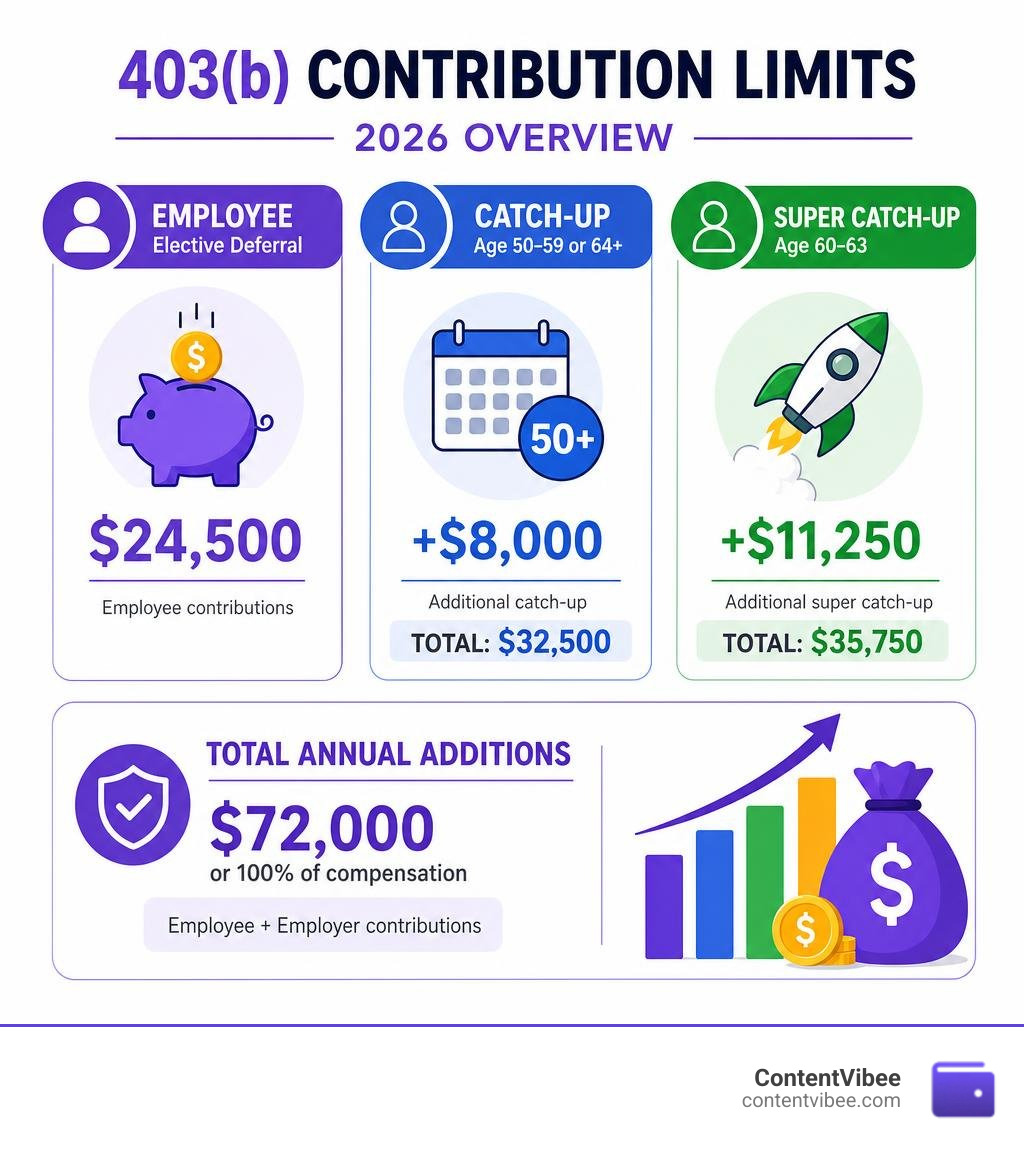
Here is a quick snapshot of the 2026 limits:
| Contribution Type | 2026 Limit |
|---|---|
| Employee elective deferral | $24,500 |
| Catch-up (age 50-59 or 64+) | +$8,000 (total: $32,500) |
| Super catch-up (ages 60-63) | +$11,250 (total: $35,750) |
| 15-year service catch-up | +$3,000/year (lifetime max: $15,000) |
| Total annual additions (employee + employer) | $72,000 or 100% of compensation |
The 403(b) is the retirement plan for teachers, nurses, hospital workers, nonprofit employees, and ministers. Like a 401(k), it lets you shelter income from taxes while you work — so the limits matter a lot.
Miss them, and you could face double taxation. Max them out correctly, and you could add tens of thousands more to your retirement nest egg each year.
And if you’re 50 or older — or approaching 60 — there are extra contribution opportunities most people don’t fully use.
This guide breaks down every limit, every catch-up rule, and every coordination scenario you need to know for 2026.
Understanding the 2026 403b Contribution Limits
When we talk about how much you can put into a 403(b) plan, we have to look at two distinct limits set by the Internal Revenue Service (IRS). These are the elective deferral limit and the annual additions limit.
Employee Elective Deferrals
An elective deferral is the portion of your salary that you choose to contribute directly from your paycheck into your 403(b) account before taxes are taken out (or as a Roth contribution). For 2026, the standard individual elective deferral limit is $24,500. This is a step up from the $23,500 limit in 2025, giving savers an extra $1,000 of tax-advantaged runway.
Total Annual Additions
The second boundary is the limit on total annual additions under Section 415(c) of the Internal Revenue Code. This represents the absolute ceiling on all money entering your account in a single year. It combines:
- Your elective deferrals (both pre-tax and Roth)
- Employer matching contributions
- Employer nonelective contributions
- After-tax (non-Roth) voluntary employee contributions
For 2026, the annual additions limit is $72,000 (up from $70,000 in 2025). However, there is a catch: your total additions cannot exceed 100% of your includible compensation for your most recent year of service. If you work part-time or have a lower salary, your actual dollar limit may be lower than $72,000.
What is Includible Compensation?
Includible compensation generally refers to the taxable wages, salaries, and professional fees you receive from the employer sponsoring your 403(b) plan. It includes elective deferrals and any pre-tax contributions to employee benefit plans (like health insurance or cafeteria plans).
To help you visualize how the baseline limits have shifted, here is a clear comparison table:
| Limit Category | Tax Year 2025 | Tax Year 2026 |
|---|---|---|
| Elective Deferral Limit | $23,500 | $24,500 |
| Annual Additions Limit (Lesser of) | $70,000 or 100% of compensation | $72,000 or 100% of compensation |
| Standard Catch-Up (Age 50+) | $7,500 | $8,000 |
| Super Catch-Up (Ages 60-63) | $11,250 | $11,250 |
For official, detailed regulatory updates on these baseline limits, you can check the IRS Retirement Topics on 403(b) Limits.
Eligibility, Plan Sponsorship, and Catch-Up Rules
Not every organization can offer a 403(b) plan. These tax-sheltered annuities are reserved for specific employers, including:
- Public school systems (for teachers, administrators, and support staff)
- Section 501(c)(3) tax-exempt organizations (such as charities, religious groups, and private foundations)
- Public hospitals and cooperative hospital service organizations
- Certain self-employed ministers and church organizations
To participate, you must be a common-law employee of an eligible employer. Independent contractors generally do not qualify.
If you do qualify, the IRS provides several unique catch-up pathways to accelerate your retirement savings. These catch-up rules are highly advantageous, but they can be complex. To explore the broader landscape of catch-up rules across all account types, take a look at our comprehensive resource, The Ultimate Guide to Retirement Contribution Catch-Up Limits.
The Standard Age 50+ Catch-Up
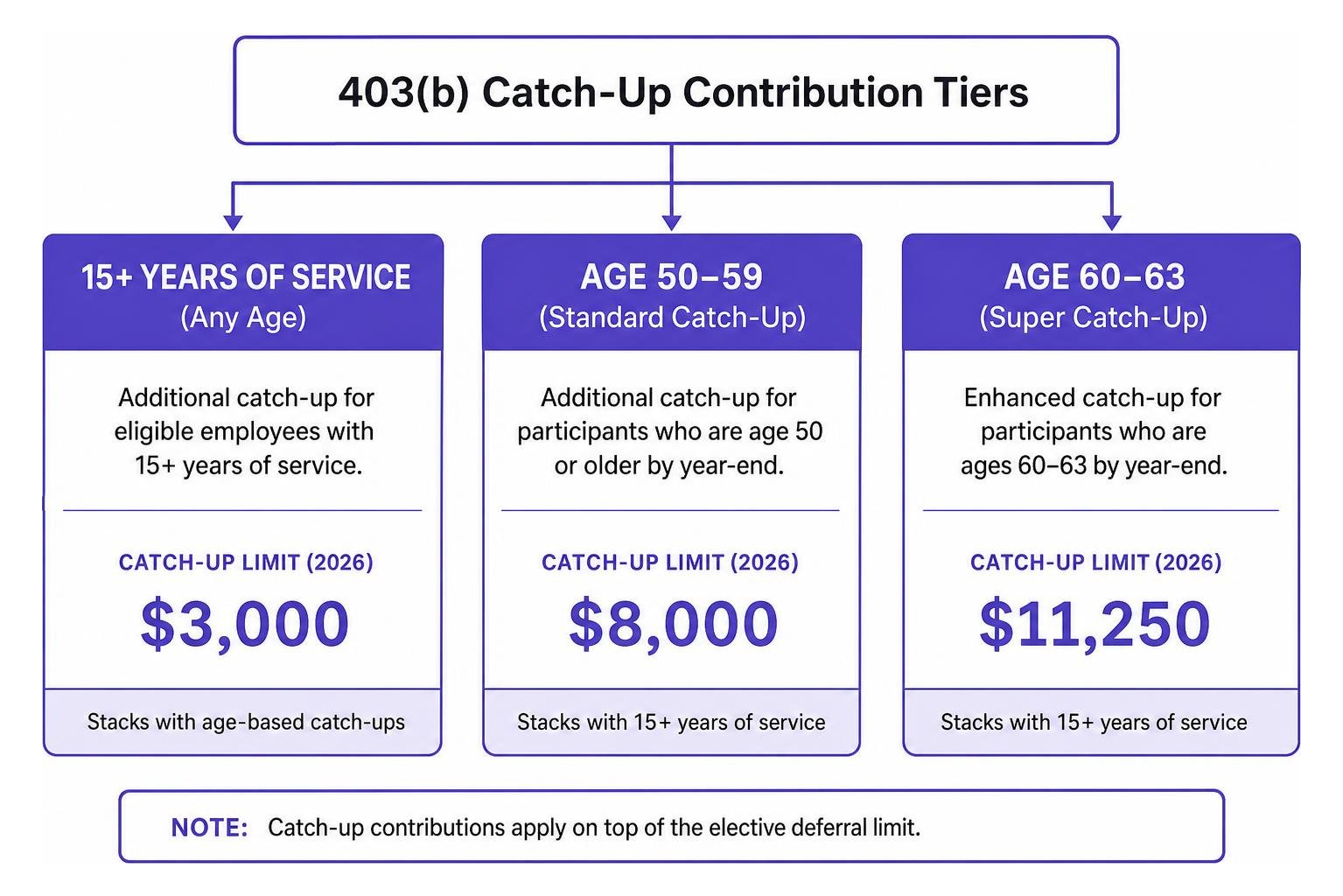
If you are age 50 or older by the end of the calendar year, you can make an additional catch-up contribution. For 2026, this standard catch-up limit is $8,000. This brings your maximum elective deferral limit to $32,500 ($24,500 + $8,000).
The SECURE 2.0 “Super Catch-Up” (Ages 60-63)
Thanks to provisions in the SECURE Act 2.0, savers who are ages 60, 61, 62, or 63 during the tax year qualify for an enhanced “super catch-up.” In 2026, this higher catch-up limit is $11,250.
If you fall into this age bracket, your total elective deferral limit jumps to $35,750 ($24,500 + $11,250). Once you turn 64, your limit reverts to the standard age 50+ catch-up level.
The 15-Year Service Catch-Up (Special 403b Deferral)
Unique to 403(b) plans, the 15-year service catch-up allows long-tenured employees of “qualified organizations” (such as public schools, hospitals, home health agencies, and churches) to contribute more. If you have completed at least 15 years of service with the same employer, you may contribute an additional $3,000 per year, up to a $15,000 lifetime cap.
However, calculating the exact limit for this catch-up requires looking at the lesser of three numbers:
- $3,000;
- $15,000 minus any prior 15-year catch-up contributions you made in previous years; or
- $5,000 multiplied by your total years of service, minus all elective deferrals made in prior years.
For a deeper dive into how these specialized employer rules are structured, you can refer to the official IRS Section 403(b) Tax-Sheltered Annuity Arrangements documentation.
How the 15-Year and Age 50 Catch-Up Provisions Interact
What happens if you are 52 years old and have worked for your school district for 16 years? Can you use both catch-up options?
Yes, you can! But the IRS enforces strict ordering rules. Any elective deferrals you make that exceed the standard $24,500 limit must be applied in this exact order:
- First, to the 15-year service catch-up (up to the $3,000 annual limit).
- Second, to the age 50+ catch-up (up to the $8,000 limit).
This ordering is highly beneficial because it allows you to preserve your lifetime age-based catch-up capacity while utilizing the capped 15-year service option first.
For example, if you qualify for both and defer $31,500 in 2026:
- The first $24,500 covers your standard elective deferrals.
- The next $3,000 is designated as your 15-year service catch-up.
- The remaining $4,000 is designated as your age 50+ catch-up.
This logical hierarchy is outlined in detail in the federal regulations under 26 CFR 1.403(b)-4 Contribution Limitations.
The New 2026 Roth Catch-Up Rule for High Earners
A major SECURE Act 2.0 rule goes into effect on January 1, 2026. This rule changes how high earners must make their catch-up contributions.
If your wages from the sponsoring employer in the preceding calendar year (2025) exceeded $150,000 (as coded for FICA/Social Security taxes), all of your age-based catch-up contributions in 2026 must be made on a Roth (after-tax) basis.
This means you will not get an immediate tax deduction on those catch-up dollars, but they will grow and can be withdrawn tax-free in retirement. If your 2025 compensation was $150,000 or less, you can still choose to make catch-up contributions on a traditional pre-tax basis.
Note: The 15-year service catch-up is exempt from this mandatory Roth rule.
Coordinating Multiple Retirement Plans and Contribution Types
Many savers hold more than one job or participate in multiple retirement plans. If you do, you must be careful. The IRS coordinates contribution limits across different plans.
401(k) and SIMPLE IRA Coordination
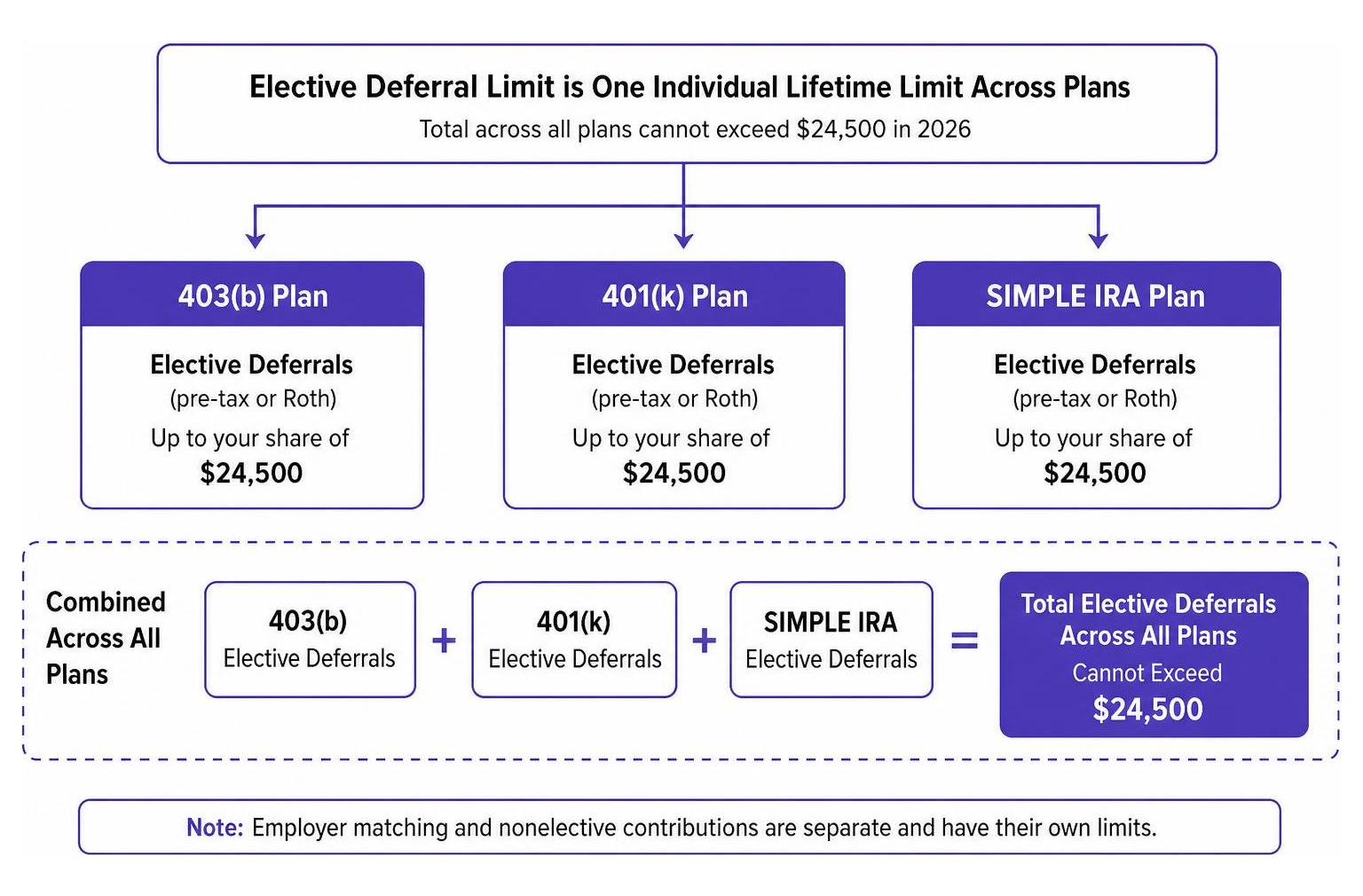
Your individual elective deferral limit ($24,500 in 2026) is an individual lifetime limit across all employers. If you contribute to a 403(b) and also participate in a 401(k) or a SIMPLE IRA through another job, your total combined elective deferrals across both plans cannot exceed $24,500.
To understand how these limits compare and are calculated, read our guide on The New 2026 Maximum 401k Contribution Limits Explained. You can also use our walkthrough on The Ultimate Guide to Calculating Your 401k Contributions to map out your paycheck deferrals.
The 457(b) Double-Dip Exception
There is a major exception to this rule: 457(b) deferred compensation plans.
If you work for a state university, municipal hospital, or public school district, you may have access to both a 403(b) and a governmental 457(b) plan. The elective deferral limits for these two plans do not coordinate.
This means you can “double-dip.” In 2026, you can contribute a full $24,500 to your 403(b) and an additional $24,500 to your 457(b), for a total of $49,000 in elective deferrals! To see how this strategy can supercharge your path to financial independence, read our deep dive: Demystifying the 457 Deferred Compensation Plan Your Golden Ticket to Early Retirement.
Managing Traditional vs. Roth 403b Contribution Limits
Many modern 403(b) plans offer both traditional (pre-tax) and Roth (after-tax) options.
Your elective deferral limit ($24,500 in 2026) is a combined limit for both types of contributions. You can split your contributions between traditional and Roth however you like, but the total cannot exceed the annual limit.
- Traditional 403(b): Contributions are made with pre-tax dollars. This lowers your current taxable income, but you will pay ordinary income taxes when you withdraw the money in retirement.
- Roth 403(b): Contributions are made with after-tax dollars. You get no upfront tax break, but your contributions and earnings grow tax-free. Qualified distributions in retirement are 100% tax-free.
When tax season arrives, your employer will report these contributions in Box 12 of your Form W-2. Pre-tax deferrals are marked with Code E, while Roth contributions are designated with Code BB.
If you are trying to decide which option makes the most sense for your current tax bracket, check out our resource, The Great Retirement Debate Roth vs Traditional 401k Calculator Guide. You can also compare your options with IRA limits using The Ultimate Guide to Your 2026 Max Roth IRA Contribution.
How Employer Contributions Affect Your 403b Contribution Limits
While your personal elective deferrals are capped at $24,500, your employer can help you save even more. Employer contributions (like matching or nonelective contributions) do not count toward your $24,500 elective deferral limit. Instead, they count toward the annual additions limit ($72,000 in 2026).
This setup allows you to build a substantial retirement nest egg. For example, if you are 45 years old and contribute $24,500 to your 403(b), your employer can contribute up to $47,500 in matching or nonelective contributions before you hit the $72,000 annual additions limit.
Plan-to-Plan Transfers and Rollovers
If you transfer funds from an old 403(b) to a new 403(b) via a direct plan-to-plan transfer, or if you roll over funds from an IRA or a 401(k), these amounts do not count toward your annual contribution limits. They are treated as asset moves rather than new annual additions.
For a comprehensive, step-by-step breakdown of how these limits are calculated, including worksheet templates for ministers and church employees, you can refer to the official IRS Publication 571 on Tax-Sheltered Annuity Plans or check the industry resources hosted at BenefitsLink.
Correcting Excess Contributions to Avoid Penalties
Even with the best intentions, it is possible to overcontribute to your retirement accounts—especially if you change employers mid-year or miscalculate your catch-up eligibility.
If you contribute more than the elective deferral limit ($24,500, or your age-adjusted limit), you must act quickly to correct the mistake.
The Correction Process
To correct an overcontribution, you must notify your plan administrator and request a corrective distribution of the excess deferral, along with any investment earnings generated by those excess funds.
This correction must be completed by April 15 of the year following the excess contribution.
Consequences of Missing the Deadline
If you fail to correct the excess contribution by the April 15 deadline, you will face severe tax consequences:
- Double Taxation: The excess contribution will be taxed twice. You will pay income tax on the excess amount in the year you contributed it, and you will pay income tax on it again when you eventually withdraw it in retirement.
- Excise Taxes: If you make excess contributions to a custodial account (which holds mutual funds rather than annuity contracts), those excess funds may be subject to a 6% cumulative excise tax under Section 4973 of the Internal Revenue Code for every year they remain uncorrected in the account.
- Plan Disqualification: In extreme cases, if a plan fails to monitor and correct excess contributions, the entire 403(b) plan could lose its tax-sheltered status, making all participants’ balances immediately taxable.
Frequently Asked Questions About 403(b) Limits
Can I contribute to both a 403(b) and a 457(b) plan up to the maximum in 2026?
Yes! Since governmental 457(b) plans do not coordinate their limits with 403(b) plans, you can contribute up to the maximum elective deferral limit in both plans simultaneously. If you are under age 50, this means you can defer up to $24,500 into your 403(b) and $24,500 into your 457(b) in 2026, for a total of $49,000 in tax-advantaged savings.
What happens if I exceed the 403(b) elective deferral limit?
If you exceed the limit, you must contact your plan administrator immediately to request a corrective distribution of the excess amount and its associated earnings. If this distribution is completed by April 15 of the following year, you will avoid double taxation. If you miss the deadline, the excess amount will be taxed twice.
Does my employer’s matching contribution count toward my elective deferral limit?
No. Your employer’s matching or nonelective contributions do not reduce your personal elective deferral limit ($24,500 in 2026). Instead, employer contributions count toward your overall annual additions limit, which is the lesser of $72,000 or 100% of your includible compensation in 2026.
Conclusion
Maximizing your retirement savings requires a clear understanding of IRS contribution limits. By learning how 403b contribution limits work, taking advantage of catch-up opportunities, and coordinating your accounts, you can build a more secure financial future.
If you are self-employed or run a small business on the side, you might also want to explore other retirement options, such as those outlined in our guide on The 2026 Max SEP Contribution Guide for Savvy Entrepreneurs. And if you are transitioning into retirement and want to understand how working might affect your Social Security benefits, take a look at The Ultimate Guide to the Earnings Test.
At ContentVibee, we are dedicated to providing clear, actionable financial advice to help you reach your goals. For more guides, calculators, and retirement planning resources, visit us at ContentVibee.


