What You Need to Know About 403b Rollover Tax Forms (Before You File)
When you move money out of a 403(b) plan, understanding 403b rollover tax forms can mean the difference between a smooth, tax-free transfer and an unexpected tax bill.
Here’s a quick answer for most people:
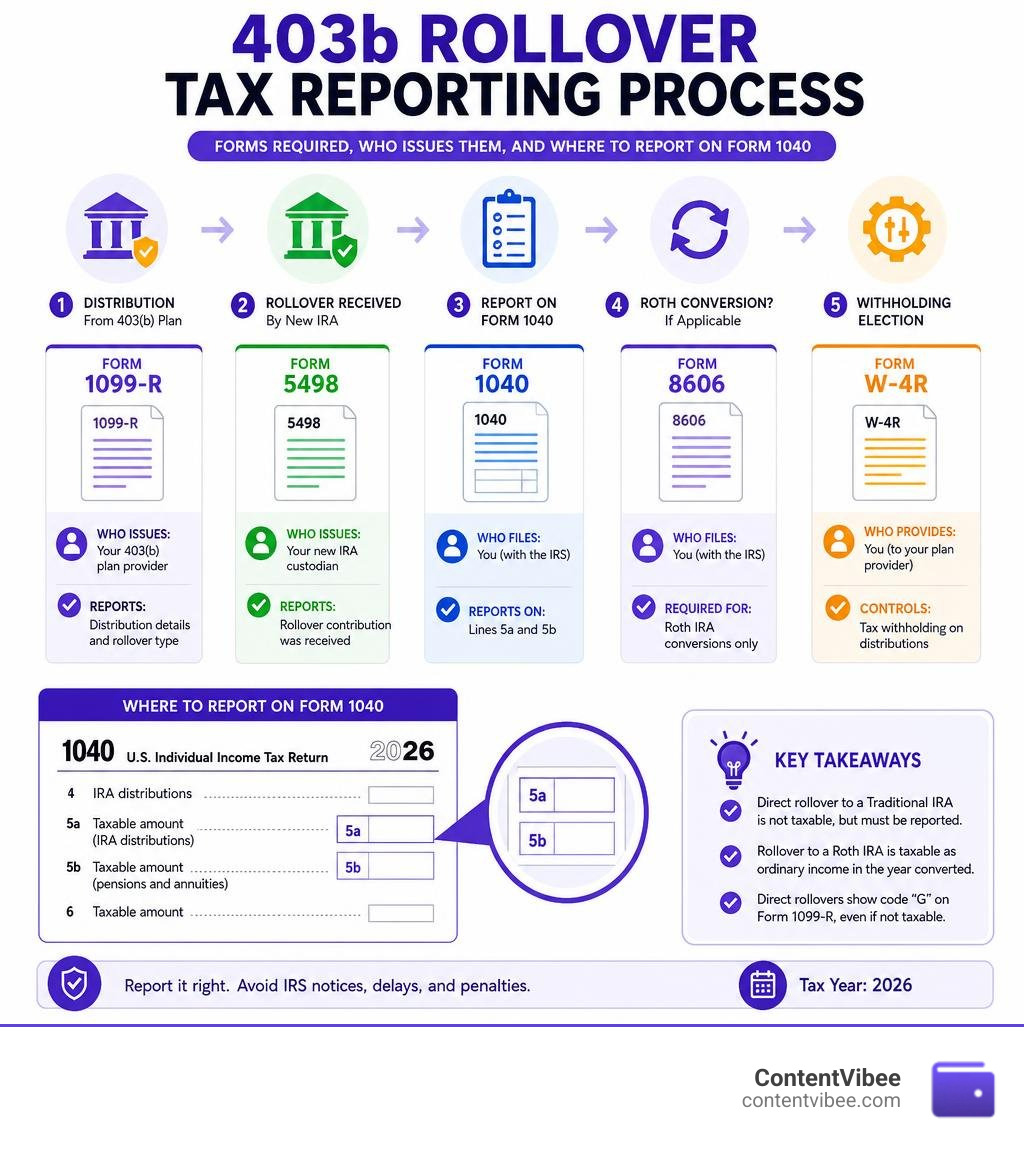
Key 403(b) rollover tax forms at a glance:
| Form | Who Issues It | What It Does |
|---|---|---|
| Form 1099-R | Your 403(b) plan provider | Reports the distribution amount and rollover type |
| Form 5498 | Your new IRA custodian | Confirms the rollover was received |
| Form 1040 | You (filed with the IRS) | Reports the rollover on Lines 5a and 5b |
| Form 8606 | You (filed with the IRS) | Required only for Roth IRA conversions |
| Form W-4R | You (given to plan provider) | Controls tax withholding on distributions |
The short version:
- A direct rollover to a Traditional IRA is not taxable — but you still have to report it
- A rollover to a Roth IRA is taxable as ordinary income in the year you convert
- You’ll receive a Form 1099-R with distribution code G for a direct rollover, even if you owe nothing
Now, here’s where people get confused.
Even a completely tax-free rollover still shows up on your tax return. The IRS needs to see it. Skipping that step — or misreading your 1099-R — can trigger notices, delays, or penalties you didn’t expect.
This guide walks you through every form, every line, and every rule you need to get this right.
Basic 403b rollover tax forms glossary:
Do You Need to Report a 403(b) Rollover on Your Taxes?
The short answer is: Yes, absolutely.
Many taxpayers assume that because a direct rollover is a nontaxable event, the IRS doesn’t need to know about it. However, the IRS tracks all movements of tax-deferred retirement funds to prevent unauthorized, tax-free withdrawals. Whenever funds leave a 403(b) plan, the plan administrator reports that distribution to the IRS. If you do not report the corresponding rollover on your tax return, the IRS computer systems will flag the transaction as an unreported, fully taxable distribution.
To help taxpayers navigate these rules, the IRS offers an Interactive Tax Assistant tool online. It takes about 15 minutes to run through the tool’s decision-tree interview to determine if your specific retirement plan transfer must be reported. That you must run the interview separately for each rollover or transfer event, and the tool does not cover complex recharacterizations of contributions.
If you are moving your account to a major custodian, such as executing a transfer using our Step-by-Step Guide to Moving Your 403B to Vanguard, we must still ensure that the transaction is cleanly documented on our annual tax return to maintain our tax-deferred status.
Essential 403b Rollover Tax Forms You Must Know
Successfully reporting your rollover requires handling several critical tax documents. Some are sent to you by your financial institutions, while others must be filled out by you when you file your taxes.
The primary 403b rollover tax forms include:
- Form 1099-R (Distributions From Pensions, Annuities, Retirement or Profit-Sharing Plans, IRAs, Insurance Contracts, etc.): Issued by your former 403(b) plan administrator, this form reports how much was distributed from your account.
- Form 5498 (IRA Contribution Information): Issued by your new IRA custodian, this form confirms that the rolled-over funds were successfully deposited into your new retirement account.
- Form W-4R (Withholding Certificate for Nonperiodic Payments and Eligible Rollover Distributions): This form is used to make federal tax withholding elections if you are taking a distribution that is not a direct rollover. You can learn more about its application in the IRS Form W-4R Substitute Withholding Certificate.
- Form 1040 (U.S. Individual Income Tax Return): The main tax return where you declare the distribution and show the IRS that the taxable amount is $0.
Understanding how these forms interact prevents costly filing errors. For a deeper dive into decoding these forms, check out our guide on Demystifying Form 1099 R And Your Retirement Distributions.
Decoding Form 1099-R and Distribution Codes
Your former 403(b) plan administrator is required to mail your Form 1099-R by January 31 of the year following your rollover. The most critical field on this form is Box 7 (Distribution Code(s)).
For a direct rollover from a pre-tax 403(b) to a Traditional IRA or another eligible employer plan, Box 7 should display Code G. This code indicates a “Direct rollover and direct payment of a shareholder-initiated distribution.” Code G tells the IRS that the funds were transferred directly between custodians, making the transaction a tax-free transfer.
If you see a code other than G (such as Code 1 for an early distribution), it means the plan administrator treated the transaction as a direct payout to you, which could trigger immediate taxes and early withdrawal penalties unless corrected.
The Role of Form 5498 in Recordkeeping
While Form 1099-R shows the money leaving your old account, Form 5498 shows the money arriving safely in your new one. Your new IRA custodian will report the rollover contribution in Box 2 of Form 5498.
Because IRA custodians have until May 31 to send Form 5498 to both you and the IRS, you will likely file your tax return before you receive it. That is completely fine. Form 5498 is for informational and recordkeeping purposes; you do not need to attach it to your tax return. The IRS uses its copy of Form 5498 to verify that the distribution reported on your Form 1099-R was indeed deposited into an eligible retirement plan within the required guidelines.
Direct vs. Indirect Rollovers: Tax Reporting Differences
How you choose to transfer your funds drastically changes your tax reporting requirements and withholding rules.
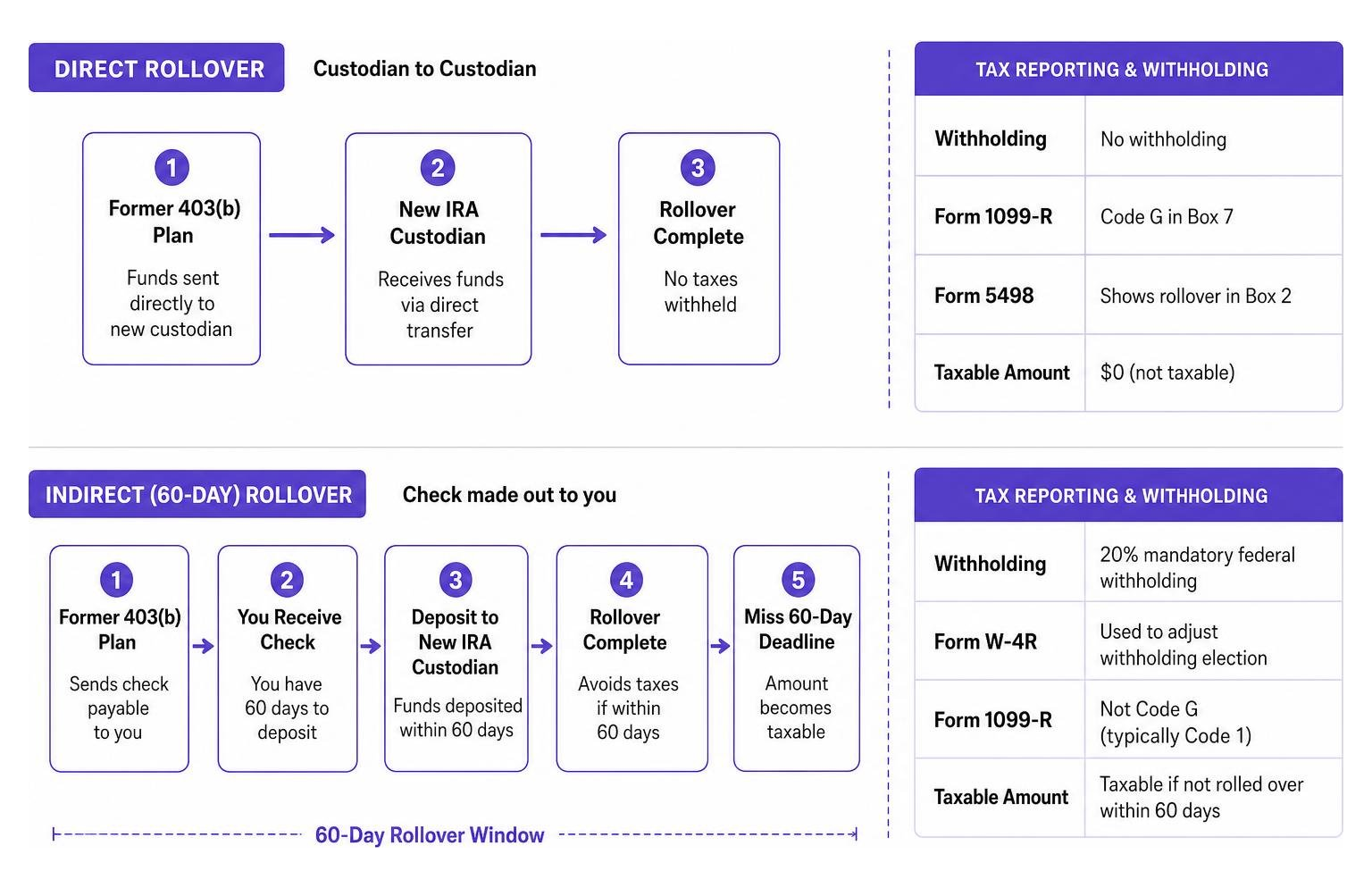
Let’s look at how these two methods stack up:
| Feature | Direct Rollover | Indirect (60-Day) Rollover |
|---|---|---|
| How Funds Move | Custodian to Custodian | Check made out to you; you deposit it |
| Mandatory Withholding | 0% | 20% federal tax withholding |
| Time Limit | None | Must deposit 100% of gross within 60 days |
| 1099-R Code | Code G | Code 1 (under 59½) or Code 7 (over 59½) |
| IRS Risk | Extremely low | High risk of taxes and 10% penalty if missed |
In a direct rollover, the 403(b) plan administrator sends the funds directly to your new IRA custodian (or writes a check payable to the custodian for your benefit). No taxes are withheld, and the entire balance continues to grow tax-deferred.
In an indirect rollover, the plan administrator writes a check directly to you. Under IRS rules, this triggers a mandatory 20% federal tax withholding. For example, if you roll over $100,000 indirectly, you will only receive $80,000. However, to complete a tax-free rollover, you must deposit the full $100,000 into your new IRA within 60 days. This means you must find $20,000 from other personal savings to make up the shortfall. If you successfully deposit the full $100,000, you will get the withheld $20,000 back as a tax refund when you file your taxes.
If you fail to deposit the full amount within the time limit, the unpaid portion is treated as a taxable distribution. If you are under age 59½, you will also face a 10% early withdrawal penalty. For more details on rollover timing, see our article on How Long Do You Have To Rollover A 401K After Quitting.
Reporting the Mandatory 20% Withholding
If you executed an indirect rollover and suffered the mandatory 20% federal withholding, you must report this withholding on your Form 1040.
Look at Box 4 of your Form 1099-R to find the exact amount withheld. You will report this amount on Line 25b of your Form 1040 (“Federal income tax withheld from Forms 1099”). By doing this, the IRS credits the withheld amount toward your total tax payments for the year, allowing you to claim it as a refund (provided you replaced the 20% shortfall and completed the rollover successfully).
Tax Implications: Traditional IRA vs. Roth IRA Rollovers
Deciding where your 403(b) funds land has major tax consequences.
- To a Traditional IRA: This is a tax-deferred transfer. Since both accounts hold pre-tax assets, the rollover is tax-free. Your investments continue to grow tax-deferred until you make withdrawals in retirement.
- To a Roth IRA: This is treated as a Roth conversion. Because Roth IRAs hold after-tax assets, you must pay ordinary income tax on the entire pre-tax amount converted in the tax year the rollover occurs.
Before making this move, check out our guide on Can You Move Your 403B To A Roth Ira to weigh the long-term benefits against the immediate tax bill.
How to Handle Roth Conversions on 403b Rollover Tax Forms
When converting pre-tax 403(b) funds to a Roth IRA, you must file Form 8606 (Nondeductible IRAs) with your Form 1040.
Form 8606 is used to track the taxable portion of your conversion and ensure you do not get double-taxed on future Roth distributions. Once you execute a Roth conversion from a 403(b) plan, the transaction is irrevocable; you cannot “undo” the conversion to avoid the tax bill.
For step-by-step instructions on handling this process, consult The Ultimate Guide To Converting Your 403B To A Roth Ira.
Step-by-Step: How to Report a 403(b) Rollover on Form 1040
When tax season arrives in 2026, you will report your 403(b) rollover on your Form 1040. Here is how to do it step-by-step for a standard, tax-free direct rollover:
- Get your Form 1099-R: Locate the total distribution amount in Box 1.
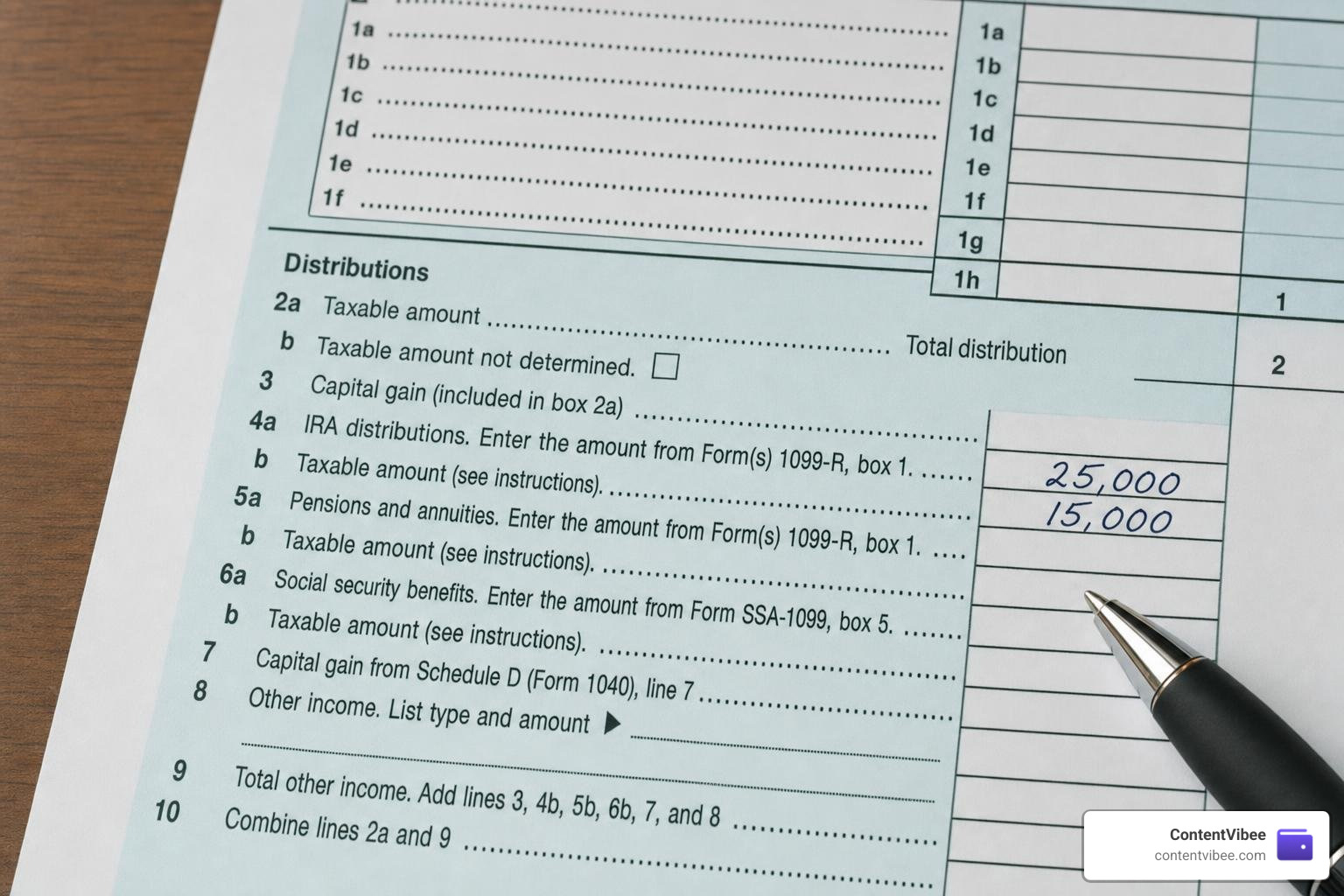
- Report the total distribution: Enter the Box 1 amount on Line 5a (“Pension and annuity distributions”) of your Form 1040.
- Determine the taxable amount: For a direct, tax-free rollover to a Traditional IRA, enter $0 on Line 5b (“Taxable amount”).
- Annotate the return: Write “ROLLOVER” next to Line 5b. This tells the IRS computer systems exactly why your distribution is not being taxed.
For more information on preparing your finances for this transition, read Breaking Up With Your Employer How To Roll A 403B Into An Ira.
Avoiding Penalties with 403b Rollover Tax Forms
If you make a mistake during an indirect rollover — such as missing the 60-day deadline due to an administrative error or a severe personal hardship — the IRS may hit you with ordinary income taxes and a 10% early withdrawal penalty (if you are under age 59½).
To report or claim an exception to this early withdrawal penalty, you must file Form 5329 (Additional Taxes on Qualified Plans and Other Tax-Favored Accounts).
In some cases, the IRS may grant a waiver for a missed 60-day deadline if the failure was due to events beyond your reasonable control (such as a financial institution error or severe illness). You can read an example of such relief in this IRS Private Letter Ruling on 60-Day Waiver, which demonstrates how the IRS evaluates hardship exceptions.
Frequently Asked Questions About 403(b) Rollover Tax Reporting
Where do I get my Form 1099-R for a 403(b) rollover?
Your Form 1099-R is issued by your former 403(b) plan provider (the financial institution that managed your employer’s plan, not your employer itself). They are required by law to mail this form to you by January 31 of the year following your distribution. Many providers also make these forms available for download through their online portals.
What happens if I miss the 60-day indirect rollover deadline?
If you miss the 60-day deadline, the entire distributed amount becomes a taxable distribution in the year it was received. If you are under 59½, you will also owe a 10% early withdrawal penalty. You must report this on Form 1040 and file Form 5329 to calculate the penalty unless you qualify for an IRS hardship waiver.
Do I need to file Form 5498 with my tax return?
No, you do not need to file Form 5498 with your tax return. It is an informational form sent by your new IRA custodian to both you and the IRS. Keep it with your personal tax records as proof that the rollover was completed.
Conclusion
Navigating 403b rollover tax forms doesn’t have to be overwhelming. By understanding which forms to expect — like the Form 1099-R from your old provider and Form 5498 from your new custodian — and knowing exactly how to fill out Form 1040, you can keep your retirement savings growing safely without any costly surprises from the IRS.
At ContentVibee, we believe that clear, actionable financial planning is the key to a secure retirement. If you are coordinating retirement benefits with a partner, don’t forget to Calculate Spouse Retirement Benefits to optimize your household’s long-term financial strategy.