


Why Every High Earner Needs a Roth Conversion Calculator Before Making a Move
A Roth conversion calculator is a tool that estimates the tax cost and long-term financial benefit of moving money from a traditional IRA or 401(k) into a Roth IRA — so you can decide if converting makes sense for your situation.
Here’s what a Roth conversion calculator typically tells you:
- Tax cost today — the dollar amount you’ll owe in the year you convert
- Projected Roth balance — how much that money grows tax-free over your time horizon
- Break-even point — how many years until the tax-free growth repays what you paid upfront
- Net advantage — the difference between future taxes saved and taxes paid now
Quick answer: A Roth conversion makes the most sense when your current tax rate is lower than your expected rate in retirement, you can pay the tax bill with money from outside the IRA, and you have at least 10–15 years for the Roth to grow.
As of 2022, only about 10% of all IRA assets in the U.S. were held in Roth form — which means most pre-retirees are still sitting on large piles of tax-deferred money that will be taxed eventually, either by them or their heirs.
The problem? Most people guess at whether converting is worth it. A single wrong assumption about your future tax rate — or ignoring hidden costs like Medicare IRMAA surcharges or Social Security taxation — can turn a smart-looking conversion into an expensive mistake.
That’s exactly what this guide walks you through.
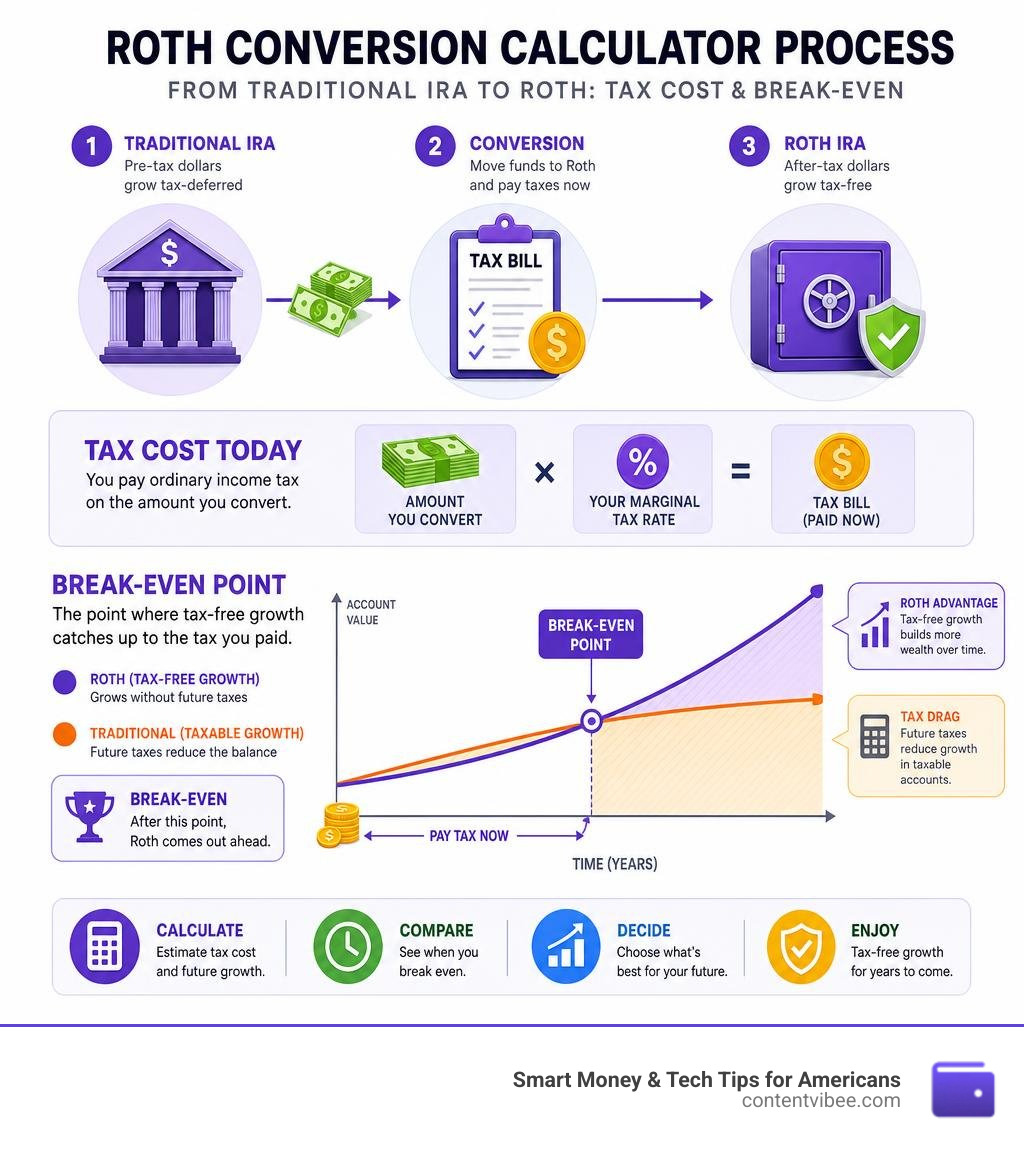
Simple guide to Roth conversion calculator terms:
What is a Roth Conversion and How Does It Work?
To understand why a Roth conversion calculator is so valuable, we first have to understand the fundamental mechanics of the transaction.
A traditional IRA or traditional 401(k) is funded with pre-tax dollars. Your contributions lower your taxable income today, but you agree to pay ordinary income taxes on both the principal and all accumulated growth when you withdraw the money in retirement. Additionally, the IRS eventually forces you to take Required Minimum Distributions (RMDs) from these accounts, whether you need the income or not.
A Roth IRA flips this tax equation. You fund a Roth IRA with after-tax dollars. Because you have already paid income tax on this money, the funds grow entirely tax-free, and all qualified withdrawals in retirement are completely tax-free. Furthermore, Roth IRAs do not have lifetime RMDs for the original owner.
A Roth conversion is the process of moving existing funds from your tax-deferred traditional account into a Roth account. Because you are moving pre-tax money into a tax-free vehicle, the IRS treats the converted amount as ordinary taxable income in the calendar year you make the move.
This brings us to the core of the debate. Why would anyone willingly prepay their taxes today? The answer lies in tax rate arbitrage and tax-free compounding. If you believe your tax rate today is lower than it will be when you withdraw the money in retirement, prepaying the tax is a mathematical win.
Furthermore, we must look at the current political and economic climate. It is July 2026. The tax provisions established under the Tax Cuts and Jobs Act (TCJA) have officially expired. This sunset means federal ordinary income tax brackets have reverted to their higher pre-2018 levels (with brackets climbing back to 10%, 15%, 25%, 28%, 33%, 35%, and 39.6%). Because tax rates have increased across the board, finding ways to optimize your brackets is more critical than ever before.
To dive deeper into how these two vehicles stack up over time, check out our comprehensive resource, The Great Retirement Debate Roth vs Traditional 401k Calculator Guide.
How to Use a Roth Conversion Calculator to Estimate Tax Impact
When you open a high-quality Roth conversion calculator, you will be asked to input several key variables. Understanding these inputs is essential to getting an accurate projection.
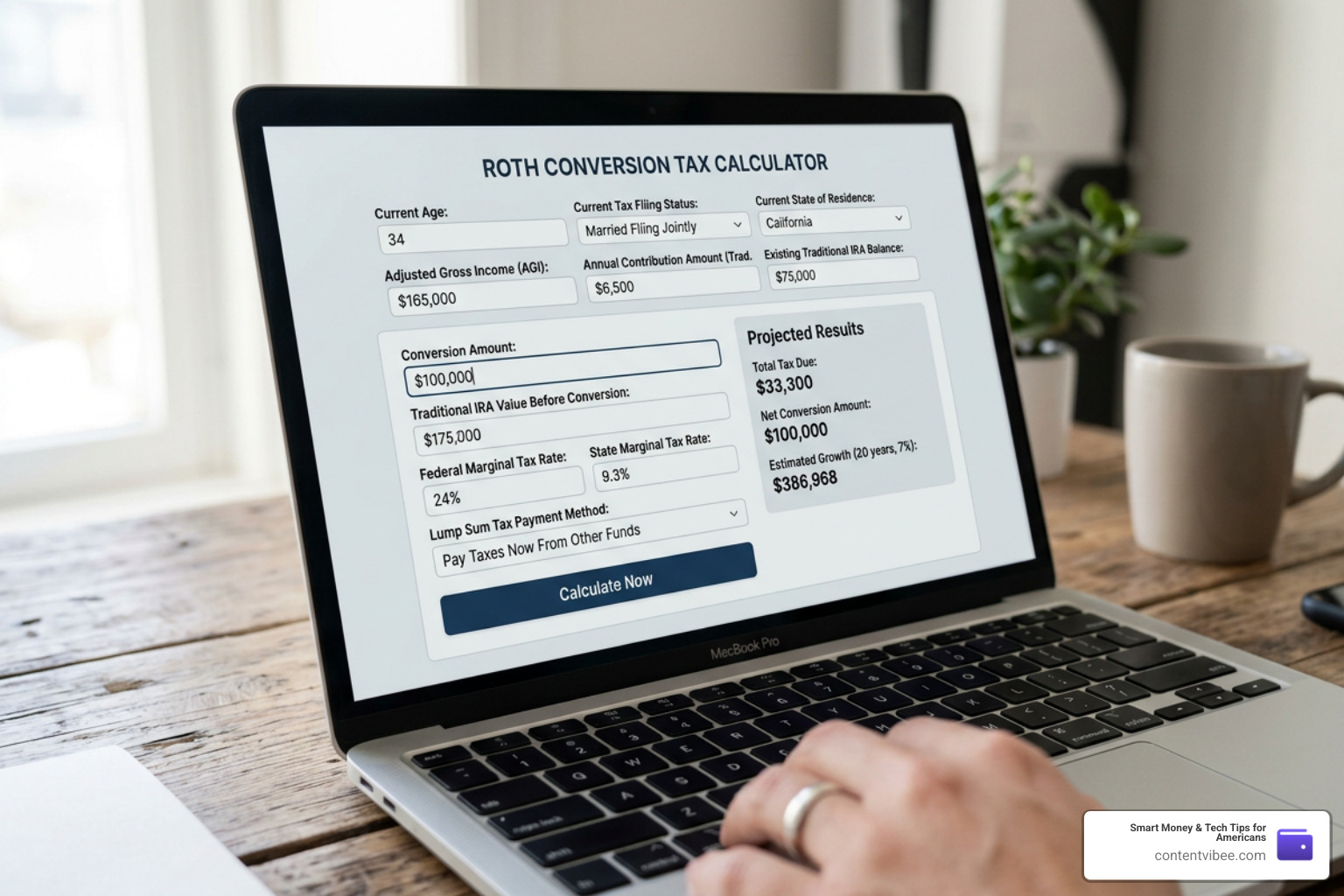
Here are the primary inputs you will need to gather before running your calculations:
- Conversion Amount: The total dollar amount you want to move from your traditional account to your Roth account.
- Current Federal Marginal Tax Rate: This must be your marginal tax rate (the tax bracket your next dollar of income falls into), not your average or effective tax rate.
- Current State and Local Tax Rate: State taxes vary wildly across the country, ranging from 0% in states like Florida and Texas to as high as 13.3% in California.
- Expected Retirement Tax Rate: The combined federal and state marginal tax rate you expect to pay when you begin withdrawing these funds.
- Investment Horizon: The number of years you plan to keep the money invested before making withdrawals.
- Expected Annual Rate of Return: The growth rate of your investments. Calculators typically model returns ranging from 3.5% for conservative short-term portfolios to 9.0% for aggressive equity allocations.
- Tax Basis: Any non-deductible (after-tax) contributions you have made to your traditional IRA. If you have basis, a portion of your conversion will be tax-free.
Once these variables are entered, the calculator runs two parallel simulations: a “With Conversion” scenario and a “Without Conversion” scenario.
In the “Without Conversion” scenario, your traditional account grows at your expected rate of return. At the end of your investment horizon, the calculator applies your expected retirement tax rate to the entire balance to find your net after-tax wealth.
In the “With Conversion” scenario, the calculator subtracts the tax cost today (using your current tax rate) and allows the remaining balance—or the full balance if you pay taxes with outside funds—to grow completely tax-free.
To see how your current savings rate and contributions stack up before you model a conversion, use The Ultimate Guide to Calculating Your 401k Contributions.
To get a feel for how these inputs function in real-time, you can test your numbers on the Roth IRA Conversion Calculator – Fidelity Investments.
The Hidden Costs: IRMAA, NIIT, and the Social Security Tax Torpedo
Most basic calculators on the internet look at your headline federal tax bracket, perform a simple multiplication step, and call it a day. Unfortunately, this lazy math can lead to disastrous financial surprises. A real-world Roth conversion does not exist in a vacuum; it impacts several other areas of your personal tax return.
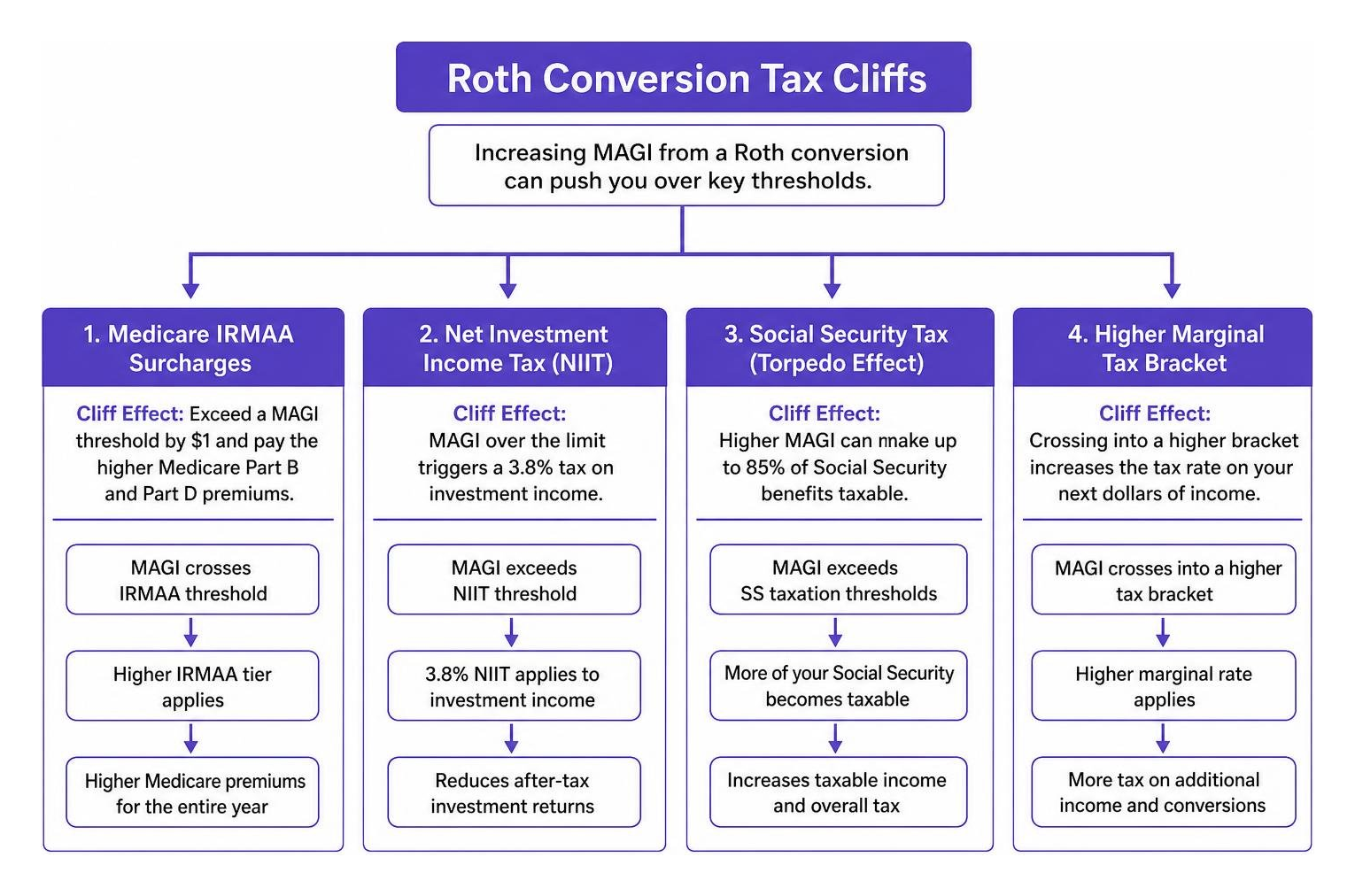
When we evaluate the true, all-in cost of a conversion, we must account for several secondary tax cliffs:
1. Medicare IRMAA Surcharges
The Income-Related Monthly Adjustment Amount (IRMAA) is a surcharge added to Medicare Part B and Part D premiums for higher-income seniors. Unlike progressive tax brackets, IRMAA is a “cliff” system. If your Modified Adjusted Gross Income (MAGI) exceeds a threshold by even one dollar, you trigger the entire premium surcharge for that tier.
Because Medicare uses a two-year lookback period, a Roth conversion completed in 2026 will directly dictate your Medicare premiums in 2028. For married couples filing jointly, the first IRMAA bracket in 2026 starts at roughly $218,000 (and $109,000 for single filers). Pushing your income over this line can easily cost you thousands of dollars in extra Medicare premiums.
2. Net Investment Income Tax (NIIT)
The NIIT is a 3.8% surtax on net investment income (like capital gains, dividends, and interest) for individuals with MAGI over $200,000 (single) or $250,000 (married filing jointly). Because a Roth conversion increases your MAGI, it can inadvertently subject your taxable brokerage account earnings to this extra 3.8% tax.
3. The Social Security “Tax Torpedo”
For moderate-income retirees, Social Security benefits are taxed based on “provisional income.” Once your provisional income crosses $25,000 (single) or $32,000 (married), up to 50% of your benefits become taxable. Cross the next threshold ($34,000 single / $44,000 married), and up to 85% of your benefits are taxed. Adding a Roth conversion to this mix can cause an extra $0.85 of Social Security to be taxed for every $1.00 you convert, creating an effective marginal tax rate of up to 49.95% in the phase-in zone.
4. 0% Long-Term Capital Gains Bracket Displacement
Taxpayers can enjoy a 0% tax rate on long-term capital gains and qualified dividends if their taxable income stays below certain thresholds (such as $49,450 for single filers and $98,900 for married couples in 2026). Because a Roth conversion counts as ordinary income, it fills up this lower bracket first, pushing your capital gains out of the 0% zone and into the 15% tax bracket.
To understand how to protect your hard-earned benefits from these costly cliffs, explore The Ultimate Guide to Social Security Benefit Optimization.
Strategic Modeling: Outside Funds, RMDs, and Break-Even Analysis
One of the most critical decisions you must model in a Roth conversion calculator is how you will pay the resulting tax bill. You have two choices: pay the taxes using a portion of the converted IRA funds, or pay the taxes using cash held in an external, taxable account.
The math heavily favors using outside funds. Let’s look at why:
| Factor | Paying Taxes with IRA Funds | Paying Taxes with Outside Funds |
|---|---|---|
| Amount Converted to Roth | Reduced by the tax amount | 100% of the target amount |
| Tax-Free Compound Growth | Lower (smaller starting principal) | Maximized (larger starting principal) |
| Under Age 59.5 Penalty | Subject to 10% early withdrawal penalty | No penalty |
| Effective Portfolio Size | Stays the same | Increases (moves taxable cash into tax-free Roth) |
When you pay conversion taxes with outside funds, you are essentially making an additional, highly efficient contribution to your retirement savings. You are taking money that would have grown in a taxable brokerage account (subject to ongoing drag from dividend and capital gains taxes) and placing it inside a tax-free wrapper.
Required Minimum Distributions (RMDs) and Estate Planning
As we plan for the long term, we must look beyond our own retirement. Traditional IRAs require you to start taking RMDs at age 73 (which will rise to age 75 in 2033 under SECURE 2.0). These forced distributions can push you into higher tax brackets later in life, especially when combined with Social Security and pensions.
Furthermore, if you plan to leave an inheritance, your heirs will be subject to the “10-year rule.” This rule requires most non-spouse beneficiaries to completely empty an inherited IRA within ten years of your death. If they inherit a massive traditional IRA, those forced withdrawals will likely occur during their peak earning years, subjecting your legacy to heavy taxation. Inheriting a Roth IRA, however, allows your beneficiaries to let the money compound tax-free for a full decade before withdrawing it completely tax-free.
The Break-Even Analysis and the Pro-Rata Rule
A break-even analysis calculates how many years of tax-free growth are required for the Roth account’s tax savings to outpace the upfront tax cost. As a general rule of thumb, if your break-even point is under 15 years, the conversion is a highly attractive option.
However, you must watch out for the IRS Pro-Rata Rule. If you hold any pre-tax assets across any of your Traditional, SEP, or SIMPLE IRAs, you cannot choose to convert only your after-tax “basis.” The IRS views all your IRAs as a single aggregate bucket. If your total IRA balance is 80% pre-tax and 20% after-tax, any conversion you make will be taxed as 80% ordinary income and 20% tax-free return of basis.
To understand how to maximize after-tax growth and avoid common basis traps, read our guide on After Tax Contributions How to Maximize Your Retirement Nest Egg.
For advisors and advanced planners looking to model these break-even points, the Roth Break-Even Tax Rate Calculator – Vanguard for Advisors is an excellent tool.
Timing Your Conversion: Spreading the Tax Bite Over Multiple Years
Unless you have an unusually low-income year, converting a massive traditional IRA all at once is rarely a good idea. A massive lump-sum conversion will instantly launch you into the highest federal and state tax brackets, destroying the tax arbitrage advantage.
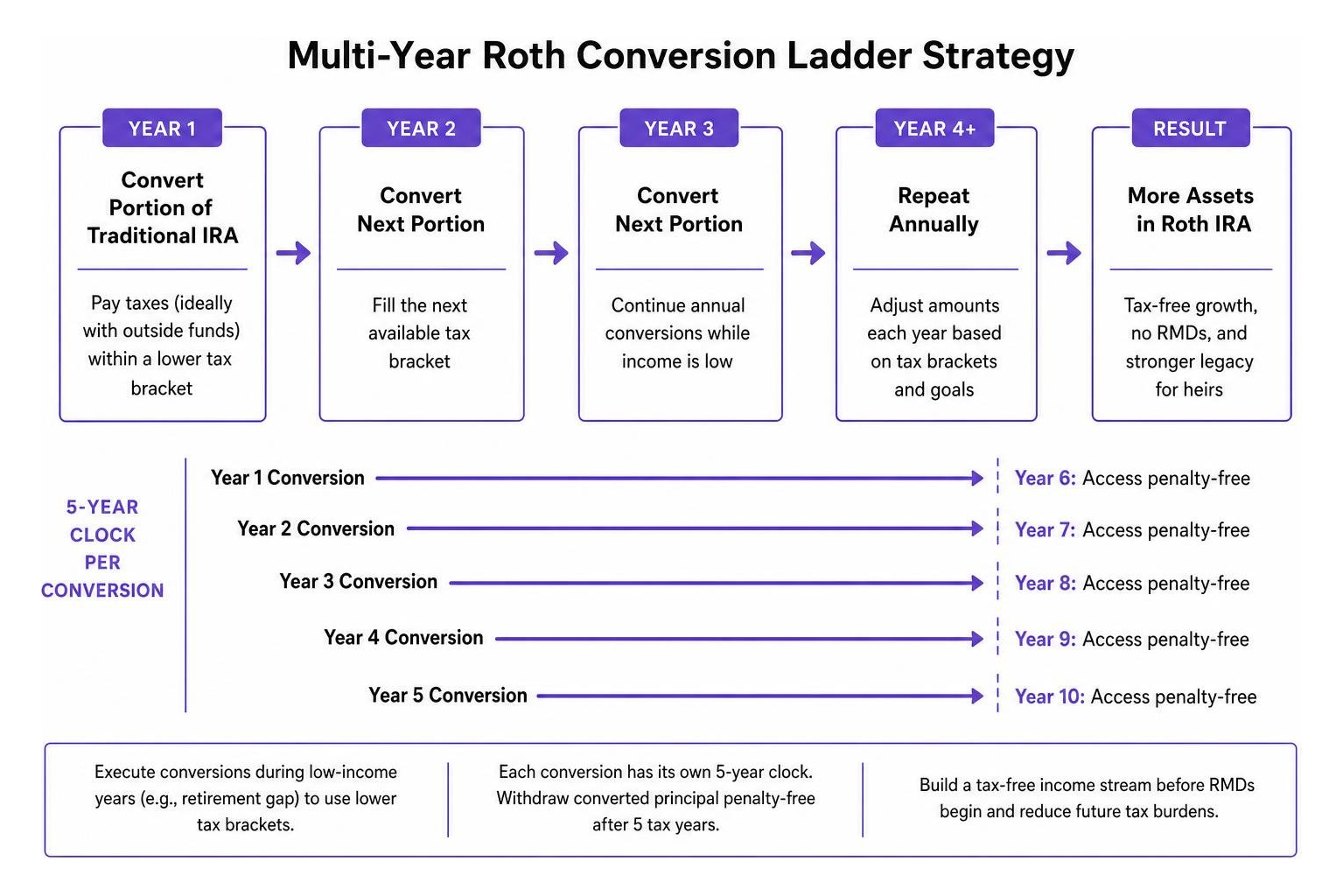
Instead, the smartest strategy is to build a multi-year conversion schedule, often referred to as a Roth conversion ladder.
The Golden Window
The absolute best time to execute a conversion ladder is during the “gap years”—the period between your retirement (when your active work income drops to zero) and the age when you must claim Social Security and start taking RMDs (ages 60 to 72). During these years, your taxable income is at an all-time low. This gives us a golden opportunity to perform partial annual conversions, carefully filling up the lower tax brackets (like the 10%, 12%, or 22% brackets) without spilling over into the higher tiers.
Each annual conversion in your ladder initiates its own independent five-year clock. If you are under age 59.5, you must wait five tax years from the year of the conversion before you can withdraw those converted principal dollars penalty-free. This is a vital consideration for early retirement planners (the FIRE community) who use conversion ladders to fund their living expenses before reaching traditional retirement age.
TSP In-Plan Conversions
For federal employees and military personnel, there is exciting news regarding the Thrift Savings Plan (TSP). Beginning January 28, 2026, the ability to complete a Roth in-plan conversion became available directly within “My Account.”
This feature allows you to convert your traditional TSP balance into a Roth TSP balance. That the TSP requires a $500 minimum conversion amount, and just like an IRA conversion, you will owe ordinary income taxes on the converted amount in the year of the transfer.
To learn more about delaying taxes strategically while optimizing your retirement accounts, see our article on Smart Strategies to Defer Taxes and Boost Your Retirement Savings.
If you are a federal employee looking to model this specific transition, check out the Roth in-plan conversion calculator | The Thrift Savings Plan (TSP).
Frequently Asked Questions about Roth Conversions
How do I use a Roth conversion calculator to plan my tax bracket?
To plan your tax bracket, you should use a “bracket-filling” strategy. First, estimate your total ordinary income for the current tax year (excluding the conversion). Next, locate the upper limit of your current federal tax bracket.
Subtract your estimated income from that upper limit to find your “remaining room” in that bracket. Input this exact amount into your Roth conversion calculator to project the precise tax cost of filling, but not exceeding, your current low-tax bracket.
What is the 5-year rule for a Roth conversion calculator projection?
The 5-year rule dictates that you must hold converted funds in your Roth IRA for at least five consecutive tax years before you can withdraw the converted principal penalty-free if you are under age 59.5.
Each partial annual conversion has its own independent five-year clock, which begins on January 1st of the year the conversion was completed. A conversion completed in November 2026, for example, becomes accessible penalty-free on January 1, 2031.
Can I undo a Roth conversion once it is completed?
No. Under older tax laws, you could “recharacterize” (undo) a Roth conversion up until October 15th of the following year if your investments lost value.
However, the Tax Cuts and Jobs Act permanently eliminated this option. Once you execute a Roth conversion, it is permanent, and the tax liability cannot be undone. This makes running precise calculations beforehand absolutely vital.
Conclusion
At ContentVibee, our mission is to cut through the noise and deliver highly actionable, concise personal finance guidance. We believe that building long-term wealth isn’t just about how much you save—it is about how much you keep after taxes.
A Roth conversion calculator is one of the most powerful tools in your retirement planning arsenal, allowing you to model various tax brackets, time horizons, and outside funding methods to find your financial sweet spot.
Ready to see how your current nest egg projects into the future? Check out our Retirement Calculator Estimate Savings Needed to map out your target numbers, or Explore our interactive financial tools to start optimizing your tax strategy today!

