


What You Need to Know About the 2026 Maximum 401k Contribution
The 2026 maximum 401k contribution limit has increased, and knowing the new numbers could meaningfully change how much you save — and how much tax you pay — this year.
Here are the key limits at a glance:
| Contribution Type | 2026 Limit |
|---|---|
| Employee elective deferral (under 50) | $24,500 |
| Catch-up contribution (age 50-59 and 64+) | $8,000 |
| Total with standard catch-up (age 50+) | $32,500 |
| Super catch-up (ages 60-63) | $11,250 |
| Total with super catch-up (ages 60-63) | $35,750 |
| Total employee + employer contributions | $72,000 |
| IRA contribution (under 50) | $7,500 |
| IRA contribution (age 50+) | $8,600 |
The IRS raised the standard employee deferral limit from $23,500 in 2025 to $24,500 in 2026. The total combined limit — including employer contributions — rose to $72,000, up from $70,000.
These increases are driven by cost-of-living adjustments tied to inflation. They may look small year to year, but they add up. The employee deferral limit has grown nearly 20% since 2022.
If you’re in or near retirement, these limits matter a lot. Maxing out your 401(k) reduces taxable income today, and the right mix of pre-tax versus Roth contributions can lower your tax bill for decades to come.
This guide covers every 2026 limit — employee deferrals, catch-up rules, employer contribution ceilings, IRA limits, and what happens if you contribute too much.
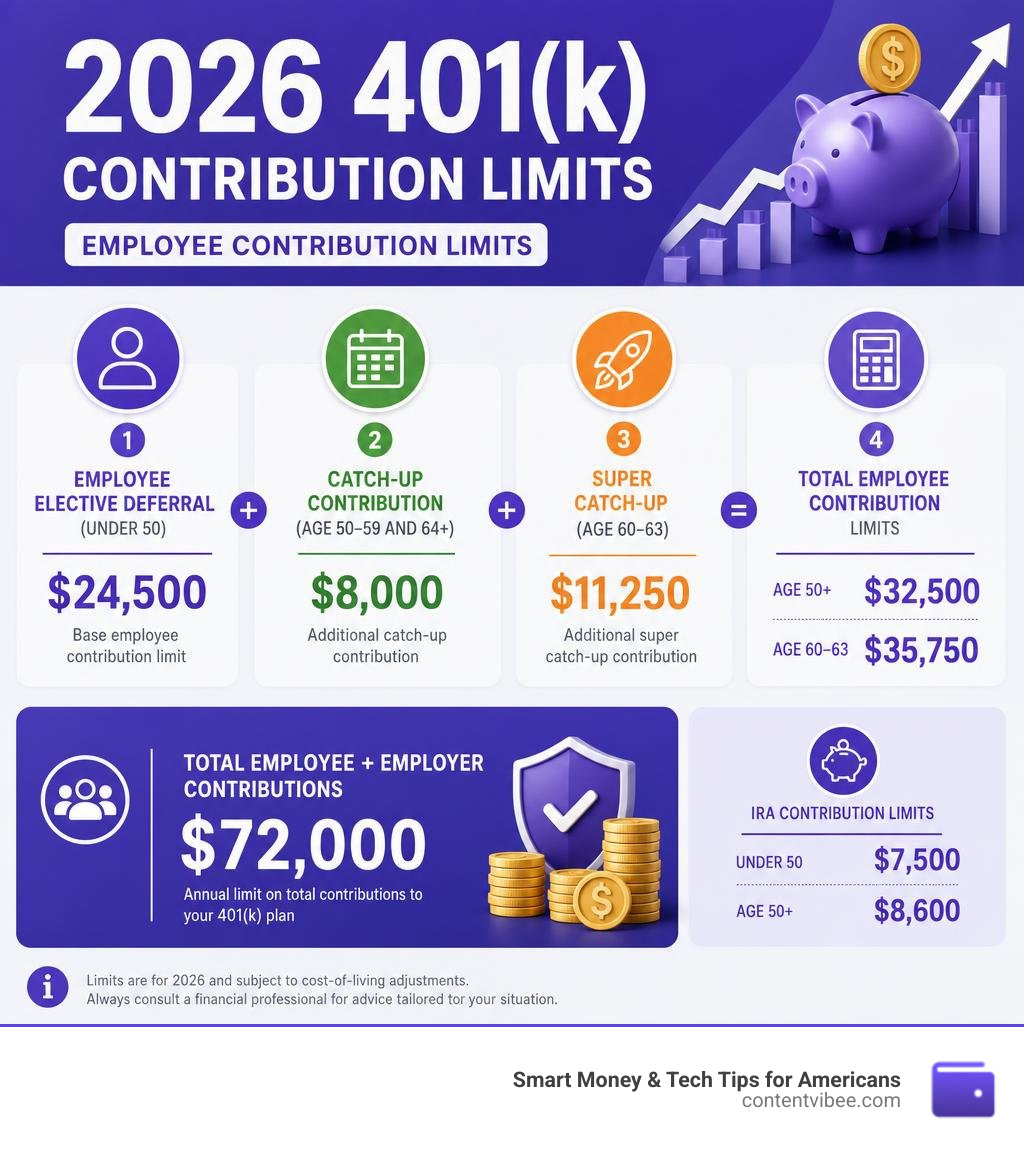
Know your 2026 maximum 401k contribution terms:
Key Rules for the 2026 Maximum 401k Contribution
To build a secure future, we must navigate the IRS rules governing retirement accounts. The 2026 maximum 401k contribution framework operates under a “two-limit” system: your individual employee elective deferral and the combined total limit (which includes employer matching and profit-sharing).
Understanding how these caps interact prevents you from leaving free money on the table or triggering unnecessary tax penalties. Let’s look at how the limits have shifted year-over-year:
| Limit Type | 2025 Limit | 2026 Limit | Change |
|---|---|---|---|
| Employee Elective Deferral | $23,500 | $24,500 | +$1,000 |
| Catch-Up (Ages 50-59, 64+) | $7,500 | $8,000 | +$500 |
| Super Catch-Up (Ages 60-63) | $11,250 | $11,250 | Unchanged |
| Total Section 415(c) Limit | $70,000 | $72,000 | +$2,000 |
| Compensation Cap | $350,000 | $360,000 | +$10,000 |
Employee Elective Deferrals for 2026
As an employee, the maximum amount you can personally choose to defer from your salary into your 401(k) plan is $24,500 for the 2026 tax year. This represents a solid $1,000 increase from the 2025 limit of $23,500, as confirmed by the IRS announcement on 2026 limit increases.
This $24,500 limit is a combined cap. It applies to both traditional (pre-tax) and Roth 401(k) contributions. For example, you can choose to put $12,250 into a pre-tax 401(k) and $12,250 into a Roth 401(k), but your total personal deferrals cannot exceed $24,500.
For a step-by-step breakdown of how to map out your paycheck deductions to hit this target perfectly by your final December paycheck, check out The Ultimate Guide to Calculating Your 401k Contributions.
The Section 415(c) Total Contribution Limit
The employee deferral is only half of the story. Under Internal Revenue Code (IRC) Section 415(c), there is a separate limit on “annual additions” made to your 401(k) account. In 2026, this total combined limit rises to $72,000 (up from $70,000 in 2025).
This $72,000 ceiling includes:
- Your personal employee elective deferrals ($24,500 standard).
- Employer matching contributions.
- Employer non-elective or profit-sharing contributions.
- Forfeitures allocated to your account.
If you are under age 50, the total of all these elements cannot exceed $72,000 or 100% of your eligible compensation, whichever is less. The eligible compensation taken into account is capped by the IRC Section 401(a)(17) compensation limit, which rises to $360,000 in 2026.
If your employer offers a generous match or profit-sharing program, this higher ceiling is where you can really accelerate your wealth. To see how to structure your savings so you do not miss out on matching funds, check out Don’t Leave Money on the Table: The Ultimate 401k Max Calculator Guide.
Maximizing the 2026 Maximum 401k Contribution with After-Tax Dollars
What if you have already maxed out your $24,500 employee deferral and your employer’s match still leaves you well below the $72,000 Section 415(c) limit? If your workplace plan permits it, you can bridge this gap using after-tax (non-Roth) contributions.
This strategy is the foundation of the popular “mega backdoor Roth.” Here is how it works:
- You contribute $24,500 as an employee elective deferral.
- Your employer contributes, say, $10,500 in matching and profit-sharing, bringing your total to $35,000.
- You still have $37,000 of “space” left before hitting the $72,000 limit ($72,000 – $35,000 = $37,000).
- You make up to $37,000 in after-tax contributions.
- You then execute an in-plan conversion or roll those after-tax dollars over into a Roth IRA.
This allows high earners to shield massive amounts of capital from future income taxes. To learn how to execute this strategy safely, read After-Tax Contributions: How to Maximize Your Retirement Nest Egg.
Catch-Up Contributions and SECURE 2.0 Rules
For those of us saving for retirement later in our careers, the IRS provides “catch-up” provisions. Thanks to the SECURE 2.0 Act, these rules have become more powerful — and slightly more complex.

Standard Age 50+ Catch-Up Deferrals
If you are age 50 or older at any point during the 2026 calendar year, you are eligible to make standard catch-up contributions. For 2026, the standard catch-up limit increases to $8,000 (up from $7,500 in 2025).
This means a worker age 50 to 59 can defer a total of $32,500 ($24,500 standard deferral + $8,000 catch-up) into their 401(k) in 2026. These catch-up contributions are incredibly valuable because they are exempt from the Section 415(c) $72,000 limit. Consequently, an older worker’s absolute maximum contribution ceiling (employee + employer + catch-up) is actually $80,000. For official definitions, refer to the IRS guidance on 401k contribution limits.
How the Super Catch-Up Affects Your 2026 Maximum 401k Contribution
The SECURE 2.0 Act introduced a special “super catch-up” tier specifically for workers who are ages 60, 61, 62, or 63 by the end of the tax year.
In 2026, the super catch-up contribution limit is $11,250. This replaces the standard $8,000 catch-up limit, meaning you do not get to combine both. However, it allows a total personal elective deferral of $35,750 ($24,500 standard deferral + $11,250 super catch-up).
When combined with employer contributions, a worker in this age bracket can reach a total contribution of $83,250. For an in-depth review of how these age-based tiers apply to various corporate plans, see the industry analysis of 2026 retirement limits.
Mandatory Roth Catch-Up Rules for High Earners
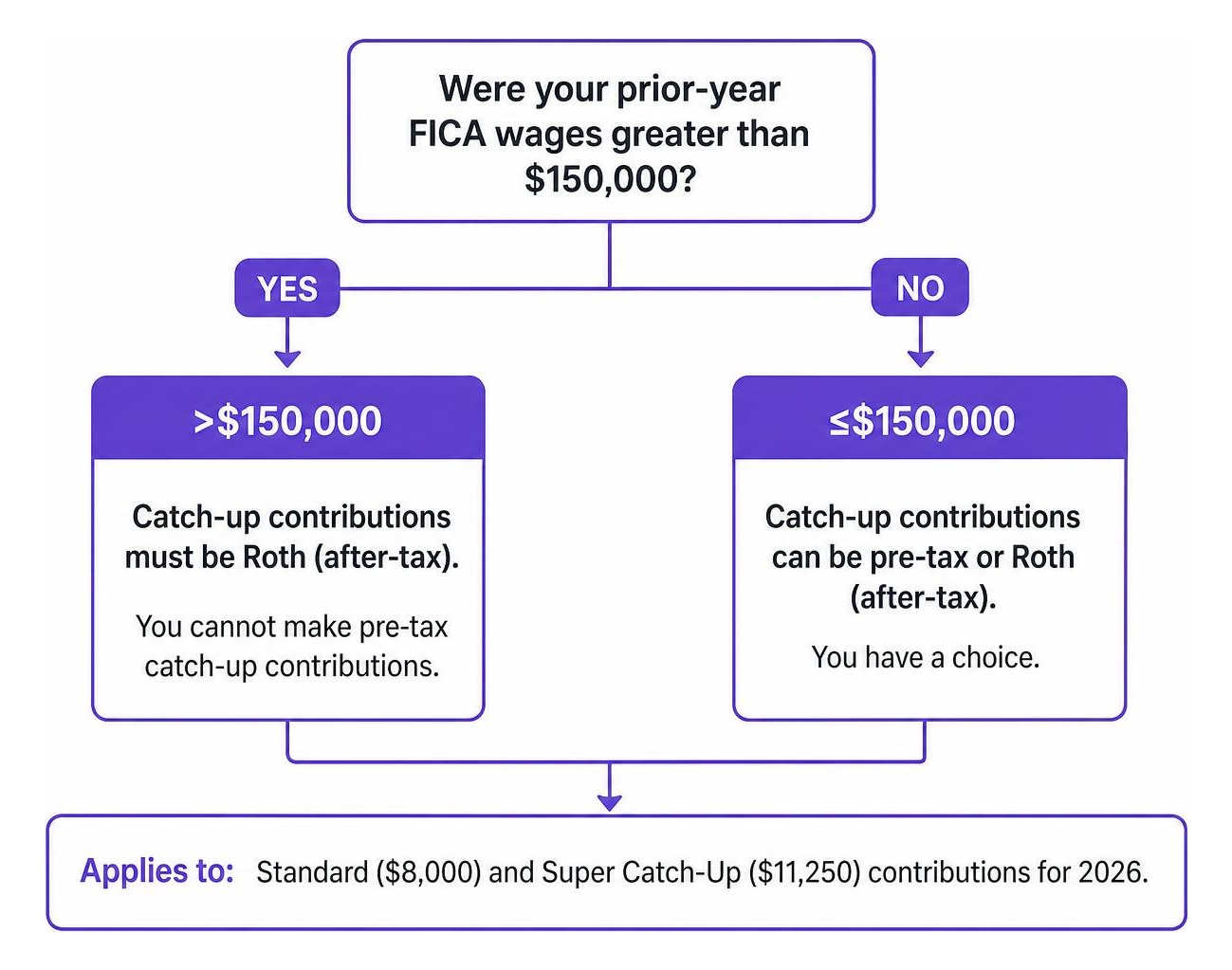
One of the most critical SECURE 2.0 changes takes effect starting in 2026. If your prior-year FICA wages (typically Box 3 of your W-2) exceeded $150,000, any catch-up contributions you make in 2026 must be made as Roth (after-tax) contributions.
This means you can no longer deduct these catch-up dollars on your tax return; they must go into a Roth 401(k) where they will grow and be withdrawn tax-free in retirement. If your prior-year wages were $150,000 or less, you retain the choice to make pre-tax or Roth catch-up contributions.
This represents a major shift in tax planning for high-earning professionals. To weigh the pros and cons of Roth versus pre-tax accounts under these new rules, check out The Great Retirement Debate: Roth vs Traditional 401k Calculator Guide.
Comparing 401(k) Limits with Other Retirement Plans
While 401(k) plans are the most common workplace retirement vehicle, they are not the only option. Knowing how they compare to 403(b) plans, 457(b) plans, and IRAs helps us build a diversified savings strategy.

403(b), 457(b), and IRA Limits in 2026
The IRS generally aligns the contribution limits of key employer-sponsored plans, but there are distinct differences to keep in mind:
- 403(b) Plans: Common for public school employees and tax-exempt organizations. The standard elective deferral limit is $24,500 in 2026, with the same catch-up ($8,000) and super catch-up ($11,250) rules.
- 457(b) Plans: Available to state and local government employees. The standard elective deferral limit is also $24,500 in 2026. However, 457(b) plans have a special “pre-retirement catch-up” that allows participants within three years of normal retirement age to defer up to twice the standard limit (up to $49,000 in 2026), provided they have unused limits from prior years.
- Individual Retirement Accounts (IRAs): The standard IRA contribution limit for 2026 (traditional or Roth) is $7,500 for those under 50, and $8,600 for those age 50 or older (which includes a $1,100 catch-up).
For a complete breakdown of plan sponsor rules and limits across public and private sector accounts, consult the retirement plan contribution limits guide. To explore how to balance these accounts alongside your workplace plan, see our resource on Smart Strategies to Defer Taxes and Boost Your Retirement Savings.
Rules for Participating in Multiple Plans
If you work for multiple employers or have a side business, you might have access to more than one retirement plan. However, you cannot simply double your contributions without looking at the rules:
- The Section 402(g) limit is an individual cap. This means your total personal elective deferrals across all 401(k) and 403(b) plans combined cannot exceed $24,500 in 2026.
- The Section 415 limit is a per-employer cap. If you participate in plans offered by two entirely unrelated employers, you can receive up to $72,000 in total additions in each plan.
- 457(b) Exception: Elective deferrals to a governmental 457(b) plan do not aggregate with 401(k) or 403(b) limits. If you work for an employer offering both a 403(b) and a governmental 457(b) plan, you can defer $24,500 to the 403(b) and another $24,500 to the 457(b), for a total of $49,000 in employee deferrals.
For a detailed analysis of how to manage multiple plans across different employers without triggering penalties, see the comprehensive guide on 401k limits.
Frequently Asked Questions about 2026 Limits
Managing retirement accounts often brings up complex tax and compliance questions. Here are the answers to the most common questions savers face in 2026.
What happens if I exceed the 2026 401(k) contribution limit?
Exceeding the 2026 maximum 401k contribution limit is an easy mistake to make, especially if you change jobs mid-year. If you contribute more than $24,500 (or your applicable catch-up limit), the excess amount is subject to double taxation if not corrected.
To correct an excess deferral:
- You must notify your plan administrator as soon as possible.
- The plan must distribute the excess contribution, along with any investment earnings on that excess, to you by April 15, 2027.
- The excess contribution is taxable in the year contributed (2026), and the associated earnings are taxable in the year distributed (2027).
If you fail to correct the error by the April 15 deadline, the excess contribution is taxed twice: once in the year contributed, and again in the year it is eventually withdrawn. For the official notice on these correction procedures, refer to the official IRS Notice 2025-67.
What are the 2026 IRA income phase-out limits?
While you can always contribute to a traditional IRA, your ability to deduct those contributions on your tax return is phased out if you (or your spouse) are covered by an active workplace retirement plan:
- Single Taxpayers: The deduction phase-out range is $81,000 to $91,000 of Modified Adjusted Gross Income (MAGI).
- Married Filing Jointly: If the contributing spouse is covered by a workplace plan, the phase-out range is $130,000 to $150,000. If the contributing spouse is not covered but their partner is, the phase-out range is $230,000 to $240,000.
For Roth IRA contributions, your ability to contribute directly is phased out based on MAGI, regardless of workplace plan coverage:
- Single Taxpayers: The phase-out range is $153,000 to $168,000.
- Married Filing Jointly: The phase-out range is $230,000 to $240,000.
Who qualifies for the 2026 Saver’s Credit?
The Saver’s Credit (officially the Retirement Savings Contributions Credit) is a non-refundable tax credit designed to encourage low-to-moderate-income taxpayers to save for retirement.
In 2026, the maximum Adjusted Gross Income (AGI) limits to qualify for this credit are:
- Married Filing Jointly: $80,500
- Head of Household: $60,375
- Single / Married Filing Separately: $40,250
Depending on your exact income, the credit can be worth 10%, 20%, or 50% of your retirement contributions (up to a maximum contribution of $2,000 per person, or $4,000 for married couples).
Conclusion
Maximizing your 2026 maximum 401k contribution is one of the most effective steps you can take to secure your financial future. Whether you are aiming for the standard $24,500 limit, leveraging the new $11,250 super catch-up, or utilizing the mega backdoor Roth strategy to reach the $72,000 total limit, staying on top of these annual changes keeps your plan on track.
At ContentVibee, we are dedicated to providing concise, actionable financial advice to help Americans optimize their retirement strategies, navigate tax changes, and make smart money decisions.
As you align your contribution strategy for the year, don’t forget to look at how your retirement savings will interact with other taxes down the road. To keep your long-term plan optimized, read our guide on Understanding taxes on Social Security benefits.


