

The Social Security Benefit Most Divorced Americans Don’t Know They Have
Surviving divorced spouse benefits are monthly Social Security payments you may be entitled to after your ex-spouse dies — even if you’ve been divorced for decades.
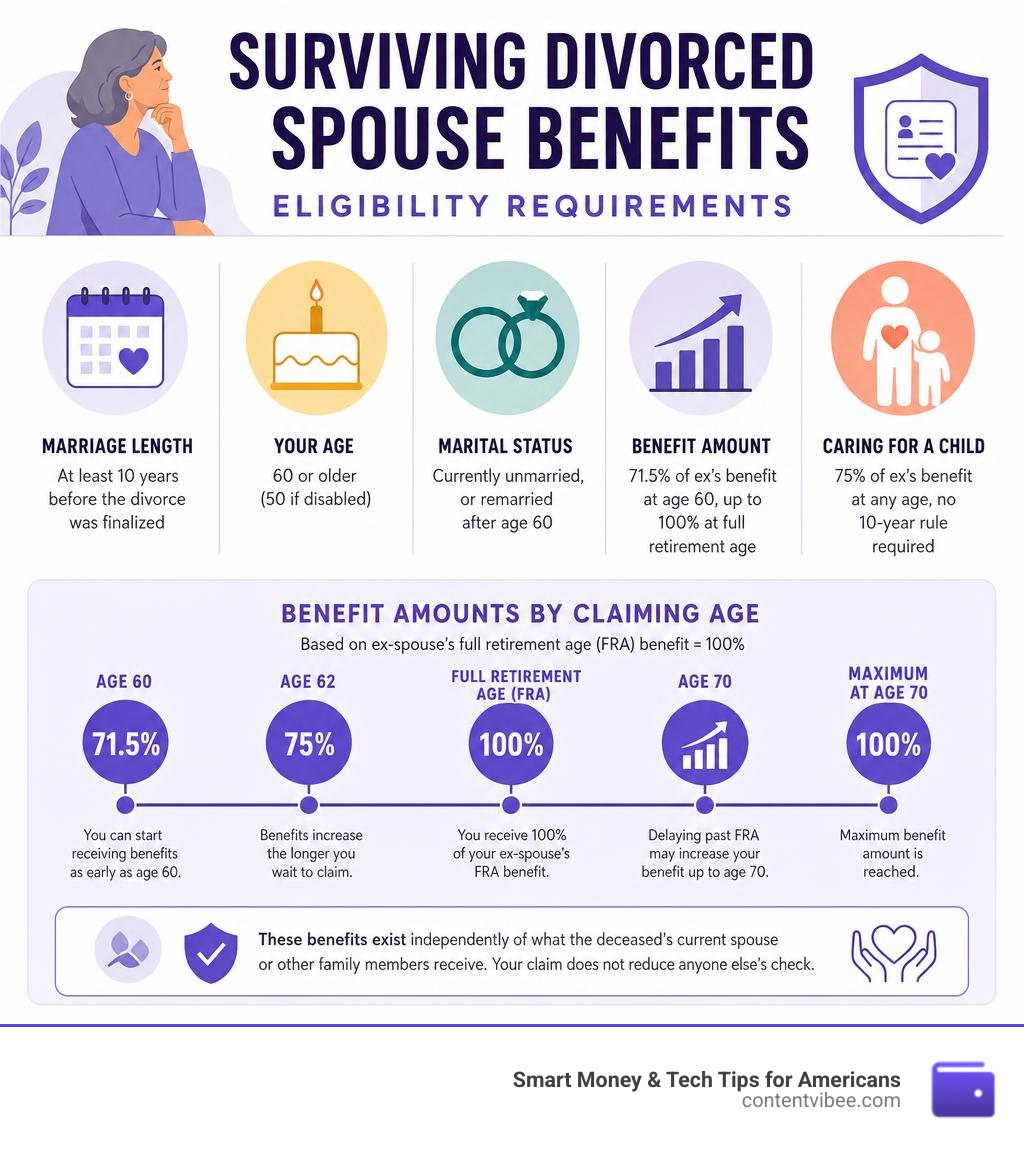
Here’s a quick summary of who qualifies and what you can get:
| Requirement | Details |
|---|---|
| Marriage length | At least 10 years before the divorce was finalized |
| Your age | 60 or older (50 if disabled) |
| Marital status | Currently unmarried, or remarried after age 60 |
| Benefit amount | 71.5% of ex’s benefit at age 60, up to 100% at full retirement age |
| Caring for a child | 75% of ex’s benefit at any age, no 10-year rule required |
These benefits exist independently of what the deceased’s current spouse or other family members receive. Your claim does not reduce anyone else’s check.
As of December 2024, approximately 466,000 people were collecting survivor benefits on a deceased former spouse’s Social Security record — and 96% of them were women. Many others who qualify never claim simply because they didn’t know the option existed.
If you’re nearing retirement and your marriage lasted at least 10 years, this benefit could be worth significantly more than your own retirement benefit. Understanding the rules now gives you time to plan the smartest claiming strategy.
Eligibility Requirements for Surviving Divorced Spouse Benefits
To qualify for surviving divorced spouse benefits, the Social Security Administration (SSA) requires you to meet a few strict criteria. Think of these as the “three keys” to unlocking this benefit. If you miss even one, the door remains shut, but if you meet all three, you are legally entitled to claim on your late ex-spouse’s work record.
First, let’s look at the legal framework. The exact criteria are laid out under federal law in Legal criteria for surviving divorced spouse benefits. To break this down into plain English, you must satisfy the following:
- The 10-Year Marriage Rule: Your marriage to your ex-spouse must have lasted for at least 10 consecutive years before the final divorce decree was signed. The SSA measures this down to the exact day. If you were married for nine years and 360 days, unfortunately, you do not qualify.
- The Age Requirement: You must be at least 60 years old to claim. However, as we will discuss below, there are exceptions if you are disabled or caring for a qualifying child.
- Marital Status: You must currently be unmarried, or you must have remarried after reaching age 60 (or age 50 if you are disabled). If you remarried before age 60, you cannot collect these benefits unless that subsequent marriage has ended by death, divorce, or annulment.
It is worth noting that your ex-spouse must have worked long enough under Social Security to be “fully insured.” Generally, this means they accumulated at least 40 work credits (roughly 10 years of work).
If you want to double-check how these rules overlap with standard spousal benefits while your ex is still living, you can read our guide on How to Check Your Eligibility for Spousal Social Security Benefits.
Age and Disability Exceptions
What happens if you cannot wait until age 60 to claim because of a severe health condition? The SSA has built-in protections for disabled surviving divorced spouses.
If you meet the definition of disability and your disability started before or within seven years of your ex-spouse’s death, you can begin collecting benefits as early as age 50.
There are a few details to keep in mind for disability-based claims:
- A five-month waiting period generally applies from the onset of your disability before payments can begin.
- The benefit amount at age 50 to 59 is fixed at 71.5% of your deceased ex-spouse’s basic benefit.
- You can learn more about how divorce impacts these disability provisions in our article, Can a Divorced Spouse Get Social Security Benefits.
Caring for a Qualifying Child
There is one major exception to both the 10-year marriage rule and the age 60 requirement. If you are caring for a child from the marriage who is under the age of 16 (or disabled), you can claim survivor benefits at any age.
Under this special rule:
- You do not need to have been married to your ex-spouse for 10 years.
- Your benefit amount will be 75% of your deceased ex-spouse’s benefit.
- Once the child turns 16, this specific “mother’s or father’s” benefit ends, though the child may continue to receive their own child’s survivor benefit until they graduate high school or turn 19.
To understand how this fits into the broader landscape of family benefits, take a look at The Ultimate Guide to Spousal Social Security Eligibility.
Claiming Strategies and the Survivor Benefit vs. Retirement Benefit Decision
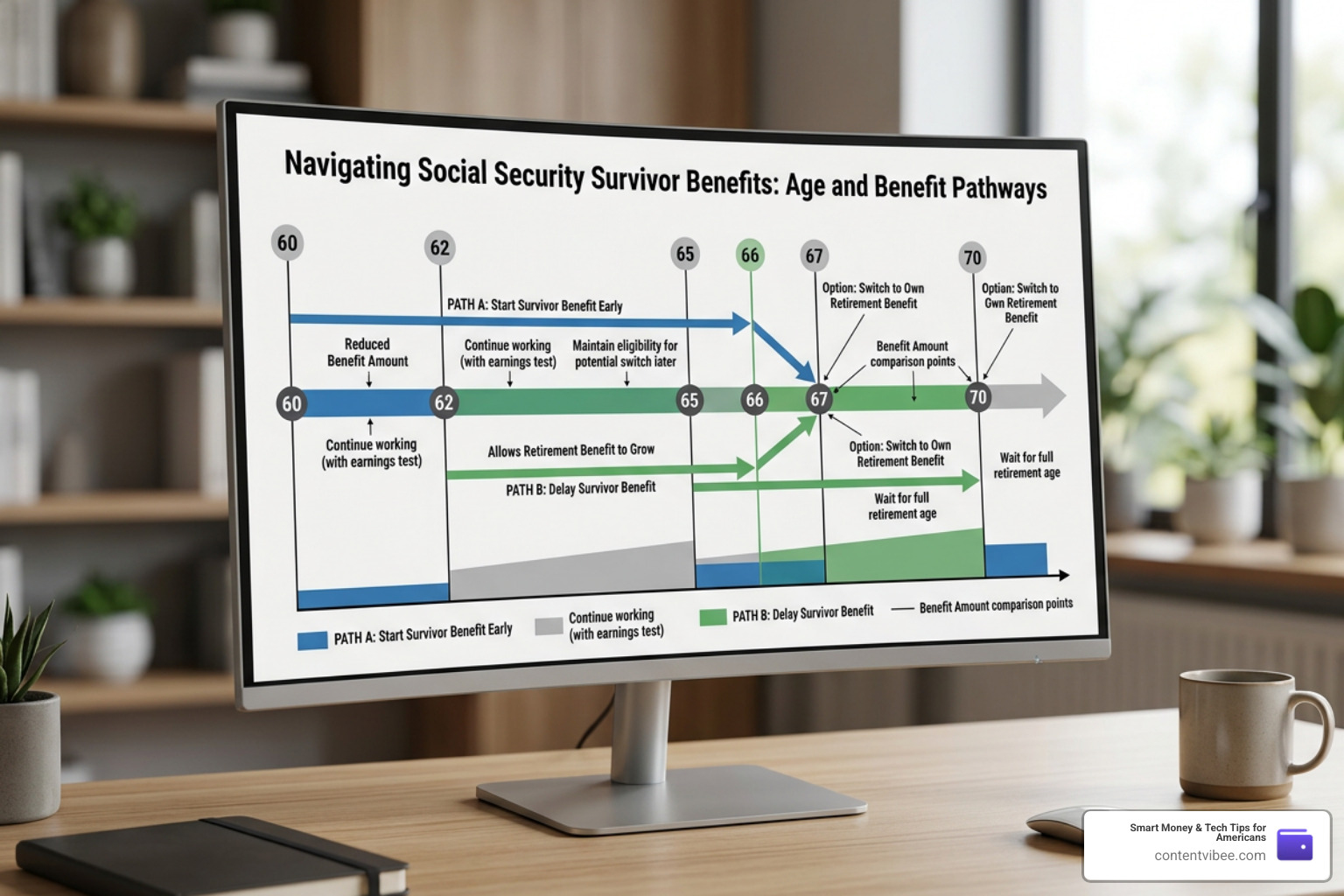
One of the most powerful aspects of surviving divorced spouse benefits is that they are exempt from “deemed filing” rules.
For standard retirement and living spousal benefits, when you apply for one, the SSA automatically files you for both and pays you the higher amount. You cannot choose to take one and let the other grow.
With survivor benefits, however, you can strategically coordinate your claims. You are permitted to claim your survivor benefit first while letting your own retirement benefit grow, or vice versa. This is a massive financial planning opportunity.
To see how claiming age shapes your lifetime payout, consult The Definitive Guide to Social Security Claiming Age. For those who plan to keep working while coordinating these benefits, our resource on Double Dipping: The Working Spouse’s Guide to Social Security offers excellent insights.
How Much Can You Claim in Surviving Divorced Spouse Benefits?
The amount you receive is directly tied to the age at which you claim. If you wait until your full retirement age (FRA) as a survivor, you are entitled to receive 100% of your deceased ex-spouse’s monthly benefit. If you claim earlier, the benefit is permanently reduced.
The table below shows how your claiming age affects your percentage of the deceased ex-spouse’s benefit (assuming a survivor FRA of 67):
| Claiming Age | Percentage of Deceased Ex-Spouse’s Benefit |
|---|---|
| 67 (Full Retirement Age) | 100.0% |
| 66 | 94.3% |
| 65 | 88.6% |
| 64 | 82.9% |
| 63 | 77.1% |
| 62 | 74.3% |
| 61 | 72.9% |
| 60 | 71.5% |
| Under 60 (Caring for child under 16) | 75.0% |
To maximize your household income, you should run your numbers carefully. You can read the Official Social Security Administration Survivor Benefits Guide to understand these calculations.
Additionally, we highly recommend using our step-by-step guide to Estimate Your Monthly Retirement Benefits in 5 Easy Steps to compare your own projected retirement benefit against your potential survivor benefit.
Full Retirement Age for Survivors vs. Retirement Benefits
It is a common point of confusion: your Full Retirement Age for survivor benefits is not always the same as your FRA for normal retirement benefits.
The SSA uses two separate tables to calculate these milestones. For survivor benefits, the FRA is slightly more generous for certain birth years. For example, if you were born in 1959, your retirement FRA is 66 years and 10 months, but your survivor FRA is 66 years and 8 months. For anyone born in 1962 or later, both FRAs converge at age 67.
To make sure you don’t miscalculate these critical dates, read our up-to-date Divorced Spouse Social Security Guide 2026.
What If Your Ex-Spouse Died Before Claiming?
If your ex-spouse passed away before they ever claimed their own Social Security retirement benefits, your survivor benefit will be calculated based on their Primary Insurance Amount (PIA). This is the amount they would have been entitled to receive if they had reached their own full retirement age on the date of their death.
Crucially, if your ex-spouse died after reaching their full retirement age but had not yet claimed, any delayed retirement credits they earned will be added to your survivor benefit.
Delayed retirement credits increase the monthly benefit by 2/3 of 1% for each month they delayed claiming past their FRA, up until age 70. This means their patience can translate into a permanently higher monthly check for you. You can read more about this scenario in Claiming What’s Yours: A Guide to Deceased Spouse Social Security.
Remarriage, the Family Maximum, and Impact on Other Beneficiaries
One of the biggest concerns for divorced individuals is how remarriage affects their eligibility. The rules here are very specific, and timing is everything.
If you remarry before you turn 60 (or before 50 if you are disabled), you lose your eligibility to claim survivor benefits on your deceased ex-spouse’s record. However, if that second marriage ends due to death, divorce, or annulment, your eligibility to claim on your first ex-spouse’s record is restored.
If you remarry after you turn 60 (or after 50 if disabled), your eligibility is completely preserved. You can still claim surviving divorced spouse benefits on your deceased ex-spouse’s record, even while happily married to your new partner.
To review the exact wording and policy updates, check out the Official Social Security Administration Rules on Remarriage.
The Family Maximum Benefit Rule
The SSA limits the total amount of money that can be paid out to a single worker’s family members. This cap is known as the Family Maximum Benefit, and it typically ranges between 150% and 180% of the deceased worker’s primary benefit amount.
If the total benefits claimed by a surviving current spouse and children exceed this limit, their individual checks are reduced proportionally to fit under the cap.
However, there is a massive exception for divorced spouses. Benefits paid to a surviving divorced spouse do not count toward the family maximum.
This means:
- You can claim your full survivor benefit without reducing the check of your ex-spouse’s current widow or widower.
- Their current family’s claims will not reduce your check.
- Multiple ex-spouses (provided each was married to the deceased for at least 10 years) can all collect full survivor benefits simultaneously without affecting each other.
For more details on how these family caps are calculated, visit the Survivor benefits | SSA informational page.
Working While Receiving Benefits
If you plan to work while receiving survivor benefits before you reach your full retirement age, you must keep the annual earnings limits in mind.
In 2026, the earnings limits are as follows:
- Under Full Retirement Age: The limit is $24,480. If you earn more than this, the SSA will withhold $1 in benefits for every $2 you earn above the limit.
- The Year You Reach Full Retirement Age: The limit is $65,160 (counting only earnings made in the months before you reach FRA). If you exceed this, the SSA will withhold $1 for every $3 earned above the limit.
- At Full Retirement Age and Beyond: The earnings test disappears. You can earn an unlimited amount without any benefit reductions.
Any benefits withheld under these rules are not lost forever. Once you reach FRA, the SSA recalculates your monthly benefit upward to account for the months benefits were withheld.
To see how this works in practice, read Working in Retirement: Are Spousal Benefits Reduced by Working.
Navigating the Application Process and Required Documents
Applying for survivor benefits requires direct interaction with the SSA. Unlike standard retirement benefits, you cannot apply for survivor benefits online. You must speak to an SSA representative directly to initiate the process.
To prepare for the application, it helps to understand the digital tools and forms the SSA uses. You can read Your Digital Guide to Form SSA-2 and Online Spousal Claims to familiarize yourself with how the agency processes spousal data.
How to Apply for Surviving Divorced Spouse Benefits
To apply, you have two primary options:
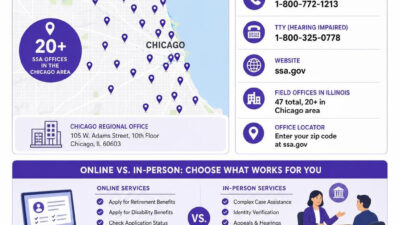
- By Phone: Call the SSA national toll-free number at 1-800-772-1213 (TTY 1-800-325-0778) between 8:00 a.m. and 7:00 p.m., Monday through Friday.
- In Person: Visit your local Social Security office. We highly recommend calling ahead to schedule an appointment to avoid long wait times.
To ensure your claim is processed smoothly, the SSA uses a rigorous internal checklist to verify your relationship and eligibility. You can review the official administrative policy and required proofs in the SSA POMS RS 00207.004 Table of Proofs.
Required Documentation and Proofs
When you apply, you must provide original documents or certified copies (the SSA will not accept photocopies). The required documents typically include:
- Proof of Death: A death certificate or funeral home notice.
- Your Birth Certificate: To verify your age and identity.
- Marriage Certificate: To prove you were legally married.
- Divorce Decree: To prove the marriage lasted at least 10 years and was legally dissolved.
- Social Security Numbers: Both your SSN and your deceased ex-spouse’s SSN. (If you do not know your ex’s SSN, the SSA can look it up using their date and place of birth, along with their parents’ names).
- Bank Account Details: For direct deposit of your monthly payments.
If you are the person coordinating the funeral arrangements or are otherwise eligible, you may also be entitled to a one-time $255 lump-sum death payment, provided you apply within two years of your ex-spouse’s death.
Frequently Asked Questions
Will my ex-spouse’s current family know if I claim benefits?
No. The SSA maintains strict confidentiality. Your application and any benefits you receive are entirely private. The SSA will never notify your ex-spouse’s current family, their widow/widower, or their children that you have filed a claim on their work record.
Can I collect both my own retirement and survivor benefits?
No, you cannot “double dip” and receive the full amount of both benefits simultaneously. However, you can choose to claim one first (such as your survivor benefit at age 60) and then switch to the other (your own retirement benefit at age 70) if it has grown larger due to delayed retirement credits.
What happens if I remarry after age 60?
If you remarry after age 60 (or age 50 if disabled), your eligibility for surviving divorced spouse benefits is unaffected. You can continue to receive or apply for benefits based on your deceased ex-spouse’s record.
Conclusion
At ContentVibee, we believe that clear financial planning is the key to a secure and happy retirement. Navigating the rules of Social Security can feel overwhelming, but taking the time to understand options like surviving divorced spouse benefits can make a massive difference in your monthly income.
Don’t leave money on the table that you worked hard to secure through years of marriage. If you believe you qualify, gather your documents and contact the SSA to discuss your options.
Ready to take the next step in securing your financial future? Claim Spousal Benefits Today and let us help you maximize every dollar you deserve.