


Why Knowing Your Full Retirement Age Could Be Worth Thousands of Dollars
What is full retirement age for Social Security? Here’s the quick answer:
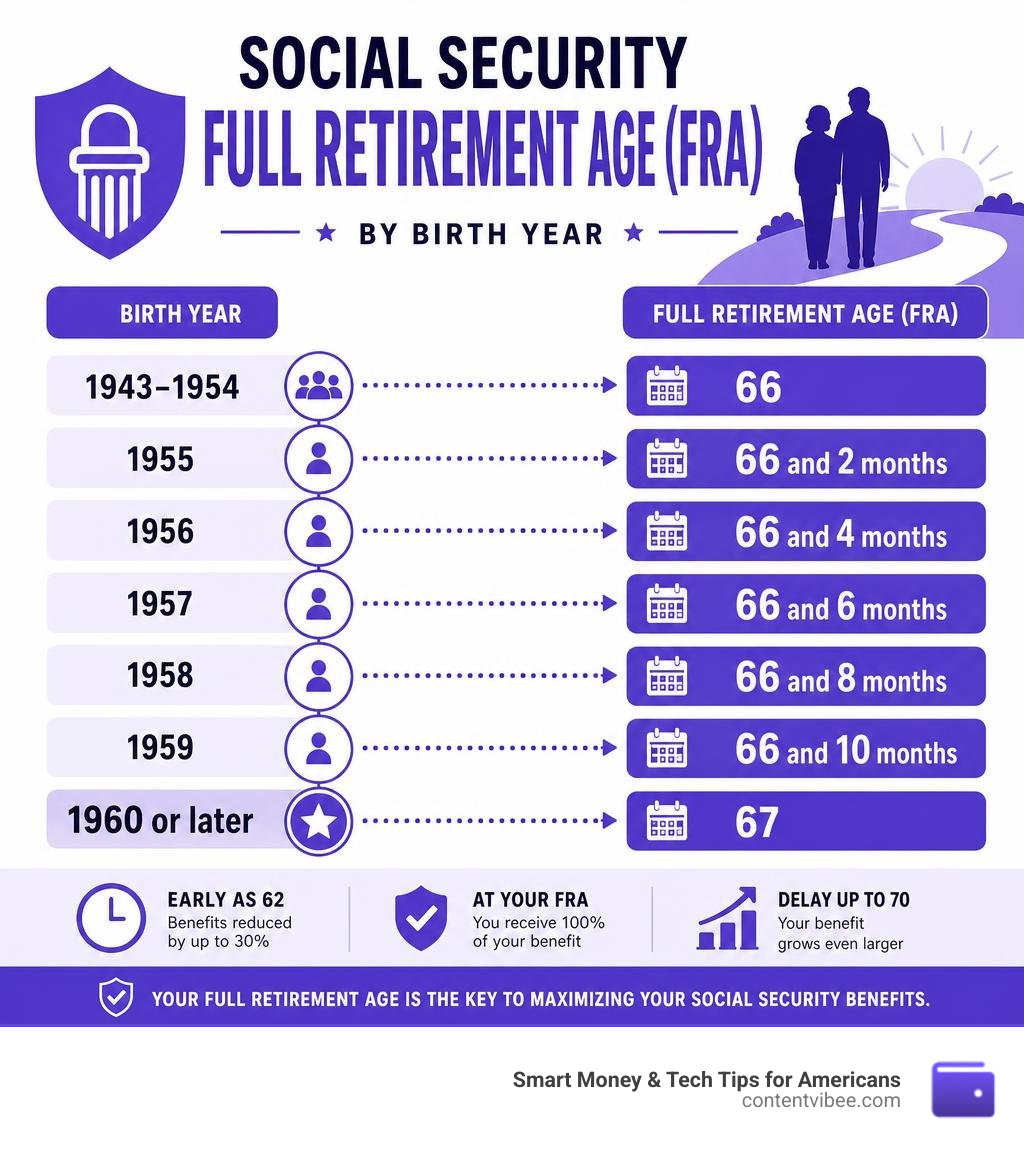
| Birth Year | Full Retirement Age (FRA) |
|---|---|
| 1943–1954 | 66 |
| 1955 | 66 and 2 months |
| 1956 | 66 and 4 months |
| 1957 | 66 and 6 months |
| 1958 | 66 and 8 months |
| 1959 | 66 and 10 months |
| 1960 or later | 67 |
Your Full Retirement Age (FRA) is the age at which you qualify for 100% of your Social Security benefit — no reductions, no penalties.
You can claim as early as age 62, but your monthly check will be permanently cut by up to 30%. Wait past your FRA — up to age 70 — and your benefit grows even larger.
If you were born in 1960 or later, your FRA is 67. That’s the age that now applies to anyone turning 62 in 2026.
This matters more than most people realize. A single decision — when to claim — can mean the difference of hundreds of dollars every month for the rest of your life.
What is full retirement age for social security vocab to learn:
- can you collect a pension and still work full-time
- retirement health insurance options
- retirement passive income ideas
What Is Full Retirement Age for Social Security?
To understand how the Social Security system works, we must first look at its cornerstone concept: the Full Retirement Age (FRA). Your FRA is not just an arbitrary milestone where you get to throw a party and eat cake. Legally and financially, it is the exact point in time when you become eligible to receive 100% of your primary insurance amount (PIA). This is the unreduced benefit calculated from your lifetime earnings history.
Historically, when the Social Security program was created, the full retirement age was set at 65. For decades, Americans knew exactly when they would reach the finish line. However, as lifespans lengthened and the demographic landscape of the United States shifted, Congress realized that the system needed structural adjustments to remain solvent.
This realization led to the landmark Social Security Amendments of 1983. Among other changes, this legislation put in place a gradual increase in the retirement age, stretching it from 65 to 67 over several decades. The transition was designed to be slow and predictable, rising in increments of two months per birth year for those born between 1938 and 1959.
Today, in July 2026, we have reached the final tier of this legislative transition. If you were born in 1960 or later, your full retirement age is officially 67. Knowing this exact age is vital because claiming your benefit even one month early triggers a permanent reduction in your monthly payout.
To find your exact milestone, you can See your Full Retirement Age (FRA) through the Social Security Administration’s official portal. Understanding this timeline is the first and most critical step in crafting a successful financial plan for your golden years. For a deeper dive into how this framework fits into your broader financial picture, check out our comprehensive guide on Understanding Your Social Security Full Retirement Age.
How Your Birth Year Determines Your Full Retirement Age
Your exact birth date dictates which rules apply to your retirement timeline. The Social Security Administration categorizes beneficiaries into strict birth cohorts to calculate benefits. However, there is a fascinating legal quirk in how these dates are calculated that many retirees miss.
According to federal guidelines, if you were born on the first day of any given month, the Social Security Administration calculates your benefits as if you were born in the previous month. For example, if your birthday is January 1, 1960, you are legally considered to have been born in 1959. Consequently, your full retirement age would be 66 years and 10 months, rather than the age 67 standard applied to the rest of the 1960 cohort.
These precise legal definitions are outlined in the Code of Federal Regulations § 404.409, which details the exact birth cohorts and their corresponding retirement ages.
The gradual two-month-per-year scale was designed to ease the transition for older workers while ensuring the system’s longevity. For instance:
- If you were born in 1955, your FRA is 66 and 2 months.
- If you were born in 1956, your FRA is 66 and 4 months.
- If you were born in 1957, your FRA is 66 and 6 months.
- If you were born in 1958, your FRA is 66 and 8 months.
- If you were born in 1959, your FRA is 66 and 10 months.
- If you were born on January 2, 1960, or later, your FRA is 67.
Because these rules are so granular, relying on general approximations can lead to costly planning mistakes. To make sure you do not miscalculate your timeline, we recommend reading The Definitive Guide to Social Security Claiming Age to align your personal retirement timeline with official regulations.
The Financial Impact of Claiming Social Security Early
The temptation to claim Social Security benefits as early as possible is incredibly strong. After all, who wouldn’t want to start receiving a monthly check at age 62? The reality, however, is that early claiming comes with a steep, permanent financial penalty.
When you choose to claim benefits before reaching your full retirement age, the Social Security Administration permanently reduces your monthly payment. This reduction is not temporary—it lasts for the rest of your life. The system is designed this way to ensure that, mathematically, an individual receives roughly the same total lifetime payout whether they claim a smaller check for more years or a larger check for fewer years. However, if you live an average or longer-than-average life, early claiming can cost you tens of thousands of dollars in lost income.
This decision is top-of-mind for millions of Americans. According to official data, 72.9 million people received benefits from programs administered by the Social Security Administration in 2024. A significant portion of these beneficiaries chose to claim early, often without fully realizing how much money they were leaving on the table.
To understand how these reductions are calculated, you can review the official rules on Retirement Age and Benefit Reduction. If you want to see how these reductions apply specifically to your work history, we have broken down the calculations in How to Calculate Your Social Security Benefit in 5 Simple Steps.

Calculating the Reduction: What Is Full Retirement Age for Social Security at Age 62?
Let’s look at the exact math behind early claiming. For individuals born in 1960 or later, whose full retirement age is 67, claiming at age 62 results in a maximum 30% reduction in their monthly benefit.
The reduction is calculated using a specific formula:
- For the first 36 months before your FRA, your benefit is reduced by 5/9 of 1% for each month (about 6.67% per year).
- For any additional months beyond 36 (up to an additional 24 months if claiming at 62), your benefit is reduced by 5/12 of 1% for each month (5% per year).
If you are a spouse claiming spousal benefits based on your partner’s work record, the penalties for early claiming are even harsher. At your full retirement age, your maximum spousal benefit is 50% of your partner’s full benefit. However, if you claim spousal benefits early at age 62, that amount is slashed to just 32.5% of their full benefit—a massive 35% permanent reduction.
You can view the detailed reduction percentages for wage earners and spouses on the Social Security Administration’s page for those Benefits Planner: Retirement | Born in 1960 or later.
To help visualize this impact, let’s look at a side-by-side comparison of a worker’s monthly benefit and a spouse’s monthly benefit based on a hypothetical $2,000 full retirement benefit at age 67:
| Claiming Age | Worker’s Benefit Percentage | Monthly Worker Benefit (FRA $2,000) | Spousal Benefit Percentage | Monthly Spousal Benefit (FRA $1,000) |
|---|---|---|---|---|
| Age 67 (FRA) | 100% | $2,000 | 50% | $1,000 |
| Age 66 | 93.3% | $1,866 | 45.8% | $916 |
| Age 65 | 86.7% | $1,734 | 41.7% | $834 |
| Age 64 | 80.0% | $1,600 | 37.5% | $750 |
| Age 63 | 75.0% | $1,500 | 35.0% | $700 |
| Age 62 | 70.0% | $1,400 | 32.5% | $650 |
As you can see, claiming at age 62 instead of age 67 costs the worker $600 every single month, and costs the spouse $350 per month. Over a 20-year retirement, that adds up to a staggering loss of retirement security.
The Benefits of Delaying Social Security Past Your Full Retirement Age
While claiming early penalizes you, delaying your claim past your full retirement age does the exact opposite: it rewards your patience with a guaranteed, permanent increase in your monthly check.
For every single month you delay claiming your benefits past your FRA, the Social Security Administration credits you with “delayed retirement credits.” This increase amounts to 2/3 of 1% per month, which translates to a massive 8% simple interest increase per year.
This accumulation of credits continues until you reach age 70. Once you blow out the candles on your 70th birthday, your benefit caps out. There is absolutely no financial incentive to delay claiming past age 70, as no further credits are earned.

This strategy is one of the most powerful tools available for maximizing your retirement income. For a comprehensive comparison of how different claiming ages affect your long-term retirement security, we recommend reading the Charles Schwab Guide on Taking Social Security: 62 vs. 67 vs. 70. Additionally, you can explore our strategic breakdown in Why Waiting for Social Security Age 70 Benefits Might Be Your Best Move to see if this approach aligns with your health and financial goals.
Maximizing Your Payout: What Is Full Retirement Age for Social Security vs Age 70?
Let’s look at the financial leverage of waiting until age 70. If your full retirement age is 67 and you delay claiming until age 70, you will earn three full years of delayed retirement credits. At 8% per year, this adds up to a 24% permanent increase in your monthly benefit.
If your monthly benefit at an FRA of 67 is $2,000, waiting until age 70 bumps that monthly check up to $2,480. If you compare that to the reduced age 62 payout of $1,400, the difference is clear: waiting until age 70 yields a massive 77% larger monthly check than claiming at age 62.
This optimization strategy is particularly valuable because Social Security benefits are adjusted annually for inflation through Cost-of-Living Adjustments (COLA). Because COLA is calculated as a percentage of your current benefit, starting with a larger baseline payment at age 70 means your future inflation adjustments will also be larger in absolute dollar terms.
To master these calculations and coordinate benefits within a household, read The Ultimate Guide to Social Security Benefit Optimization. However, delayed claiming is not without its trade-offs. To weigh the potential downsides—such as health risks and break-even timelines—be sure to read Patience is a Virtue But is it a Payoff The Cons of Late Social Security Claiming.
How Full Retirement Age Differs for Survivors (Widows and Widowers)
One of the most complex areas of Social Security planning is understanding survivor benefits. If you are a widow or widower, the rules regarding your full retirement age and early claiming are different from those that apply to standard retired workers.
First, the age at which you can begin claiming survivor benefits is younger. While retired workers must wait until age 62 to claim reduced benefits, a surviving spouse can claim reduced survivor benefits as early as age 60 (or age 50 if the survivor has a qualifying disability).
Second, the transition timeline for a survivor’s full retirement age is slightly different from the retirement benefit timeline. For survivor benefits, the full retirement age is 66 for those born between 1945 and 1956, and it gradually increases to 67 for those born in 1962 or later. This is a crucial distinction: a survivor’s FRA reaches age 67 two years later in the birth-year cohorts than it does for retired workers.
If you claim survivor benefits at your survivor FRA, you are eligible to receive 100% of the deceased worker’s benefit. However, claiming early at age 60 results in a permanent reduction of about 28.5% of the deceased worker’s benefit amount.
These specific legal distinctions and tables are outlined in detail in the 20 CFR § 404.409 – What is full retirement age? legal database. Understanding these survivor timelines is essential for couples when mapping out their joint retirement strategy, as the higher-earning spouse’s claiming age ultimately determines the maximum survivor benefit available to the surviving partner.
Frequently Asked Questions About Social Security Full Retirement Age
What is the full retirement age for someone born in 1960 or later?
If you were born in 1960 or later, your full retirement age is 67. This is the highest age currently mandated by law for unreduced old-age benefits. If you choose to claim retirement benefits before reaching age 67, your monthly payments will be permanently reduced. For more details on this cohort, you can view the official FAQ on What is full retirement age? from the Social Security Administration.
Does Medicare eligibility align with my Social Security Full Retirement Age?
No, Medicare eligibility does not align with your Social Security Full Retirement Age. Regardless of your birth year or when you choose to claim Social Security benefits, you become eligible for Medicare at age 65.
It is highly recommended that you apply for Medicare within the three months before you turn 65, even if you plan to delay your Social Security retirement benefits past your full retirement age. Delaying your Medicare enrollment without qualifying employer coverage can lead to permanent premium penalties. To learn more about how to coordinate your healthcare and retirement timelines, refer to the official booklet on Retirement Benefits – Social Security Administration.
How do I estimate my monthly Social Security benefits?
Estimating your monthly retirement benefits is a straightforward process thanks to online tools. The Social Security Administration provides personalized estimates based on your actual earnings history through your online account.
To help you navigate this process, we have put together a step-by-step guide in Estimate Your Monthly Retirement Benefits in 5 Easy Steps. Additionally, you can input your numbers into our interactive Social Security Calculator Estimate Your Benefit Amount to model different claiming scenarios and see how early or delayed claiming will affect your monthly retirement budget.
Conclusion
At ContentVibee, we believe that navigating your retirement should not feel like trying to solve a puzzle in the dark. Designing a successful retirement strategy requires a clear understanding of the rules, particularly what is full retirement age for social security and how your claiming choices affect your lifetime income.
As you plan, it is also helpful to keep an eye on the broader landscape of the Social Security system. According to the Fast Facts & Figures About Social Security, 2025, the ratio of covered workers to Social Security beneficiaries is projected to fall from 2.7 in 2024 down to 2.3 by 2035. This demographic shift highlights why personal planning and optimizing your individual benefits is more important than ever.
Many retirees also choose to work part-time after reaching retirement age. If you plan to earn an income while collecting benefits, you will want to understand how the Social Security earnings test works. To ensure your spousal or retirement benefits are not unexpectedly reduced, read our detailed guide on Working in Retirement: Are Spousal Benefits Reduced by Working? to keep your financial plan on track.


