Why Dual Social Security Benefits Matter More Than Most Couples Realize
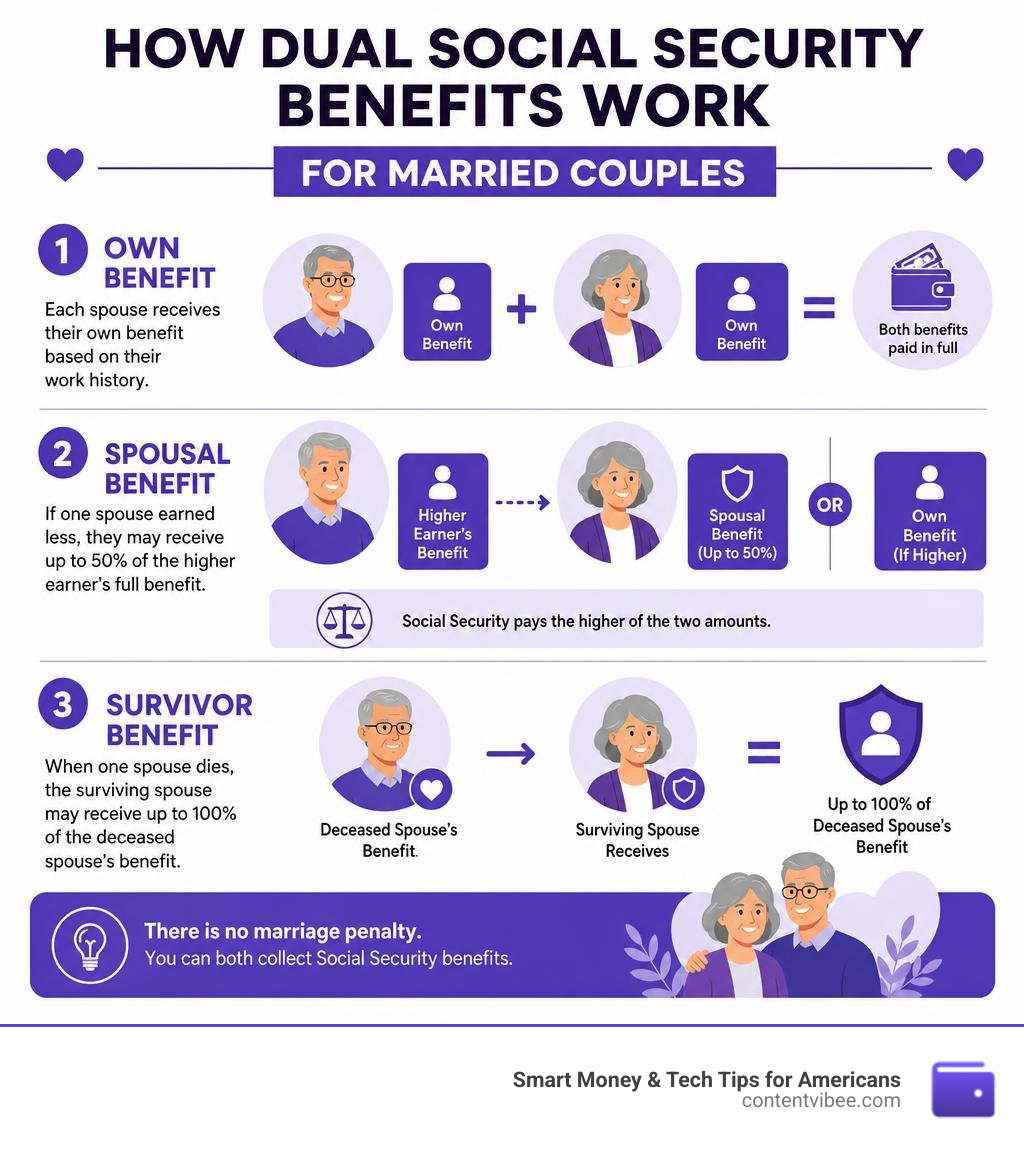
Can both spouses collect Social Security at the same time? Yes — and there is no marriage penalty that reduces either spouse’s payment.
Here is the quick answer:
| Situation | What Happens |
|---|---|
| Both spouses worked and earned 40+ credits | Each receives their own benefit independently |
| One spouse earned much less (or nothing) | Lower earner may claim a spousal benefit up to 50% of the higher earner’s full benefit |
| Both spouses qualify for own + spousal benefit | Social Security pays the higher of the two amounts |
| One spouse dies | Surviving spouse receives up to 100% of the deceased spouse’s benefit |
For example, if one spouse receives $1,400 per month and the other receives $1,200, the household collects $2,600 combined — no cap, no penalty.
But knowing that you can both collect is just the starting point. When and how you each claim can make a difference of well over $200,000 in total lifetime benefits. The rules around spousal benefits, survivor benefits, and filing timing are genuinely complex — and the wrong move is permanent.
This guide breaks it all down in plain language so you can make the decision that is right for your household.
Can both spouses collect social security vocabulary:
- can a divorced spouse collect social security
- can a surviving spouse get social security benefits
- can divorced spouse get social security benefits
Can Both Spouses Collect Social Security at the Same Time?

When we sit down with couples to map out their retirement, one of the most common myths we encounter is the fear of a “marriage penalty.” Many people worry that the Social Security Administration (SSA) will cap their combined household income or reduce one person’s check simply because they are married.
We have good news: there is absolutely no marriage penalty when it comes to standard retirement benefits.
If you and your spouse both worked and paid into the system, you are both entitled to your respective benefits. The SSA does not look at your marriage certificate and decide to trim 10% off the top. In fact, understanding how to coordinate your claims is one of the most powerful tools we have for securing your household’s financial future.
However, because the rules are highly dependent on age and work history, the timing of when you file is everything. Did you know that more than 90 percent of married couples have age differences within a 20-year range (from -10 to +10 years)? This age gap heavily influences the number of possible claiming-age combinations available to you. Coordinating your filings is not just a matter of picking an age; it is a strategic dance. To explore this further, you can read our deep dive on do both spouses collect social security and learn more about how couples navigate these options on both spouses collect social security.
Can Both Spouses Collect Social Security Based on Their Own Work Records?
To qualify for retirement benefits on your own record, you must accumulate at least 40 work credits, which roughly equates to 10 years of covered employment. If both you and your partner meet this requirement, you will each receive your own monthly check based on your individual 35 highest-earning years of work.
Let’s look at a quick real-world scenario. If both spouses have worked and earned enough credits individually, they will each get their own Social Security benefit. For example, a couple could receive $2,600 per month combined if one spouse is due $1,200 and the other is due $1,400. There is no reduction to either check.
For a closer look at this dynamic, check out our article on can a married couple both collect social security. Additionally, the SSA’s official publication, [PDF] 5 Things Every Woman Should Know About Social Security, highlights that a working woman’s benefit is calculated using the exact same formula as a man’s, ensuring her hard work is fully reflected in her retirement check.
How Deemed Filing Rules Apply When Both Spouses Collect Social Security
In the past, couples could use advanced strategies to “game” the system. A popular loophole allowed one spouse to file for spousal benefits at their Full Retirement Age (FRA) while letting their own retirement benefit grow by 8% per year up to age 70.
That loophole is officially a thing of the past. Under the “deemed filing” rules introduced by the Bipartisan Budget Act of 2015, when you file for either retirement or spousal benefits, you are automatically “deemed” to have filed for both. You cannot choose to claim only the spousal benefit while letting your own record grow.
Instead, the SSA will calculate both amounts. If you are eligible for both your own retirement benefit and a spousal benefit, the SSA will always pay your own benefit first. If the spousal benefit is higher than your own, you will receive a combination of the two benefits that equals the higher spousal rate. As explained in the Can I collect Social Security spouse’s benefits and my own retirement benefits? | SSA FAQ, you get the larger of the two amounts, but you cannot “double dip” or collect both in full.
Spousal Benefits vs. Survivor Benefits: Key Differences

Many couples confuse spousal benefits with survivor benefits, but they are entirely different animals. Understanding the distinction is vital to protecting the longer-living spouse from longevity risk.
To help visualize how these two benefits differ, we have outlined their key characteristics below:
| Feature | Spousal Benefits | Survivor Benefits |
|---|---|---|
| Availability | While your spouse is still living | Only after your spouse passes away |
| Maximum Amount | Up to 50% of your spouse’s PIA | Up to 100% of your deceased spouse’s actual benefit |
| Impact of Delaying Past FRA | Does not increase past your own FRA | Increases if the deceased spouse delayed claiming up to age 70 |
| Earliest Claiming Age | Age 62 (unless caring for an eligible child) | Age 60 (or age 50 if disabled) |
| Deemed Filing Rules | Apply strictly (cannot claim spousal alone) | Do not apply (can claim survivor and delay own benefit) |
To understand the core eligibility rules of spousal payments, read our guide on what is a social security spousal benefit and explore the foundational laws in the golden rules can a spouse collect ss spousal benefits.
The 50% Rule for Spousal Benefits
The spousal benefit is designed to provide financial security for spouses who either did not work outside the home or earned significantly less than their partners. Under this rule, a spouse can receive up to 50% of the higher-earning spouse’s Primary Insurance Amount (PIA) — which is the benefit the higher earner is entitled to at their Full Retirement Age.
However, to get that full 50%, the lower-earning spouse must wait until their own Full Retirement Age to claim. If they claim early (as early as age 62), the benefit is permanently reduced. For example, if your FRA is 67 and you claim spousal benefits at age 62, your spousal benefit will be reduced to roughly 32.5% of your partner’s PIA.
It is also important to note that the spousal benefit is capped. Unlike personal retirement benefits, spousal benefits do not earn delayed retirement credits. Waiting past your FRA to claim a spousal benefit will not increase the monthly payment. For step-by-step instructions on how to submit a claim, see our guide on applying for spousal benefits or use the official calculator on Benefits for Spouses – Social Security Administration.
Maximizing Survivor Benefits by Delaying
While spousal benefits top out at 50% of the worker’s PIA, survivor benefits can reach 100% of the deceased worker’s actual monthly check. This is where strategic delaying pays off.
If the higher earner in a marriage delays claiming their benefit past their FRA, they earn delayed retirement credits of 8% per year up to age 70. This increases their personal retirement check to as much as 124% or 132% of their PIA. When they pass away, that entire, maximized benefit is passed on to the surviving spouse as a survivor benefit (assuming the survivor has reached their own FRA).
For most couples, maximizing the survivor benefit is the single most critical goal of retirement planning. Because women statistically outlive men, delaying the husband’s benefit (if he is the higher earner) acts as a powerful insurance policy for his widow. To learn more about how to structure your retirement around these rules, read the ultimate guide to spousal social security eligibility.
Coordinated Claiming Strategies for Married Couples
When we look at retirement planning, we have to think as a team. A strategy that looks great for one individual might be a disaster for the household’s combined lifetime income.
To help optimize your household plan, we recommend reviewing the smart couples guide to social security strategies and examining the framework provided in Social Security Strategies for Married Couples – Vanguard.
Here are the most common claiming strategies for couples:
- Both Claim Early (Age 62): This provides immediate cash flow but permanently reduces both spouses’ benefits by up to 30%. This is generally only recommended if there are urgent health or financial challenges.
- Both Claim at Full Retirement Age (FRA): This ensures both spouses receive 100% of their base benefits without any permanent age-based reductions.
- Both Delay to Age 70: This maximizes monthly household income, yielding up to 132% of each spouse’s PIA. This is ideal for healthy couples with ample retirement savings to bridge the gap.
- The Split Strategy: The lower-earning spouse claims early to provide household cash flow, while the higher-earning spouse delays until age 70 to maximize both their personal check and the future survivor benefit.
The Split Strategy for High and Low Earners
For couples with unequal earnings histories, the “split strategy” is often the sweet spot. In this scenario, the lower earner files for their own retirement benefits early (for example, at age 62 or FRA). This brings immediate income into the household.
Meanwhile, the higher-earning spouse delays filing until age 70. By doing so, the higher earner’s check grows by 8% each year. Once the higher earner finally files at 70, the lower-earning spouse can evaluate if they are eligible for an “excess spousal benefit” to top up their monthly check. More importantly, this strategy guarantees that the maximum possible survivor benefit is locked in.
The math behind these choices can be incredibly complex. For couples with a dually entitled low earner, there are 9,409 possible monthly claiming-age combinations. Even if you only look at age choices in annual increments, you still have to evaluate 81 different options! To read more about how to coordinate these timing options, check out our article on how to claim spousal benefits and review the mathematical breakdown in Research: Social Security Retirement Benefit Claiming-Age Combinations Available to Married Couples.
Voluntary Suspension and the File-and-Suspend Rules
What happens if you claimed your retirement benefits early but now regret it? If you have reached your Full Retirement Age but have not yet turned 70, you have the option to voluntarily suspend your retirement benefits.
By suspending your benefits, you earn delayed retirement credits (8% per year) for every month your payments are paused, allowing you to secure a higher monthly check when you resume payments at age 70.
However, you must be careful. Under the current rules, if you suspend your retirement benefits, any spousal benefits payable to your partner on your record are also suspended. You cannot pause your own benefit to let it grow while your spouse continues to collect a spousal check on your record. To see how working during retirement interacts with suspended or active benefits, read our analysis: working in retirement are spousal benefits reduced by working.
Special Rules: Divorced Spouses and the Family Maximum
The complexity of Social Security does not stop at traditional marriages. There are two major areas where special rules apply: divorced couples and large families.
Divorced Spouse Benefits
If you are divorced, you may still be eligible to claim spousal benefits on your ex-spouse’s work record. To qualify, you must meet the following criteria:
- Your marriage lasted at least 10 years.
- You are currently unmarried (if you remarry, you generally lose eligibility to claim on your ex’s record).
- You are at least 62 years old.
- Your ex-spouse is also eligible for retirement or disability benefits.
One of the best aspects of this rule is that claiming benefits on an ex-spouse’s record has absolutely zero impact on their personal benefit, nor does it affect their current spouse’s benefits. Furthermore, if you have been divorced for at least two consecutive years, you can claim spousal benefits even if your ex-spouse has not yet filed for their own retirement check.
The Family Maximum Benefit
If multiple family members are claiming benefits on a single worker’s record (for example, a spouse, a divorced spouse, and dependent children), the SSA applies a cap called the Family Maximum Benefit.
The family maximum caps the total amount a family can collect from Social Security on an individual worker’s earnings record (including spousal, children’s, and survivor benefits) at between 150 and 188 percent of the worker’s primary insurance amount.
If the total calculated benefits exceed this limit, the payments to the family members are reduced proportionally. However, there is a major exception: any benefits paid to a divorced spouse do not count toward the family maximum. Your ex-spouse’s claims will never shrink the benefits payable to you or your current family.
Frequently Asked Questions about Dual Benefits
What is the maximum monthly Social Security check in 2026?
The highest possible monthly payment for an individual reaching full retirement age in 2026 is $4,152. For those who are able to delay claiming until age 70, the maximum individual monthly benefit rises to $5,181. To qualify for these maximum amounts, an individual must have earned at least the maximum taxable wage limit for 35 years of their working career.
Does my spouse collecting a benefit reduce my own payment?
No. Your personal retirement check is based entirely on your own work history and is paid independently. Your spouse claiming their own benefit — or even claiming a spousal benefit on your record — will never reduce your personal monthly payment.
Can I switch from my own benefit to a spousal benefit later?
Yes, but only if your spouse has already filed for their own retirement benefits. Under the deemed filing rules, if you file for retirement, the SSA automatically checks if you are due an “excess spousal benefit.” If 50% of your spouse’s PIA is higher than your own retirement benefit, the SSA will top up your payment to match that higher spousal amount.
Conclusion
Navigating Social Security as a couple requires looking at your finances as a unified team. While the rules around deemed filing, spousal top-ups, and survivor benefits can seem overwhelming, taking the time to coordinate your claiming ages can secure hundreds of thousands of dollars in extra lifetime income.
At Smart Money & Tech Tips for Americans, we are dedicated to simplifying these complex financial decisions. By sitting down with your partner, reviewing your earnings statements, and aligning your claiming strategies, you can protect your household against longevity risk and build a more resilient retirement.
Ready to take the next step in securing your financial future? Maximize your retirement strategy with the Ultimate Guide to Spousal Social Security Eligibility and start building your custom household plan today.