


The $200,000 Decision Most Couples Get Wrong
If you want to maximize your spouse’s retirement cash, the single most important move is coordinating when each of you claims Social Security — because getting this wrong can quietly cost your household six figures.
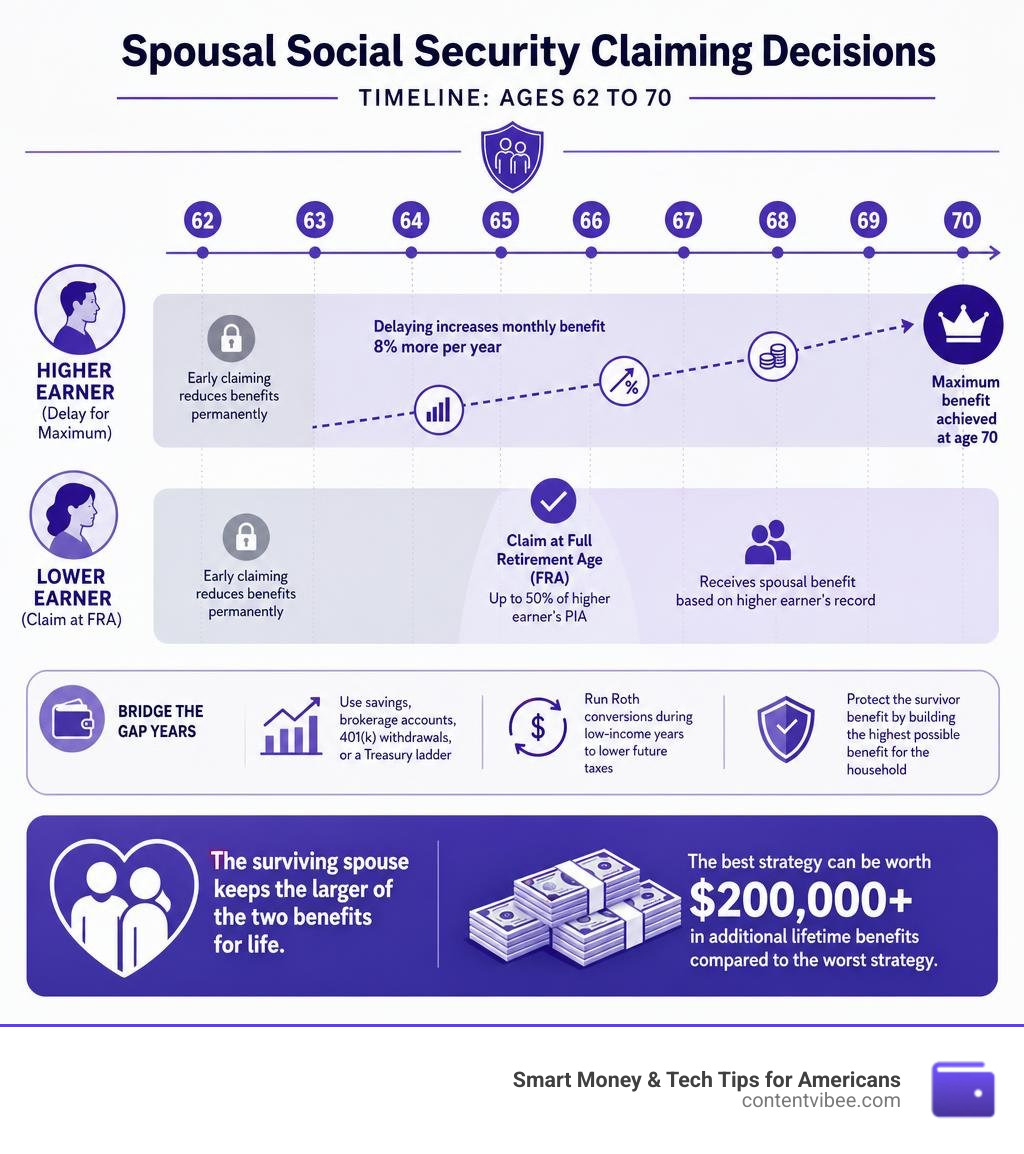
Here’s a quick snapshot of the top strategies to boost your combined lifetime benefits:
- Higher earner delays to age 70 — earns 8% more per year in delayed credits, and locks in a larger survivor benefit for life
- Lower earner claims at Full Retirement Age (FRA) — gets up to 50% of the higher earner’s Primary Insurance Amount (PIA) without a permanent reduction
- Bridge the income gap — use taxable brokerage accounts, 401(k) withdrawals, or a Treasury ladder to cover living expenses while the higher earner waits
- Run Roth conversions during the gap years — low income before Social Security starts = lower tax brackets = major long-term savings
- Protect the survivor benefit — the surviving spouse keeps the larger of the two benefits for the rest of their life, so the higher earner’s claiming age matters enormously
The gap between the best and worst claiming strategy for a typical couple can easily exceed $200,000 in lifetime benefits. And yet most couples file based on fatigue or habit — not math.
This guide breaks down exactly how spousal Social Security benefits work, which strategies generate the most household income, and how to stress-test your plan against real-life variables like health, taxes, and longevity.
Explore more about maximize spouse retirement cash:
The Foundation of Spousal Benefits: How to Maximize Spouse Retirement Cash

Before we can build a masterpiece of a retirement plan, we have to understand the raw materials. Many people mistakenly believe that when you marry, your Social Security benefits simply merge, or that a lower-earning spouse is automatically entitled to half of whatever the higher earner brings home at any given moment. The reality is governed by a strict set of rules.
At its core, a spousal benefit allows a lower-earning or non-working spouse to claim a benefit based on their partner’s work record. Under the “50% rule,” the maximum spousal benefit a husband or wife can receive is exactly 50% of the higher-earning spouse’s Primary Insurance Amount (PIA).
However, to get that full 50%, the lower earner must wait until their own Full Retirement Age (FRA) to claim. If they claim early (as early as age 62), that 50% is permanently reduced.
Understanding these differences is crucial. To get a complete handle on who qualifies and when, check out The Ultimate Guide To Spousal Social Security Eligibility. Once you know you qualify, you can use specialized tools to Calculate Spouse Retirement Benefits to see what your household numbers look like.
To visualize how the timing of your claim permanently alters your spousal benefit, look at this breakdown:
| Claiming Age (Lower Earner) | Percentage of Higher Earner’s PIA | Permanent Reduction from Max |
|---|---|---|
| 62 | 32.5% to 35% | ~30% to 35% reduction |
| 63 | ~37.5% | ~25% reduction |
| 64 | ~41.7% | ~16.7% reduction |
| 65 | ~45.8% | ~8.3% reduction |
| 66 | ~50% (If FRA is 66) | 0% reduction |
| 67 (FRA for most) | 50% | 0% reduction |
Notice that delaying past FRA does not increase the spousal benefit. Unlike your own earned benefit, spousal benefits do not earn delayed retirement credits. Waiting until age 70 to claim a spousal benefit yields the exact same monthly check as claiming it at age 67.
How the Primary Insurance Amount (PIA) Helps Maximize Spouse Retirement Cash
Your Primary Insurance Amount (PIA) is the cornerstone of your Social Security strategy. It is the monthly benefit you are entitled to receive if you claim at your exact Full Retirement Age (FRA). For anyone born in 1960 or later, the FRA is 67.
When we talk about how to maximize spouse retirement cash, we must look at how the PIA of the higher earner dictates the spousal payout. If Spouse A has a PIA of $3,000 at age 67, and Spouse B has a PIA of only $800 based on their own work history, Spouse B’s potential spousal benefit is $1,500 (50% of $3,000).
Because $1,500 is significantly higher than Spouse B’s own $800 earned benefit, the Social Security Administration (SSA) will pay Spouse B their own $800 first, and then top it off with a $700 spousal supplement to reach the $1,500 total.
To dive deeper into this mathematical relationship and learn how to optimize these figures, read up on How to Maximize Your Spouse’s Social Security Benefits.
The Coordination Rules and Filing Order Requirements
Here is where many couples hit a major roadblock: coordination rules. Under the modern “deemed filing” laws, you cannot choose to claim only your spousal benefit while letting your own retirement benefit grow. When you apply for benefits, the SSA automatically “deems” you to be filing for both your own earned benefit and your spousal benefit, and they will pay you the higher of the two.
Furthermore, a lower-earning spouse cannot claim a spousal benefit until the higher-earning spouse has officially filed for their own retirement benefits.
This filing order requirement means if the higher earner wants to delay until age 70 to maximize their own check, the lower earner cannot collect a spousal benefit during those delay years. They can, however, claim their own smaller retirement benefit first at 62 or FRA, and then “step up” to the larger spousal benefit once the higher earner finally files at age 70.
Navigating this sequence requires precision, which is why understanding the process of Applying For Spousal Benefits is so critical to avoid leaving money on the table.
Strategic Claiming Scenarios for Unequal Earners

When one spouse has significantly higher lifetime earnings than the other, coordinating your claiming ages is the ultimate lever for building household wealth. If you both simply file at age 62 or even age 64 out of fatigue, you stand to lose massive sums of money.
By contrast, couples who coordinate their claiming strategies can increase their combined lifetime Social Security benefits by up to $200,000 compared to making suboptimal, uncoordinated decisions.
To learn more about how to structure these plans, check out the Social Security Strategies for Married Couples – Vanguard guide, and review The Smart Couples Guide To Social Security Strategies to see how these timelines fit together.
Why the Higher Earner Delaying to Age 70 is the Ultimate Strategy
If you remember only one rule from this entire guide, let it be this: the higher earner should delay claiming until age 70 whenever possible.
For every year the higher earner delays claiming past their FRA, their monthly benefit increases by a guaranteed 8% due to delayed retirement credits. This compounds to a 24% permanent boost if they delay from age 67 to 70.
Let’s look at the math for a couple where the higher earner has a PIA of $2,800 and the lower earner has a PIA of $800.
- Scenario A (Suboptimal): Both claim immediately at age 62. The higher earner’s check is slashed to $1,960 (a 30% cut). The lower earner’s spousal benefit is also deeply cut. Combined, they receive a heavily reduced household income for life.
- Scenario B (Optimized): The higher earner delays to age 70, pushing their monthly check to $3,472 (124% of their PIA). Meanwhile, the lower earner claims their spousal benefit at FRA (age 67), securing a full 50% spousal check of $1,400.
This optimized strategy generates $1,932 more per month ($23,184 more per year) than if they had both claimed early at 62. Over a 20- to 30-year retirement, this single decision adds hundreds of thousands of dollars in pure cash to the household. To find out if this timeline fits your personal retirement window, check out our guide on the Best Age To Collect Ss.
How the Lower Earner’s Timing Impacts the Household
While the higher earner is delaying to age 70, when should the lower earner claim?
Because the spousal benefit maxes out at the lower earner’s FRA, there is absolutely no incentive for the lower-earning spouse to wait past age 67 to claim a spousal benefit.
However, if the lower earner claims early at age 62, their spousal benefit is hit with a permanent reduction of up to 30% to 35%. While claiming early might provide needed cash flow to help the higher earner delay, you must weigh that short-term cash against the permanent reduction of the lower earner’s benefit.
To calculate the exact age-based trade-offs for your household, refer to At What Age Can I Claim My Spouses Social Security.
Protecting the Survivor Benefit: The Long-Term Play
Many couples make the critical mistake of planning only for their joint life expectancy. They look at a break-even calculator and say, “Well, if we don’t live past 80, delaying to 70 doesn’t make sense.”
This represents a dangerous misunderstanding of how survivor benefits work.
When one spouse passes away, the surviving spouse does not get to keep both Social Security checks. Instead, the smaller check disappears, and the survivor is left with only the larger of the two benefits. This means the higher earner’s claiming age doesn’t just dictate their own retirement income—it permanently sets the floor for the surviving spouse’s standard of living.
For a comprehensive breakdown of these rules, read What You Need To Know About Spousal Survivor Benefits and consult the Social Security tips for couples | Fidelity resource.
Why Protecting the Larger Benefit is Critical for Longevity
Because women statistically outlive men, and couples often have age gaps, the higher earner delaying to age 70 is primarily a protective insurance policy for the surviving spouse.
Delaying the higher-earning spouse’s claim to age 70 can add approximately $311,000 to a surviving spouse’s lifetime household income.
If the higher earner claims early at 62 and dies at 75, they leave their surviving spouse with a permanently stunted survivor benefit for the rest of their life. If the higher earner instead waits until 70, they lock in a maximum, inflation-adjusted benefit that will support the survivor even if they live to 95 or 100.
To understand how to execute this transfer of benefits smoothly when the time comes, review our guide on how to Claim Deceased Spouse Benefits.
When Health and Longevity Dictate a Different Strategy to Maximize Spouse Retirement Cash
While delaying to age 70 is the golden rule, there are specific circumstances where couples should throw this rule out the window.
If both spouses have severe, chronic health conditions and a family history of short lifespans, claiming early may indeed maximize their lifetime household payout. If neither spouse is likely to live past age 75, then both claiming at age 62 or 64 makes mathematical sense.
However, you must stress-test your plan. If only one spouse is in poor health, the higher earner should still delay to 70 if the other spouse is healthy and expected to live a long life. The healthy spouse will eventually inherit that maximized survivor benefit.
To run these complex, joint life expectancy scenarios and stress-test your own plan, use our Timing Is Everything The Best Age To Take Social Security Calculator Guide.
Bridging the Income Gap and Tax-Planning Opportunities
If you are convinced that the higher earner should delay claiming until age 70, you are left with a very practical question: How do we pay our bills in the meantime?
If you retire at age 62 or 65, but wait until 70 to claim your maximum Social Security, you face several “gap years” with little or no guaranteed income. Bridging this gap requires a deliberate asset-coordination strategy.
To see how top financial planners coordinate these assets, check out Spousal Benefits: An Often Overlooked Key to Maximizing Social ….
Funding the Gap Years with Smart Asset Location
Instead of pulling proportionally from all of your accounts, or claiming Social Security early out of fear, you can fund your gap years using a highly targeted withdrawal sequence:
- Taxable Brokerage Accounts First: Prioritize drawing down your taxable brokerage accounts. This allows your traditional 401(k) and IRA assets to continue compounding tax-deferred, and capital gains are taxed at lower rates (0% or 15% for most joint filers) compared to ordinary income rates.
- Capping Brokerage Withdrawals: For a 60-year-old couple with $2.8 million in retirement savings (e.g., $1.6M in 401(k)s, $400K in Roths, and $800K in taxable brokerage), they can easily bridge 8 years to Social Security at age 70 by capping brokerage withdrawals at $35,000 to $40,000 annually. This preserves the bulk of their tax-advantaged accounts while avoiding sequence-of-returns risk.
- Building a Treasury Ladder: To secure guaranteed, risk-free cash flow during these bridge years, you can construct a five-year Treasury ladder. With yields holding strong, locking in a predictable stream of income from maturing short-term Treasuries ensures you won’t have to sell equities during a market downturn.
Tax-Planning and Roth Conversions in the Low-Income Window
These gap years before Social Security begins aren’t just an income hurdle — they are a massive tax-planning playground.
Because your taxable income is exceptionally low during these years, you have a golden opportunity to execute Roth conversions. By converting traditional 401(k) or IRA funds into a Roth IRA, you pay taxes on those dollars at today’s historically low tax brackets (such as the 10% or 12% brackets).
Once those funds are inside the Roth, they grow tax-free, have no Required Minimum Distributions (RMDs), and can be withdrawn tax-free later in life.
Furthermore, keeping your income low during these years helps you manage provisional income (the formula the IRS uses to determine if your Social Security benefits are taxed) and prevents you from triggering expensive Medicare IRMAA surcharges later on.
As of June 2026, the first IRMAA threshold for joint filers sits at $218,000. Executing smart Roth conversions now keeps your future RMDs small enough to stay safely below these tax and premium cliffs.
Frequently Asked Questions about Spousal Benefits
Can a married couple both collect Social Security at the same time?
Yes, absolutely! There is no “marriage penalty” when it comes to collecting Social Security. Both spouses can collect their own individual retirement benefits simultaneously if they both have sufficient work history (at least 40 work credits).
In fact, the maximum Social Security benefit for a married couple both retiring at age 70 in 2026 is $10,860 per month ($130,320 per year) before taxes.
If one spouse qualifies for a higher spousal benefit than their own earned benefit, they will receive a combination of both, up to the maximum spousal amount. To explore how dual-benefit rules apply to your household, check out Can A Married Couple Both Collect Social Security.
How do non-covered government pensions affect spousal benefits?
If you receive a pension from a government job (like a public school teacher or police officer) where you did not pay Social Security taxes, your spousal and survivor benefits may be severely reduced or eliminated. This is due to two federal provisions:
- The Government Pension Offset (GPO): This reduces your spousal or survivor benefit by two-thirds of the amount of your government pension. If your government pension is $3,000 a month, your spousal benefit is reduced by $2,000. If your spousal benefit was only $1,500, it is wiped out entirely.
- The Windfall Elimination Provision (WEP): This modifies the formula used to calculate your own retirement benefit if you also have a non-covered pension, though it does not directly slash spousal benefits.
If you or your spouse has a public pension, you must factor the GPO and WEP into your coordination plans, as standard spousal benefit calculations will not apply.
What tools should we use to model our joint-claiming strategy?
You should never guess when it comes to a six-figure retirement decision. We highly recommend using a combination of the following tools:
- SSA.gov (My Social Security): Both spouses must create accounts to pull their official Primary Insurance Amount (PIA) and work history statements.
- OpenSocialSecurity.com: This free, open-source calculator is exceptionally powerful for married couples. It runs mathematical models to show you the exact claiming ages that will maximize your combined lifetime household benefits.
- MaxiFi or specialized planning software: To coordinate your Social Security claiming with your 401(k) withdrawals, tax brackets, and Roth conversions.
For a detailed review of the best digital modeling tools available, see our guide on how to Do The Math Top Social Security Calculators For Married Couples.
Conclusion
At Smart Money & Tech Tips for Americans, we believe that maximizing your hard-earned wealth shouldn’t require a PhD in mathematics. Coordinating your Social Security claiming strategy is one of the most reliable ways to secure your household’s financial future and protect your spouse from long-term longevity risk.
By having the higher earner delay to age 70, coordinating the lower earner’s claim at FRA, and using smart asset location to bridge the gap years, you can lock in a secure, inflation-protected stream of income that lasts as long as you both shall live.
Are you ready to build your customized claiming plan? Take your first step today by reviewing The Golden Rules Can A Spouse Collect Ss Spousal Benefits to ensure your household doesn’t leave a single dollar on the table.