


Why Timing Matters for Social Security Spousal Benefits Before Full Retirement Age
Understanding social security spousal benefits before full retirement age can mean the difference between a comfortable retirement and leaving thousands of dollars unclaimed — or permanently reduced.
Quick Answer: Key Facts About Early Spousal Benefits
| Question | Answer |
|---|---|
| Earliest age to claim | 62 (or any age if caring for a qualifying child) |
| Maximum spousal benefit at FRA | Up to 50% of worker’s primary insurance amount (PIA) |
| Benefit at age 62 (FRA 67) | As low as 32.5% of worker’s PIA — a 35% reduction |
| Benefit at age 62 (FRA 66) | 35% of worker’s PIA |
| Does delaying past FRA increase spousal benefits? | No — spousal benefits do not earn delayed retirement credits |
| Can you claim spousal benefits only? | Not if born after January 1, 1954 — deemed filing applies |
More than 2 million Americans collect spousal retirement benefits, yet many couples claim too early without realizing the permanent cost.
Claiming even one year before your full retirement age locks in a lower monthly payment for life.
The rules around early claiming are surprisingly detailed. Reduction formulas, deemed filing rules, and the 2015 Bipartisan Budget Act all shape what you can actually receive — and when. This guide walks you through everything you need to know before you file.
Eligibility for Social Security Spousal Benefits Before Full Retirement Age
Before we jump into the math of how early claiming shrinks your monthly check, let’s establish who actually qualifies to receive these benefits. The Social Security Administration (SSA) has strict gatekeeping rules, and understanding them is your first step toward a successful retirement strategy.
To begin with, what exactly is this benefit? As we explain in our comprehensive overview of What Is a Social Security Spousal Benefit?, it is a monthly payment designed to support a spouse who may have had lower lifetime earnings or spent time out of the workforce to care for family.
To qualify for social security spousal benefits before full retirement age, you must meet several core criteria:
- Age Requirement: You must be at least 62 years old to claim. However, there is a major exception: if you are caring for a child of the primary worker who is under age 16 or disabled, the age 62 minimum is waived.
- Marriage Duration: You must generally be married to the primary worker for at least one continuous year before applying. For more details on these legal parameters, you can review the official policy guidelines in SSA – POMS: RS 00202.001 – Definitions and Requirements for Spouse Benefits – 07/24/2017.
- Primary Worker Status: Your spouse must already be actively receiving their own retirement or disability benefits for you to collect a spousal benefit on their record.
But what if you are no longer married? There is good news here. You may still be eligible to claim on your former partner’s work record. As we detail in our guide on Can Divorced Spouse Get Social Security Benefits?, you must have been married for at least 10 years, be currently unmarried, and be at least age 62. The beauty of the divorced spouse rule is that your ex-spouse does not even need to be collecting their own benefit yet, as long as you have been divorced for at least two consecutive years.
To dive deeper into these rules, check out the SSA’s official blog post on Do You Qualify for Social Security Spouse’s Benefits? | Social Security Matters | SSA.
How Early Claiming Reduces Your Monthly Payout
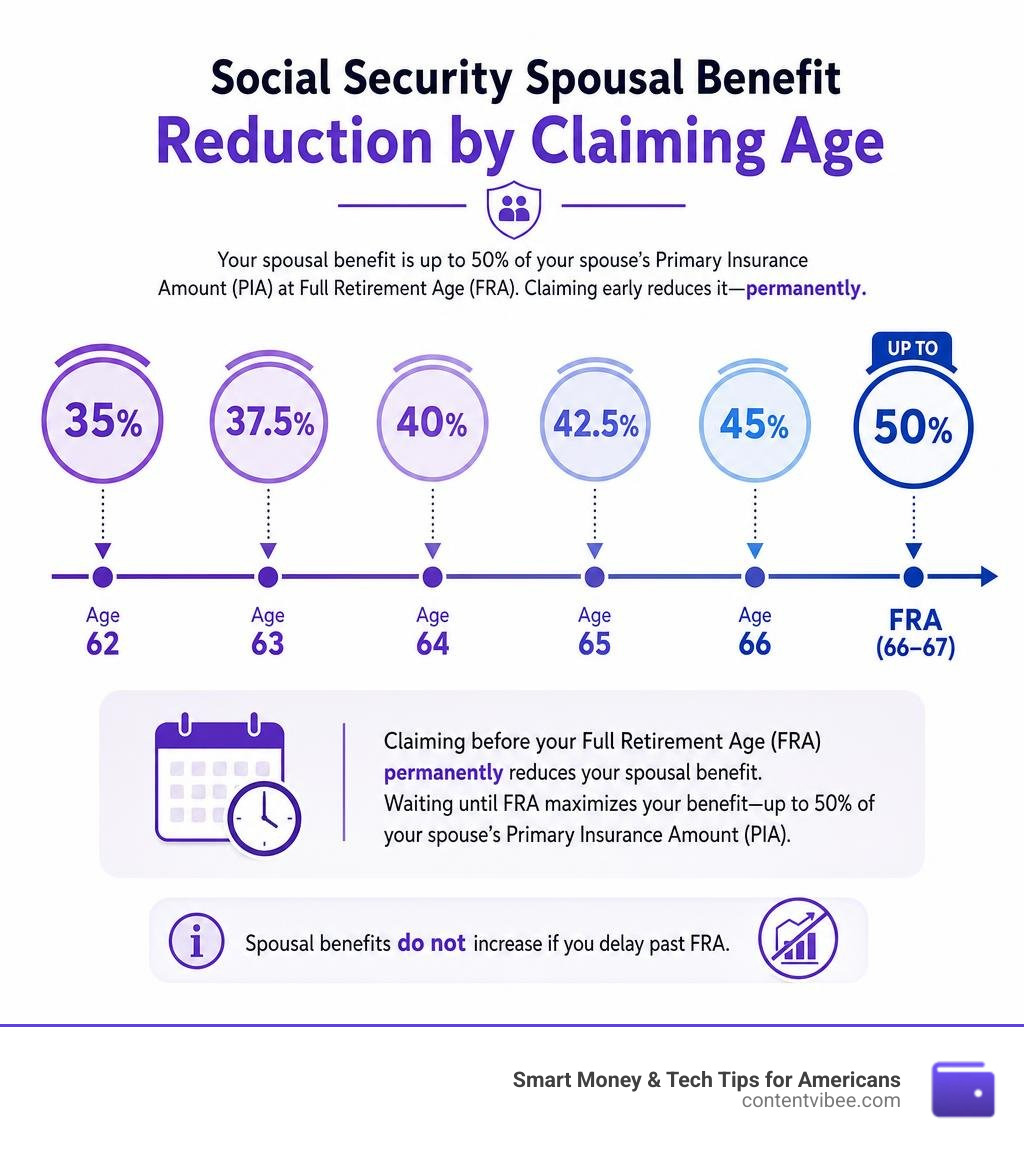
If you decide to claim your spousal benefit before reaching your Full Retirement Age (FRA)—which is 67 for anyone born in 1960 or later—your monthly payout will be permanently reduced.
At your FRA, the maximum spousal benefit you can receive is exactly 50% of your partner’s Primary Insurance Amount (PIA). The PIA is the amount your spouse is eligible to receive at their own FRA. If you claim early, the SSA applies a monthly reduction formula that permanently chips away at that 50% cap.
The table below highlights how much your spousal benefit is reduced compared to your personal retirement benefit depending on the age you choose to claim (assuming an FRA of 67):
| Claiming Age | Spousal Benefit Reduction | Personal Benefit Reduction | Spousal Benefit as % of Partner’s PIA |
|---|---|---|---|
| 67 (FRA) | 0% | 0% | 50.0% |
| 66 | 8.33% | 6.67% | 45.8% |
| 65 | 16.67% | 13.33% | 41.7% |
| 64 | 25.00% | 20.00% | 37.5% |
| 63 | 30.00% | 25.00% | 35.0% |
| 62 | 35.00% | 30.00% | 32.5% |
Notice something important here? The penalty for claiming spousal benefits early is actually steeper than the penalty for claiming your personal retirement benefits early. For example, claiming at age 62 reduces your personal benefit by 30%, but it slashes your spousal benefit by a whopping 35%.
To find out exactly when you reach your unreduced benefit age, take a look at our quick guide on How to Calculate Your Spousal Retirement Age Easily. You can also read the SSA’s direct breakdown of these reductions on the Retirement Age and Benefit Reduction – Social Security Administration page.
Calculating the Reduction for Social Security Spousal Benefits Before Full Retirement Age
So, how exactly does the SSA calculate this reduction? They use a two-tiered monthly reduction formula:
- The 36-Month Rule: For the first 36 months before your FRA, your spousal benefit is reduced by 25/36 of 1% for each month you claim early.
- Beyond 36 Months: For any additional months beyond 36 (up to a maximum of 60 months if you claim at age 62), the benefit is reduced by an additional 5/12 of 1% per month.
Let’s look at a real-world example to see this math in action. Suppose your husband’s PIA at his FRA is $2,000. Under normal circumstances, your maximum spousal benefit at your FRA would be $1,000 (50% of $2,000).
If your FRA is 67 and you choose to claim your spousal benefit at exactly age 62, you are claiming 60 months early.
- For the first 36 months: 36 months × (25/36 of 1%) = 25% reduction.
- For the remaining 24 months: 24 months × (5/12 of 1%) = 10% reduction.
- Total Reduction: 25% + 10% = 35% reduction.
Instead of receiving $1,000 a month, your spousal benefit is reduced by $350, leaving you with a permanent monthly payment of $650 (which is 32.5% of his $2,000 PIA).
To run these numbers based on your own unique situation, you can use our interactive Social Security Spousal Benefit Calculator.
The Impact of Deemed Filing and the 2015 Bipartisan Budget Act

In the past, couples used clever loopholes to maximize their lifetime benefits. A popular method was the “restricted application” strategy, where a spouse at FRA would file for spousal benefits only, allowing their own personal retirement benefit to accumulate delayed retirement credits (an 8% increase per year) up to age 70.
However, the Bipartisan Budget Act of 2015 completely changed the landscape. It permanently closed these loopholes for anyone who turned 62 after January 1, 1954. To understand the official parameters of these changes, you can read the SSA’s guide on Benefits for Spouses.
How Deemed Filing Affects Social Security Spousal Benefits Before Full Retirement Age
The primary mechanism that eliminated these loopholes is called deemed filing.
Under deemed filing rules, when you apply for either your personal retirement benefit or your spousal benefit, you are “deemed” to have applied for both simultaneously. The SSA will calculate both benefit amounts and pay you your personal retirement benefit first. If your spousal benefit is higher than your personal benefit, they will add an extra spousal top-up to make up the difference.
For example, let’s say you qualify for a personal retirement benefit of $800, but your spousal benefit is worth $1,100. If you file, you will not receive both checks. Instead, you will receive your $800 personal benefit plus a $300 spousal top-up, giving you a total of $1,100.
Because of deemed filing, you can no longer choose to claim only the spousal benefit while letting your own benefit grow. This makes strategic timing more critical than ever. For a deeper dive into coordinating these decisions, check out The Smart Couple’s Guide to Social Security Strategies.
Exceptions to Deemed Filing Rules
While deemed filing applies to the vast majority of retirees in 2026, there are three important exceptions where you are not forced to file for both benefits at once:
- Caring for a Child in Care: If you are receiving spousal benefits because you have a qualifying child (under age 16 or disabled) in your care, deemed filing does not apply.
- Disability Benefits: If you are entitled to Social Security Disability Insurance (SSDI) and receive spousal benefits, you are exempt from deemed filing rules.
- Survivor Benefits: Deemed filing does not apply to survivor benefits. If your spouse passes away, you can choose to claim survivor benefits early while letting your own retirement benefit grow untouched until age 70, or vice versa.
Coordinated Claiming Strategies and Survivor Benefits
Now that you know the rules, how do you use them to your advantage? Coordinated timing is one of the most powerful tools married couples have to secure their financial future.
A highly effective approach is the split strategy. In this scenario, the lower-earning spouse claims their benefit early (often at age 62) to bring immediate income into the household. Meanwhile, the higher-earning spouse delays claiming their own benefit until age 70.
This strategy offers two major advantages:
- It allows the higher earner’s benefit to grow by 8% per year past their FRA, maximizing the primary monthly check.
- It secures a much larger safety net for the surviving spouse.
When one spouse passes away, the survivor is entitled to up to 100% of the deceased worker’s monthly benefit if the survivor has reached their own FRA. By delaying the higher earner’s claim to age 70, you are permanently maximizing the survivor benefit for whichever spouse outlives the other.
That early claiming reductions also impact survivor benefits. If you claim survivor benefits before your own FRA (you can claim them as early as age 60), the monthly survivor payout will be permanently reduced.
How to Apply for Early Spousal Benefits
Ready to take the next step? Applying for social security spousal benefits before full retirement age is a straightforward process, but you will need to gather the correct documentation to avoid processing delays.
We have put together a step-by-step walkthrough in our guide on Applying for Spousal Benefits. Generally, the easiest way to apply is online through the official SSA website.
To complete your application (often referred to as Form SSA-2), you will need to provide:
- Your Social Security number and your spouse’s Social Security number.
- Your birth certificate.
- Your marriage certificate (and divorce papers, if claiming as a divorced spouse).
- Your bank routing and account numbers for direct deposit.
- Recent W-2 forms or self-employment tax returns.
For a detailed digital roadmap on navigating the online system, see Your Digital Guide to Form SSA-2 and Online Spousal Claims. You can also review the exact payment rules in the official SSA – POMS: RS 00202.020 – Spouse’s Benefits – Payment – 01/20/2026 manual.
Frequently Asked Questions about Early Spousal Benefits
Can I claim spousal benefits if my spouse hasn’t filed yet?
No. If you are currently married, you cannot collect a spousal benefit on your partner’s record until they have actively filed for their own retirement or disability benefits.
The only exception to this rule is for divorced spouses. If you have been divorced for at least two consecutive years, you can claim spousal benefits even if your ex-spouse has not filed yet, provided they are eligible to receive benefits (at least age 62) and you meet the other divorce eligibility criteria.
Do spousal benefits earn delayed retirement credits?
No, they do not. While your personal retirement benefits grow by 8% each year you delay claiming past your FRA (up to age 70), spousal benefits hit a strict ceiling at your FRA.
Because spousal benefits do not earn delayed retirement credits, there is absolutely no financial advantage to waiting past your FRA to claim them. If you are planning to collect a spousal benefit, you should file no later than your FRA.
How does working affect early spousal benefits?
If you plan to work while receiving early spousal benefits, you must keep the Retirement Earnings Test in mind.
If you are under your FRA for the entire year, the SSA sets an annual earnings limit. If you earn more than this limit, they will temporarily withhold $1 from your benefits for every $2 you earn above the threshold. Once you reach your FRA, the SSA will recalculate your monthly payment upward to account for the benefits that were withheld.
For a complete breakdown of how this works, take a look at our article on Working in Retirement: Are Spousal Benefits Reduced by Working?.
Conclusion
At Smart Money & Tech Tips for Americans, we believe that navigating your retirement should not feel like decoding a foreign language. Coordinated financial planning is the key to unlocking the full potential of your hard-earned Social Security benefits.
Claiming social security spousal benefits before full retirement age is a highly personal decision. While claiming early at age 62 provides immediate cash flow, it comes at the cost of a permanent 35% reduction in your monthly payout. By understanding the rules of deemed filing, early reduction percentages, and survivor benefits, you and your partner can build a strategy that maximizes your lifetime household wealth.
For more strategic guidance on securing your family’s financial future, explore our detailed pillar article: Claiming What’s Yours: A Guide to Deceased Spouse Social Security.


