


Why Most People Retire With Less Than They Should
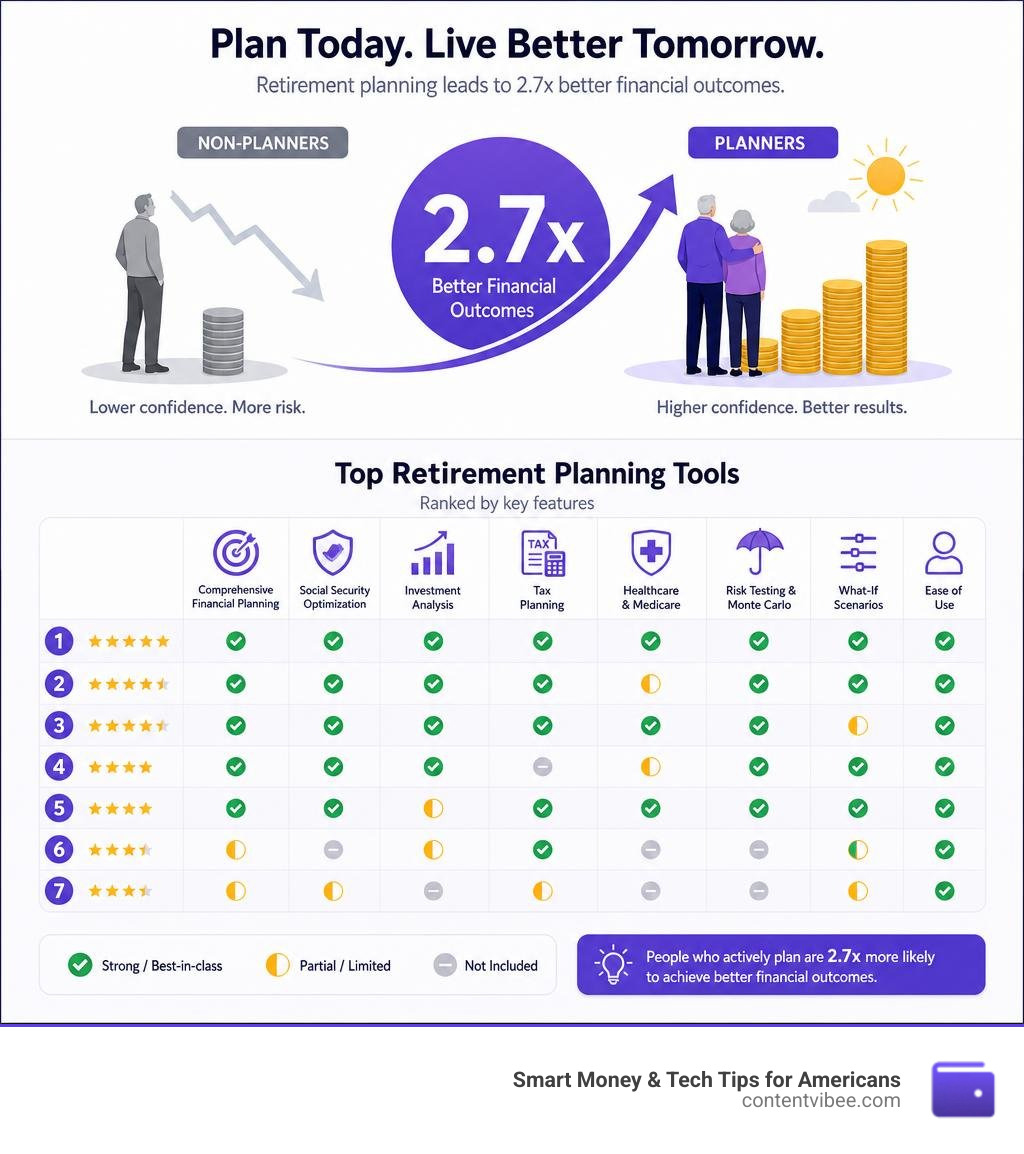
If you want a quick answer, here are the best retirement planning tools available right now:
- Boldin – Best all-in-one DIY planner with AI, taxes, Social Security, and healthcare
- ProjectionLab – Best for visual, detailed planning with Monte Carlo and backtesting
- WealthTrace – Best for holding-level investment accuracy and advisor use
- MaxiFi – Best for lifetime spending optimization and Social Security strategy
- Granary – Best for tax-transparent, low-cost planning with live what-if sliders
- Fidelity Tools – Best free calculator suite for Fidelity account holders
- Bullseye – Best free AI-powered year-by-year projection tool
Most people spend more time planning a vacation than planning their retirement. That’s a costly mistake.
Research shows that people who actively plan do 2.7 times better financially than those who don’t. And those who plan are 54% more likely to live comfortably in retirement. The gap between planners and non-planners isn’t luck — it’s information.
The problem? Most people don’t know where to start.
A quick Google search turns up dozens of retirement calculators. Some are free. Some cost hundreds of dollars per year. Some are buried inside brokerage websites. And almost none of them explain what’s actually going on under the hood.
You type in your savings, pick an expected return, and get back a single number — like “$1.2 million by age 65.” But that number doesn’t tell you:
- How much you’ll owe in taxes each year
- When to claim Social Security for maximum lifetime income
- What happens to your plan if the market drops 35% early in retirement
- How Medicare costs and IRMAA surcharges will hit your cash flow
That’s the gap modern retirement planning software is designed to fill. And in this guide, we cut through the noise and show you exactly which tools are worth your time — and which ones to skip.
Why Traditional Calculators Fail and How Modern Software Helps

For decades, the standard approach to retirement planning was simple: open up a spreadsheet, enter a flat 6% or 7% annual return, assume a 3% inflation rate, and apply a generic “4% rule” for withdrawals.
While that looks neat on paper, real life is rarely linear. Traditional, static retirement calculators fail because they treat your financial future as a single, unchanging average. They ignore the sequence of returns risk—the very real danger that a market crash in your first few years of retirement could permanently deplete your portfolio, even if the long-term historical average returns look great.
This is why we need to move past outdated tools. If you’ve ever asked yourself, Is The Dave Ramsey Investment Calculator Accurate, you quickly realize that oversimplified models often paint an unrealistically rosy picture. They ignore progressive taxes, bracket changes, and the complex mechanics of drawing down different accounts.
Modern retirement software solves this by replacing static assumptions with dynamic, year-by-year projections. Instead of lumping your net worth into one giant bucket, advanced planners model your assets across nine or more distinct account types, including Traditional 401(k)s, Roth IRAs, Health Savings Accounts (HSAs), and taxable brokerage accounts.
When you use a comprehensive Retirement Calculator Estimate Savings Needed, the software runs your plan through progressive tax brackets, calculates state-specific taxes, and factors in Required Minimum Distributions (RMDs) starting at age 73 or 75. This level of detail helps you transition from guessing to knowing. If you are new to this level of modeling, starting with a Beginners Guide To Retirement Calculator options can help you understand how these inputs interact to build a resilient financial plan.
Key Features to Prioritize in the Best Retirement Planning Tools
When evaluating the best retirement planning tools, it is easy to get overwhelmed by flashy user interfaces. However, the true value of any financial planning platform lies under the hood. To build a plan you can actually trust, you should prioritize tools that offer the following advanced features:
- Monte Carlo Simulations: Rather than assuming a flat market return, Monte Carlo engines run your plan through 1,000 to 5,000 randomized market sequences. This gives you a probability score (e.g., a “92% chance of success”) that reflects how your portfolio would survive historical volatility.
- Historical Backtesting: This feature allows you to test your exact portfolio and withdrawal strategy against real historical periods, such as the Great Depression, the 1970s stagflation era, or the 2008 financial crisis, using actual market data.
- Cash Flow Visualization: Look for tools that use clean visual aids like Sankey diagrams or stacked area charts. These let you see exactly how money flows from your various income sources, through taxes, and into your spending buckets year by year.
- Live “What-If” Scenarios: You want the ability to drag a slider to instantly see how retiring two years early, moving to a lower-tax state, or buying a second home impacts your lifetime solvency.
To help you decide between a quick, free option and a comprehensive paid platform, we rely on a structured framework. Many of the tools I rely on for retirement planning fall into these categories, and you can compare their core differences below:
| Feature | Free Online Calculators | Premium DIY Software ($39 – $120/yr) | Advisor-Level Platforms ($150+/yr) |
|---|---|---|---|
| Tax Modeling | Flat rate assumptions only | Progressive federal & state brackets | Highly detailed, includes bracket-filling |
| Account Aggregation | Manual entry only | Secure bank/brokerage linking | Automated feeds with holding-level tracking |
| Simulation Types | Simple linear projection | Monte Carlo & backtesting | Multi-scenario stress testing |
| Social Security | Simple estimate inputs | Claiming age optimization | Advanced spousal & survivor modeling |
| Data Privacy | High ad presence, data sold | Encrypted, private, exportable | Professional compliance standards |
To find the right balance for your budget, you can also explore our interactive finance calculator to test basic assumptions before investing in premium software.
Advanced Tax Modeling and Roth Conversions
Taxes are often the single largest expense you will face in retirement, yet they are the most frequently ignored factor in basic planning. A truly tax-aware retirement planner does not just assume a flat 15% or 20% tax rate. It models progressive federal income brackets, capital gains tax stacking, and state-specific tax rules.
For example, during your peak earning years, you might maximize your pre-tax accounts. Understanding how to optimize these contributions is key, as outlined in our guide: Dont Leave Money On The Table The Ultimate 401K Max Calculator Guide.
Once you retire, the goal shifts to tax-efficient drawdown. The best tools help you identify the “tax valley”—the low-income window between your retirement date and the start of RMDs and Social Security. During these years, you can execute strategic Roth conversions, moving money from traditional accounts to Roth accounts at lower tax brackets. Modern platforms model this year-by-year, showing you exactly how much lifetime tax you can save by filling up lower tax brackets before your RMD obligations kick in.
Social Security Optimization and Claiming Strategies
Deciding when to claim Social Security is a multi-thousand-dollar decision. For every year you delay claiming past your Full Retirement Age (FRA) up to age 70, your benefit increases by roughly 8%. Claiming at age 62 versus age 70 can result in a massive difference in lifetime benefits—often exceeding $300,000 for couples.
To get the most out of your benefits, check out The Ultimate Guide To Social Security Benefit Optimization. The best retirement planning tools calculate these trade-offs automatically. They analyze your provisional income to estimate how much of your Social Security benefit will be subject to income tax (using IRS thresholds that are famously not adjusted for inflation).
If you want to run quick comparisons without paying for premium software, you can leverage some of the Best Free Social Security Calculator Options Your No Cost Retirement Roadmap to map out your claiming strategy.
Evaluating the Best Retirement Planning Tools by Category
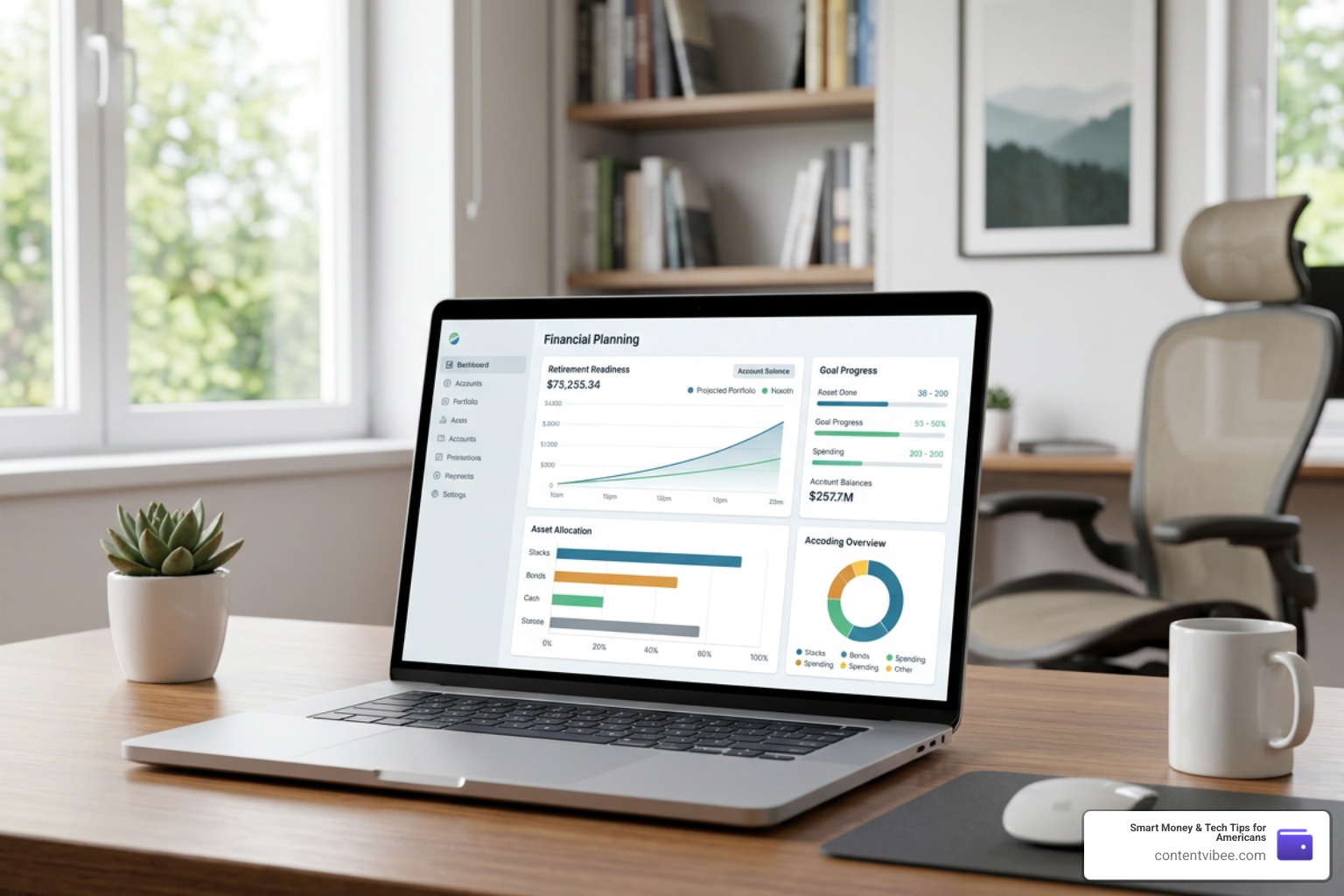
No single retirement tool is perfect for everyone. A DIY investor who loves spreadsheets has very different needs compared to a pre-retiree who wants a guided, AI-driven experience. Let’s break down the leading platforms by how they fit your planning style.
Comprehensive DIY Software for Hands-On Planners Using the Best Retirement Planning Tools
For those who want complete control over their financial plan, comprehensive DIY platforms offer professional-grade features without the high advisor fees.
Boldin (Formerly NewRetirement)
Boldin: DIY Retirement & Financial Planning Software is widely regarded as one of the most comprehensive tools on the market. It takes a panoramic approach to financial wellness, looking far beyond simple savings and investments.
- Core Features: Boldin models real estate equity, future home down-sizing, medical expenses, Medicare premiums, and long-term care scenarios.
- AI Integration: It features an intuitive AI assistant that allows you to ask questions in plain language (e.g., “What happens if I retire at 63 instead of 65?”) and receive personalized answers based on your data.
- User Impact: According to their data, 70% of Boldin customers are more likely to grow their net worth, and planners feel significantly more in control of their money.
ProjectionLab
Created by a developer frustrated by the lack of flexible, visual tools, ProjectionLab has quickly become a favorite for the financial independence, retire early (FIRE) community.
- Core Features: It offers stunning visual cash-flow diagrams (Sankey charts), milestone tracking, and highly customizable decision trees.
- Nuanced Planning: You can build multi-phase plans with highly specific income and expense rules, model international tax presets (including the US, Canada, UK, and Australia), and run advanced historical backtesting.
- Cost: ProjectionLab offers a free tier for basic planning, a Premium tier at $9/month, and a Lifetime license for $799 that includes offline access and advanced encryption.
WealthTrace
If you want professional-grade software that leaves no stone unturned, Retirement Planning Software | Financial Planning Software is a powerful choice.
- Core Features: It is the only retail retirement planning software that models each individual investment holding for accurate projections, rather than relying on generic asset class averages.
- Advisor-Grade Engine: WealthTrace is highly trusted by financial planners and individuals alike because it accounts for progressive tax codes, RMDs, and complex pension structures with extreme mathematical fidelity.
MaxiFi Planner
Built on the principles of economics rather than traditional finance, MaxiFi was developed by renowned Boston University economist Laurence Kotlikoff.
- Core Features: Instead of asking you to guess your future spending, MaxiFi uses advanced algorithms to calculate your “living standard.” It then builds a lifetime annual budget designed to maintain that standard of living for life.
- Optimization: It automatically identifies the most tax-efficient withdrawal sequences and maximizes your Social Security claiming strategy to unlock tens of thousands of dollars in “found money.”
AI-Powered and Interactive What-If Planners: The Best Retirement Planning Tools for Dynamic Modeling
If you prefer a lighter, more interactive approach that focuses on real-time feedback and behavioral guidance, these modern tools excel at dynamic modeling.
Granary
Granary is a modern, low-cost, tax-aware retirement planner designed for people who want transparency without black-box math.
- Core Features: It features live “what-if” sliders that instantly update your projections as you drag your retirement age, savings rate, or spending targets.
- Formula Transparency: You can click on any number on your dashboard to reveal the exact mathematical formula and tax rules used to calculate it.
- Cost & Value: At just $39/year, Granary is highly affordable, models 2026 tax tables, and supports advanced withdrawal strategies like “Bracket Fill” and “IRMAA Shield” to protect your cash flow.
Bullseye Retirement Planning
Bullseye is a completely free, AI-powered retirement planner that offers year-by-year projections without premium paywalls or account creation.
- Core Features: It excels at modeling the complex interactions between taxes, Social Security, and Medicare premiums.
- Interactive Scenarios: Bullseye helps couples model coordinated Social Security claiming strategies and stress-test their portfolios against sudden 2008-style market drops.
PivotReset (Retirement Financial Decision Support Engine)
PivotReset takes a unique, behavioral-science approach to retirement planning. Recognizing that financial planning is highly emotional, it integrates cognitive bias detection and psychological check-ins.
- Core Features: Before you run a simulation, the tool guides you through a 15-second breathing exercise to activate your prefrontal cortex. It then scans your inputs for “Present Bias” (the tendency to claim Social Security early for immediate satisfaction at the expense of long-term wealth) and provides a personalized 90-day action plan.
Managing Complex Scenarios: Early Retirement, Healthcare, and Withdrawals
As you get closer to retirement, your planning must become more granular. General rules of thumb no longer suffice when you are managing complex, real-world variables.
If you are planning for early retirement (the FIRE movement), traditional age-based rules do not apply. You must carefully navigate early withdrawal penalties, construct Roth conversion ladders, or utilize Section 72(t) Substantially Equal Periodic Payments (SEPP) to access your retirement accounts without penalty. Understanding how to manage these early drawdowns is essential, and tools like ProjectionLab and Boldin are specifically built to model these multi-phase income streams. To see how your safe withdrawal rates hold up over a 40- or 50-year retirement, you can read our breakdown in Demystifying The 4 Percent Retirement Withdrawal Calculator.
Furthermore, healthcare is often the most underestimated cost in retirement. If you retire before age 65, you must bridge the healthcare gap before Medicare eligibility. This means modeling Affordable Care Act (ACA) premium tax credits, which require keeping your taxable income within very specific limits.
Once you reach age 65, Medicare premium planning becomes critical. High-income earners face Income-Related Monthly Adjustment Amount (IRMAA) surcharges, which are steep cliffs that spike your Medicare Part B and Part D premiums if your modified adjusted gross income (MAGI) crosses certain thresholds by even a single dollar. The best retirement planning software models these IRMAA brackets year-by-year, allowing you to adjust your withdrawal sequence to stay just under the cliffs.
For those planning to work past traditional retirement age, coordinating these benefits with active employment income adds another layer of complexity. If this matches your path, check out The Ultimate Guide To Working Past 65 And Beyond to see how active income interacts with Medicare and Social Security rules.
Frequently Asked Questions about Retirement Planning Software
How accurate are free retirement calculators?
Most free online retirement calculators are dangerously oversimplified. They typically group all your assets into a single balance, apply a flat, linear investment return, and assume a fixed tax rate throughout your retirement.
In reality, these tools miss the critical interactions that dictate your actual financial success. They ignore progressive tax brackets, capital gains tax stacking, RMDs, and Medicare IRMAA cliffs. For a simple projection, a free tool can give you a rough starting point. However, relying on them for major decisions can lead to expensive mistakes, such as underestimating your retirement tax bill or claiming Social Security at an sub-optimal age.
If you prefer a hands-off, simple approach but still want to build a reliable foundation, we recommend checking out the Best Autopilot Investing Strategies For Beginners Who Hate Math to keep your accumulation phase on track.
How do retirement tools handle data privacy and security?
Because retirement planning requires entering highly sensitive financial data, privacy and security are paramount. Modern tools handle this in a few different ways:
- Browser-Based Local Storage: Tools like ProjectionLab (with its offline mode) and some free FIRE planners store your data directly in your browser’s local storage. No data is ever sent to an external server, and no account signup is required.
- Bank-Level Encryption: Cloud-based platforms like Boldin and WealthTrace use bank-level AES-256 encryption to protect your data in transit and at rest.
- No Screen-Scraping: Many modern tools avoid traditional screen-scraping and instead use secure, read-only aggregators like Plaid to link accounts, meaning they never see or store your login credentials.
- Full Data Export: Look for tools that allow you to export your entire plan as a JSON or CSV file at any time, giving you complete ownership of your data.
When should I transition from a DIY tool to a professional advisor?
While modern software is incredibly powerful, there are times when human expertise is invaluable. You should consider transitioning to, or consulting with, a fee-only fiduciary financial advisor if:
- You have a highly complex estate: This includes owning multiple rental properties, managing business succession, or navigating complex equity compensation (like ISOs, NSOs, or RSUs).
- You need behavioral coaching: A software tool can show you the math, but it cannot stop you from panic-selling during a market downturn. An advisor acts as an emotional guardrail.
- You want a second opinion: Many DIY investors use software to build their baseline plan, then pay a flat-fee Certified Financial Planner (CFP) to review their assumptions and confirm their withdrawal strategy.
If you are looking at automated options to manage your investments while you focus on high-level planning, it is important to understand the associated costs. You can learn more about these structures in The Ultimate Guide To Robo Advisor Fees.
Conclusion
At ContentVibee, we believe that taking control of your financial future should not require a degree in finance or a complex, messy spreadsheet. The best retirement planning tools available in 2026 make it easier than ever to build a personalized, highly accurate roadmap to financial independence.
Whether you choose a comprehensive DIY platform like Boldin, a highly visual tool like ProjectionLab, or a free year-by-year planner like Bullseye, the key is to stop guessing and start modeling. By accounting for taxes, Social Security claiming ages, and healthcare costs, you can make smart money decisions today that secure your lifestyle tomorrow.
Ready to take the first step? Start exploring your numbers and test your retirement readiness with our easy-to-use, interactive finance calculator today.


