
Why Social Security Spousal Rules Matter More Than Most People Realize
Understanding Social Security spousal rules is one of the most important steps you can take before claiming retirement benefits — and one of the most commonly skipped.
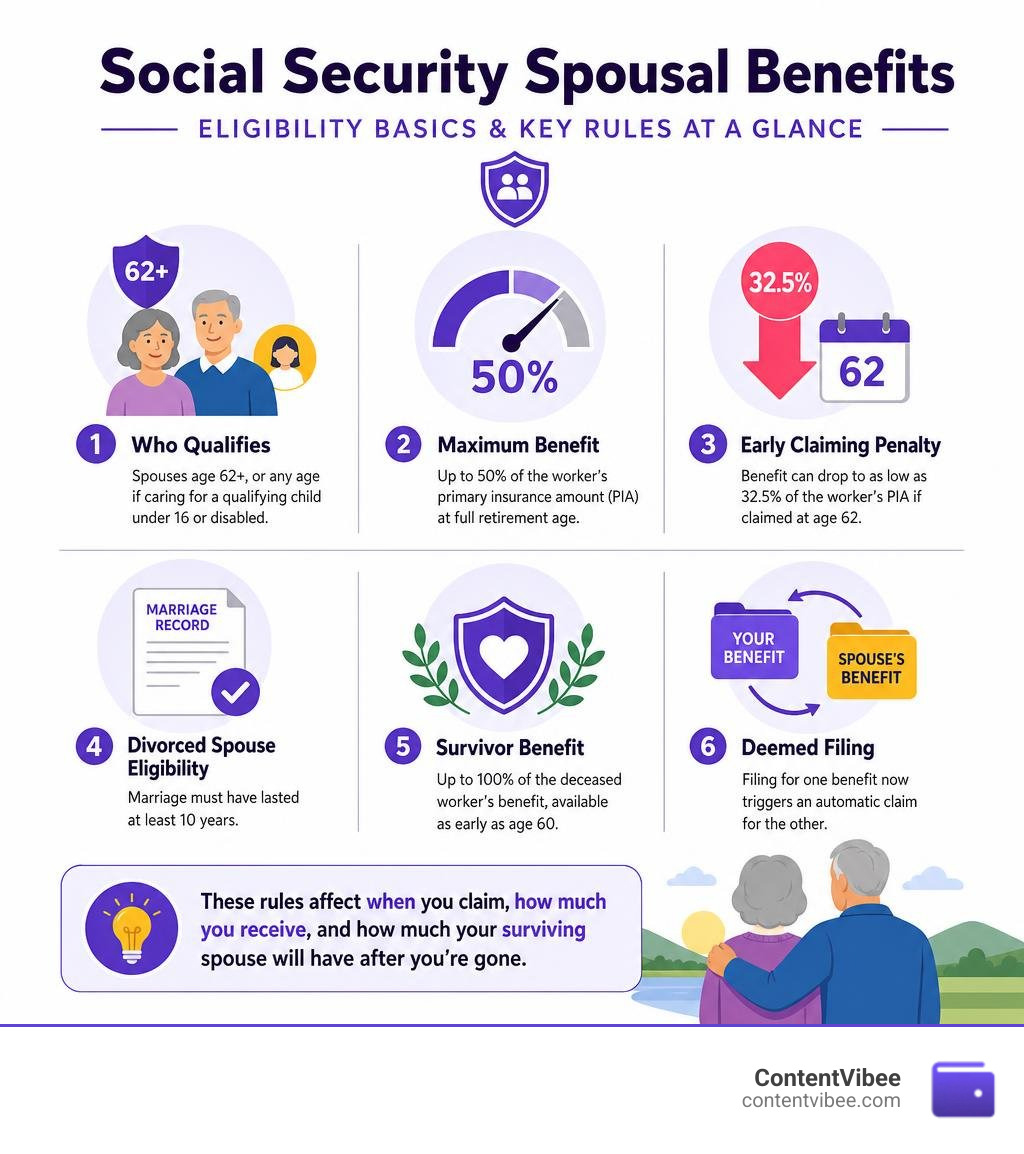
Here is a quick overview of the core rules:
| Rule | Key Detail |
|---|---|
| Who qualifies | Spouses age 62+, or any age if caring for a qualifying child under 16 or disabled |
| Maximum benefit | Up to 50% of the worker’s primary insurance amount (PIA) at full retirement age |
| Early claiming penalty | Benefit can drop to as low as 32.5% of the worker’s PIA if claimed at age 62 |
| Divorced spouse eligibility | Marriage must have lasted at least 10 years |
| Survivor benefit | Up to 100% of the deceased worker’s benefit, available as early as age 60 |
| Deemed filing | Filing for one benefit now triggers an automatic claim for the other |
These rules affect when you claim, how much you receive, and — critically — how much your surviving spouse will have after you are gone.
The 2015 Bipartisan Budget Act changed the game for couples who hoped to collect one benefit while letting the other grow. Many strategies that were popular before 2016 are simply no longer available. At the same time, some exceptions still exist — and knowing them can make a real difference to your household income in retirement.
This guide breaks it all down in plain language, including what changed, what still works, and how the Windfall Elimination Provision (WEP) fits into the picture for public sector workers and their spouses.
Quick Social Security spousal rules terms:
Understanding the Core Social Security Spousal Rules

When navigating retirement planning as a couple, it helps to think of Social Security not just as an individual benefit, but as a joint financial asset. The Social Security Administration (SSA) provides a system where a lower-earning partner can claim retirement income based on the work history of their spouse. This mechanism is designed to support households where one partner took time out of the workforce, worked part-time, or earned a lower salary over their lifetime.
To make the most of this system, you need to understand how the SSA defines a spouse and who is eligible. If you want a deep dive into the foundational requirements, check out our guide on How to Understand Spousal Benefit Eligibility.
Eligibility Requirements Under Social Security Spousal Rules
To qualify for spousal benefits, the primary worker must already be entitled to their own retirement or disability benefits. In other words, you cannot claim a spousal benefit on your partner’s record until they have actually filed for their own benefits.
According to the SSA Handbook § 305 and the official policy manual SSA – POMS: RS 00202.001, a spouse must meet several criteria to receive payments:
- Age Requirement: You must be at least 62 years old to claim spousal benefits, unless you have a qualifying “child-in-care.”
- Marriage Duration: You must be validly married to the primary worker. Generally, you must have been married for at least one continuous year before the spousal benefit is approved.
- The Child-in-Care Exception: If you are caring for a child of the primary worker who is under the age of 16 or who became disabled before age 22, the age 62 requirement is waived. In this scenario, you can receive spousal benefits at any age, and the payment is not reduced for early claiming.
- Legal vs. Deemed Spouse: The SSA recognizes both legal spouses (validly married under the laws of the worker’s state of domicile) and “deemed” spouses. A deemed spouse is someone who entered into a marriage ceremony in good faith that would have been legal if not for a technical legal impediment.
Additionally, your own individual retirement benefit must not be higher than the spousal benefit. If you are eligible for both, the SSA will compare the two and pay you an amount that effectively equals the higher of the two options.
How the 50% Maximum Benefit is Calculated
The maximum spousal benefit you can receive is exactly 50% of your partner’s Primary Insurance Amount (PIA). The PIA is the monthly benefit your spouse is eligible to receive if they claim at their exact Full Retirement Age (FRA).
To see how this works, let’s look at a quick example. Suppose your spouse has a PIA of $2,000 per month. If you wait until your own Full Retirement Age to claim, your spousal benefit will be:
$$\text{Maximum Spousal Benefit} = \$2,000 \times 50\% = \$1,000 \text{ per month}$$
It is important to note that the spousal benefit is tied directly to the worker’s PIA, not their actual payout. If your spouse decides to delay their retirement claim past their FRA to earn Delayed Retirement Credits (which increase their benefit by 8% per year up to age 70), your spousal benefit does not increase. It remains capped at 50% of their FRA amount.
Conversely, if your spouse claims their own retirement benefit early at age 62 (which permanently reduces their payment), your spousal benefit is still based on 50% of their full PIA, though your own claiming age will determine whether that 50% is reduced. To run these numbers for your specific situation, you can use our guide to Calculate Your Spousal Benefits The Easy Way.
The Impact of Early Claiming and Deemed Filing
Timing is everything when it comes to Social Security. If you claim your spousal benefit before you reach your own Full Retirement Age, the SSA applies a permanent monthly reduction to your payout. Understanding these reductions is vital, as a hasty decision at age 62 can impact your household budget for the rest of your life. For a strategic overview of this concept, read Social Security Spousal Benefits Timing Is Everything.
Age Reductions and the 32.5% Minimum
The reduction formula for spousal benefits is steeper than the reduction for a worker’s own retirement benefit. According to official guidelines on Benefits for Spouses, the spousal benefit is reduced by:
- 25/36 of 1% per month for the first 36 months before your Full Retirement Age.
- 5/12 of 1% per month for any additional months beyond 36 months.
If your Full Retirement Age is 67 and you choose to claim your spousal benefit at the minimum age of 62 (exactly 60 months early), the reduction is calculated as follows:
- For the first 36 months: $36 \times (25/36 \times 1\%) = 25\%$ reduction.
- For the remaining 24 months: $24 \times (5/12 \times 1\%) = 10\%$ reduction.
- Total reduction: $25\% + 10\% = 35\%$ reduction.
This means that instead of receiving 50% of your spouse’s PIA, you will receive only 32.5% of their PIA.
Below is a comparison table outlining how claiming early affects your spousal benefit percentage based on a Full Retirement Age of 67:
| Claiming Age | Months Before FRA (67) | Spousal Benefit Percentage of Worker’s PIA |
|---|---|---|
| 67 (FRA) | 0 | 50.0% |
| 66 | 12 | 45.8% |
| 65 | 24 | 41.7% |
| 64 | 36 | 37.5% |
| 63 | 48 | 35.0% |
| 62 | 60 | 32.5% |
Deemed Filing and the 2015 Bipartisan Budget Act
In the past, savvy couples used a popular loophole known as the “restricted application.” This allowed a spouse at Full Retirement Age to file for spousal benefits only, while letting their own retirement benefit grow by 8% per year until age 70.
The Bipartisan Budget Act of 2015 closed this loophole for almost everyone. Under the current rules of deemed filing, when you apply for either your own retirement benefit or a spousal benefit, you are “deemed” to have applied for both simultaneously. The SSA will calculate both benefits and pay you an amount equal to the higher of the two. You can no longer choose to receive only the spousal benefit while letting your own retirement record grow.
The law also changed the “file and suspend” strategy. Previously, a higher earner could file for benefits and immediately suspend them, allowing their spouse to collect spousal benefits while the higher earner’s benefit continued to accumulate delayed retirement credits. Today, if a worker suspends their retirement benefit, any spousal benefits based on their record are also suspended.
Special Rules for Divorced and Surviving Spouses
The Social Security spousal rules extend beyond current marriages. Ex-spouses and surviving partners may also be eligible for benefits on a worker’s record, often with more flexible rules.
The 10-Year Marriage Rule for Ex-Spouses
If you are divorced, you can still claim spousal benefits on your ex-spouse’s record, provided you meet the following requirements:
- Your marriage lasted for at least 10 continuous years before the divorce became final.
- You are currently unmarried. If you remarry, you generally lose the right to claim benefits on your ex-spouse’s record (unless your subsequent marriage ends by death, divorce, or annulment).
- You are at least 62 years old.
- Your ex-spouse is eligible for retirement or disability benefits (even if they have not filed for them yet, as long as you have been divorced for at least two continuous years).
This last point is a major advantage. Unlike current spouses, who must wait for the worker to file, an independently entitled divorced spouse can claim benefits even if their ex-spouse has not yet retired. Crucially, claiming benefits as a divorced spouse has absolutely no impact on the benefit amount your ex-spouse (or their current spouse) receives. For a comprehensive look at how this works, see How the Ten Year Marriage Rule Affects Your Divorced Spousal Benefits.
Survivor Benefits vs. Social Security Spousal Rules
It is common to confuse spousal benefits with survivor benefits, but they are entirely different programs with different rules and payment amounts:
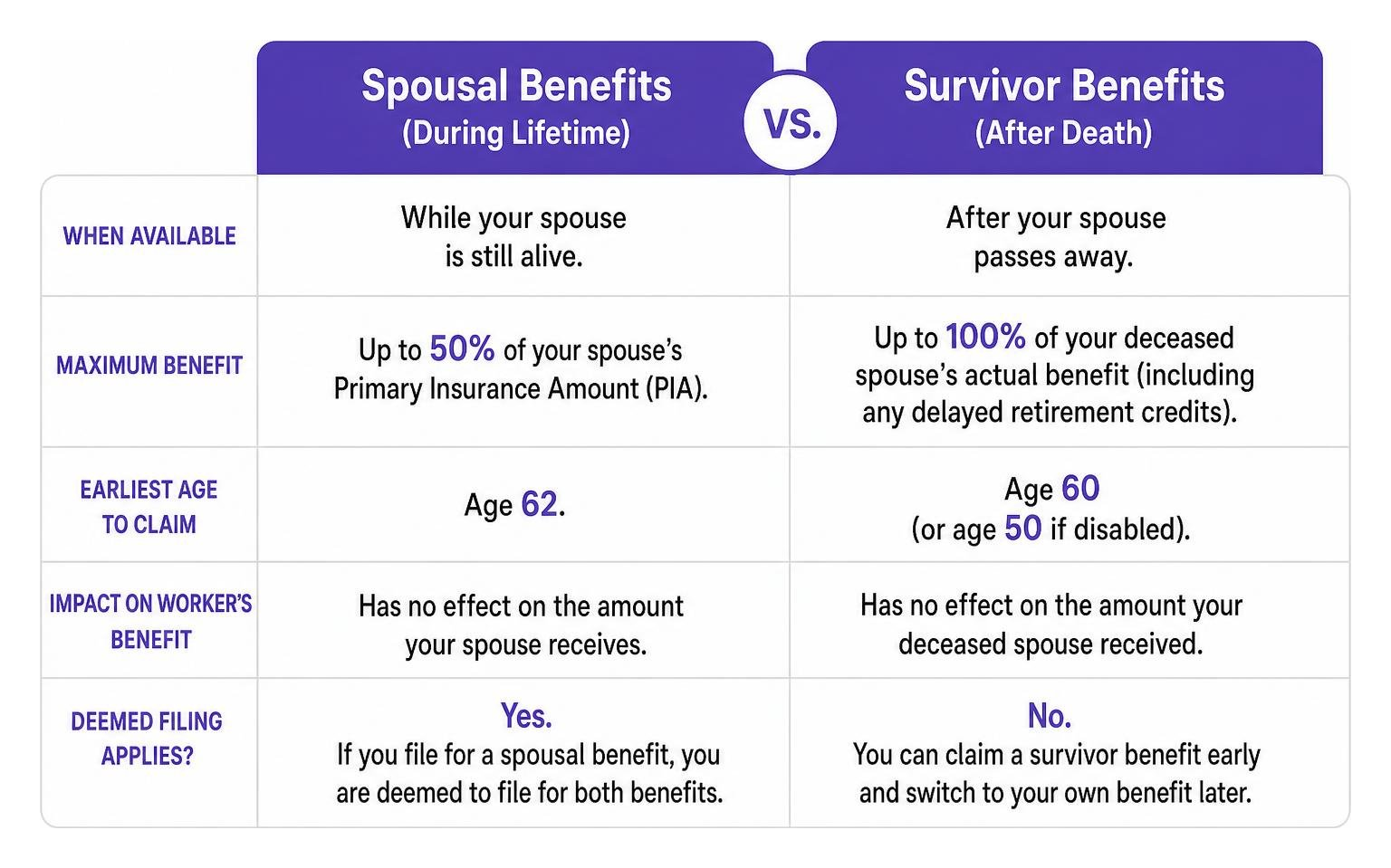
- Spousal Benefits (Lifetime): Available while your spouse is still alive. The maximum benefit is capped at 50% of the worker’s PIA, and the minimum claiming age is 62.
- Survivor Benefits (Post-Death): Available after your spouse passes away. As a surviving spouse, you can receive up to 100% of your deceased partner’s actual benefit (including any delayed retirement credits they earned). Furthermore, you can claim survivor benefits as early as age 60 (or age 50 if you are disabled).
Because deemed filing does not apply to survivor benefits, you can choose to claim a survivor benefit early while letting your own retirement benefit grow, then switch to your own higher benefit at age 70.
Maximizing Benefits: Strategies for Couples
To get the most out of your joint Social Security benefits, you need to coordinate your claiming dates. This is especially true for couples with a significant gap in lifetime earnings. For actionable strategies, we recommend checking out The Smart Couples Guide to Social Security Strategies.
Coordinated Claiming and Delaying the Higher Earner
The most effective strategy for married couples is often to have the higher-earning spouse delay claiming their benefit for as long as possible, up to age 70.
This approach offers a double benefit:
- It maximizes the monthly retirement check for the household while both partners are alive, thanks to the 8% annual delayed retirement credits.
- It secures the highest possible survivor benefit for the lower-earning spouse, who will inherit 100% of that larger amount if the higher earner passes away first.
While the higher earner delays, the lower-earning spouse can claim their own retirement benefit early (or at FRA) to provide the household with some income. Once the higher earner files, the lower-earning spouse can step up to a higher spousal benefit if 50% of the higher earner’s PIA is greater than their own retirement benefit.
Here is a quick sequence to coordinate your claims effectively:
- Identify the higher earner: Determine which spouse has the larger PIA.
- Estimate your benefits: Log in to your SSA accounts to view your estimated payouts at different ages.
- Have the lower earner claim first: This brings income into the household while allowing the higher earner’s benefit to grow.
- Delay the higher earner to age 70: This locks in the maximum retirement and survivor benefit.
- Switch to spousal benefits if applicable: The lower earner can transition to a spousal top-up once the higher earner files.
Exceptions for Disability and Child-in-Care Situations
There are key exceptions to the standard reduction and deemed filing rules:
- Disability Benefits: If a worker is receiving Social Security Disability Insurance (SSDI), their spouse can claim spousal benefits without waiting for the worker to reach retirement age.
- Child-in-Care: If you are caring for a child who is under 16 or disabled, your spousal benefit is not reduced for early claiming, even if you claim before your Full Retirement Age. The deemed filing rules also do not force you to claim your own retirement benefit early in this situation.
- Family Maximum: That the total amount of benefits that can be paid on a single worker’s record to their family (spouse, children, etc.) is capped by the Family Maximum. This limit is typically between 150% and 180% of the worker’s PIA.
The Windfall Elimination Provision (WEP) and Government Pension Offset (GPO)
If you or your spouse worked in a public sector job — such as a teacher, police officer, firefighter, or government employee — and earned a pension from an employer that did not withhold Social Security taxes, your benefits may be reduced. This is due to two federal laws: the Windfall Elimination Provision (WEP) and the Government Pension Offset (GPO).
- Windfall Elimination Provision (WEP): This rule affects how your own retirement benefit is calculated. It reduces your Social Security payout to account for the “non-covered” pension you receive from public work.
- Government Pension Offset (GPO): This rule specifically targets spousal and survivor benefits. If you receive a non-covered government pension, the GPO reduces your spousal or survivor benefit by two-thirds of the amount of your pension.
For example, if you receive a monthly civil service pension of $1,200, two-thirds of that amount ($800) will be deducted from any Social Security spousal benefit you are eligible to receive. If your estimated spousal benefit is $900, your actual payout after the GPO reduction will be just $100 per month. If the two-thirds reduction is larger than the spousal benefit, your spousal benefit is reduced to zero.
Types of pensions commonly affected by WEP and GPO:
- Local and state government pensions (e.g., public school teachers in certain states)
- Federal Civil Service Retirement System (CSRS) pensions
- Foreign pensions earned for work outside the United States
Frequently Asked Questions about Spousal Benefits
Can I receive spousal benefits if I qualify for my own retirement benefit?
Yes, but you cannot “double dip” by receiving both benefits in full. The SSA will calculate both your own retirement benefit and your spousal benefit. If your own benefit is higher, you will receive your own benefit. If the spousal benefit is higher, you will receive your own benefit first, plus a “spousal top-up” to bring the total amount up to the spousal benefit level.
Does my spouse’s claim reduce my own retirement benefit?
No. When your spouse or ex-spouse claims a spousal benefit on your earnings record, it has absolutely no impact on your own retirement benefit. Your monthly payment remains exactly the same, and any family maximum rules do not apply to divorced spouses.
How do recent law changes affect restricted applications?
Under the post-2016 rules established by the Bipartisan Budget Act of 2015, the ability to file a restricted application has been phased out. Only individuals who were born on or before January 1, 1954, were grandfathered into the old rules. Since we are in 2026, anyone reaching retirement age today is subject to the deemed filing rules, meaning you must claim all eligible benefits at once.
Conclusion
Navigating the Social Security spousal rules can feel overwhelming, but taking the time to understand these guidelines is a powerful way to secure your financial future. Whether you are coordinating claiming ages with your partner, planning around a divorce, or accounting for a public pension, small adjustments to your strategy can yield thousands of dollars in extra lifetime income.
At ContentVibee, we believe that clear, step-by-step guidance is the key to confident retirement planning. Don’t leave your hard-earned money on the table — Optimize your retirement strategy today with ContentVibee’s Ultimate Guide.