


What You Need to Know About Deceased Spouse Benefits Right Now
Deceased spouse benefits can provide critical financial support after one of life’s hardest moments. Here’s a quick overview of what’s available and who qualifies:
Quick Answer: Key Deceased Spouse Benefits at a Glance
| Benefit Type | Who Qualifies | How Much |
|---|---|---|
| Social Security Survivor Benefit | Spouse age 60+, or 50+ if disabled | 71.5% to 100% of deceased’s benefit |
| Survivor Benefit (any age) | Caring for deceased’s child under 16 | 75% of deceased’s benefit |
| Lump-Sum Death Payment | Surviving spouse or eligible child | $255 one-time payment |
| Federal Employee (FERS/CSRS) | Spouse of federal worker or retiree | Up to 55% of unreduced annuity |
| VA Dependency & Indemnity (DIC) | Spouse of qualifying veteran | Monthly payment based on service |
Losing a spouse is devastating — emotionally and financially. The bills don’t pause. Retirement plans shift overnight. And suddenly you’re faced with a stack of paperwork and decisions you were never prepared to make.
The good news? You likely have more financial support available than you realize.
As of September 2025, more than 3.8 million widows and widowers were already receiving Social Security survivor benefits. If you’re not sure whether you qualify — or how much you could get — you’re not alone. Most people don’t fully understand these benefits until they need them.
This guide walks you through everything: eligibility, benefit amounts, how to apply, and smart strategies to maximize what you receive.
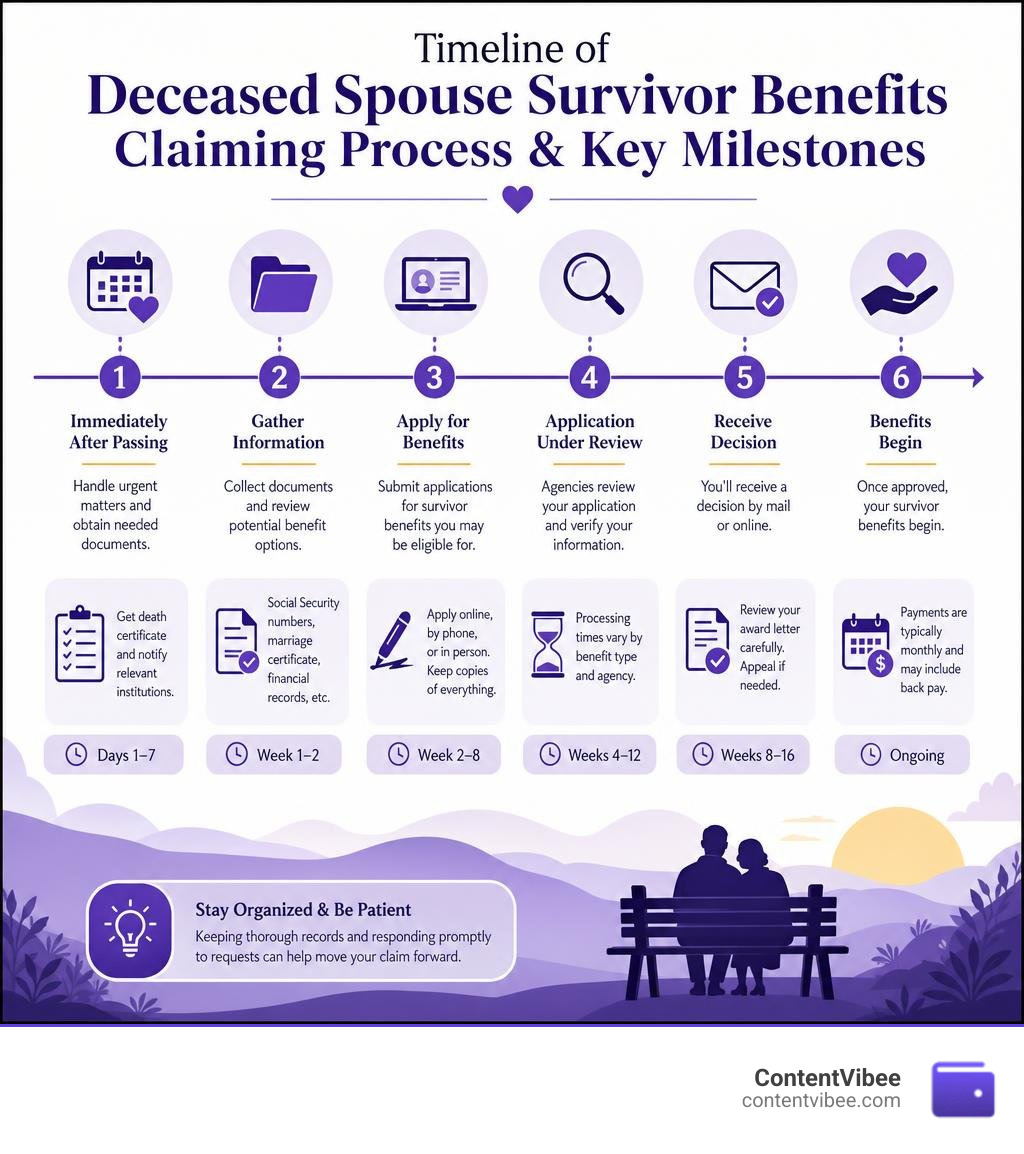
Key deceased spouse benefits vocabulary:
Understanding Social Security Deceased Spouse Benefits

When we talk about deceased spouse benefits, we are primarily referring to Social Security survivor benefits. These benefits are a form of life insurance built directly into the Social Security system. Over their working lifetime, your spouse paid Social Security taxes (FICA), earning “credits” that secure these protections for you and your family.
As we look at the landscape in July 2026, it is clear how vital these programs are. According to official data, over 3.8 million widows and widowers (including some divorced spouses) were receiving monthly survivor benefits as of September 2025.
The core philosophy behind this benefit is simple: it is designed to replace a portion of the household income that was lost when your partner passed away. However, the rules governing how these benefits are paid out can be surprisingly complex. To get a foundational understanding of how this income safety net functions, we recommend reading our detailed guide on how survivor benefits work when a spouse passes away.
Eligibility Requirements for Deceased Spouse Benefits
The Social Security Administration (SSA) enforces strict guidelines regarding who can claim a survivor benefit on a deceased worker’s record. Understanding these requirements is the first step toward securing your financial future.
Generally, to qualify for a monthly survivor benefit as a widow or widower, you must meet the following criteria:
- Age Requirements: You must be at least 60 years old to claim standard survivor benefits. If you are disabled, you can claim as early as age 50 (provided your disability started before or within seven years of your spouse’s death).
- Marriage Duration: Under standard rules, you must have been legally married to your spouse for at least nine months before their death.
- The Exceptions: The nine-month marriage rule is waived under certain circumstances, such as if your spouse’s death was accidental, occurred in the line of active military duty, or if you are the biological parent of your late spouse’s child.
- Caring for Children: If you are caring for your deceased spouse’s child who is under age 16 or disabled, you can receive survivor benefits at any age without meeting the nine-month marriage rule.
For the exact policy definitions and highly specific legal scenarios regarding relationships, you can consult the SSA – POMS: RS 00207.001 – Widow(er)’s Benefits Definitions and Requirements. To break this down into plain English, we have also put together a beginner-friendly breakdown outlining what you need to know about spousal survivor benefits.
Calculating Your Deceased Spouse Benefits Payout
How much will you actually receive each month? Your monthly payment is based on your deceased spouse’s lifetime earnings. The more they paid into Social Security, the higher your survivor benefit will be.
Specifically, your payout will fall within a range of 71.5% to 100% of your late spouse’s Primary Insurance Amount (PIA) — which is the benefit they were receiving (or were entitled to receive) at their Full Retirement Age (FRA).
Your age at the time you claim the benefit is the biggest factor determining where you fall on this spectrum:
- At Full Retirement Age (FRA) or Later: You receive 100% of your deceased spouse’s monthly benefit. That the FRA for survivor benefits can differ slightly from your standard retirement FRA. For example, if you were born in 1962 or later, your survivor FRA is 67.
- Between Age 60 and FRA: Your benefit is reduced. The closer you are to age 60, the lower the percentage, bottoming out at 71.5% if you claim right at age 60.
- Disabled (Ages 50 to 59): You receive 71.5% of the deceased spouse’s benefit.
- Caring for a Child Under 16: You receive 75% of the benefit, regardless of your age.
Understanding how your personal age milestones interact with these percentages is crucial. We highly recommend reviewing the complete guide to Social Security Full Retirement to map out your personal timeline. For those who want to review the official calculation formulas, reduction factors, and payment policy, you can explore the SSA – POMS: RS 00207.002 – Widow(er)’s Benefits – Payment and Termination.
Strategic Claiming and Dual Entitlement Rules
One of the most powerful features of the Social Security system for survivors is the “dual entitlement” rule. However, it is also one of the most widely misunderstood.
Under Social Security rules, you cannot simply add your own retirement benefit to your survivor benefit to get a double payment. Instead, the SSA will pay you your own retirement benefit first. If your survivor benefit is higher than your own benefit, they will add an extra amount to make up the difference, effectively giving you the higher of the two amounts.
But here is where strategy comes into play: you have the right to choose which benefit to claim first.
This means you can strategically claim a reduced survivor benefit early while letting your own retirement benefit grow, or vice versa.
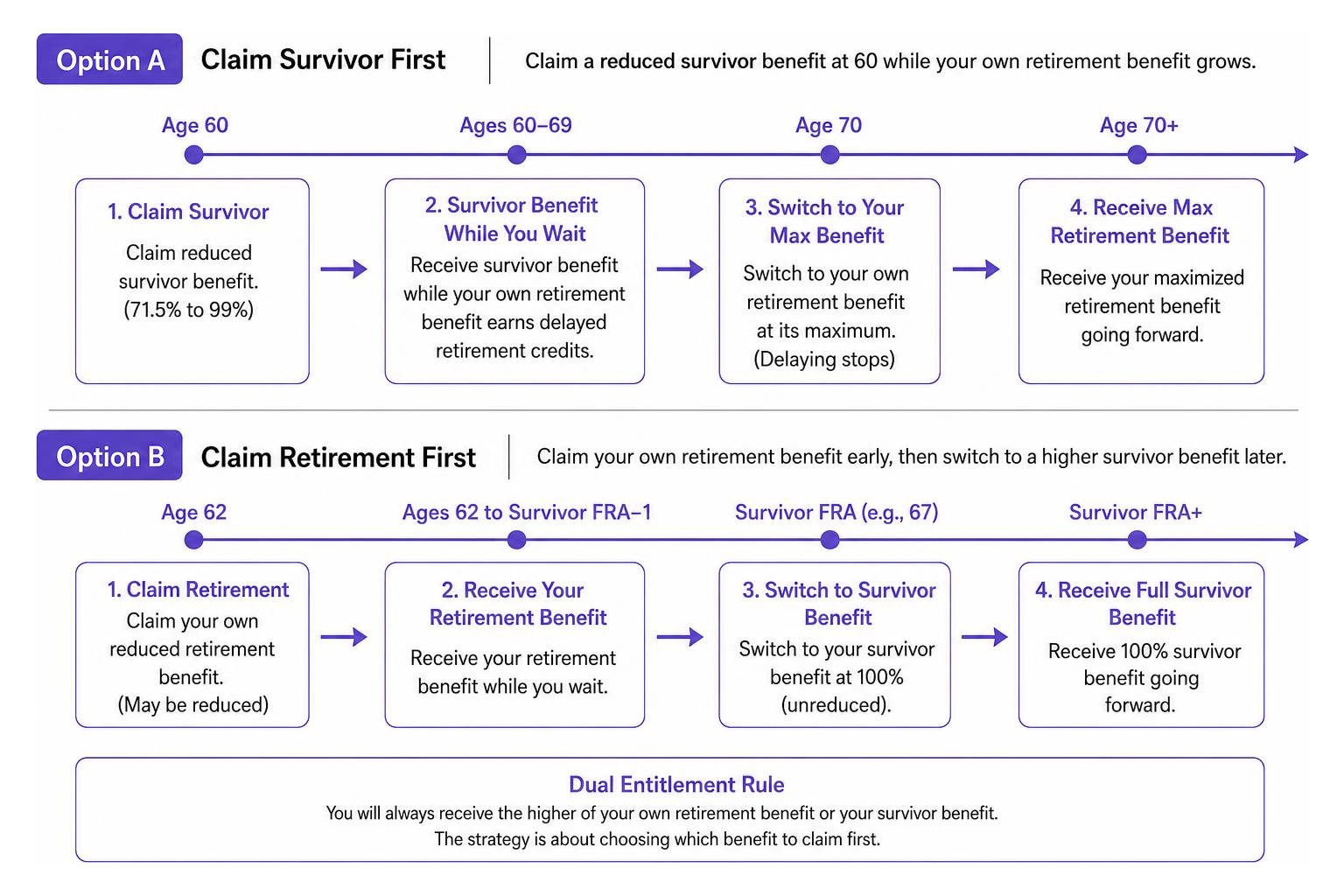
Let’s look at how this works in practice:
- Option A (Claim Survivor First): You can claim a reduced survivor benefit at age 60. While you are living on this survivor income, your own retirement benefit continues to earn delayed retirement credits. At age 70, when your own benefit has reached its absolute maximum, you can switch from the survivor benefit to your own maximized retirement benefit.
- Option B (Claim Retirement First): If your own retirement benefit is relatively small, you might choose to claim your own reduced retirement benefit at age 62, and then wait until you reach your survivor Full Retirement Age to switch to a 100% unreduced survivor benefit.
Navigating these choices requires careful planning. To make the best decision for your specific financial landscape in 2026, we suggest reading our guide on to claim early or delay your 2026 Social Security optimization playbook alongside the ultimate guide to Social Security benefit optimization.
Rules for Surviving Divorced Spouses
What happens if you were divorced from your spouse before they passed away? You may still be eligible to claim deceased spouse benefits on their record. The SSA treats surviving divorced spouses almost exactly the same as surviving legal spouses, provided you meet a few extra conditions:
- The 10-Year Rule: Your marriage to your deceased ex-spouse must have lasted for at least 10 consecutive years before the divorce was finalized.
- Your Marital Status: You must currently be unmarried, or your remarriage must have occurred after you reached age 60 (or age 50 if you are disabled). Remarrying before age 60 disqualifies you from claiming on an ex-spouse’s record unless that subsequent marriage has ended.
- No Impact on Others: Claiming a benefit as a surviving divorced spouse has absolutely no impact on the benefits received by the deceased’s current widow or widower, nor does it count against the family maximum.
Divorce adds an extra layer of complexity to retirement planning, but these benefits can be an absolute lifesaver. To learn more about this specific scenario, check out our guide on surviving divorced spouse benefits explained simply and read our compilation of answers to your biggest Social Security questions after divorce.
Federal, Veteran, and State-Specific Survivor Programs
While Social Security is the most common source of survivor support, it is far from the only one. If your late spouse was a federal employee, a military veteran, or a state government worker, you may be entitled to entirely different, highly specialized survivor programs.
Federal Employee Benefits (FERS and CSRS)
If your spouse worked for the federal government, their retirement fell under either the Federal Employees Retirement System (FERS) or the Civil Service Retirement System (CSRS). Both systems offer robust survivor benefits, managed by the Office of Personnel Management (OPM).
- Basic Employee Death Benefit (BEDB): Under FERS, if an active employee dies after completing at least 18 months of creditable service, their surviving spouse is entitled to the BEDB. For deaths occurring after December 1, 2021, this benefit consists of a flat payment of $37,055.54 plus 50% of the employee’s final average salary.
- Monthly Survivor Annuity: If a retired federal employee dies, the surviving spouse can receive a monthly annuity. Under FERS, the maximum survivor annuity is 50% of the retiree’s unreduced benefit (which requires a 10% reduction in the retiree’s pension during their lifetime). Under CSRS, the maximum survivor annuity is 55% of the retiree’s unreduced benefit.
- Thrift Savings Plan (TSP): If your spouse had a TSP account, the funds are distributed according to their beneficiary designations. For surviving spouses, the TSP automatically establishes a “Beneficiary Participant Account” in your name, which remains tax-deferred and is initially invested in the conservative G Fund.
To understand the exact legal administration of these federal pensions, you can read the official CSRS FERS Spouse Benefits – Death of an Annuitant Chapter 71 or review the rules regarding Thrift Savings Plan Death Benefits.
VA Survivor Benefits and Pensions
For the spouses of those who served in the United States military, the Department of Veterans Affairs (VA) provides crucial financial resources.
- Dependency and Indemnity Compensation (DIC): This is a tax-free monthly monetary benefit paid to eligible surviving spouses of military service members who died in the line of duty or as a result of a service-connected injury or illness. You can also qualify if the veteran was rated as totally disabled by the VA for a specific period before their death, even if the disability didn’t directly cause their death.
- VA Survivors Pension: This is a needs-based, tax-free monthly benefit paid to low-income, unremarried surviving spouses of wartime veterans. Unlike DIC, the veteran’s death does not need to be service-connected, but the survivor’s household income and net worth must fall below limits set by Congress.
- The Month-of-Death Benefit: Under federal law (38 U.S.C. § 5310(b)), a surviving spouse is often entitled to a one-time payment equal to the veteran’s full disability or pension benefit for the month of their death. However, as noted in the legal precedent General Counsel (022) – VAOPGCPREC 1-2009, this benefit is a one-time payment that terminates upon the surviving spouse’s death and cannot be paid out to the spouse’s estate if they pass away before receiving it.
How to Apply for Survivor Benefits
Now that you know what benefits might be on the table, how do you actually claim them?
First, it is important to know that you cannot apply for Social Security survivor benefits online. You must apply either in person at a local Social Security office or over the phone.
Here is a step-by-step checklist to guide you through the process:
- Report the Death Immediately: In most cases, the funeral home handling the arrangements will report the death to the SSA if you provide them with your spouse’s Social Security number. However, you should still contact the SSA yourself to ensure the report was processed.
- Schedule an Appointment: Call the SSA national toll-free number at 1-800-772-1213 (TTY 1-800-325-0778) to schedule an appointment.
- Gather Your Documents: You will need to provide original documents or certified copies. Do not mail originals unless instructed; it is usually best to bring them to your appointment. Have these ready:
- Proof of death (death certificate or funeral home notice).
- Your birth certificate and Social Security number.
- Your deceased spouse’s birth certificate and Social Security number.
- Your marriage certificate.
- Your divorce decree (if applying as a surviving divorced spouse).
- W-2 forms or self-employment tax returns for the deceased spouse’s most recent tax year.
- Your bank account routing and account numbers for direct deposit.
- Claim the $255 Lump-Sum Death Payment: During your application, make sure to ask for the one-time $255 lump-sum death payment. This is paid directly to the surviving spouse if they were living in the same household at the time of death.
To make sure you don’t hit any administrative roadblocks, we have compiled a detailed walkthrough on how to claim deceased spouse benefits and a practical checklist in claiming whats yours a guide to deceased spouse Social Security.
Frequently Asked Questions about Deceased Spouse Benefits
How does remarriage affect my eligibility for survivor benefits?
If you remarry before age 60 (or before age 50 if you are disabled), you lose your eligibility for survivor benefits on your deceased spouse’s record. However, if that subsequent marriage ends (by death, divorce, or annulment), your eligibility on your late spouse’s record is restored.
If you remarry at or after age 60 (or age 50 if disabled), your remarriage has absolutely no effect on your eligibility. You can continue to receive the survivor benefit based on your late spouse’s record, or you can choose to claim a spousal benefit on your new spouse’s record if that amount is higher.
Can I receive both my own retirement benefit and a survivor benefit?
No, the SSA does not allow “double dipping.” You cannot receive both payments in full. Instead, you will receive the higher of the two amounts. If your own retirement benefit is higher, you will receive your benefit. If the survivor benefit is higher, you will receive your retirement benefit topped off with an auxiliary amount to equal the survivor benefit.
However, as discussed in our strategic claiming section, you can choose to claim one benefit first while letting the other grow. To understand how age affects these choices, check out the definitive guide to Social Security claiming age.
What is the Social Security offset for state pension recipients?
If you receive a pension from a state, local, or federal government job where you did not pay Social Security taxes (such as some public school teachers, police officers, or state employees), your survivor benefit may be reduced. This is due to a federal law called the Government Pension Offset (GPO).
The GPO reduces your Social Security survivor benefit by two-thirds of the amount of your government pension. For example, if you receive a monthly state pension of $1,200, two-thirds of that is $800. If you are eligible for an $1,000 Social Security survivor benefit, the GPO will reduce that benefit by $800, leaving you with a $200 monthly Social Security payment.
Similarly, state-level retirement systems like the State Employees Retirement System (SERS) may apply a Social Security offset at age 60, reducing your state pension by up to 50% of your Social Security survivor benefit if your employment contributed to both systems.
Conclusion
Navigating deceased spouse benefits during a time of deep personal grief can feel overwhelming. The rules are dense, the paperwork is dry, and the stakes are incredibly high. But taking the time to understand your options, gather your documents, and strategically coordinate your claims can make a massive difference in your long-term financial security.
At ContentVibee, we are dedicated to simplifying U.S. retirement planning so you can make confident, informed financial decisions. You don’t have to guess your way through this process. To see exactly how your household retirement strategy shifts, use our free tool to calculate your spouse retirement benefits and take control of your financial future today.