


What Every Family With a 529 Should Know About the Roth Rollover Option
A 529 to Roth IRA rollover is one of the most valuable — and least understood — moves available to American families with leftover college savings. Thanks to the SECURE 2.0 Act, signed into law in December 2022, unused funds in a 529 education savings account can now be transferred directly into a Roth IRA for the beneficiary, completely free of federal income tax and the usual 10% penalty.
Here’s the quick answer on how it works:
- The 529 account must be open for at least 15 years
- Only contributions made more than 5 years ago are eligible
- The annual rollover amount is capped at the Roth IRA contribution limit ($7,500 in 2026 for those under 50)
- The lifetime maximum is $35,000 per beneficiary
- The rollover goes into a Roth IRA owned by the 529 beneficiary — not the parent
- Roth IRA income limits do not apply to these rollovers
- The beneficiary must have earned income at least equal to the rollover amount
This matters more than most families realize. American families hold over $480 billion in 529 accounts, and industry estimates suggest 10-15% of account holders end up with funds they never use for education. Before this rule existed, those leftover dollars faced a painful choice: pay income tax plus a 10% penalty on earnings, or leave the money locked up indefinitely.
Now there’s a third option — and it’s a good one.
The catch? The rules are strict, the IRS guidance is still incomplete in some areas, and state tax treatment varies widely. Getting this wrong can cost you.
This guide walks you through everything you need to know before moving a single dollar.
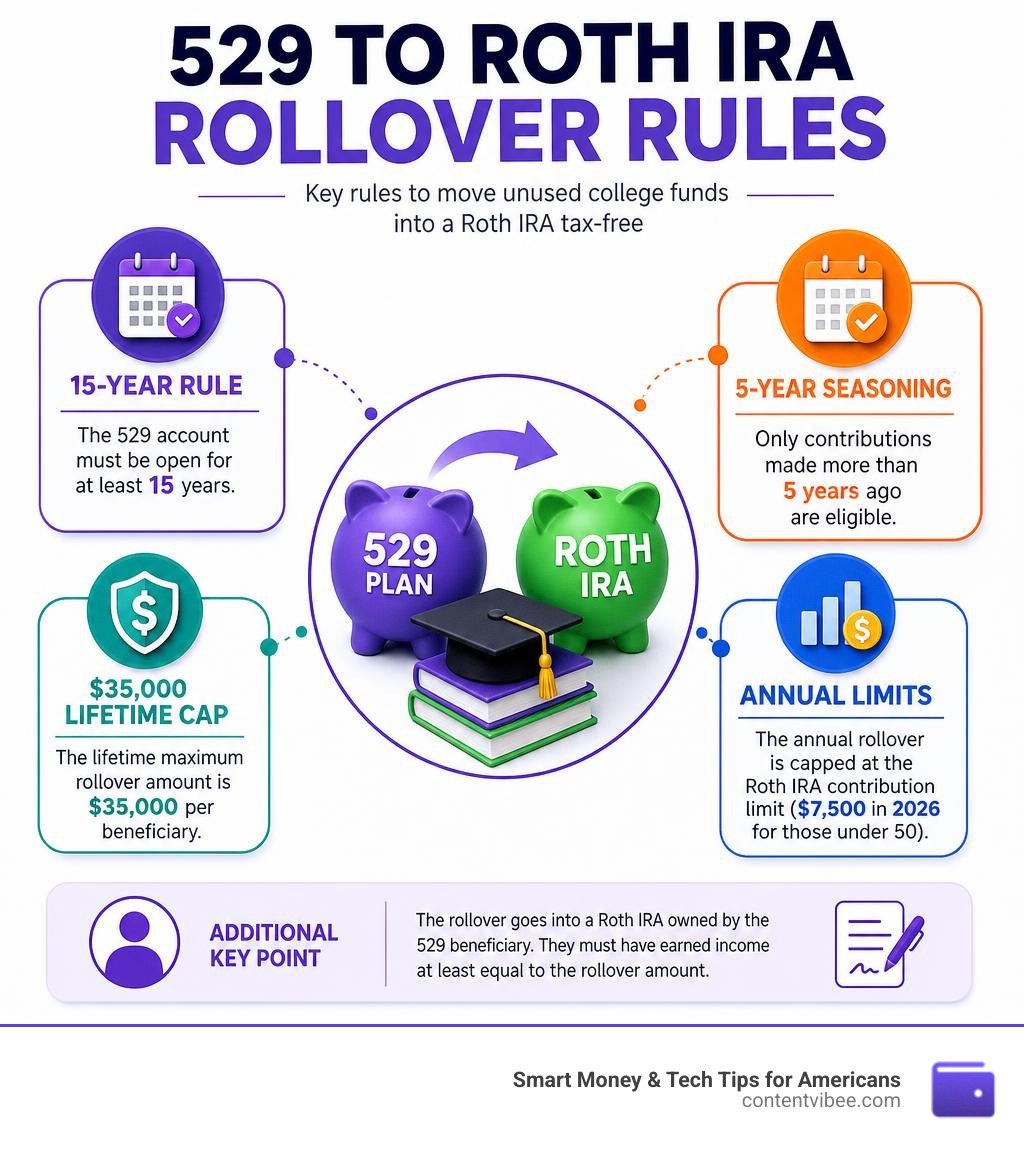
529 to roth rollover terms at a glance:
What is a 529 to roth rollover Under SECURE 2.0?

At its core, a 529 to roth rollover is a financial strategy designed to prevent college savers from being penalized for overfunding their accounts. For decades, the primary drawback of the 529 plan was its rigid “use-it-or-lose-it” nature regarding qualified higher education expenses. If your child received a scholarship, chose an alternative career path, or simply spent less than anticipated, those leftover funds felt trapped.
Under Section 126 of the SECURE 2.0 Act, Congress established a direct, tax-free transfer pathway to move these idle assets into a Roth IRA. This provision transforms the 529 plan from a pure education funding vehicle into a dual-purpose wealth-building tool. Instead of paying a steep federal tax bill and a 10% penalty on non-qualified earnings, you can now give your child a massive head start on their retirement savings.
At ContentVibee, we love finding ways to optimize your family savings, and setting up a solid education plan is key. If you have wondered how to fund these accounts initially without losing sleep, check out our guide on How To Automate Your 529 College Savings Without The Stress.
The Core Mechanics of a 529 to roth rollover
Executing this strategy requires a clear understanding of the transactional mechanics. First, this transfer must be completed as a direct, trustee-to-trustee transfer. This means the funds must flow directly from your 529 plan administrator to the Roth IRA custodian.
If you make the mistake of taking an indirect rollover — meaning you withdraw the money to your personal bank account with the intention of deposit-matching it into a Roth IRA later — the transaction will be classified as a non-qualified distribution. You will immediately trigger federal income taxes and the 10% penalty on the earnings portion.
Second, the recipient Roth IRA must be in the name of the designated beneficiary of the 529 plan. You cannot roll over funds from a child’s 529 plan directly into a parent’s Roth IRA. The beneficiary on both accounts must match perfectly at the time of the rollover. For a deep dive into the underlying rules of these accounts, you can review 529-to-Roth IRA Rollovers: What to Know and Roll Over Unused 529 Funds to Roth IRA Accounts .
Eligibility Requirements and the Strict Timing Rules
The IRS does not hand out tax-free retirement space without some serious strings attached. To prevent wealthy families from using 529 plans as a temporary tax-sheltered pass-through to fund Roth IRAs overnight, the SECURE 2.0 Act outlines two incredibly strict timing rules.
Understanding these rules is essential to avoiding costly penalties. When planning your long-term retirement building blocks, managing these timelines fits perfectly alongside other advanced strategies, such as utilizing After Tax Contributions How To Maximize Your Retirement Nest Egg.
The 15-Year Account Age Rule
The first major hurdle is the 15-year account age rule. To be eligible for a 529 to roth rollover, the 529 plan account must have been open and maintained for at least 15 continuous years prior to the date of the rollover.
While this sounds simple, several operational questions remain:
- Does changing the beneficiary reset the clock? Current industry consensus and conservative tax planning suggest that changing the designated beneficiary to someone outside the immediate family, or even within it, may reset the 15-year clock. Definitive IRS guidance is still pending on this specific detail.
- Does rolling over to a different state plan reset the clock? Generally, moving funds from one state’s 529 plan to another (an plan-to-plan rollover) is not believed to reset the 15-year clock, provided the account history is fully documented and transferred.
- Reopening accounts: Reopening a closed 529 account will almost certainly reset your 15-year clock to zero.
To be safe, we recommend checking your original account statements or contacting your 529 administrator to verify the exact “creation date” of the account before initiating any transfer.
The 5-Year Contribution Seasoning Rule
Even if your 529 account has been open for 15 years, you cannot simply dump a large sum of money into the account today and roll it over tomorrow. Under the 5-year contribution seasoning rule, any contributions made to the 529 plan within the five years preceding the rollover date—along with any investment earnings associated with those specific contributions—are strictly ineligible for transfer.
Only older, seasoned funds that have lived in the account for more than five years can be moved to the Roth IRA. This means you must carefully track your contribution history. If you are planning a rollover in 2026, any contributions made in 2021 or later must be excluded from your calculations.
Contribution Limits and Income Rules
Once you have cleared the hurdle of the 15-year and 5-year rules, you must navigate the strict financial limits governing how much money can actually be moved each year.
To help visualize how these rules stack up against standard retirement planning, we have outlined the core differences in the table below. For more creative ways to shelter your income, check out our guide on Smart Strategies To Defer Taxes And Boost Your Retirement Savings.
Comparison: 529 to Roth Rollovers vs. Standard Roth IRA Contributions
| Feature | 529 to Roth IRA Rollover | Standard Roth IRA Contribution |
|---|---|---|
| Annual Limit (2026) | $7,500 (under age 50) | $7,500 (under age 50) |
| Lifetime Limit | $35,000 per beneficiary | No lifetime limit |
| Income Phase-Outs | Waived (No MAGI limits apply) | Restricted ($153k-$168k Single in 2026) |
| Earned Income Required? | Yes (Beneficiary must have earned income) | Yes (Contributor must have earned income) |
| Source of Funds | Seasoned 529 plan assets | Cash, checking, or earned compensation |
Annual and Lifetime Limits for a 529 to roth rollover
The annual rollover limit is not a separate, bonus contribution space. Instead, it is tied directly to the beneficiary’s standard annual Roth IRA contribution limit. For the year 2026, this limit is $7,500 for individuals under age 50 (and $8,600 for those 50 and older).
This means that any amount rolled over from a 529 plan counts against the beneficiary’s total Roth IRA contribution limit for that tax year. The beneficiary cannot roll over $7,500 from a 529 plan and make a standard $7,500 contribution in the same year.
Furthermore, the beneficiary must have earned income (compensation) at least equal to the amount being rolled over. For example, if your child earned only $4,000 from a part-time summer job in 2026, the maximum amount you can roll over from their 529 to their Roth IRA that year is $4,000. For an in-depth look at how contribution math impacts your broad retirement strategy, see The Ultimate Guide To Calculating Your 401K Contributions.
The $35,000 Lifetime Cap Per Beneficiary
While the annual limit restricts how quickly you can move the money, the statutory lifetime cap restricts the total volume. A designated beneficiary can only receive a maximum of $35,000 in total 529-to-Roth rollovers over their entire lifetime. This limit applies per beneficiary, regardless of how many different 529 accounts exist for them or how many different family members have funded those accounts.
Because of the annual limits, reaching the $35,000 lifetime cap requires a multi-year strategy. At the 2026 limit of $7,500 per year, it will take approximately 4.7 years of maximum transfers to fully exhaust the $35,000 cap.
However, starting this process early can yield incredible results. If a 22-year-old college graduate has $35,000 rolled over into a Roth IRA over five years, and that money compounds at an average annual return of 7.5%, those funds could grow to over $1 million by the time they reach retirement age at 67 — without them ever adding another penny.
State Tax Implications and Potential Pitfalls
While the federal government has paved a clear, tax-free path for these transfers, state tax laws are a completely different animal. This is the single biggest trap for families executing a 529 to roth rollover.
Because state tax codes do not automatically conform to federal changes, you must investigate how your home state treats these transactions. For a detailed breakdown of these regional nuances, we recommend reviewing How to Convert a 529 Plan to a Roth IRA | Morningstar and Understanding 529 rollovers to a Roth IRA .
Deduction Recapture and Non-Qualified State Treatment
If you live in a state that offers a state income tax deduction or credit for 529 contributions (such as Indiana, Colorado, or New York), the state may view a Roth rollover as a “non-qualified distribution.” If so, you could face deduction recapture, meaning the state will force you to pay back the tax breaks you claimed when you originally contributed the funds.
Even worse, some states do not recognize the SECURE 2.0 provision at all. California, for example, treats a 529-to-Roth rollover as a standard non-qualified distribution. This means California residents face state income taxes on the earnings portion of the rollover, plus an additional state-specific 2.5% tax penalty.
Before moving any funds, we strongly advise consulting with a qualified tax professional in your state to ensure you won’t be hit with an unexpected state tax bill.
Step-by-Step Process to Execute the Rollover
Executing a 529 to Roth transfer requires coordination between your 529 plan administrator and your Roth IRA custodian.
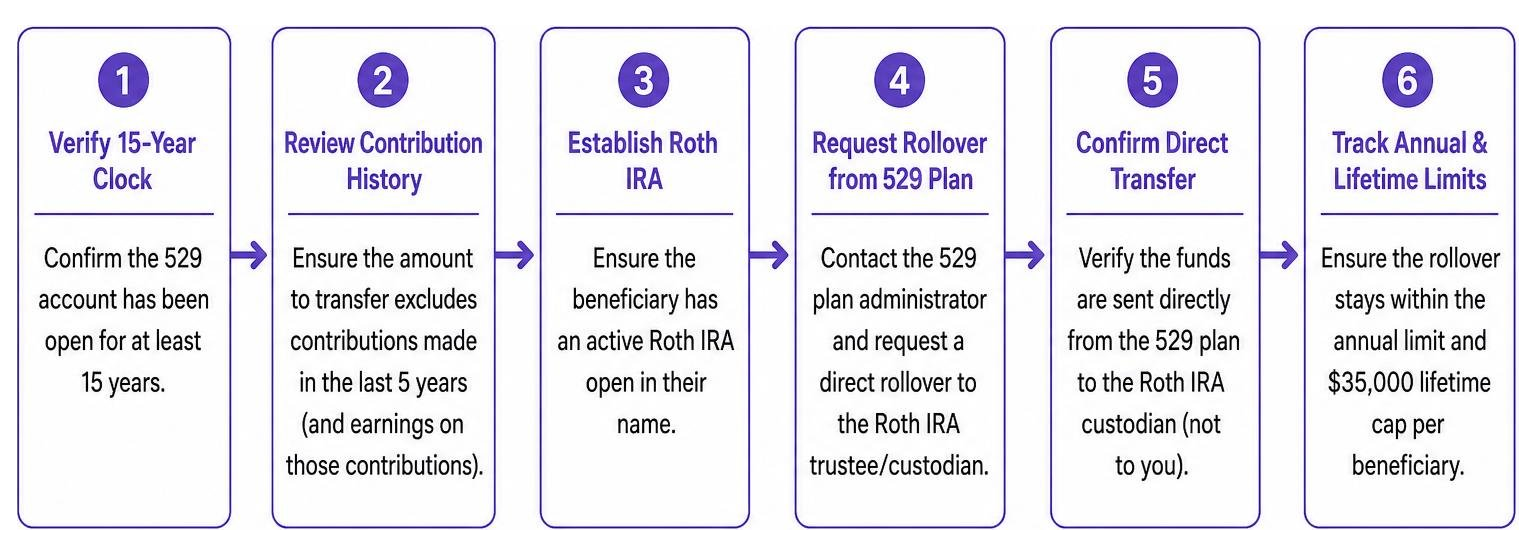
Here is the exact checklist to follow to ensure a smooth, penalty-free transfer:
- Verify the 15-Year Clock: Contact your 529 plan administrator to confirm the exact date the account was opened. Ensure it has been active for at least 15 years.
- Review the Contribution History: Export your transaction ledger and make sure the amount you want to transfer does not include any contributions made within the last 5 years (or earnings on those contributions).
- Establish the Roth IRA: Ensure the beneficiary has an active Roth IRA open in their name. The custodian of the Roth IRA must be ready to receive the transfer.
- Confirm Earned Income: Verify that the beneficiary has earned income for the tax year that is at least equal to the intended rollover amount.
- Submit the Rollover Forms: Fill out the specific “Roth IRA Rollover Request” form (often referred to as Form 310 or similar, depending on the plan) provided by your 529 plan administrator. You will need to provide the beneficiary’s Roth IRA account number and the custodian’s routing information.
- Execute Direct Transfer: Instruct the 529 plan to send the funds directly to the Roth IRA custodian as a trustee-to-trustee transfer.
- Document the Transaction: Keep copies of all forms, quarterly statements, and transfer confirmations for your tax records.
To see how this fits into your broader financial landscape, you can run various scenarios on our 401k vs Roth calculator.
Comparing the Rollover to Other Leftover 529 Options
While the Roth IRA rollover is a fantastic tool, it is not the only option for unused 529 funds. Before committing to a multi-year rollover strategy, compare it to these alternative paths:
- Change the Beneficiary: You can change the beneficiary of the 529 plan to another qualifying family member (such as a sibling, cousin, or even yourself) tax-free. This is often the best choice if other family members have near-term educational expenses.
- Pay Off Student Loans: Under the SECURE Act of 2019, you can use 529 funds to pay off up to $10,000 (lifetime limit) of student loans for the beneficiary and another $10,000 for each of their siblings.
- Keep It in the Account: There is no requirement to empty a 529 plan. You can leave the funds in the account to compound tax-free for future generations, such as potential grandchildren.
- Take a Non-Qualified Withdrawal: If you absolutely need the cash, you can withdraw it. You will pay federal and state income tax on the earnings portion, plus a 10% penalty. If the beneficiary received a scholarship, the 10% penalty is waived on withdrawals up to the scholarship amount, though income tax on earnings still applies.
Frequently Asked Questions about 529 to Roth Rollovers
Do Roth IRA income limits apply to 529 to Roth rollovers?
No. Under the SECURE 2.0 Act, the standard modified adjusted gross income (MAGI) phase-out limits that normally restrict high earners from contributing directly to a Roth IRA are completely waived for 529 rollovers. This makes the strategy an exceptional tool for young professionals who have entered high-paying fields straight out of college and are otherwise locked out of standard Roth IRA contributions.
Does changing the 529 beneficiary reset the 15-year clock?
The IRS has not yet issued final, definitive regulations on this question. However, conservative financial planners generally operate under the assumption that a beneficiary change does reset the 15-year clock, especially if the new beneficiary is in a different generation. To avoid resetting the clock, it is safest to establish the 529 account in the child’s name early and avoid changing the beneficiary if you plan to use this rollover strategy.
Can a parent roll over 529 funds into their own Roth IRA?
No. The SECURE 2.0 Act explicitly states that the recipient Roth IRA must belong to the designated beneficiary of the 529 account. Because the parent is typically the owner of the account and the child is the beneficiary, the funds must go to the child’s Roth IRA. If a parent wants to roll the funds into their own Roth IRA, they would first need to change the designated beneficiary of the 529 plan to themselves, which would likely reset the 15-year clock.
Conclusion
The 529 to roth rollover is a powerful financial planning tool that eliminates the fear of overfunding a college savings account. By understanding the strict 15-year account age rule, the 5-year contribution seasoning requirement, and the state-specific tax traps, you can seamlessly transition leftover education funds into a tax-free retirement nest egg for your child.
At ContentVibee, we are dedicated to helping you make smart, actionable money decisions that build long-term family wealth. To see how these moves fit into your overall savings plan, check out our comprehensive Finance Calculator to model your compounding growth and take control of your financial future today.


