


The IRS Won’t Let You Keep That 401k Money Forever — Here’s When You Must Start Taking It Out
The age of mandatory withdrawal from a 401k is currently 73 for most Americans — but it depends on when you were born, and the rules have changed significantly in recent years.
Quick Answer: When Do 401k Mandatory Withdrawals Start?
| Birth Year | RMD Start Age | First RMD Deadline |
|---|---|---|
| 1950 or earlier | 72 | Already started |
| 1951 – 1959 | 73 | April 1 after turning 73 |
| 1960 or later | 75 | April 1 after turning 75 |
These are called Required Minimum Distributions (RMDs) — the minimum amounts the IRS requires you to withdraw from your retirement accounts each year. Miss one, and you could face a penalty of up to 25% of the amount you failed to withdraw.
The rules changed under the SECURE Act of 2019 and were updated again by SECURE 2.0 in 2022. Those changes pushed the starting age higher for millions of retirees and pre-retirees — and also reduced penalties for honest mistakes.
There are also important exceptions. If you’re still working past RMD age, you may be able to delay withdrawals from your current employer’s 401k. And if you have a Roth 401k, the rules changed in your favor starting in 2024 — you no longer have to take RMDs during your lifetime.
This guide breaks down everything you need to know: when your mandatory withdrawals start, how much you’ll owe, what the tax impact looks like, and how to minimize it.
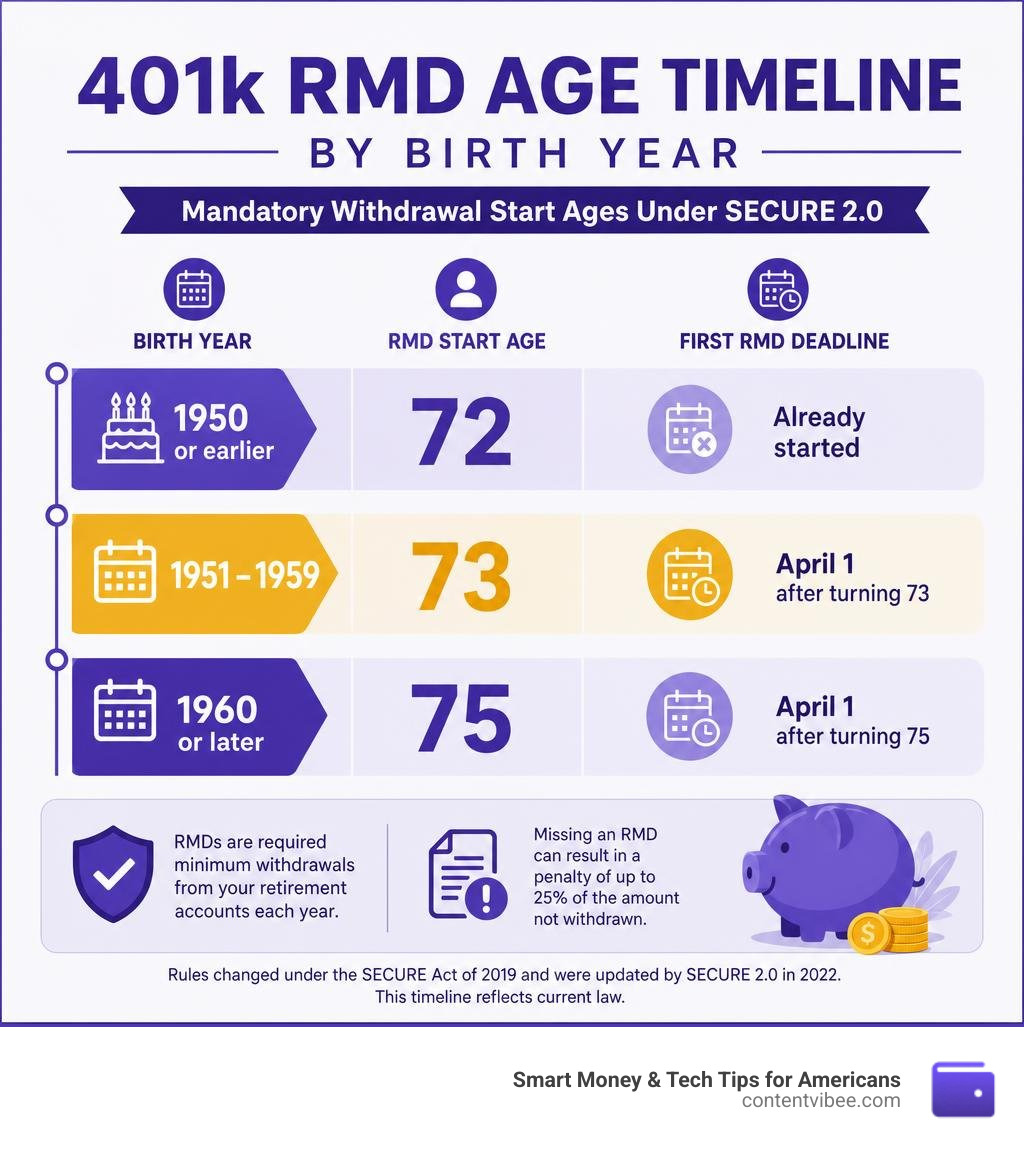
Understanding the Age of Mandatory Withdrawal from 401k Under SECURE 2.0

When we save for retirement using tax-deferred accounts like traditional 401(k) plans, we are essentially making a deal with the federal government. The IRS allows us to deduct our contributions from our taxable income today, and our investments grow tax-free for decades. However, the government eventually wants its share of the pie. They do not allow us to hoard tax-deferred wealth indefinitely.
To ensure these accounts are used to fund retirement rather than serve as permanent tax shelters for estate planning, the IRS mandates that we begin taking annual withdrawals. These compulsory liquidations are legally known as Required Minimum Distributions (RMDs).
The rules governing the age of mandatory withdrawal from a 401k have undergone a massive shift over the last several years. For decades, the magic age was 70½. If you reached that age, you had to start pulling money out.
However, Congress passed the SECURE Act of 2019, which raised the starting RMD age to 72. Just as savers were adjusting to that timeline, Congress passed the SECURE Act 2.0 at the end of 2022, which bumped the age again to 73 starting in 2023. Under SECURE 2.0, the age of mandatory withdrawal is scheduled to rise to 75 by the year 2033.
To see how these shifting rules fit into your broader financial picture, we recommend reading our Retirement Benefits Complete Guide 2026.
How Birth Years Determine Your Age of Mandatory Withdrawal from 401k
Because the transition from age 73 to 75 happens over a multi-year timeline, your specific birth year determines when your mandatory withdrawals must begin. It is easy to get confused by the overlapping rules, but we can break it down into simple cohorts:
- Born in 1950 or earlier: Your RMD age was 72 (or 70½ if born before July 1, 1949). You should already be taking your mandatory withdrawals.
- Born between 1951 and 1959: Your age of mandatory withdrawal from a 401k is exactly 73. For example, if you turned 73 in 2025, you must take your first distribution soon.
- Born in 1960 or later: Your mandatory withdrawal age is 75. Your first RMD year will be 2035 or later, depending on when you hit that milestone.
Note on the 1959 birth year anomaly: There was a technical drafting error in the original SECURE 2.0 legislation that created a brief overlap for individuals born in 1959, seemingly giving them two different RMD ages. Congressional technical corrections and IRS guidance have clarified that if you were born in 1959, your RMD age is 73, and if you were born in 1960 or later, it is 75.
For a complete breakdown of how these ages translate to specific calendar years, explore The Essential Rmd Age Table Guide For Smart Retirees.
Still Working Exception: Delaying the Age of Mandatory Withdrawal from 401k
What if you reach age 73 (or 75) but have no intention of retiring? If you are still happily employed and actively participating in your company’s 401(k) plan, the IRS offers a highly beneficial loophole known as the “still working” exception.
Under this rule, if you are still employed past your normal RMD age, you can delay taking mandatory withdrawals from your current employer’s 401(k) plan until April 1 of the calendar year following the year you finally retire. This is an incredibly valuable tool for active workers who want to keep compounding their tax-deferred savings.
However, this exception comes with two major caveats:
- The 5% Owner Rule: You cannot use the “still working” exception if you own more than 5% of the business that sponsors your 401(k) plan. If you are a business owner with a significant stake, you must start taking RMDs at your designated age, regardless of your employment status.
- Only Applies to Your Current Plan: The exception only protects the 401(k) account with the company you are currently working for. If you have old 401(k) plans left behind at previous employers, those accounts are not exempt. You must still take RMDs from those legacy accounts unless you roll them over into your active employer’s plan before reaching your RMD age.
Before trying to utilize this strategy, we always advise checking your specific plan documents. While the IRS permits the still-working exception, individual plan sponsors are allowed to have more restrictive rules and can mandate distributions anyway. You can verify these guidelines in the IRS 401k Resource Guide.
Traditional vs. Roth 401(k) RMD Rules and Calculations
The type of 401(k) account you hold completely changes how the IRS treats your mandatory withdrawals. While traditional 401(k)s require you to pay taxes upon withdrawal, Roth accounts are built on post-tax dollars, meaning they enjoy a highly privileged status.
Here is a quick look at how RMD rules compare across the most common retirement accounts:
| Account Type | Subject to Lifetime RMDs? | Can You Aggregate Withdrawals? | Tax Treatment of Distributions |
|---|---|---|---|
| Traditional 401(k) | Yes (unless still working) | No (must take from each plan) | Taxed as ordinary income |
| Roth 401(k) | No (as of 2024) | N/A | 100% Tax-Free |
| Traditional IRA | Yes | Yes (can combine and withdraw from one) | Taxed as ordinary income |
| Roth IRA | No | N/A | 100% Tax-Free |
Prior to 2024, one of the most frustrating differences between a Roth IRA and a Roth 401(k) was that Roth 401(k)s were still subject to mandatory lifetime distributions. Even though the withdrawals were tax-free, savers were forced to pull money out of their tax-sheltered Roth accounts.
Thankfully, SECURE 2.0 eliminated this discrepancy. Starting in 2024, designated Roth 401(k) accounts are completely exempt from lifetime RMDs, aligning them with the longstanding rules for Roth IRAs.
Another critical difference to note is account aggregation. If you have multiple Traditional IRAs, the IRS allows you to calculate the RMD for each account, add them together, and withdraw the total amount from just one of your IRAs.
This is not the case for 401(k) plans. Traditional 401(k) RMDs cannot be aggregated. If you have three separate traditional 401(k) accounts with different former employers, you must calculate and withdraw the specific RMD amount from each individual plan. For additional clarification on these differences, refer to the IRS RMD FAQs.
How to Calculate Your 401(k) Required Minimum Distribution
Calculating your RMD might seem intimidating, but it actually boils down to a simple mathematical formula.
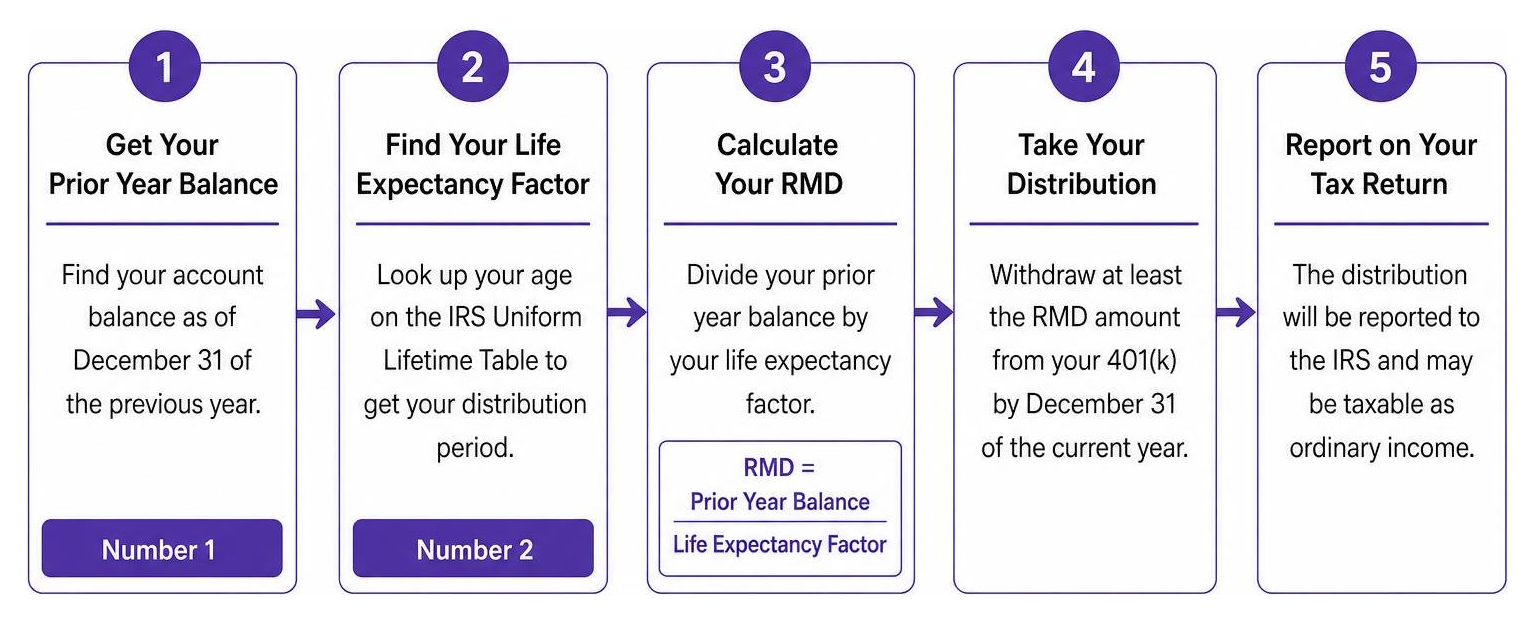
To calculate your annual distribution, you need two numbers:
- Your account balance as of December 31 of the previous year.
- Your life expectancy factor (also known as a distribution period) from the IRS Uniform Lifetime Table.
The formula is:
$$\text{Annual RMD Amount} = \frac{\text{Prior Year-End Balance}}{\text{IRS Life Expectancy Factor}}$$
The IRS updates these tables periodically to reflect modern life expectancies. For most retirees, the Uniform Lifetime Table is the standard tool. If your spouse is more than 10 years younger than you and is the sole beneficiary of your account, you get to use the Joint Life and Last Survivor Expectancy Table, which provides a larger divisor and results in a lower required annual withdrawal.
Let’s look at a practical example. Say you are 75 years old, and your traditional 401(k) balance on December 31 of last year was $250,000.
- According to the IRS Uniform Lifetime Table, the life expectancy factor for a 75-year-old is 24.6.
- We divide $250,000 by 24.6.
- Your RMD for the year is $10,162.60.
If you want to run your own numbers or see how different balances impact your net cash flow, you can use our Before You Cash Out Use This 401K Withdrawal Calculator First tool, or review the Fidelity RMD calculation guide.
Penalties, Taxes, and Strategic Ways to Minimize RMD Impact

Taking your RMDs on time is not something you want to put off. In the past, the penalty for missing a required minimum distribution was one of the most punitive in the entire tax code: a staggering 50% excise tax on the amount you failed to withdraw.
Fortunately, SECURE 2.0 threw retirees a lifeline. The law reduced this penalty to 25%. Furthermore, if you correct the mistake quickly—typically by withdrawing the missed amount and filing a corrected return within a two-year “correction window”—the penalty drops even further to 10%.
If you do make an honest mistake and miss a deadline, you can request a full waiver of the penalty from the IRS. You do this by filing IRS Form 5329 along with a letter of explanation showing “reasonable cause” (such as a serious illness, mental incapacity, or a bank error) and proving that you have already taken steps to withdraw the missing funds.
Beyond the penalties, we must also consider the tax reality. RMDs from a traditional 401(k) are treated as ordinary income. They are not taxed at favorable capital gains rates. This influx of mandatory income can have a massive domino effect on your overall financial health:
- Higher Tax Brackets: A large RMD can easily push you into a higher federal and state income tax bracket.
- Social Security Taxation: Up to 85% of your Social Security benefits can become taxable if your “combined income” (AGI + nontaxable interest + half of your Social Security benefits) crosses certain thresholds.
- Medicare IRMAA Surcharges: If your income exceeds specific limits, you may be hit with the Income-Related Monthly Adjustment Amount (IRMAA), which significantly increases your Medicare Part B and Part D premiums.
To keep track of how these rules apply to your accounts, you can visit the official IRS RMD Topics page.
Smart Strategies to Reduce Your RMD Tax Burden
Because RMDs can disrupt your tax planning, it is vital to utilize proactive strategies to manage them. The years between your actual retirement and the start of your mandatory withdrawals are what we call the “planning sweet spot.”
We recommend considering the following strategies:
- Roth Conversions: If you have retired but have not yet reached your age of mandatory withdrawal from a 401k, you can systematically convert portions of your traditional 401(k) or IRA into a Roth IRA. You will pay ordinary income taxes on the converted amount now, but those funds will grow completely tax-free and will be shielded from future RMD requirements.
- Qualified Charitable Distributions (QCDs): If you are charitably inclined, you can execute a QCD. This allows you to transfer up to $105,000 per year (as of 2026, indexed for inflation) directly from a traditional IRA to an eligible charity. The transfer counts toward your RMD but is excluded from your adjusted gross income (AGI). Note: You cannot make a QCD directly from an active 401(k). You must first roll your 401(k) funds over into a traditional IRA.
- Account Consolidation: If you have multiple old 401(k) plans spread across different employers, consolidate them. Rolling them into a single Traditional IRA or into your active employer’s 401(k) (if you are still working) simplifies your administration and reduces the chance of missing a mandatory deadline.
For a deeper dive into these methods, read our guides on Smart Strategies To Defer Taxes And Boost Your Retirement Savings and The Ultimate Guide To Retirement Money Management.
Frequently Asked Questions About 401(k) RMDs
Can I aggregate my 401(k) RMDs and take them from a single account?
No. Unlike traditional IRAs, which allow you to sum your RMDs and withdraw the total from a single account, 401(k) plans must be calculated and withdrawn individually. Each employer plan is treated as an independent entity by the IRS. If you fail to take the exact RMD from a specific 401(k) plan, you will face a penalty, even if you withdrew extra money from a different 401(k) or IRA.
What are the RMD rules for inherited 401(k) accounts?
The rules for beneficiaries changed dramatically under the SECURE Act of 2019. Most non-spouse beneficiaries (such as children or grandchildren) who inherit a 401(k) are now subject to the 10-year rule. This rule requires the entire account to be fully distributed by December 31 of the tenth year following the year of the owner’s death.
Exceptions to this rule apply to “Eligible Designated Beneficiaries,” which include surviving spouses, disabled or chronically ill individuals, and minor children of the account owner (until they reach the age of majority). Spouses still retain the unique ability to roll the inherited 401(k) into their own retirement account, delaying RMDs until they reach their own RMD age.
Can I continue making contributions to my 401(k) after RMD age?
Yes! Reaching your RMD age does not prevent you from making new contributions. If you are still working and your employer allows it, you can continue making salary deferrals and receiving company matching contributions.
To make sure you are maximizing your savings if you are still working, take a look at our breakdown of The New 2026 Maximum 401K Contribution Limits Explained.
Conclusion
Navigating the age of mandatory withdrawal from a 401k does not have to be a stressful ordeal. While the tax code is constantly evolving under laws like SECURE 2.0, staying informed is the best way to protect your hard-earned savings from unnecessary penalties and high tax brackets.
At ContentVibee, our mission is to deliver clear, actionable, and reliable financial guidance to help you navigate these complex retirement timelines. By planning ahead, utilizing Roth conversions, or taking advantage of the still-working exception, you can keep more of your money working for you throughout your golden years.
If you want to explore more about early retirement rules or withdrawal exceptions, learn more about retirement topics and exceptions to tax on early distributions at 55.


