


What You Need to Know About Fidelity Futures Commissions Before You Trade
Fidelity futures commissions are one of the most searched — and most misunderstood — topics among investors who want exposure to futures markets through one of the country’s most trusted brokers.
Here’s the short answer:
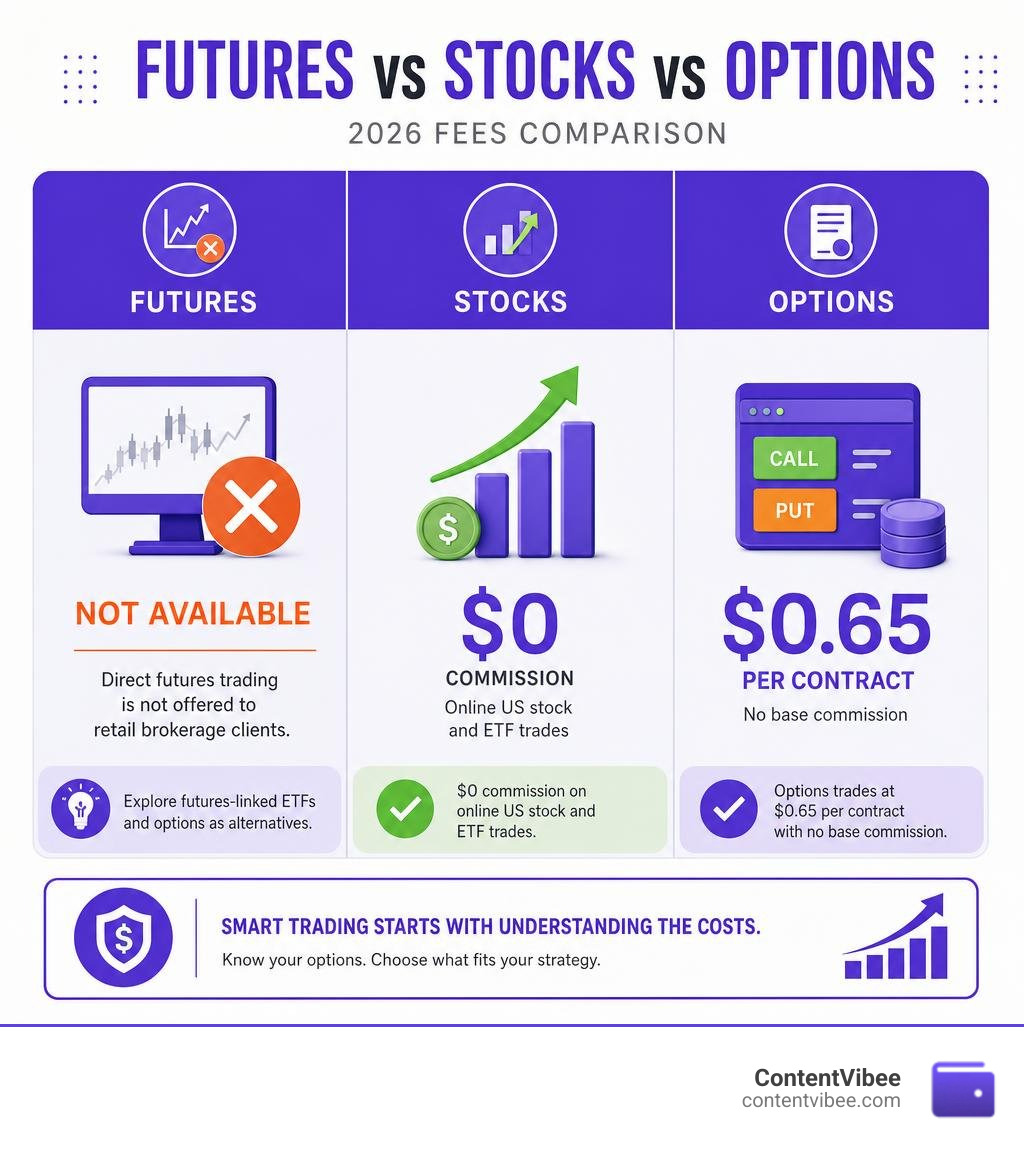
Fidelity does not currently offer direct futures trading to retail brokerage clients. If you’re looking to trade futures contracts like ES (S&P 500 E-mini) or crude oil directly, Fidelity is not set up for that.
But that doesn’t mean you’re out of options. Fidelity does offer:
- $0 commission on online US stock and ETF trades
- $0.65 per contract for options trades (with no base commission)
- Access to futures-linked ETFs and options as alternatives
- Margin rates as low as 7.50% for qualifying account balances
- A base margin rate of 10.575% (effective December 12, 2025)
So if you’re a mid-career investor — maybe approaching retirement and wondering how futures or alternative assets fit into a tax-advantaged account like an IRA — understanding what Fidelity does charge, and what it doesn’t offer, is the right place to start.
This guide walks you through exactly that: what Fidelity charges, what you can actually trade, and how to think about cost efficiency for your situation.
Simple guide to fidelity futures commissions:
Understanding Fidelity Futures Commissions and Account Capabilities
When we talk about futures trading, we are looking at agreements to buy or sell an asset at a predetermined future date and price. This is a highly specialized, leveraged realm of the financial world. For retail traders looking to manage their risk or speculate on macro moves, the search for competitive futures pricing is a top priority.
At ContentVibee, we believe in giving you the straight facts without making you dig through the fine print. To understand how futures fit into your broader portfolio strategy, it helps to look at our breakdown of Fidelity Fees And Commissions Explained Without The Fine Print.
While Fidelity is a powerhouse for traditional retirement planning, wealth management, and stock trading, it does not support direct futures contracts. Instead of trading physical commodities or index futures directly in a retail brokerage account, Fidelity directs retail investors toward alternative derivatives. These include options on highly liquid exchange-traded funds (ETFs) and specialized equity products that track commodity indexes.
By utilizing these alternative derivatives, you can gain similar economic exposure to oil, gold, or the S&P 500 without needing a specialized futures margin account.
The Reality of Fidelity Futures Commissions for Retail Traders
If you open a standard brokerage account expecting to trade direct futures, you will quickly find that the option is unavailable. Because of this, there is no standard schedule for fidelity futures commissions on standard contracts like the E-mini S&P 500 or micro crude oil.
For traders who absolutely must trade direct futures, looking at dedicated futures brokers is necessary. In those environments, standard futures commission structures are typically priced on a per-contract basis. For example, some specialized brokers charge tiered rates ranging from $0.25 to $0.85 per contract depending on your monthly trading volume. You can see how these external pricing models work by looking at the standard tiered schedules in the Commissions Futures | Interactive Brokers LLC guide.
If you are trading other instruments at Fidelity, you will enjoy a highly competitive fee structure. Online trades for US stocks and ETFs carry a $0 commission. If you prefer to look at the official documentation for all supported assets, you can review the Trading Commissions and Margin Rates | Fidelity page.
How to Navigate Fidelity Futures Commissions in Retirement Accounts
Many long-term investors want to use futures or alternative derivatives to hedge their portfolios inside tax-advantaged accounts like a Traditional IRA or a Roth IRA.
While you cannot trade direct futures in a Fidelity IRA, you can trade futures-based ETFs (such as those tracking the VIX, gold, or agricultural commodities) and write options on those ETFs. Doing so within an IRA offers massive tax advantages. In a standard taxable account, short-term trading of derivatives can trigger heavy tax burdens. Within an IRA, your gains grow tax-deferred (or tax-free in the case of a Roth IRA), allowing your compound interest to work much harder.
Before you begin executing complex options or alternative strategies in a retirement account, make sure you understand the rules. You can learn more about account maintenance and compliance by reading our Fidelity Brokerage Account Fees Review What You Need To Know.
Comparing Fidelity’s Standard Fees to Futures Industry Standards
To put things in perspective, let us look at how Fidelity’s standard trading fees compare to what you would pay at a broker that specializes in direct futures.

While direct futures trading requires paying a execution fee, exchange clearing fees, and regulatory fees (NFA fees) on every single contract, Fidelity keeps its standard equity and options pricing incredibly transparent.
| Asset Class | Fidelity Online Fee | Typical Futures Broker Fee |
|---|---|---|
| US Stocks & ETFs | $0.00 | N/A (or clearing fees) |
| Options Contracts | $0.00 base + $0.65/contract | N/A |
| Standard Futures | Not Offered | $0.25 to $0.85/contract + exchange fees |
| Micro Futures | Not Offered | $0.10 to $0.50/contract + exchange fees |
If you are looking to trade options as a proxy for futures, you will find that Fidelity’s options pricing is highly competitive. With a $0 base fee and only $0.65 per contract, it is easy to scale into positions. For a complete look at how options pricing works, check out our guide to Fidelity Option Commissions.
Conversely, if you decide to use a dedicated futures broker, your transaction costs will include exchange fees (charged by the CME, ICE, or CBOE) which can add an extra $1.00 to $2.50 per contract on top of the broker’s commission. You can review these additional regulatory and exchange costs in the Commissions Futures | Interactive Brokers LLC documentation.
Margin Requirements and Leverage Alternatives at Fidelity
Futures trading is popular primarily because of leverage. When you trade a futures contract, you only need to put up a small fraction of the contract’s total value (known as performance bond margin).
Because Fidelity does not offer direct futures, retail traders must use margin accounts to gain leverage on stocks, ETFs, and options. Margin trading allows you to borrow against your existing securities to purchase more assets.
Fidelity’s margin rates are structured in tiers, with a base margin rate of 10.575% (effective since December 12, 2025). However, if you maintain a larger debit balance, you can unlock much lower rates:
- $0 to $24,999 debit balance: 11.825%
- $1,000,000+ debit balance: Rates as low as 7.50%
Using margin to trade leveraged ETFs or multi-leg options strategies can simulate the leverage of a futures contract, but you must be highly aware of the borrowing costs. To find out how to optimize your cash balance and minimize interest costs, read our comprehensive Fidelity Trading Fees And Savings guide.
Trading Platforms and Tools for Alternative Derivatives
To trade alternative derivatives effectively, you need powerful analytical software. Fidelity provides its flagship platform, Active Trader Pro (ATP), free of charge to all active traders.
Active Trader Pro offers:
- Real-time streaming market data and customizable charts.
- Advanced options analysis tools, including profit-and-loss charts.
- Multi-leg options order entry.
- Risk monitoring tools to keep your leverage in check.
If you are wondering about the future of Fidelity’s desktop software and how it compares to newer web-based platforms, you will find our review of the Fidelity Active Trader Pro Replacement highly valuable.
Frequently Asked Questions About Fidelity Futures
Can you trade futures directly on Fidelity?
No. Fidelity does not support direct futures or options on futures trading for retail accounts. If you want to trade physical commodities or equity index futures directly, you will need to open an account with a specialized futures broker. However, you can trade futures-based ETFs and standard options on Fidelity. For more on transaction costs, see our guide on Fidelity Fee Per Trade.
What are the fees for trading options on Fidelity?
Fidelity charges $0.00 base commission for online options trades, plus a $0.65 per-contract fee. Notably, if you place a buy-to-close order for an option priced between $0.00 and $0.65, Fidelity waives the contract fee. For a deeper look at these rules, read our article Are Fidelity Trades Really Free Demystifying The Fees.
Does Fidelity charge an outgoing account transfer fee?
No. Fidelity is one of the few major brokers that charges $0 for outgoing ACAT transfers. This means if you ever decide to transfer your assets to another broker to trade direct futures, you won’t be penalized with an exit fee. You can read more about account transfer policies in our Fidelity Brokerage Account Fees Review What You Need To Know.
Conclusion
While fidelity futures commissions do not exist for direct contracts, Fidelity remains an exceptional platform for long-term wealth building, retirement planning, and trading alternative derivatives. By utilizing options, commodity ETFs, and tax-advantaged IRAs, you can achieve your financial goals with minimal friction.
At ContentVibee, we are dedicated to helping you make smart, actionable financial decisions. To learn how to keep more of your hard-earned money and trade efficiently, check out our ultimate Fidelity Trading Fees and Savings Guide.


