


Why Catch-Up Contribution Limits Matter for Your Retirement
Catch-up contribution limits are the extra amounts the IRS allows workers age 50 and older to save in retirement accounts each year — on top of the standard limits everyone else gets.
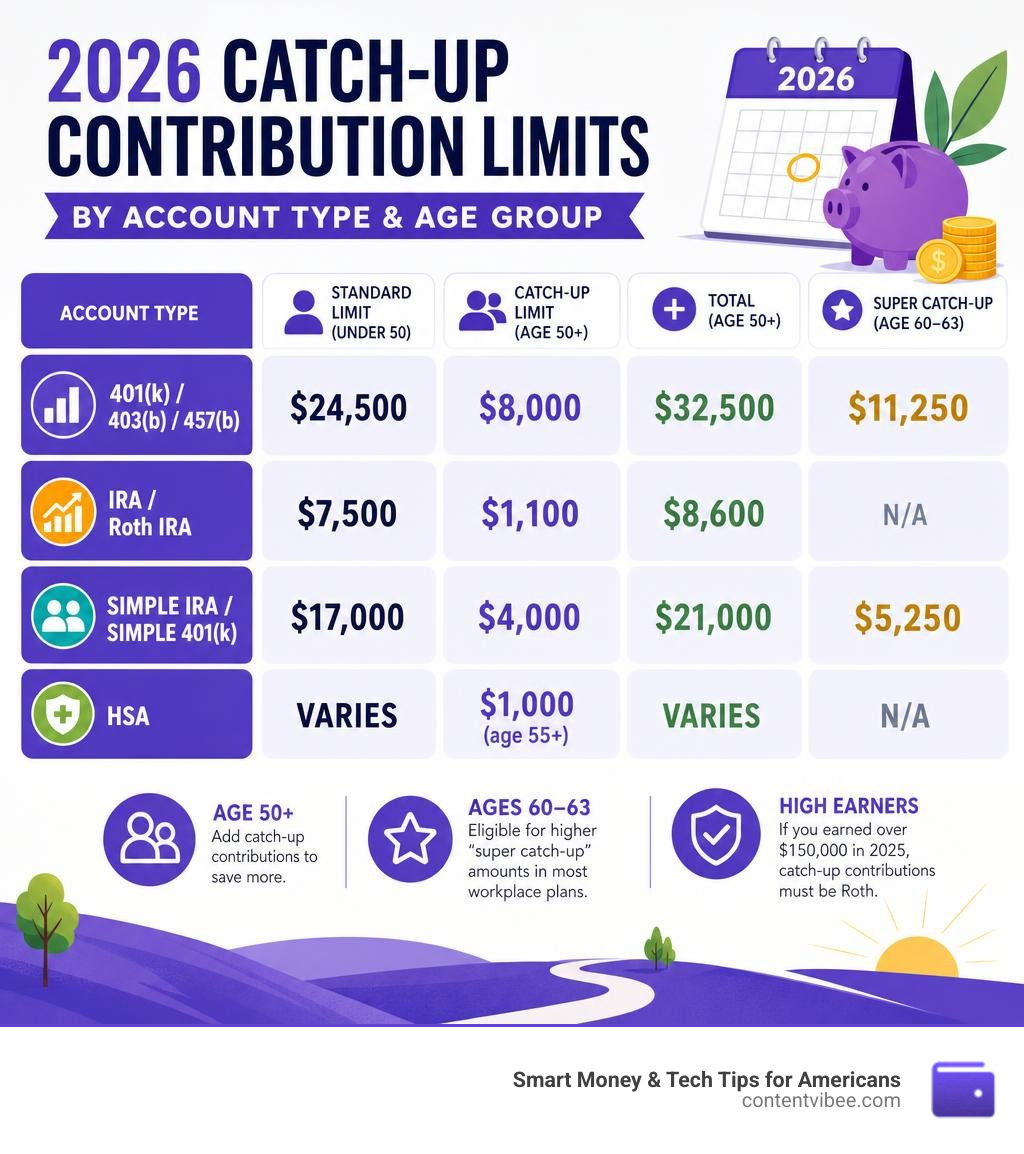
Here’s a quick snapshot of the 2026 catch-up limits by account type:
| Account Type | Standard Limit | Catch-Up (Age 50+) | Total (Age 50+) | Super Catch-Up (Age 60-63) |
|---|---|---|---|---|
| 401(k) / 403(b) / 457(b) | $24,500 | $8,000 | $32,500 | $11,250 |
| IRA / Roth IRA | $7,500 | $1,100 | $8,600 | N/A |
| SIMPLE IRA / SIMPLE 401(k) | $17,000 | $4,000 | $21,000 | $5,250 |
| HSA | Varies | $1,000 (age 55+) | Varies | N/A |
If you’re 50 or older and feel like you got a late start on saving, these rules were designed specifically for you. They let you put away significantly more each year — giving your nest egg a meaningful boost right when you need it most.
And in 2026, two big changes make this even more important:
- Ages 60-63 can now use a “super catch-up” limit of $11,250 in most workplace plans, thanks to the SECURE 2.0 Act.
- High earners (those who made over $150,000 in 2025) must now make their catch-up contributions to a Roth account — a rule that changes the tax strategy for millions of workers.
This guide breaks down every limit, every rule, and every deadline you need to know — so you can make the most of the time you have left before retirement.
Discover more about catch up contribution limits:
Understanding the 2026 Catch Up Contribution Limits

At its core, a catch-up contribution is an IRS-sanctioned way to fast-track your retirement savings. The IRS establishes standard annual contribution limits for various retirement vehicles to prevent individuals from sheltering unlimited amounts of income from taxes. However, recognizing that many Americans find themselves behind on their retirement goals as they approach their golden years, the government created catch up contribution limits.
These limits allow individuals of a certain age—typically 50 and older—to make elective deferrals beyond the standard annual caps.
Under IRS rules, your contributions are not officially classified as “catch-up” until your total savings for the year exceed either the standard annual limit or the specific plan limits (such as those determined by non-discrimination testing). Once you cross that threshold, any additional money you save is categorized under the catch-up umbrella, up to the maximum allowable catch-up limit.
For 2026, the IRS has adjusted these limits upward to account for inflation. Navigating these rules requires understanding how different accounts interact. To help you stay compliant and optimize your strategy, you can review the official COLA increases for dollar limitations on benefits and contributions | Internal Revenue Service .
Additionally, if you want to understand how your baseline savings are calculated before you factor in these extra amounts, check out our guide on The Ultimate Guide To Calculating Your 401K Contributions.
Standard 401(k), 403(b), and 457(b) Catch Up Contribution Limits
For most workplace retirement plans—including traditional 401(k)s, 403(b) plans for non-profit and educational employees, and governmental 457(b) plans—the standard elective deferral limit for 2026 is $24,500.
If you are age 50 or older by December 31, 2026, you are eligible to make a standard catch-up contribution of $8,000. This brings your total allowable employee contribution to $32,500 for the year.
These rules also apply to federal employees utilizing the Thrift Savings Plan (TSP). For detailed agency-specific guidelines on how these limits are implemented, you can refer to the 2026 TSP Contribution Limits | The Thrift Savings Plan (TSP) .
It is important to note that this $32,500 limit only applies to your pre-tax or Roth elective deferrals as an employee. If your employer offers matching contributions or non-elective contributions, the absolute maximum ceiling—known as the Section 415 limit or the “annual additions limit”—is $72,000 for 2026. However, for participants age 50 and older, this combined limit jumps to $80,000 once the $8,000 catch-up contribution is included.
To learn more about maximizing your workplace accounts and ensuring you do not leave free employer matching dollars on the table, read our comprehensive guide: Dont Leave Money On The Table The Ultimate 401K Max Calculator Guide.
IRA and Roth IRA Catch Up Contribution Limits
Individual Retirement Accounts (IRAs) operate on a different scale than employer-sponsored plans. For 2026, the standard IRA contribution limit is $7,500. For savers age 50 and older, the IRA catch-up contribution limit is $1,100, which allows for a maximum annual contribution of $8,600 across all your traditional and Roth IRAs combined.
Unlike workplace plans, where catch-up contributions are managed via payroll deductions throughout the calendar year, you have until the tax-filing deadline in April 2027 to make your 2026 IRA contributions.
However, you must keep income limits and phase-out rules in mind:
- Traditional IRA Deductibility: If you or your spouse are covered by a retirement plan at work, your ability to deduct traditional IRA contributions phases out at higher income levels.
- Roth IRA Contribution Eligibility: Your ability to contribute directly to a Roth IRA is entirely restricted if your Modified Adjusted Gross Income (MAGI) exceeds certain thresholds. For high earners, the “backdoor Roth IRA” remains a viable alternative, but direct contributions are subject to strict phase-outs.
To weigh the tax advantages of pre-tax traditional savings versus tax-free Roth growth, explore The Great Retirement Debate Roth Vs Traditional 401K Calculator Guide.
SIMPLE IRA and HSA Catch-Up Rules
Workplace SIMPLE IRA and SIMPLE 401(k) plans are tailored for small businesses, and they feature their own distinct limits. For 2026, the standard salary reduction limit for a SIMPLE plan is $17,000. The catch-up contribution limit for participants age 50 and older is $4,000, enabling a maximum contribution of $21,000.
Health Savings Accounts (HSAs) represent another powerful, tax-advantaged savings vehicle. Often called the “triple-tax-advantaged” account, HSAs allow for tax-deductible contributions, tax-free growth, and tax-free withdrawals for qualified medical expenses.
HSAs feature a unique catch-up structure:
- Age Requirement: The catch-up provision begins at age 55, rather than age 50.
- Catch-Up Amount: Eligible individuals can contribute an additional $1,000 per year.
- Strategy: If you can afford to pay for current medical expenses out-of-pocket, you can let your HSA contributions compound over time, effectively turning your HSA into a supplementary retirement account.
SECURE 2.0 and the New “Super Catch-Up” for Ages 60-63
One of the most talked-about provisions of the SECURE 2.0 Act is the introduction of the “super catch-up” contribution limit, which is fully active in 2026. This rule targets a highly specific age bracket—individuals who turn 60, 61, 62, or 63 during the calendar year.
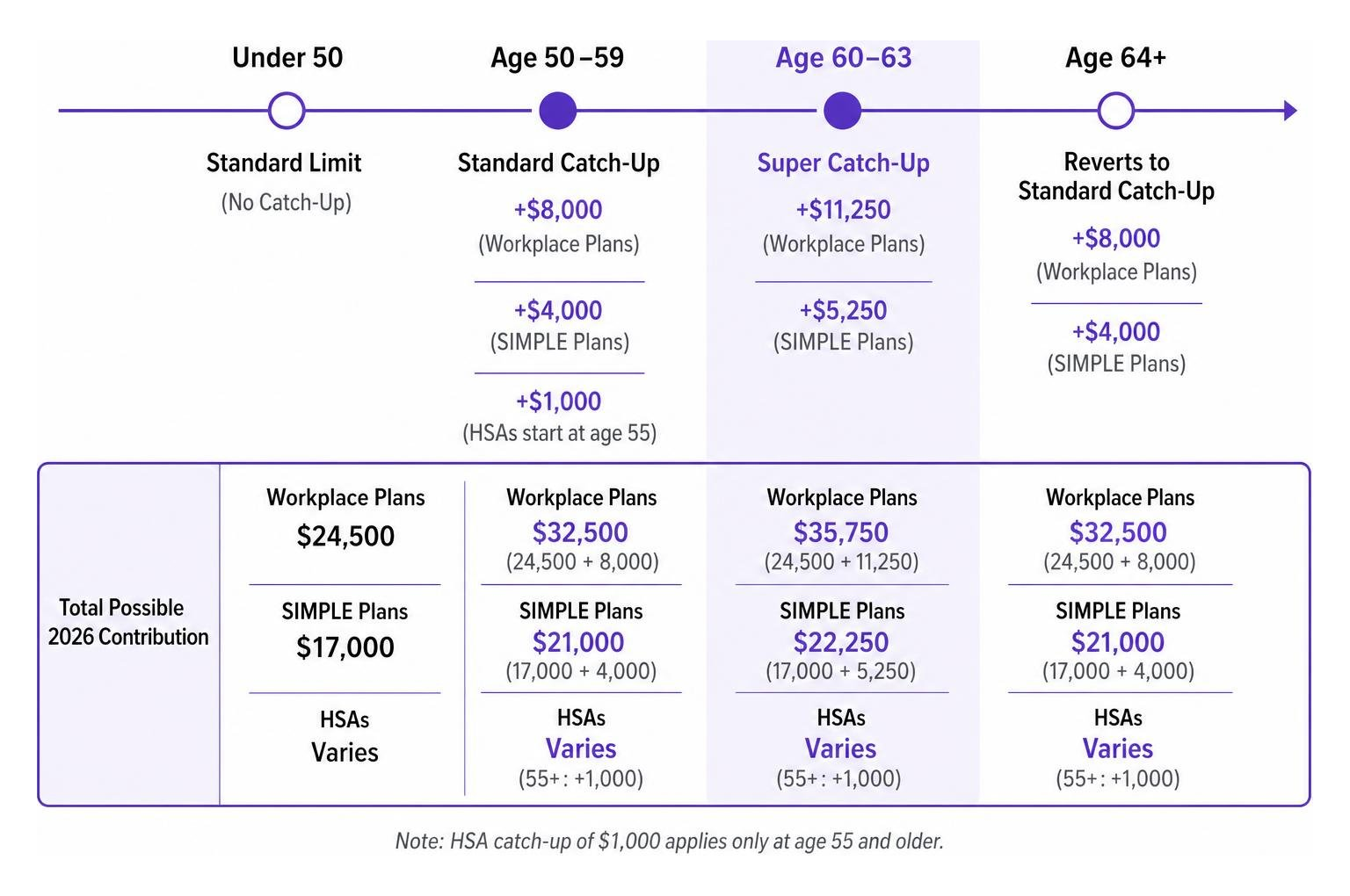
Under this rule, standard workplace plan participants in this age range can make a super catch-up contribution of $11,250 instead of the standard $8,000 catch-up. This means that if you are in this age sweet spot, you can contribute a total of $35,750 ($24,500 standard limit + $11,250 super catch-up) to your 401(k), 403(b), or governmental 457(b) plan in 2026.
For SIMPLE plans, the super catch-up limit for ages 60-63 is $5,250 instead of the standard $4,000 catch-up, allowing a total contribution of $22,250.
Once you turn 64, your catch-up limit reverts to the standard $8,000 limit (adjusted for inflation). This makes the ages of 60 to 63 a critical window to maximize your retirement savings. For official regulatory details on how SECURE 2.0 adjusts these limits over time, you can visit the Retirement topics – Catch-up contributions | Internal Revenue Service page.
The 2026 Mandatory Roth Catch-Up Rule for High Earners
Starting in 2026, a major tax change takes effect for high-earning retirement savers. Under Section 603 of the SECURE 2.0 Act, if your wages in the prior calendar year (2025) exceeded $150,000, any catch-up contributions you make to an employer-sponsored plan—such as a 401(k), 403(b), or TSP—must be made on a Roth (after-tax) basis.
This means you can no longer deduct these catch-up contributions from your current-year taxable income. Instead, they will be funded with after-tax dollars, meaning they will grow tax-free and can be withdrawn tax-free in retirement.
Here is a breakdown of how this rule applies based on your income:

Key details to keep in mind regarding this transition include:
- FICA Wage Definition: The $150,000 threshold is based on your Medicare wages (Box 5 of your W-2) from the previous year, earned from the employer sponsoring your current plan.
- Plan Requirements: If a plan has even one high-earning participant, the employer must offer a Roth option for catch-up contributions. If the employer does not offer a Roth feature, no one in the plan—regardless of income—will be allowed to make catch-up contributions.
- Exclusion of IRAs: This mandatory Roth rule applies only to employer-sponsored plans. Standard and Roth IRA catch-up contributions are not subject to this high-earner restriction.
This change represents a shift in tax-planning strategies. While you lose the immediate tax break on your catch-up contributions, you gain tax-free growth and tax-free distributions in the future. To understand how to blend pre-tax, Roth, and traditional after-tax contributions to maximize your long-term wealth, check out our guide on After Tax Contributions How To Maximize Your Retirement Nest Egg and read Understanding new Roth 401(k) catch-up rules .
Pros, Cons, and Strategic Planning for Catch-Up Contributions
Deciding whether to max out your catch up contribution limits requires evaluating your current financial health, your tax bracket, and your retirement timeline.
The Benefits
- Accelerated Compounding: Putting away an extra $8,000 or $11,250 per year starting at age 50 can have a massive impact. For example, contributing an extra $8,000 annually for 15 years (from age 50 to 65) at an average annual return of 7% can add over $200,000 to your retirement nest egg.
- Tax Optimization: For those below the $150,000 income threshold, pre-tax catch-up contributions lower your current Adjusted Gross Income (AGI), reducing your tax bill today.
- Tax-Free Growth: For high earners forced into Roth catch-ups, or those who choose the Roth path, you secure tax-free growth and tax-free withdrawals, protecting yourself against future tax rate increases.
The Drawbacks and Considerations
- Cash Flow Constraints: Saving an extra $8,000 to $11,250 per year requires a significant monthly commitment. You must ensure this does not compromise your ability to maintain an emergency fund or pay down high-interest debt.
- Lack of Liquidity: Once funds are placed in a retirement account, accessing them prior to age 59½ can trigger a 10% IRS early withdrawal penalty (with some exceptions).
To build a balanced approach that reduces your current tax burden while keeping your savings liquid, explore our Smart Strategies To Defer Taxes And Boost Your Retirement Savings. For a broader perspective on retirement timelines and savings strategies, you can read Catch-Up Contributions 2025 and 2026: A Guide .
Frequently Asked Questions About Catch-Up Contributions
Can I make catch-up contributions to both an IRA and a 401(k)?
Yes. The catch-up limits for IRAs and employer-sponsored plans like 401(k)s are entirely independent of one another. If you are age 50 or older, you can contribute the maximum catch-up amount to your workplace plan ($8,000, or $11,250 if you qualify for the super catch-up) and also contribute the maximum catch-up amount to an IRA ($1,100). This allows you to save up to $41,150 or $44,400 in tax-advantaged accounts in 2026.
What happens if I overcontribute to my retirement plan?
If you accidentally contribute more than the combined standard and catch-up limits, the excess amount is considered an “excess deferral.” If left uncorrected, this money is taxed twice: once in the year you made the contribution, and again when you withdraw it in retirement. To fix this, you must notify your plan administrator and request a corrective distribution of the excess amount (plus any earnings on those funds) by April 15 of the following year.
Do catch-up contributions qualify for employer matching?
It depends on your employer’s plan design. Some employers match all employee contributions, including catch-up contributions, up to a certain percentage of your salary. Many plans utilize the “spillover method,” which automatically transitions your contributions into catch-up savings once you hit the standard limit, ensuring you do not miss out on any matching funds. You should check with your HR department or plan administrator to understand how your specific plan handles matches on catch-up contributions.
Conclusion
Maximizing your catch up contribution limits is one of the most effective ways to strengthen your financial security as retirement approaches. Whether you are taking advantage of the standard $8,000 catch-up, leveraging the new $11,250 super catch-up for ages 60-63, or adjusting your strategy to accommodate the new Roth mandate for high earners, staying informed is key to optimizing your tax strategy.
At ContentVibee, we are committed to providing you with clear, actionable insights to help you make smart money decisions. To see how these extra contributions can impact your retirement timeline and to model your savings over time, use our free ContentVibee Finance Calculator.


