


What the Fidelity Price Per Trade Actually Costs You (Quick Answer)
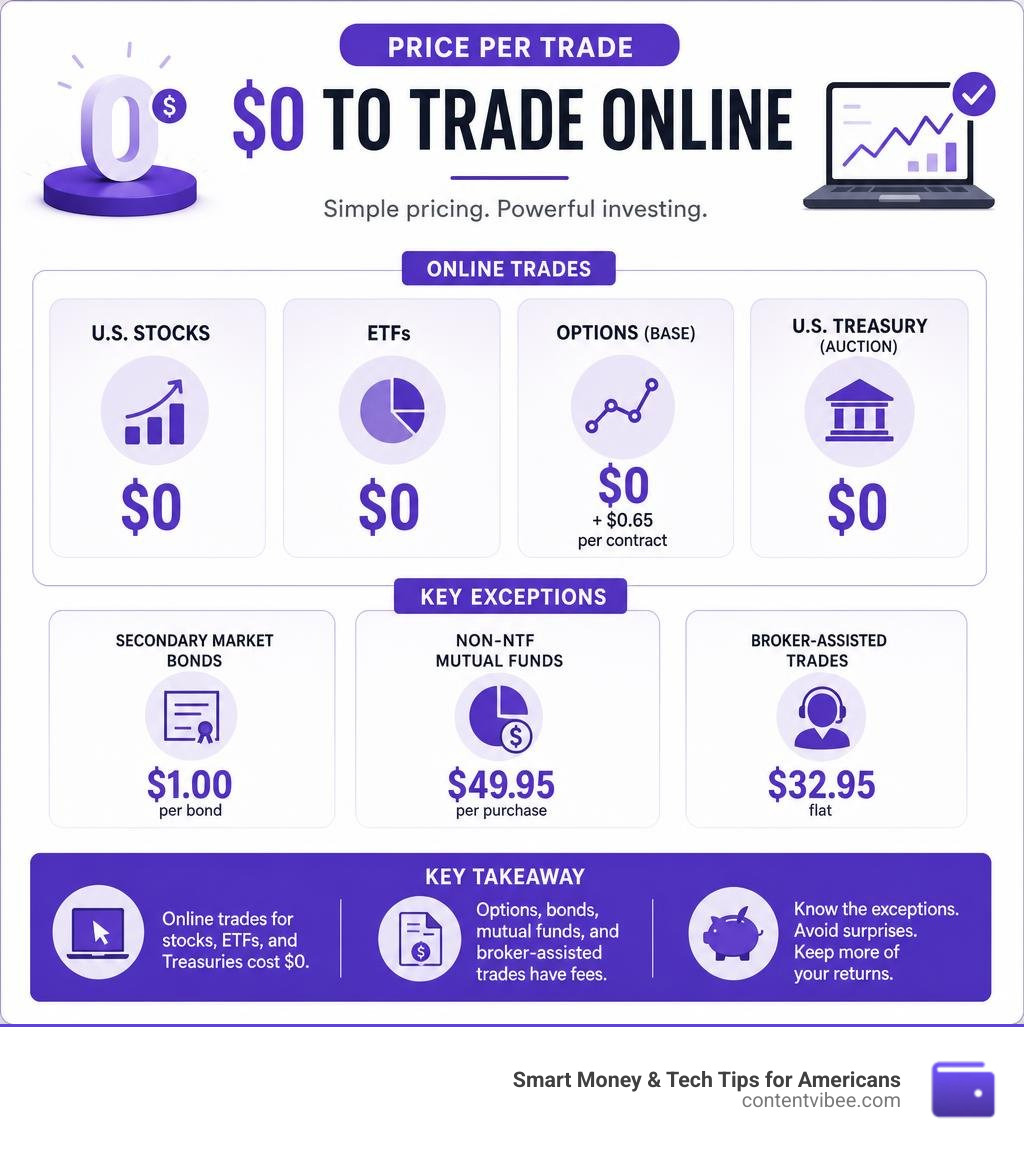
The fidelity price per trade is $0 for online U.S. stocks, ETFs, and options — but options add a $0.65 per-contract fee on top of that zero base commission. Here’s a quick breakdown:
| Trade Type | Online Cost |
|---|---|
| U.S. stocks | $0 |
| ETFs | $0 |
| Options (base) | $0 + $0.65 per contract |
| U.S. Treasury (auction) | $0 |
| Secondary market bonds | $1.00 per bond |
| Non-NTF mutual funds | $49.95 per purchase |
| Broker-assisted trades | $32.95 flat |
So for most everyday investors buying stocks or ETFs online, the cost is simply zero.
That said, “zero commission” doesn’t always mean “zero cost.” Fidelity’s pricing structure has layers — and depending on how you trade, what you trade, and how much you borrow, your real costs can vary quite a bit.
For example, if you call a representative to place a trade instead of doing it online, that same stock trade jumps to $32.95. Trade options on 20 contracts? You’ll pay $13 in contract fees alone. And if you’re borrowing on margin, interest rates range from 7.50% to 11.825% depending on your balance.
Understanding the full picture — not just the headline “$0” — is what separates savvy investors from those who get surprised by their account statements.
This guide breaks down every layer of Fidelity’s cost structure so you know exactly what you’re paying and where you might be able to save.
Fidelity price per trade vocab explained:
Understanding the Fidelity Price Per Trade for Stocks and ETFs
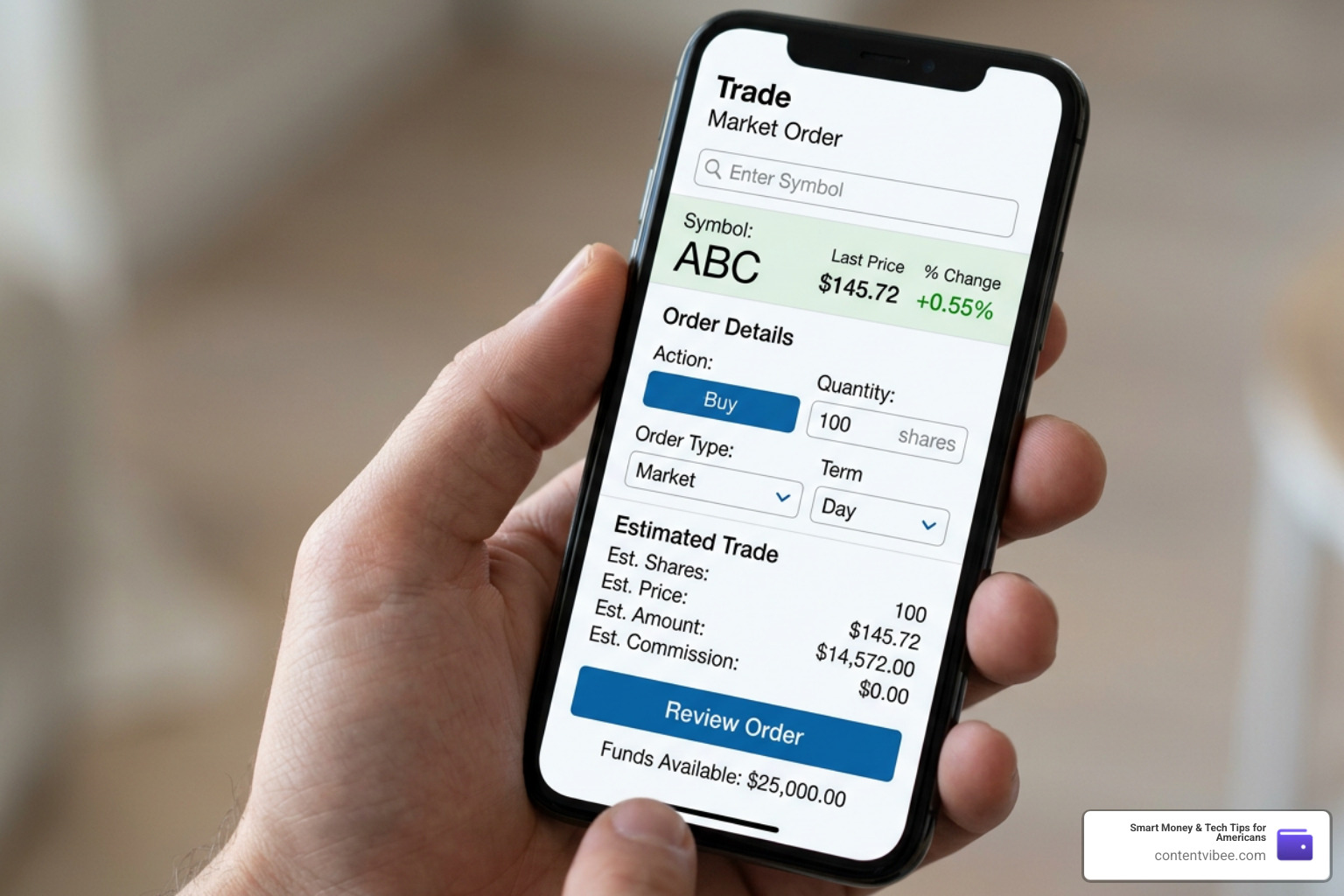
When we look at the core of self-directed investing, the fidelity price per trade for standard U.S. equities and Exchange-Traded Funds (ETFs) is exceptionally straightforward. Since the industry-wide shift to commission-free trading, online trades executed through the website, the Fidelity Mobile app, or platforms like Active Trader Pro will cost you exactly $0.00. This applies regardless of whether you are buying one single share or 10,000 shares.
But why does this matter so much? Many brokerages claim to offer free trading, yet they quietly make up for it with poor order execution. Fidelity stands out here by focusing on price improvement. In fact, third-party data shows that Fidelity saves investors an average of $24.50 on a 1,000-share equity order compared to the industry average of $4.34. This means you aren’t just saving on the front-end commission; you are also getting a better entry and exit price on your shares.
For retail investors who don’t have thousands of dollars to buy full shares of high-priced tech stocks, Fidelity offers fractional share trading (also known as dollar-based investing). You can purchase fractional shares of over 7,000 U.S. stocks and ETFs with a minimum transaction value of just $1.00. Best of all, there are no extra fees or commissions attached to these partial transactions.
To understand how these zero-commission claims hold up under scrutiny, you can read our detailed breakdown on Are Fidelity Trades Really Free Demystifying The Fees. For the absolute fine print straight from the source, you can also consult the official Fidelity Brokerage and Commission Fee Schedule | Trading information .
Here is a quick look at how the different trading channels compare for standard stock and ETF transactions:
| Trading Channel | Commission Rate |
|---|---|
| Online (Web, Mobile, Active Trader Pro) | $0.00 |
| FAST (Automated Phone System) | $12.95 |
| Representative-Assisted (Live Broker) | $32.95 |
How Options Contracts Affect the Fidelity Price Per Trade
If you want to incorporate options into your investment strategy, the pricing model changes slightly. While the base commission to open or close an options position online remains $0.00, you will be charged a standard contract fee of $0.65 per contract.
This contract fee is highly competitive, but it does scale directly with your trading volume. For instance, if you execute a multi-leg order or trade in large blocks, those $0.65 fees can add up:
- Trading 5 contracts: $3.25
- Trading 50 contracts: $32.50
- Trading 100 contracts: $65.00
There is, however, a very friendly rule for small-time options traders: Fidelity does not charge a contract fee to close out short options (write-to-cover or buy-to-close) if the contract value is $0.10 or less. This allows you to lock in your profits on decaying options without paying a fee to exit.
For professional options traders, different volume-based schedules or additional exchange fees may apply. You can explore the full nuances of these contracts and how multi-leg orders are calculated in our guide on Fidelity Options Fees Explained And Demystified.
Broker-Assisted Surcharges and the True Fidelity Price Per Trade
In our digital-first world, we often assume everyone trades online. But what happens if your internet goes down, your app glitches, or you simply prefer having a human guide you through a complex transaction? This is where you have to watch out for the broker-assisted trade fee.
Fidelity provides two alternative channels for trading, both of which incur surcharges:
- FAST (Fidelity Automated Service Telephone): This is an interactive voice-response phone system. If you execute a stock or ETF trade through FAST, the cost is $12.95 per trade.
- Representative-Assisted Trades: If you speak directly with a live Fidelity associate to place a trade, you will be charged a flat fee of $32.95 per trade.
For options trades placed through these phone channels, the surcharge is added to the standard $0.65 per-contract fee. This means a representative-assisted trade of 10 options contracts would cost you $32.95 plus $6.50, totaling $39.45.
While these fees might seem high, they are designed to cover the operational costs of maintaining live phone support. To avoid these costs entirely, we highly recommend stick to online trading platforms whenever possible. To learn more about when these fees are applied and how to request a waiver during system outages, check out our resource on Broker Assisted Trade Fee Fidelity.
Mutual Funds, Fixed Income, and Other Investment Fees

Moving beyond stocks and options, let’s look at how the fidelity price per trade translates to mutual funds and fixed-income products. Fidelity is famous for its massive mutual fund marketplace, but navigating the fees here requires some attention.
Fidelity categorizes mutual funds into three distinct buckets:
- Fidelity Funds: These are proprietary funds managed directly by Fidelity (such as the popular FXAIX or their ZERO-expense ratio index funds like FZROX). These carry a $0.00 transaction fee to buy, sell, or exchange.
- FundsNetwork No-Transaction-Fee (NTF) Funds: Fidelity partners with other fund families to offer over 3,700 mutual funds with no transaction fees. However, these are subject to a short-term redemption fee of $49.95 if you sell or exchange your shares within 60 days of purchase. This fee is designed to discourage short-term trading and protect long-term fund shareholders.
- Transaction-Fee Funds: If you buy a non-Fidelity mutual fund that is not on the NTF list, you will pay a flat $49.95 per purchase. Selling these funds, however, typically costs $0.
To avoid costly surprises, we always recommend verifying whether a fund is classified as NTF before clicking the buy button. You can read more about this in our targeted review: Fidelity Mutual Fund Trade Fee When Is Free Not Actually Free.
For fixed-income investors, Fidelity is highly competitive. If you purchase U.S. Treasury securities (including Treasury bills, notes, and bonds) through an online auction or the secondary market, you will pay $0.00 in transaction fees.
For other secondary market bonds and Certificates of Deposit (CDs), Fidelity charges a modest mark-up or mark-down of $1.00 per bond when traded online (with a maximum charge of $250). If you require the assistance of a live broker to place a bond trade, a minimum markup of $19.95 will apply.
To review how these transparent costs fit into a broader portfolio strategy, check out the Straightforward and Transparent Pricing – Fidelity official page.
Margin Rates and Account Balance Tiers
For active traders looking to leverage their portfolios, understanding margin rates is just as critical as knowing the fidelity price per trade. Borrowing on margin allows you to purchase more securities than you have cash to cover, using your existing portfolio as collateral.
Fidelity utilizes a tiered interest rate structure. This means the more money you borrow (your debit balance), the lower your annual interest rate will be. Effective as of late 2025 and holding steady into June 2026, Fidelity’s base margin rate is 10.575%.
Here is how the margin interest rates break down by debit balance tiers:
| Margin Debit Balance | Margin Rate |
|---|---|
| $0 – $24,999 | 11.825% |
| $25,000 – $49,999 | 11.325% |
| $50,000 – $99,999 | 10.575% |
| $100,000 – $249,999 | 10.075% |
| $250,000 – $499,999 | 9.575% |
| $500,000 – $999,999 | 8.750% |
| $1,000,000+ | 7.500% |
How does this stack up against major competitors? Fidelity’s margin rates are remarkably competitive, especially for high-balance accounts. For example, while Fidelity’s lowest rate is 7.50% for balances over $1M, competitors like Schwab, E*Trade, and Vanguard often hover between 10.00% and 10.45% for similar tiers.
However, margin borrowing always carries risk. If your portfolio value drops significantly, you may face a margin call, requiring you to deposit cash or sell off assets immediately to cover the loan. To read more about how these rates are calculated daily and how to apply for margin approval, visit Trading Commissions and Margin Rates – Fidelity Investments .
Hidden Costs, Wire Fees, and Account Minimums
When we evaluate a brokerage, we have to look beyond trading commissions. “Ancillary fees” — the little costs for account transfers, wires, or paper statements — can quietly eat away at your returns if you aren’t careful.
Fortunately, Fidelity is one of the most investor-friendly brokerages when it comes to account maintenance.
- Account Fees: Standard retail brokerage accounts and IRAs have $0.00 annual maintenance fees and no minimum balance requirements.
- Transfer-Out Fees (ACAT): This is a huge differentiator. While most major brokerages charge between $50 and $75 to transfer your account to another firm, Fidelity charges $0.00 for outgoing ACAT transfers.
- Wire Transfers: Incoming wire transfers are completely free. Outgoing domestic bank wires carry a small fee of $10.00, which is significantly lower than the $25 to $35 industry standard. If you want to avoid this $10 fee entirely, you can simply use electronic bank transfers (ACH), which are always free but take 1 to 3 business days to settle.
- Foreign Transaction Fees: If you decide to trade international stocks directly on foreign exchanges (in 25 countries and 16 local currencies), you will be subject to country-specific taxes and a foreign currency exchange fee. This fee starts at 1.0% of the transaction value for amounts under $100,000 and scales down to 0.20% or less for amounts over $1,000,000.
- Regulatory Assessments: For stock sales, small regulatory fees (such as those from the SEC and FINRA) are passed along to the investor. These typically amount to just a few pennies per transaction and are standard across all brokerages.
For a deeper dive into these secondary fees, you can read our comprehensive Fidelity Brokerage Account Fees Review What You Need To Know to ensure you never run into an unexpected charge.
Frequently Asked Questions About Fidelity Trading Costs
Does Fidelity charge an annual fee for brokerage accounts?
No. Standard retail brokerage accounts, including traditional IRAs, Roth IRAs, and individual taxable accounts, have no annual maintenance fees or monthly account fees. There are also no minimum balance requirements to keep your account open.
What is the short-term redemption fee for mutual funds?
Fidelity charges a flat $49.95 short-term redemption fee if you sell or exchange shares of a FundsNetwork No-Transaction-Fee (NTF) mutual fund after holding them for less than 60 days. This fee is designed to prevent short-term trading of mutual funds, which raises administrative costs for all fund holders. It does not apply to Fidelity-branded funds.
Is there a fee to transfer an account out of Fidelity?
Unlike almost all of its major competitors, Fidelity does not charge an outgoing ACAT transfer fee. If you decide to move your assets to another brokerage, you will not face a penalty or transfer fee from Fidelity.
Conclusion
When we look at the complete landscape of retail investing in June 2026, the fidelity price per trade remains one of the most transparent and cost-effective options on the market. For the vast majority of retail investors trading online, the cost of building a portfolio of U.S. stocks, ETFs, and Treasuries is absolute zero.
By eliminating account minimums, annual fees, and outgoing transfer costs, Fidelity has removed almost every major financial barrier to entry. While you do need to keep an eye on broker-assisted surcharges, options contract fees, and short-term mutual fund redemption penalties, these are easily avoidable with a bit of planning.
We believe that cost transparency is the foundation of smart financial planning. If you are ready to evaluate how these trading costs fit into your long-term wealth-building strategy, take a look at our comprehensive analysis on the Fidelity Fee Per Trade and start optimizing your portfolio today.
For more details on maximizing your savings, visit our primary pillar page at https://contentvibee.com/fidelity-fee-per-trade/.


