


How Much Is Your Spouse Social Security Amount — and How Is It Calculated?
Understanding your spouse social security amount could be one of the most important steps you take before retiring. Yet millions of couples miss out on this benefit entirely — either because they don’t know it exists or because they claim at the wrong time.
Here’s a quick answer before we dive deeper:
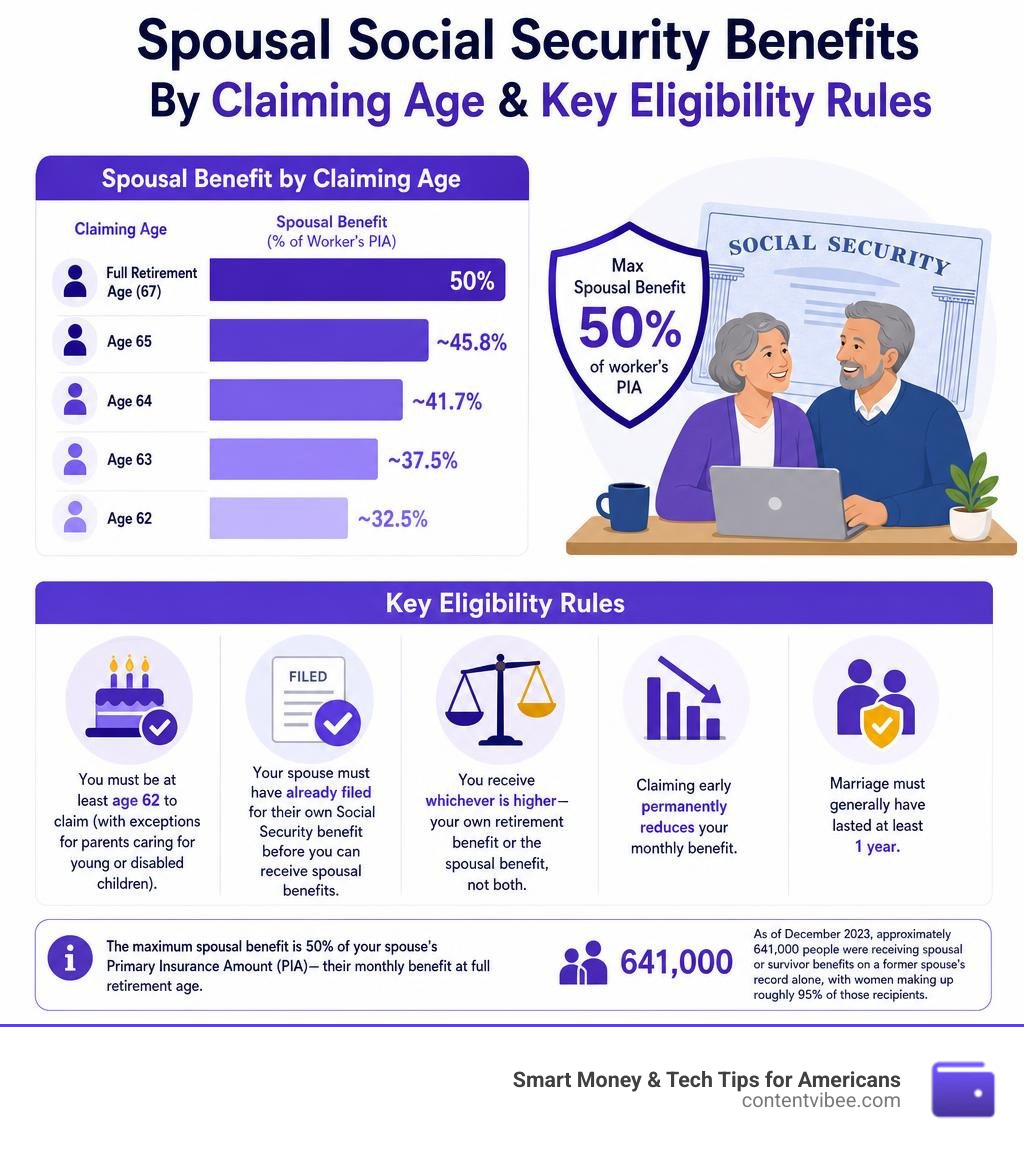
| Claiming Age | Spousal Benefit (% of Worker’s PIA) |
|---|---|
| Full Retirement Age (67) | Up to 50% of worker’s PIA |
| Age 65 | ~45.8% of worker’s PIA |
| Age 64 | ~41.7% of worker’s PIA |
| Age 63 | ~37.5% of worker’s PIA |
| Age 62 | ~32.5% of worker’s PIA |
Key facts at a glance:
- The maximum spousal benefit is 50% of your spouse’s Primary Insurance Amount (PIA) — their monthly benefit at full retirement age
- You must be at least age 62 to claim (with exceptions for parents caring for young or disabled children)
- Your spouse must have already filed for their own Social Security benefit before you can receive spousal benefits
- You receive whichever is higher — your own retirement benefit or the spousal benefit, not both
- Claiming early permanently reduces your monthly amount
For many couples — especially those with unequal earnings histories — spousal benefits can add hundreds of dollars a month to household income. As of December 2023, approximately 641,000 people were receiving spousal or survivor benefits on a former spouse’s record alone, with women making up roughly 95% of those recipients.
The tricky part? When you claim, whether your spouse has filed, and how your own earnings record compares all affect the final number in ways that aren’t always obvious. This guide walks you through each piece so you can calculate exactly what you’re entitled to.
Relevant articles related to spouse social security amount:
What Is a Spousal Benefit and Who Is Eligible?
At its core, a spousal Social Security benefit is designed to provide financial security for couples, particularly when one spouse earned significantly less than the other or took time out of the workforce to care for family. Instead of relying solely on your own work history, the federal government allows you to receive a benefit based on your partner’s earnings record.
But you cannot simply sign up because you are married. The Social Security Administration (SSA) enforces strict eligibility guidelines to ensure that only qualifying couples receive these payments. Understanding these criteria is the first step in unlocking your potential household income. To explore these requirements in depth, you can read The Ultimate Guide to Spousal Social Security Eligibility.
Basic Eligibility Rules for Married Couples
To qualify for a spousal benefit on a living worker’s record, you must meet several fundamental criteria:
- The One-Year Marriage Rule: You must be married to the primary worker for at least one continuous year before you can apply for spousal benefits.
- The Filing Requirement: Your spouse must have already filed for and be receiving their own retirement or disability benefits. If your spouse is waiting until age 70 to claim, you cannot receive spousal benefits on their record in the meantime.
- Age Requirements: You must be at least 62 years old to claim. However, claiming at age 62 will result in a permanent reduction in your monthly payment. To receive the maximum possible amount, you should wait until you reach your own Full Retirement Age (FRA).
To see if your marriage and age align with these rules, check out our guide on How to Check Your Eligibility for Spousal Social Security Benefits.
Exceptions for Caring for a Qualifying Child
There is a major exception to the minimum age requirement of 62. If you are caring for a child of the primary worker, you can collect spousal benefits at any age, and your benefit will not be reduced for early claiming.
To qualify for this exception, the child must be:
- Under the age of 16, or
- Disabled (with a disability that began before age 22) and entitled to receive child’s benefits on your spouse’s record.
Under official SSA guidelines, once the youngest child turns 16, the parent’s spousal benefits will stop unless they are at least age 62. You can review the exact policy and payment regulations in the SSA – POMS: RS 00202.020 – Spouse’s Benefits – Payment – 01/20/2026 manual.
Calculating Your Spouse Social Security Amount
Calculating your spouse social security amount is relatively straightforward in theory, but it requires understanding a few key terms. The most important of these is the Primary Insurance Amount (PIA).
The PIA is the monthly benefit a worker is entitled to receive if they claim at their exact Full Retirement Age (FRA). Under the standard 50% rule, the maximum spousal benefit you can receive is exactly half (50%) of your spouse’s PIA.
For example, if your spouse’s PIA is $2,800 per month, your maximum spousal benefit at your full retirement age is $1,400 per month. If you want to run the math for your own situation, you can read our detailed breakdown on how to Calculate Spouse Retirement Benefits.

How Claiming Age Affects Your Spouse Social Security Amount
While the 50% rule is the gold standard, it only applies if you wait until your own Full Retirement Age to claim. If you decide to claim earlier, the SSA applies a permanent monthly reduction to your benefit.
The reduction formula for early spousal benefits is slightly different—and more aggressive—than the reduction for a worker’s own retirement benefit:
- For the first 36 months before your FRA, your spousal benefit is reduced by 25/36 of 1% for each month.
- For any additional months beyond 36 (up to a maximum of 60 months if claiming at age 62 when your FRA is 67), the benefit is further reduced by 5/12 of 1% per month.
This means that if your FRA is 67 and you claim at age 62 (60 months early), your benefit is reduced by 35% in total. Instead of receiving 50% of your partner’s PIA, you will receive just 32.5% of their PIA.
To understand how timing impacts your strategy, check out our resource At What Age Can I Claim My Spouse’s Social Security? and review the official calculations directly on the Benefits for Spouses – Social Security Administration page.
The Spousal Excess Benefit Formula
What happens if you have your own work history and qualify for a personal retirement benefit? The SSA will not allow you to “double-dip” and collect both your full retirement benefit and a full spousal benefit. Instead, they use the spousal excess benefit formula.
When you apply, the SSA first calculates your own retirement benefit. If your own benefit is higher than the spousal benefit, you simply receive your own amount. If your spousal benefit is higher, you receive your own benefit plus a “top-up” (the excess spousal benefit) to bring your total check up to the spousal benefit amount.
Let’s look at an example for a couple where both have reached their FRA of 67:
- Spouse A (Higher Earner): PIA of $3,000
- Spouse B (Lower Earner): PIA of $1,000
- Maximum Spousal Benefit (50% of Spouse A’s PIA): $1,500
| Benefit Component | Monthly Amount |
|---|---|
| Spouse B’s Own Retirement Benefit | $1,000 |
| Spousal Excess Top-Up ($1,500 – $1,000) | $500 |
| Total Monthly Benefit Paid to Spouse B | $1,500 |
If Spouse B claims at FRA, they receive a total of $1,500. This is paid out as $1,000 from their own record and a $500 spousal top-up. To play with these numbers based on your unique earnings histories, try using our Tools/Finance Calculator/Social Security Spousal Benefit Calculator.
Strategic Claiming: Reductions, Deemed Filing, and Survivor Benefits
When it comes to Social Security, timing is everything. Because early claiming permanently reduces your monthly check, coordinating when you and your spouse file can dramatically alter your lifetime household wealth. A poor claiming strategy can easily cost a couple over $200,000 in lost lifetime benefits. To build an optimal plan, we recommend reading The Smart Couples Guide to Social Security Strategies.
Deemed Filing and Recent Legislative Changes
In the past, savvy couples used strategies like “file-and-suspend” or “restricted applications” to maximize their benefits. A higher-earning spouse would file for benefits and immediately suspend them, allowing their own benefit to earn delayed retirement credits while allowing the lower-earning spouse to collect a spousal benefit. Alternatively, a spouse could file a restricted application to claim only spousal benefits while letting their own retirement benefit grow until age 70.
However, federal law changed these rules for anyone turning 66 after May 1, 2016. Today, the law enforces deemed filing. When you apply for either your own retirement benefit or a spousal benefit, you are “deemed” to have applied for both. The SSA will automatically calculate both and pay you the higher amount. You can no longer choose to receive only the spousal benefit while delaying your own.
For an in-depth analysis of how these post-2016 rules impact modern retirement planning, you can read the guide on Spousal Benefits: An Often Overlooked Key to Maximizing Social … .
Divorced Spouse Claiming Rules
If you are divorced, you may still be eligible to claim a spousal benefit on your ex-spouse’s record. The SSA has specific rules to ensure this benefit is available to former partners without impacting the ex-spouse’s current family:
- The 10-Year Rule: Your marriage must have lasted for at least 10 consecutive years before the divorce was finalized.
- Marital Status: You must currently be unmarried. If you remarry, you generally lose the right to claim on your ex-spouse’s record (unless your second marriage ends).
- The 2-Year Rule: If your ex-spouse has not yet filed for benefits but is eligible (at least age 62), you can still claim on their record if you have been divorced for at least two continuous years.
- No Impact on Others: Claiming on an ex-spouse’s record does not reduce their own benefit, nor does it affect the benefits of their current spouse.
To learn more about navigating these complex rules, read Can Divorced Spouse Get Social Security Benefits?.
How Survivor Benefits Differ from Spousal Benefits
It is incredibly common to confuse spousal benefits with survivor benefits, but they are entirely different programs with different math. While a spousal benefit is capped at 50% of a living worker’s PIA, a survivor benefit can be up to 100% of the deceased worker’s actual benefit.
If the higher-earning spouse dies first, the surviving spouse’s smaller benefit stops, and they step into the larger benefit amount of the deceased.
Furthermore:
- Survivor benefits can be claimed as early as age 60 (or age 50 if the survivor is disabled).
- The claiming age of the higher earner matters immensely. If the higher earner delayed claiming until age 70 to maximize their check, that larger amount is passed on entirely to the surviving spouse. If they claimed early at 62, they permanently cap the widow’s benefit at a lower amount.
How to Estimate and Apply for Your Spousal Benefits
Ready to take action? The process of estimating and applying for your spouse social security amount has become highly streamlined thanks to digital government services, but you still need to know where to look and what documents to gather. To prepare yourself for the application, read our walkthrough on how to Claim Spousal Benefits.
Estimating Your Spouse Social Security Amount Online
The most accurate way to estimate your future household income is by utilizing the tools provided directly by the SSA.
- Go to ssa.gov and log into (or create) your personal my Social Security account.
- Scroll to the Retirement Calculator section.
- Select the option to “Calculate a Benefit as a Spouse” or “Compare with Benefit as a Spouse.”
- Enter your spouse’s estimated Primary Insurance Amount (PIA) at their Full Retirement Age.
- Choose your planned claiming age or date to see an instant, personalized projection of your monthly spousal benefit.
For direct access to these estimation tools and step-by-step guidance, visit the Social Security Spouse’s Benefit Estimates page.
Steps and Documents Needed to Apply
When you are ready to officially file, you can apply online at ssa.gov, call the toll-free number at 1-800-772-1213, or schedule an in-person appointment at your local California SSA office.
To complete Form SSA-2-BK (the official application for spouse’s benefits), you will need to gather the following documents:
- Your Social Security number and your spouse’s Social Security number.
- Your birth certificate.
- Proof of U.S. citizenship or lawful alien status.
- Your marriage certificate (and divorce decrees if claiming on an ex-spouse’s record).
- Your recent W-2 forms or self-employment tax returns to verify your own earnings history.
To keep these requirements handy, you can download the SOCIAL SECURITY quick reference guide, which details the annual limits, COLA updates, and required documentation.
Frequently Asked Questions About Spousal Social Security
Navigating the rules of the SSA can feel like learning a foreign language. Here are answers to some of the most common questions we receive from California retirees.
Can I collect my own retirement benefit and a spousal benefit at the same time?
No, there is no “double-dipping.” The SSA will calculate both benefits and pay you the higher of the two amounts. If your spousal benefit is larger than your own retirement benefit, you will receive your own benefit amount plus a spousal excess top-up to bridge the difference. You can read more about how this works for dual-income households in our article, Do Both Spouses Collect Social Security?.
Does my spousal benefit increase if my spouse delays claiming past full retirement age?
No. Delayed retirement credits (which increase a worker’s own benefit by 8% per year for every year they delay claiming past FRA up to age 70) do not apply to spousal benefits. A spousal benefit is strictly capped at 50% of the worker’s PIA. Waiting past your own FRA to claim a spousal benefit will not increase your check. For more on how timing affects these payouts, read Social Security Spousal Benefits Timing Is Everything.
Will claiming a spousal benefit reduce my partner’s own monthly payment?
Absolutely not. Your spousal benefit is paid independently. Claiming on your partner’s work record has zero impact on the amount they receive each month, nor does it affect any benefits paid to a divorced ex-spouse. To learn more about how these benefits operate side-by-side, check out How Social Security Spousal Benefits Work for Married Couples.
Conclusion
Determining and maximizing your spouse social security amount is one of the smartest financial moves you can make as a couple. By understanding the 50% rule, avoiding early claiming penalties when possible, and coordinating your filing dates, you can secure a larger, more stable income stream for your golden years.
At Smart Money & Tech Tips for Americans, we are dedicated to bringing you the most practical, up-to-date advice on personal finance. Whether you are living in California or planning your retirement from afar, taking the time to coordinate your Social Security strategy today will pay massive dividends tomorrow.
If you have recently lost a partner or want to prepare for the future, make sure to read our companion resource, claiming-whats-yours-a-guide-to-deceased-spouse-social-security, to understand how survivor benefits can protect your household.


