


What the File and Suspend Rules Actually Mean for Your Retirement
The file and suspend rules changed dramatically in 2016 — and most couples planning retirement still don’t fully understand what was lost, what remains, and what to do now.
Here’s the quick answer:
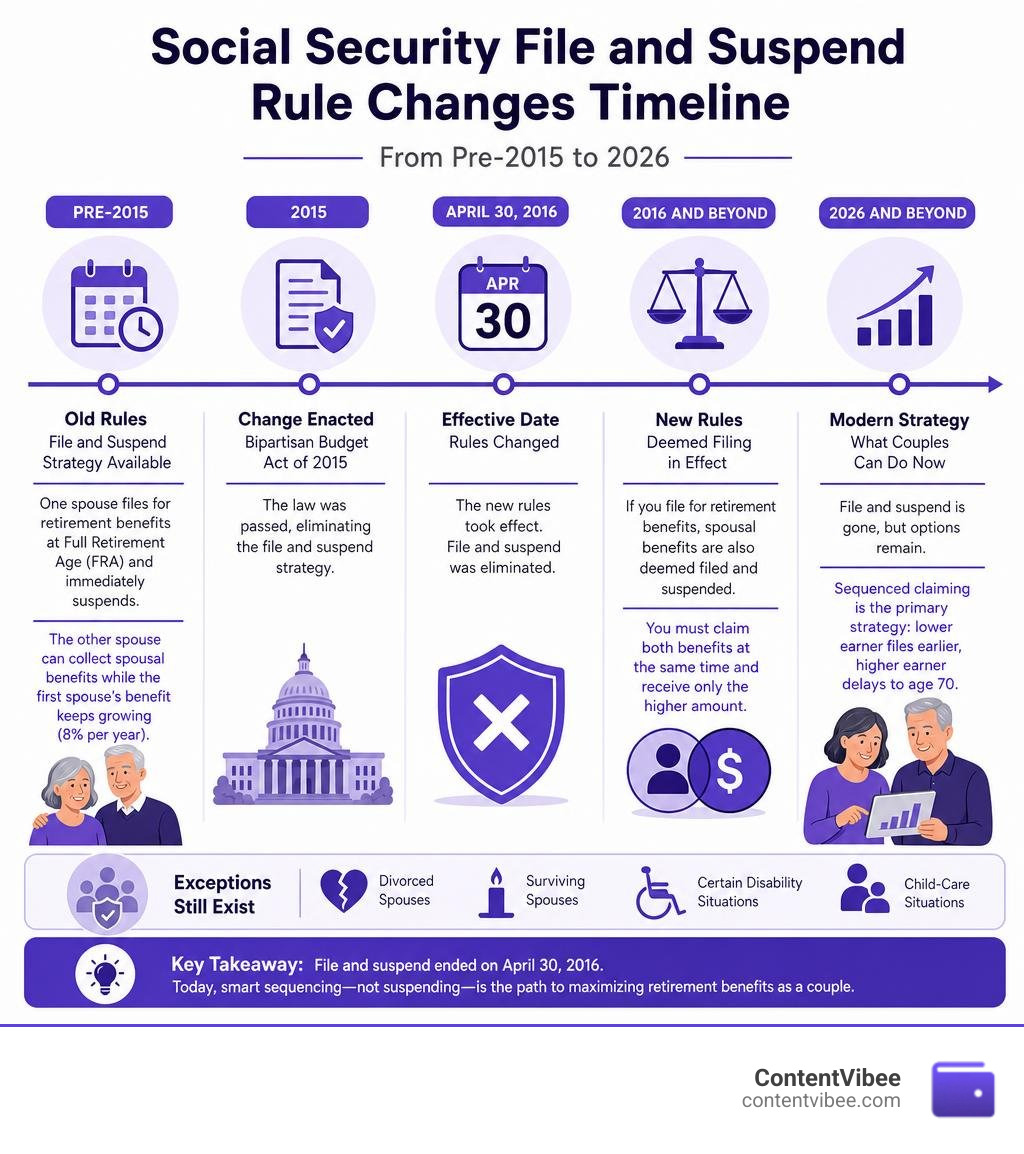
- File and suspend was a strategy where one spouse filed for Social Security at Full Retirement Age (FRA), then immediately suspended payments — letting the other spouse collect spousal benefits while the first spouse’s benefit kept growing at 8% per year.
- It was eliminated by the Bipartisan Budget Act of 2015, effective April 30, 2016.
- Today, if you suspend your retirement benefit, your spouse’s spousal benefit is also suspended — you can no longer “have it both ways.”
- Deemed filing now requires you to claim both your retirement and spousal benefits at the same time, receiving only the higher amount.
- Exceptions exist for divorced spouses, surviving spouses, and certain disability or child-care situations.
- The modern alternative is sequenced claiming — the lower earner files early while the higher earner delays to age 70.
If you’ve been searching for a way to maximize your Social Security benefits as a couple, understanding these rule changes is the essential starting point. A typical married couple has over 567 possible ways to file — and choosing the wrong one can cost tens of thousands of dollars over a lifetime.
This guide walks you through exactly how the old rules worked, what replaced them, and what your real options look like in 2026.
Relevant articles related to file and suspend rules:
What Was the File and Suspend Strategy and How Did It Work?
Before the rules changed, the “file and suspend” strategy was the gold standard for married couples looking to maximize their lifetime Social Security benefits. To understand why it was so popular, we have to look at how spousal benefits and delayed retirement credits interact.
Under the original system, a worker’s spouse could not claim a spousal benefit until the primary worker actually filed for their own retirement benefit. This created a dilemma for couples. If the higher-earning spouse wanted to delay claiming until age 70 to maximize their benefit, the lower-earning spouse was forced to wait as well, missing out on years of spousal payments.
The Senior Citizens’ Freedom to Work Act of 2000 introduced a loophole. It allowed a worker who reached Full Retirement Age (FRA) to file for retirement benefits and then immediately suspend receiving them.
This elegant maneuver accomplished two things at once:
- Activated Spousal Benefits: Because the primary worker had technically “filed,” their spouse became eligible to claim spousal benefits (which can be up to 50% of the worker’s FRA benefit).
- Earned Delayed Retirement Credits: Because the primary worker had “suspended” their payments, they continued to earn delayed retirement credits. These credits increased their future monthly benefit by 8% per year for every year they delayed, up to age 70.
Imagine a couple, Ann and Rod, both at their Full Retirement Age of 66. Ann’s monthly benefit at FRA was $2,000, while Rod’s own retirement benefit was negligible. Under the old rules, Ann could file for her benefits and immediately suspend them. Because Ann filed, Rod could immediately claim a spousal benefit of $1,000 per month (50% of Ann’s benefit). Meanwhile, Ann’s suspended benefit grew by 8% each year. By the time Ann turned 70, her monthly benefit had grown by 32% to $2,640, and she could begin collecting her maximized payment. Over those four years, the couple collected $48,000 in spousal benefits that would have otherwise been lost.
This strategy was highly praised in financial planning circles. Professional publications, such as this article from the Journal of Accountancy, frequently detailed how to execute this maneuver to secure a comfortable retirement. For a deeper dive into how couples historically approached these options, you can read The Smart Couples Guide to Social Security Strategies.
How the Bipartisan Budget Act of 2015 Rewrote the File and Suspend Rules
While file and suspend was a fantastic deal for retirees, it eventually caught the eye of lawmakers in Washington. The strategy was criticized for disproportionately benefiting wealthier, savvy couples who could afford to delay claiming their primary benefits.
According to the Congressional Budget Office, the file-and-suspend and restricted application strategies collectively cost the Social Security Trust Fund approximately $9.5 billion over 10 years. Interestingly, despite the strategy’s fame among financial planners, less than 0.2% of Old-Age and Survivors Insurance (OASI) beneficiaries (fewer than 100,000 people) were actually using these strategies as of December 2014. Additionally, about 60% of new retired-worker beneficiaries claimed benefits before reaching their FRA in 2014, meaning the vast majority of everyday claimants were entirely unaffected by the rules.
To preserve the financial integrity of the system and ensure fairness in delayed retirement incentives, Congress passed the Bipartisan Budget Act (BBA) of 2015.
The BBA of 2015 set a strict deadline: any voluntary suspension requests submitted on or after April 30, 2016, would fall under new, highly restrictive rules. Under the new file and suspend rules, if a worker suspends their retirement benefits, all auxiliary benefits on their record are also suspended. This means if you choose to suspend your payments to earn delayed retirement credits, your spouse can no longer receive spousal benefits on your record during that suspension period.
To explore how these legislative changes tie into your overall retirement timeline, take a look at Understanding Your Social Security Full Retirement Age and check out the official SSA Filing Rules for Retirement and Spouses Benefits.
The Death of the Restricted Application for Most Filers
Alongside the changes to voluntary suspension, the 2015 law targeted another popular strategy: the “restricted application.” Under the old rules, a person who reached FRA could file a restricted application for spousal benefits only, allowing their own retirement benefit to grow by 8% per year until age 70.
The BBA of 2015 grandfathered in individuals who were born before January 2, 1954. Those who met this birthdate criteria and reached FRA could still file a restricted application to claim only spousal benefits while delaying their own. However, because we are now in July 2026, anyone born before January 2, 1954, is already at least 72 years old. Because benefits stop growing at age 70, this grandfathering provision has effectively expired for all practical planning purposes today.
Understanding Deemed Filing Under the New File and Suspend Rules
The mechanism that ultimately closed these loopholes is called deemed filing.
Under the old rules, deemed filing only applied to individuals who claimed benefits before reaching their Full Retirement Age. If you claimed early, the Social Security Administration (SSA) “deemed” you to be filing for both your own retirement benefits and spousal benefits simultaneously, giving you the higher of the two. If you waited until FRA, deemed filing no longer applied, which is what allowed people to file restricted applications.
Under the current rules, deemed filing applies to everyone, regardless of age. When you file for either retirement or spousal benefits today, you are required to file for the other benefit as well if you are eligible for both.
This is governed by the dual entitlement rule. You do not get to receive both benefits added together. Instead, the SSA will calculate both amounts and pay you a total sum equal to the higher of the two.
For a complete breakdown of how these rules affect married dynamics, read Double the Fun: Understanding Your Spousal Social Security Benefits.
Modern Alternatives: How Couples Can Optimize Benefits Today
With the classic file and suspend strategy gone, how can couples optimize their Social Security benefits in 2026? Over 90% of Social Security recipients receive less money than they are entitled to, often losing tens of thousands of dollars in lifetime benefits due to suboptimal claiming choices.
The most effective modern equivalent is sequenced claiming.
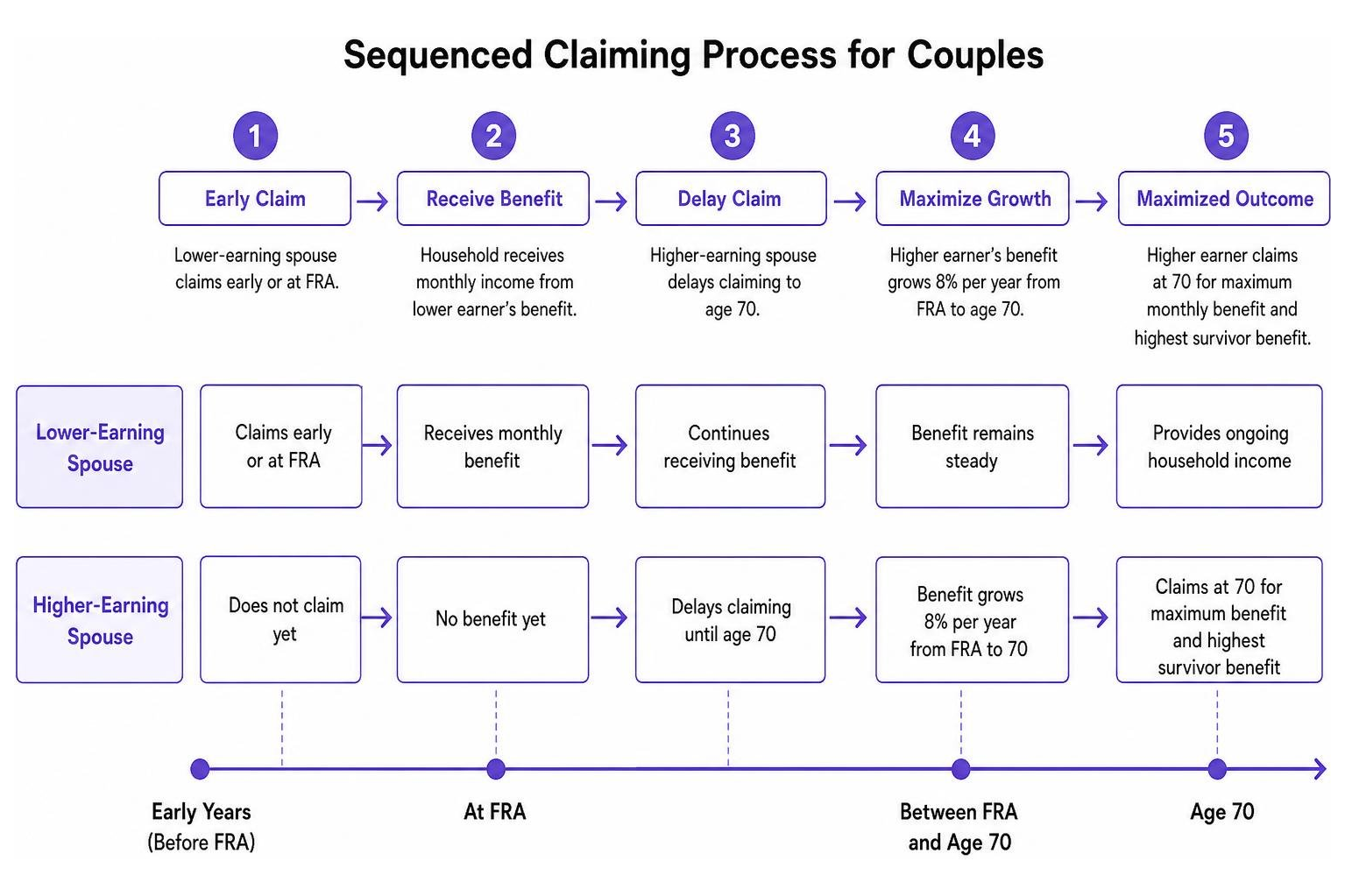
Instead of trying to “have it both ways” through a suspension, couples coordinate their initial claiming ages to maximize household income. In most cases, the optimal strategy involves the lower-earning spouse claiming their retirement benefits early or at FRA, while the higher-earning spouse delays claiming until age 70.
This approach achieves two major goals:
- Immediate Income: The household receives some monthly income early on from the lower earner’s benefit.
- Maximized Longevity Protection: The higher earner’s benefit grows by 8% per year from FRA to age 70. This ensures that the largest possible benefit is maximized, which also establishes the highest possible survivor benefit for the surviving spouse later in life.
To evaluate which claiming age makes the most sense for your household, read To Claim Early or Delay: Your 2026 Social Security Optimization Playbook.
Here is a side-by-side comparison of how the classic file and suspend strategy compares to modern sequenced claiming:
| Feature / Strategy | Pre-2016 File and Suspend | Modern Sequenced Claiming (Post-2016) |
|---|---|---|
| Spousal Benefit Source | Allowed on suspended record | Requires primary earner to actively receive benefits |
| Primary Earner Benefit | Suspended at FRA, grows 8%/yr to 70 | Delayed (not filed) to age 70, grows 8%/yr |
| Lower Earner Strategy | Claims spousal benefit at FRA | Claims own retirement benefit first, may switch to spousal later |
| Deemed Filing Impact | Did not apply at FRA | Applies at all ages; must claim both if eligible |
| Estimated Lifetime Gain | High (with early access to spousal cash) | $100,000–$200,000 over claiming both at age 62 |
Exceptions to Deemed Filing: Divorced Spouses and Survivors
While the deemed filing rules are strict, Congress did leave several important exceptions in place to protect vulnerable individuals:
- Divorced Spouses: If you are divorced and were married for at least 10 years, you can receive divorced spouse benefits on your ex-spouse’s record. Crucially, the ex-spouse does not need to have claimed their own benefits yet, as long as you have been divorced for at least two consecutive years. Furthermore, if your ex-spouse decides to voluntarily suspend their retirement benefits today, your divorced spouse benefits will not be suspended.
- Survivor Benefits: Deemed filing does not apply to survivor benefits. A surviving spouse (or eligible divorced surviving spouse) can choose to claim survivor benefits early (as early as age 60 at a reduced rate) while letting their own retirement benefit grow untouched until age 70, or vice versa.
- Child Care and Disability Exceptions: If you are caring for an entitled child who is under age 16 or disabled, or if you are receiving Social Security Disability Insurance (SSDI) payments, you are exempt from the standard deemed filing rules.
If you want to make sure you aren’t leaving money on the table, we highly recommend reading How to Claim Spousal Retirement Benefits Without Losing Your Mind.
How Voluntary Suspension Works Today
Can you still suspend your Social Security benefits today? Yes, but the rules and outcomes are very different than they were before 2016.
If you have reached Full Retirement Age but are not yet age 70, you can ask the SSA to suspend your retirement benefit payments. The primary reason to do this today is if you claimed your benefits early, regret the decision because you no longer need the immediate income (perhaps you went back to work), and want to start earning delayed retirement credits to boost your future monthly payment.

Under the current file and suspend rules, voluntary suspension comes with several strict limitations:
- Suspension of All Record Benefits: Any auxiliary benefits (such as spousal or child benefits) paid on your record will be suspended for the exact same duration.
- Suspension of Your Own Auxiliary Benefits: If you are receiving benefits on someone else’s record, those auxiliary benefits are also suspended.
- No Retroactive Reinstatement: You can no longer request a lump-sum retroactive payment for the months your benefits were suspended. You can only reinstate your benefits going forward.
Navigating the Modern File and Suspend Rules for Individuals
If you choose to voluntarily suspend your benefits today, there are two crucial administrative details you must keep in mind:
- Medicare Part B Premiums: Normally, if you are enrolled in Medicare, your Part B premiums are automatically deducted from your monthly Social Security check. When you suspend your benefits, these deductions stop. The Centers for Medicare & Medicaid Services (CMS) will bill you directly for your premiums. If you fail to pay these bills on time, you risk losing your Medicare coverage.
- SSI Eligibility: Suspending your retirement benefits will make you ineligible for Supplemental Security Income (SSI) payments.
These administrative guidelines are detailed in the official Social Security policy manual, specifically under SSA – POMS: GN 02409.110 – Conditions for Voluntary Suspension.
Frequently Asked Questions About Social Security Claiming
Can couples still use the file and suspend strategy in 2026?
No. The file and suspend strategy that allowed one spouse to collect spousal benefits while the other suspended their retirement benefit to earn delayed credits was eliminated. The final deadline to submit a request under the old rules was April 29, 2016. No new arrangements of this type can be created under the current 2026 rules.
What happens to my spouse’s benefit if I suspend my retirement benefits today?
If you voluntarily suspend your retirement benefits today, any spousal or auxiliary benefits being paid on your earnings record will also be suspended. The only exception to this rule is for eligible divorced spouses, who can continue to receive their divorced spouse benefits even if you suspend your retirement record.
Does deemed filing apply to survivor benefits?
No, deemed filing does not apply to survivor benefits. A surviving spouse can claim a survivor benefit while letting their own retirement benefit grow, or they can claim their own retirement benefit early and switch to a maximized survivor benefit at their Full Retirement Age.
Conclusion
The elimination of the classic file and suspend loophole undoubtedly made Social Security planning more challenging for married couples. However, optimizing your lifetime benefits is still entirely possible. By coordinating your filing ages and utilizing strategies like sequenced claiming, you can protect your household against longevity risk and secure a much larger lifetime payout.
Because every household’s financial situation, health status, and life expectancy are unique, it is vital to calculate your options carefully. To see how these rules apply directly to your household numbers, use our free tool to calculate your spouse’s retirement benefits and take control of your retirement security today.


