


Why Roth IRA Rollover Limits Matter More Than Most People Realize
Understanding roth ira rollover limits is one of the most important steps you can take before moving money out of a 403(b), 401(k), or traditional IRA — especially if you’re hoping to avoid a surprise tax bill.
Here’s the quick answer most people need:
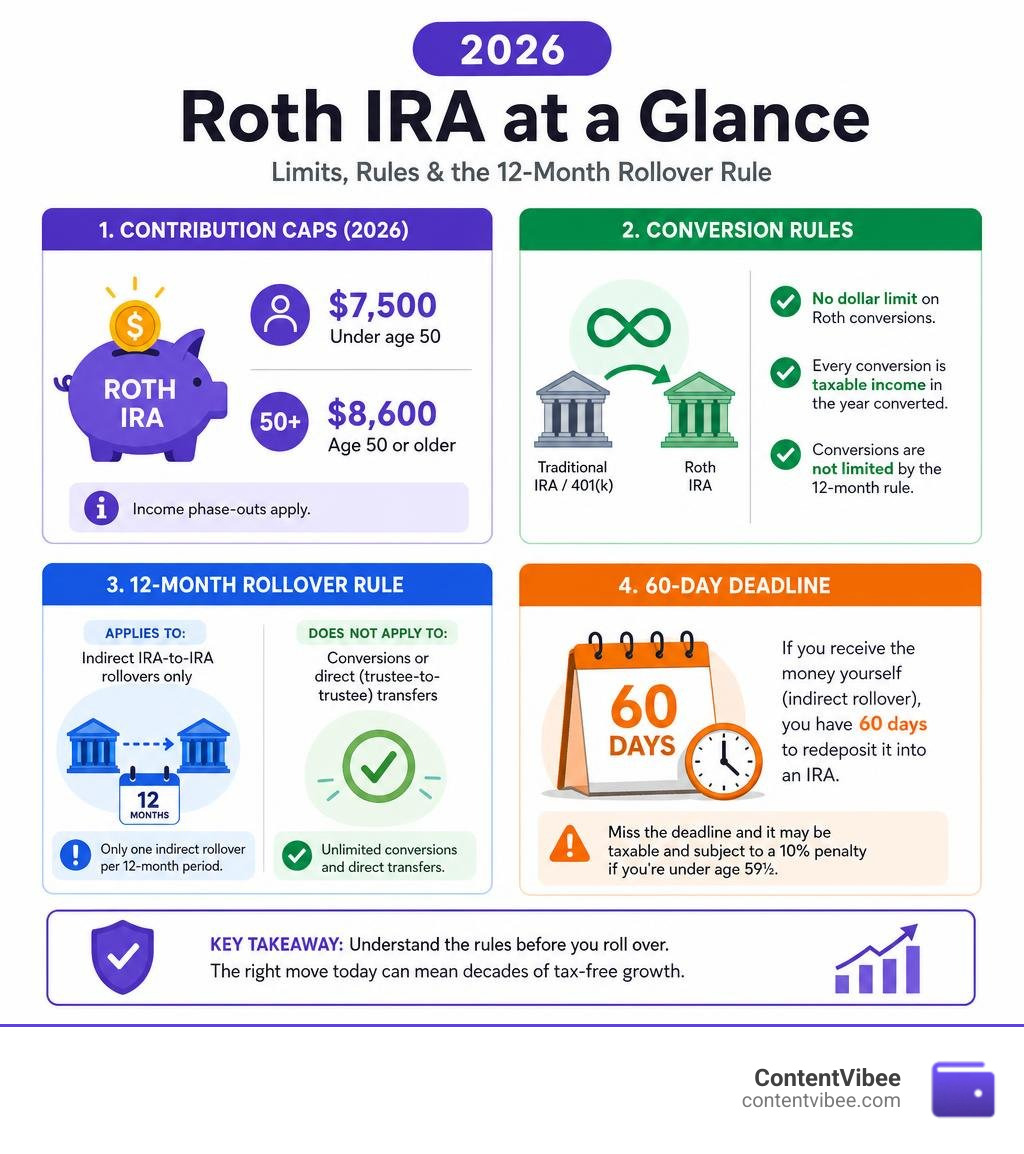
- Roth IRA conversions have no dollar limit. You can roll over your entire 401(k) or traditional IRA into a Roth IRA in one move if you want to.
- Direct contributions do have limits. In 2026, the max is $7,500 per year ($8,600 if you’re 50 or older), and income phase-outs apply.
- The one-rollover-per-year rule applies to indirect IRA-to-IRA rollovers only — not to conversions or trustee-to-trustee transfers.
- Every conversion is a taxable event. The amount you convert gets added to your income for that year.
- A 60-day deadline applies if you take a distribution yourself instead of doing a direct rollover.
The rules sound simple at first. But the details — the pro-rata rule, the 5-year clock, withholding traps, and the 12-month IRA rollover limit — catch a lot of people off guard.
If you’re a mid-career professional thinking about rolling a 403(b) into a Roth IRA before retirement, getting these rules wrong can mean unnecessary taxes, IRS penalties, or losing years of tax-free growth. This guide breaks it all down clearly.
Handy roth ira rollover limits terms:
What is the One-Rollover-Per-Year Rule for IRAs?
Let’s start with one of the most misunderstood restrictions in the retirement landscape: the IRS one-rollover-per-year rule. This rule is a major structural boundary for anyone managing their own retirement accounts, and tripping over it can result in painful financial penalties.
According to Rollovers of retirement plan and IRA distributions | Internal Revenue Service, you are generally allowed to make only one rollover from an IRA to another (or the same) IRA within any 12-month period.
Here is how this rule actually works in practice:
- The 12-Month Clock: This is not a calendar-year limit. It is a rolling 12-month (365-day) period. If you complete an indirect rollover on October 15, you cannot perform another indirect rollover from any of your IRAs until October 15 of the following year.
- Aggregate Application: The limit applies across all of your IRAs in the aggregate. You cannot bypass this rule by doing one rollover from traditional IRA “A” and another from traditional IRA “B.” The IRS treats all of your traditional, Roth, SEP, and SIMPLE IRAs as a single pool for this specific rule.
- Indirect Rollovers Only: This restriction only applies to indirect rollovers (also known as 60-day rollovers). An indirect rollover occurs when you request a distribution check made payable directly to you, deposit those funds into your personal bank account, and then deposit them into another IRA within 60 days.
What is Excluded from the One-Per-Year Rule?
Thankfully, the IRS does not want to lock down your money entirely. The following transactions are completely exempt from the one-rollover-per-year limit:
- Trustee-to-Trustee Transfers: If you instruct your current IRA custodian to send the funds directly to your new IRA custodian (without you ever touching the money), this is a transfer, not a rollover. There are absolutely no frequency limits on these direct transfers.
- Plan-to-IRA Rollovers: Moving money from an employer-sponsored plan (like a 401(k) or 403(b)) into an IRA does not trigger the 12-month limit.
- Roth Conversions: Moving pre-tax assets from a traditional IRA into a Roth IRA (a conversion) is not subject to the one-rollover-per-year rule.
When planning your savings strategy, understanding these transfer rules is just as vital as knowing The Ultimate Guide to the Retirement Contribution Catch-Up Limits to keep your tax-advantaged growth on track.
Understanding Roth IRA Rollover Limits and Conversion Rules
When we talk about roth ira rollover limits, we have to separate standard annual contributions from rollovers and conversions. While the IRS limits how much new cash you can put into a Roth IRA each year, there is no limit on the amount you can roll over or convert from pre-tax retirement accounts.
If you want to move $10,000, $100,000, or even $1,000,000 from a traditional IRA or a former employer’s 401(k) into a Roth IRA, you are legally permitted to do so in a single tax year. However, you must pay income taxes on any pre-tax dollars you convert.
This unlimited conversion feature is highly beneficial for savers who expect to be in a higher tax bracket during retirement, as it allows them to lock in current tax rates and enjoy tax-free growth and withdrawals later. We see this strategy utilized across a variety of accounts:
- Traditional IRA to Roth IRA: Anyone can convert pre-tax IRA assets to a Roth IRA, regardless of income.
- 401(k)/403(b) to Roth IRA: If you leave your job, you can roll your traditional employer plan directly into a personal Roth IRA. If you are still with your employer, you may be able to do an “in-plan” Roth conversion if your plan allows it. For more details on these employer-sponsored shifts, read our guide on Can You Move Your 403b to a Roth IRA?.
The SECURE 2.0 Act and 529-to-Roth Rollovers
Thanks to the SECURE 2.0 Act, there is a unique rollover path for unused college savings. Account owners can now roll over unused 529 plan assets directly into a Roth IRA for the designated beneficiary. However, this path has strict parameters:
- There is a $35,000 lifetime limit per beneficiary.
- The annual rollover amount is subject to standard Roth IRA contribution limits (e.g., up to $7,500 in 2026).
- The 529 account must have been open for at least 15 years.
- Any contributions (and earnings on those contributions) made in the last 5 years cannot be rolled over.
To make sure you don’t step on any tax landmines while shifting college savings, check out The Ultimate Guide to Moving Unused College Funds to a Roth IRA. For broader guidelines on moving plan assets, refer to Topic no. 413, Rollovers from retirement plans | Internal Revenue Service.
Direct vs. Indirect Roth IRA Rollover Limits
If you decide to execute a rollover, you must choose between a direct rollover and an indirect rollover. The path you choose makes a massive difference in how your transaction is taxed and whether you face mandatory withholding.
- Direct Rollover (Trustee-to-Trustee): The funds go directly from your old account custodian to your new Roth IRA custodian. The money never enters your personal bank account. This is the safest method. It bypasses the one-rollover-per-year rule, avoids mandatory tax withholding, and eliminates the risk of missing the 60-day deposit window.
- Indirect Rollover (60-Day Rollover): The custodian of your pre-tax account writes a check made out to you. By law, if the distribution comes from an employer plan like a 401(k) or 403(b), the custodian is required to withhold 20% for federal income taxes.
This withholding creates a significant hurdle. If you distribute $50,000 from your 401(k), you will only receive $40,000 cash. To complete a tax-free rollover, you must deposit the full $50,000 into your new IRA within 60 days. This means you have to find $10,000 of personal cash to make up for the withheld amount. If you fail to deposit the full $50,000, the $10,000 difference is treated as a taxable distribution and may be subject to a 10% early withdrawal penalty if you are under age 59½.
Because of these withholding traps, we always recommend using a direct trustee-to-trustee transfer. If you’re currently working with a 403(b) account, you can read more about safe transfer methods in The Ultimate Guide to Converting Your 403b to a Roth IRA.
How 2026 Contribution Rules Impact Roth IRA Rollover Limits
While rollovers and conversions do not have dollar limits, your ability to make direct annual contributions to a Roth IRA is strictly capped by the IRS. In 2026, these contribution limits have adjusted upward to account for inflation.
For 2026, the base Roth IRA contribution limit is $7,500 (up from $7,000 in 2025). If you are age 50 or older, you can make an additional catch-up contribution of $1,100, bringing your total personal contribution limit to $8,600. This catch-up limit has increased due to SECURE 2.0 cost-of-living adjustments, marking a shift from the historic flat $1,000 catch-up amount.
However, your ability to contribute directly to a Roth IRA phases out entirely if your Modified Adjusted Gross Income (MAGI) exceeds certain thresholds.
2026 Roth IRA Income Phase-Out Ranges
| Filing Status | Full Contribution Allowed (MAGI) | Reduced Contribution Phase-Out Range | No Contribution Allowed |
|---|---|---|---|
| Single / Head of Household | Under $153,000 | $153,000 to $168,000 | Over $168,000 |
| Married Filing Jointly | Under $242,000 | $242,000 to $252,000 | Over $252,000 |
| Married Filing Separately | N/A | $0 to $10,000 | Over $10,000 |
If your income falls within the phase-out range, your maximum contribution is proportionally reduced. If your income exceeds the limit, you cannot make a direct contribution to a Roth IRA at all.
For a complete step-by-step breakdown of how to calculate your eligibility and manage these limits, see The Ultimate Guide to Your 2026 Max Roth IRA Contribution and the official Retirement topics – IRA contribution limits | Internal Revenue Service.
Tax Consequences and the Pro-Rata Rule
If your income prevents you from making a direct Roth IRA contribution, you can use the backdoor Roth IRA strategy. This involves making a non-deductible contribution to a traditional IRA and then immediately converting those funds to a Roth IRA. Because there are no income limits on conversions, this is a highly effective way for high earners to build tax-free wealth.
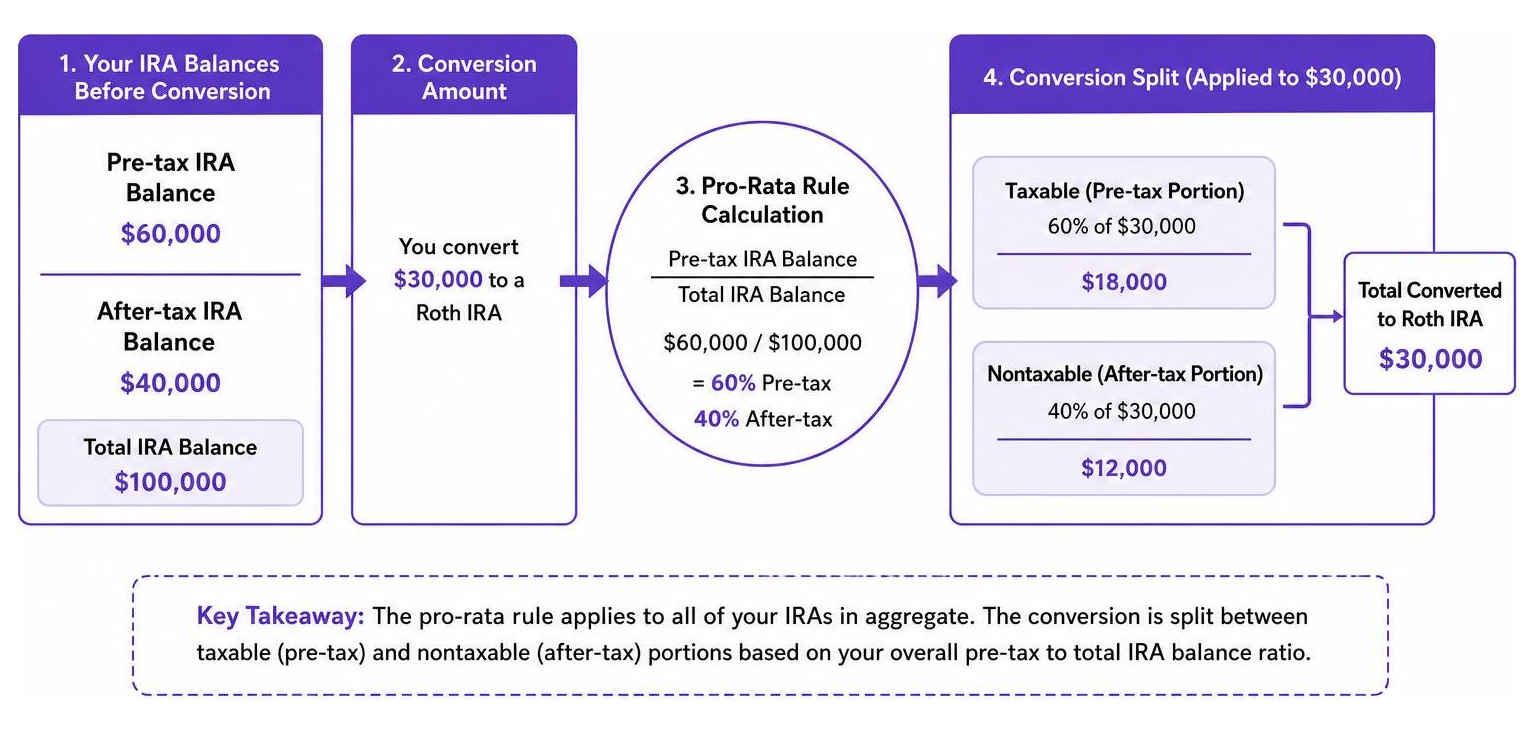
However, many savers fall victim to the pro-rata rule. Under IRC Section 408(d)(2), the IRS treats all of your traditional, SEP, and SIMPLE IRAs as a single, combined account when calculating the tax on a Roth conversion. You cannot simply convert “only the after-tax dollars” you just contributed.
How the Pro-Rata Rule Works
Imagine you have $92,500 in an existing pre-tax rollover traditional IRA. You decide to make a $7,500 non-deductible (after-tax) contribution to a new traditional IRA to execute a backdoor Roth conversion.
Your total IRA balance is now $100,000. Your after-tax basis is only 7.5% of the total ($7,500 / $100,000).
When you convert $7,500 to a Roth IRA, the IRS rules dictate that only 7.5% ($562.50) of the conversion is tax-free. The remaining 92.5% ($6,937.50) is treated as pre-tax income and is fully taxable at your current ordinary income tax bracket.
To learn how to isolate your pre-tax assets and avoid this tax trap, read our 2026 Backdoor Roth Guide: Dodging the Pro-Rata Tax Trap and utilize The Ultimate Backdoor Roth Calculator Guide for High Earners.
The 5-Year Rule for Conversions
It is also important to remember that every Roth conversion starts its own 5-year holding period. While you can withdraw your original contributions at any time tax- and penalty-free, you must wait 5 years from the year of the conversion (and be at least age 59½) to withdraw converted earnings or principal penalty-free.
At-a-Glance Rollover Comparison
To keep these strategies clear, we have compiled a quick reference table comparing the mechanics of each rollover type:
| Rollover Type | Annual Limit | Mandatory Withholding | One-Per-Year Rule Applies? | Tax Treatment |
|---|---|---|---|---|
| Direct Rollover (Trustee-to-Trustee) | None | 0% | No | Tax-neutral (unless converting pre-tax to Roth) |
| Indirect Rollover (60-Day) | None (but limited by frequency) | 20% (if from employer plan) | Yes (if IRA-to-IRA) | Tax-neutral if completed within 60 days |
| Roth Conversion | None | 0% (if direct) | No | Fully taxable in the year of conversion |
Frequently Asked Questions About Roth IRA Rollover Limits
Can I roll over my entire 401(k) into a Roth IRA?
Yes, there are absolutely no dollar limits on how much you can roll over from a 401(k) to a Roth IRA. However, if your 401(k) consists of pre-tax dollars, the entire rolled-over amount will be treated as ordinary taxable income in the year of the transfer.
For high-balance accounts, this can easily push you into a much higher tax bracket. To model how this transition affects your long-term retirement projections, use The Great Retirement Debate: Roth vs Traditional 401k Calculator Guide.
Are there required minimum distributions (RMDs) for Roth IRAs?
No. Unlike traditional IRAs and traditional 401(k)s, which require you to begin taking RMDs at age 73 (or age 75 depending on your birth year under SECURE 2.0), original Roth IRA owners are exempt from lifetime RMDs. Your money can continue to grow tax-free for your entire life.
However, keep in mind that inherited Roth IRAs are subject to the 10-year distribution rule for non-spouse beneficiaries. For official government details on withdrawal exemptions, consult the Retirement plans FAQs regarding IRAs | Internal Revenue Service.
What happens if I violate the one-rollover-per-year rule?
If you perform more than one indirect rollover in a 12-month period, the second transaction is disqualified as a rollover. The IRS will treat the distribution as a fully taxable withdrawal.
Furthermore, if those funds are deposited into another IRA, they will be classified as an excess contribution. Excess contributions that are not corrected before your tax filing deadline are subject to a 6% excise tax penalty every single year they remain in the account.
Conclusion
Navigating roth ira rollover limits requires careful attention to detail, but the long-term benefits of tax diversification and tax-free growth are well worth the effort. By choosing direct trustee-to-trustee transfers, keeping an eye on the 12-month indirect rollover clock, and watching out for the pro-rata rule, you can safely maximize your retirement savings.
At ContentVibee, we are dedicated to providing clear, step-by-step financial guidance to help you take control of your financial future. Whether you are adjusting your portfolio, planning a backdoor Roth strategy, or dealing with other legal and financial timelines like the statute of limitations explained in our civil guides, we have you covered. Use our tools and checklists to execute your retirement plan with confidence!


