Why a Post Retirement Career Change Is More Common — and More Achievable — Than You Think
Making a post retirement career change is something most workers are already planning for. In fact, 74% of workers say they intend to get a new job after they retire — whether for extra income, a sense of purpose, or simply to stay sharp and connected.
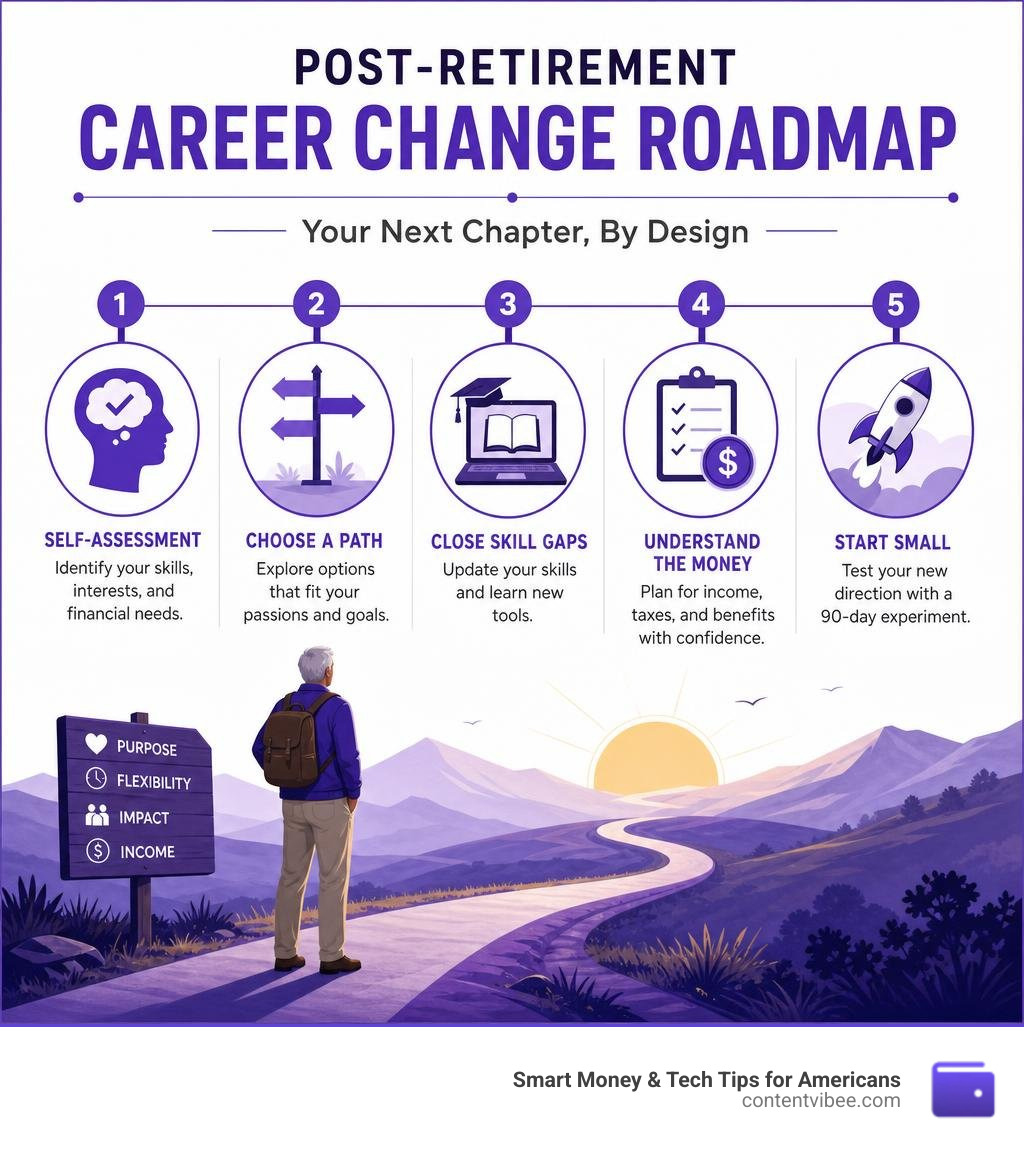
Here is a quick look at what a post-retirement career change typically involves:
| Step | What It Means |
|---|---|
| Self-assessment | Identify your skills, interests, and financial needs |
| Choose a path | Consulting, education, trades, nonprofit, franchise, or gig work |
| Close skill gaps | Update credentials or learn new tools (no degree required for many paths) |
| Understand the money | Know how earned income affects Social Security and taxes |
| Start small | Test your new direction with a 90-day experiment before committing |
This kind of career shift is often called an encore career — a second act that blends income with meaning. It is not just about the paycheck. Research shows that working later in life can improve cognitive health, reduce loneliness, and give structure to days that can otherwise feel unmoored.
The good news? You do not need to start from scratch. Most retirees have decades of transferable skills that employers — and clients — are willing to pay for. And with 58% of Baby Boomers saying they want a second career that serves their community, there is clearly a strong pull toward purpose, not just profit.
This guide walks you through every step: from figuring out what you actually want, to the smartest paths available, to protecting your Social Security benefits while you earn.
Post retirement career change vocab to learn:
Designing Your Post Retirement Career Change: Self-Assessment and Mindset

Transitioning to a new field in your golden years requires a shift in how you view work. Many of us spent our primary careers climbing ladders, chasing promotions, or simply paying the bills. A post retirement career change is your opportunity to rewrite that script.
Psychologists often point to Self-Determination Theory to explain why traditional, completely passive retirement can sometimes lead to feelings of emptiness or anxiety. According to this theory, human motivation and well-being rely on three basic needs:
- Autonomy: Having control over your time, schedule, and the work you choose to do.
- Competence: Feeling capable and effective at what you do.
- Relatedness: Staying connected to other people and feeling like you belong to a community.
A well-designed second career satisfies all three. You get to choose your projects (autonomy), leverage your decades of wisdom (competence), and interact with clients, colleagues, or students (relatedness).
You are certainly not alone in wanting a fresh start. Research from the Urban Institute shows that 27% of workers transitioned fully into a new occupation in their early 50s or later. Why? Because they wanted something different. The same study revealed that 45% of job changers successfully achieved their desired flexibility in their second career.
To find your own sweet spot, we recommend adopting a prototype mindset. Instead of quitting your routine to jump headfirst into an expensive business venture or a multi-year degree program, treat your ideas as drafts. Run 90-day experiments. If you want to write, try freelancing for three months before launching a major blog. If you want to teach, try tutoring first. Treating your transition as a series of low-risk tests relieves the pressure and allows you to gather real-world data on what you actually enjoy. For a deeper dive into preparing for this transition, read The Essential Guide to Returning to Work After Retirement.
The Myth of Spontaneity: Creating Your Second Act Design Brief
The worst advice you can receive when retiring is to “just let life unfold.” While a few weeks of unscheduled lounging is fantastic, waiting around for your perfect second act to magically reveal itself usually leads to boredom. Clarity is manufactured through deliberate action, not passive waiting.
Think of your transition as a strategic project. You need to write your own design brief—a simple, five-section document that outlines exactly what you want your new life to look like:
- Constraints: How many hours a week do you actually want to work? Do you want to travel three months out of the year? Your second career must fit around your life, not the other way around.
- Values: What matters to you now? Is it creativity, mentoring others, working outdoors, or intellectual stimulation?
- Contribution: What kind of legacy or impact do you want to leave behind?
- Relationships: Do you want to work solo from home, or do you need a lively team environment to stay happy?
- Experiments: What three small, low-risk things will you test over the next 90 days to see if your ideas hold water?
Writing this brief keeps you focused and prevents you from falling back into stressful corporate dynamics. If you want a smoother transition, you might also look into temporary “stepping stone” roles. Learn more about how these work by reading about Bridge Jobs to Help You Ease Into Retirement.
Overcoming Obstacles and Ageism in a Post Retirement Career Change
Let’s address the elephant in the room: age discrimination and skill gaps are real challenges. Some hiring managers harbor outdated biases, worrying that older workers might be overqualified, resistant to feedback, or uncomfortable with modern technology.
Fortunately, you can easily dismantle these objections:
- Conquer the Digital Tool Stack: You do not need to be a computer programmer, but you must be comfortable with modern collaboration tools. Take a few hours to learn platforms like Zoom (for virtual meetings) and Slack or Microsoft Teams (for daily communication). Showing that you can navigate these tools immediately removes the “tech-challenged” stereotype.
- Focus on Accomplishments, Not Graduation Dates: When updating your resume, focus on your recent, quantifiable achievements from the last 10 to 15 years. You do not need to list jobs from the 1980s or include the year you graduated from college. Keep your resume modern, clean, and limited to two pages.
- Embrace Alternative Credentials: If your target field requires new technical skills, you do not need to go back to college for four years. Look into professional certifications, boot camps, or online courses (via platforms like Coursera, Udemy, or local community colleges) to quickly bridge any gaps.
You have legal protections on your side, too. To understand how to protect yourself in the job market, read about Your Legal Rights When Working Past Retirement Age.
Evaluating In-Demand Paths: From Consulting to Hands-On Trades

When choosing your next chapter, it helps to understand the landscape of popular post-retirement options. The table below compares three of the most common paths:
| Career Path | Financial Potential | Flexibility | Startup Costs | Best For |
|---|---|---|---|---|
| Consulting | High ($150–$500+/hr) | Very High | Very Low | Corporate veterans, specialists, and project managers |
| Franchising | Variable | Moderate to High | High ($150k–$1M) | Retirees with capital who want a proven business playbook |
| Nonprofit / Education | Moderate | High | None | Those seeking community impact and mentoring |
Whether you want to work behind a desk or get your hands dirty, there is an option that fits your energy levels and financial goals. For a comprehensive list of active jobs, check out The Best Retirement Jobs for Seniors to Stay Active and Earn.
Leveraging Corporate Expertise in Consulting and Franchising
If you spent decades in the corporate world, your specialized knowledge is highly valuable. Many companies prefer to hire seasoned professionals as independent contractors or consultants because it allows them to access executive-level expertise without paying for full-time benefits.
Two lucrative avenues to consider are:
- Executive & Career Coaching: If you have a background in leadership, human resources, or management, you can help younger professionals navigate their careers. Certified executive coaches can easily command $150 to $500 per hour depending on their background and target market.
- Franchise Ownership: If you want to run a business but do not want to build one from scratch, buying a franchise is a highly structured, lower-risk alternative. Approximately 35% of Decorating Den store franchisees are over 50, and 35% of Caring Transitions store owners are between the ages of 55 and 60. These models provide a built-in playbook, training, and marketing support. That franchise investments typically range from $150,000 to $1 million, so you must carefully evaluate your liquid capital before diving in.
To learn more about the pros and cons of stepping into the business world as a senior, read about Embarking on an encore career as an entrepreneur.
Transitioning to Education, Nonprofits, and Skilled Trades
For many retirees, the second act is less about maximizing profit and more about giving back or working with their hands.
- Education and Nonprofits: With 58% of Baby Boomers wanting a second career that serves their community, education is a natural fit. Public schools are facing critical staffing challenges—in fact, 76% of public schools struggled to hire certified teachers for the 2025 school year. Programs like “Transition to Teaching” offer alternative certification pathways, allowing you to use your real-world experience to teach in high-need classrooms. Alternatively, if you hold a Master’s degree, you can reach out to department heads at local community colleges to secure part-time adjunct professor roles.
- Skilled and Hands-On Trades: If you are tired of staring at computer screens, hands-on trades offer a refreshing, active alternative. For example, the RV industry has become a major hotspot for career changers. Many former cybersecurity, military, and corporate professionals are choosing to attend technical academies to become mobile RV service technicians. This allows them to run mobile businesses, work outdoors, and solve tangible, mechanical problems.
To read a fascinating real-world case study of this exact transition, check out Career Change at 50? Why One Former Cybersecurity Professional Chose the RV Industry | National RV Training Academy. You can also explore general ideas via 10 Second Career Ideas for Retirees | HowStuffWorks – Money, learn about Ten Ways to Transition into Paid Work Instead of Retirement, or browse curated opportunities at Best Jobs for Retirees – Kiplinger.
Financial Planning and Social Security Optimization
A successful post-retirement career change requires careful financial planning. The goal is to increase your income and engagement without accidentally triggering tax penalties or reducing your hard-earned benefits.
When mapping out your finances, it is helpful to look at the broader landscape of American retirement wealth. The median household wealth in the US, including home equity, is $166,900. Meanwhile, the top decile (top 10%) of US household wealth begins at $1,623,000. Knowing where you stand helps you determine whether your second career needs to maximize income or if you can afford to prioritize pure passion.
For military veterans or corporate retirees with pensions, a second career offers the opportunity for “pension stacking” or dual compensation—combining your pension with a fresh paycheck to build an incredibly robust financial cushion. To understand how to manage this strategy, read Double Dipping: How to Work and Collect Social Security at the Same Time and Working Past 70: How to Handle Your Social Security Benefits.
Navigating Benefits and Taxes During a Post Retirement Career Change
If you plan to work and collect Social Security benefits at the same time, you must keep a close eye on the rules, especially if you have not yet reached your Full Retirement Age (FRA).
- The Social Security Earnings Limit: If you are under your FRA, the Social Security Administration (SSA) imposes an annual limit on your earned income. If you earn more than this limit, the SSA will temporarily withhold a portion of your benefits. The good news? These withheld benefits are not lost forever; they will be added back to recalculate your monthly check once you reach FRA.
- Tax Bracket Creep: Adding a new salary on top of your retirement withdrawals and Social Security can push you into a higher federal income tax bracket.
- Medicare and IRMAA: If your combined income pushes you past certain thresholds, you may trigger the Income-Related Monthly Adjustment Amount (IRMAA), which increases your Medicare Part B and Part D premiums.
- Spousal Benefits: Your post-retirement earnings can also impact spousal benefits depending on how your accounts are structured.
Staying compliant while maximizing your earnings is a delicate balance. To ensure you do not make costly mistakes, check out The Ultimate Guide to Working Past 65 and Beyond.
Managing Startup Costs and the “Die with Zero” Wealth Mindset
Many retirees are terrified of spending their savings, choosing to live frugally even when they have substantial wealth. Statistically, this fear is often irrational. Studies show that retirees who had $500,000 or more right before retirement had spent down a median of only 11.8% of that money 20 years later. In other words, most of their wealth went completely unused.
This has led many financial planners to advocate for a “Die with Zero” mindset. The core philosophy is to focus on maximizing life experiences and building “memory dividends” while you still have the health and energy to enjoy them.
Your retirement savings can serve as “permission money.” Because your basic living costs are covered, you do not need to chase the highest-paying, high-stress corporate jobs. You can use a small portion of your savings as startup capital to launch a business, buy a franchise, or invest in vocational training without worrying about immediate, massive returns.
To read a highly motivating story of a retiree who successfully un-retired at 62 to build a thriving, highly profitable second act, check out I ‘Un-Retired’ at 62 and Now I Make More Than My Old Corporate Job.
Frequently Asked Questions about Post-Retirement Careers
How does working in retirement affect my Social Security benefits?
If you have reached your Full Retirement Age (FRA), you can earn as much money as you want with absolutely no reduction in your Social Security benefits. If you are under your FRA, your benefits will be temporarily reduced if your earned income exceeds the annual limit. However, the SSA will recalculate and increase your monthly benefit once you reach FRA to make up for those withheld funds. For a detailed breakdown of this process, read Double Dipping: How to Work and Collect Social Security at the Same Time.
What are the best low-cost business ideas for retirees?
If you want to start a business without investing thousands of dollars in startup capital, focus on service-based models that leverage your existing skills. Outstanding low-cost options include:
- Consulting or Coaching: Using your corporate expertise to advise businesses or individuals.
- Freelance Writing: Writing articles, marketing copy, or technical documents from home. For tips on getting started, read Retirement Freelance Writing Jobs for Seniors.
- Tutoring or Mentoring: Helping students excel in academic subjects or test preparation.
- Pet Sitting or Dog Walking: A highly flexible, active, and fun way to earn extra cash in your local neighborhood.
How can I transition to a new field without a degree?
You do not need to spend years in college to make a successful career pivot. You can break into exciting new fields by:
- Leveraging Transferable Skills: Communication, leadership, problem-solving, and project management are highly valued across every single industry.
- Earning Alternative Certifications: Fast-track technical credentials, trade certifications, or real estate licenses can be completed in a matter of weeks or months.
- Embracing the Gig Economy: Platforms for freelancers, handymen, tutors, and drivers allow you to start earning immediately on your own schedule. To master this approach, read How to Master the Gig Economy in Retirement.
Conclusion
At ContentVibee, we believe that retirement is not the end of your productive life—it is simply the beginning of your most exciting chapter. A post retirement career change gives you the unique opportunity to design a lifestyle that perfectly balances financial security with personal purpose. By conducting a thoughtful self-assessment, embracing a prototype mindset, and understanding the financial rules of the game, you can build a second act that is intellectually stimulating, socially connected, and deeply rewarding.
Ready to take the next step in planning your post-retirement finances? Learn how working in retirement affects spousal benefits to ensure your family’s financial plan remains perfectly optimized.